

Denver mayoral runoff between Mike Johnston, Kelly Brough hits home stretch | COVER STORY
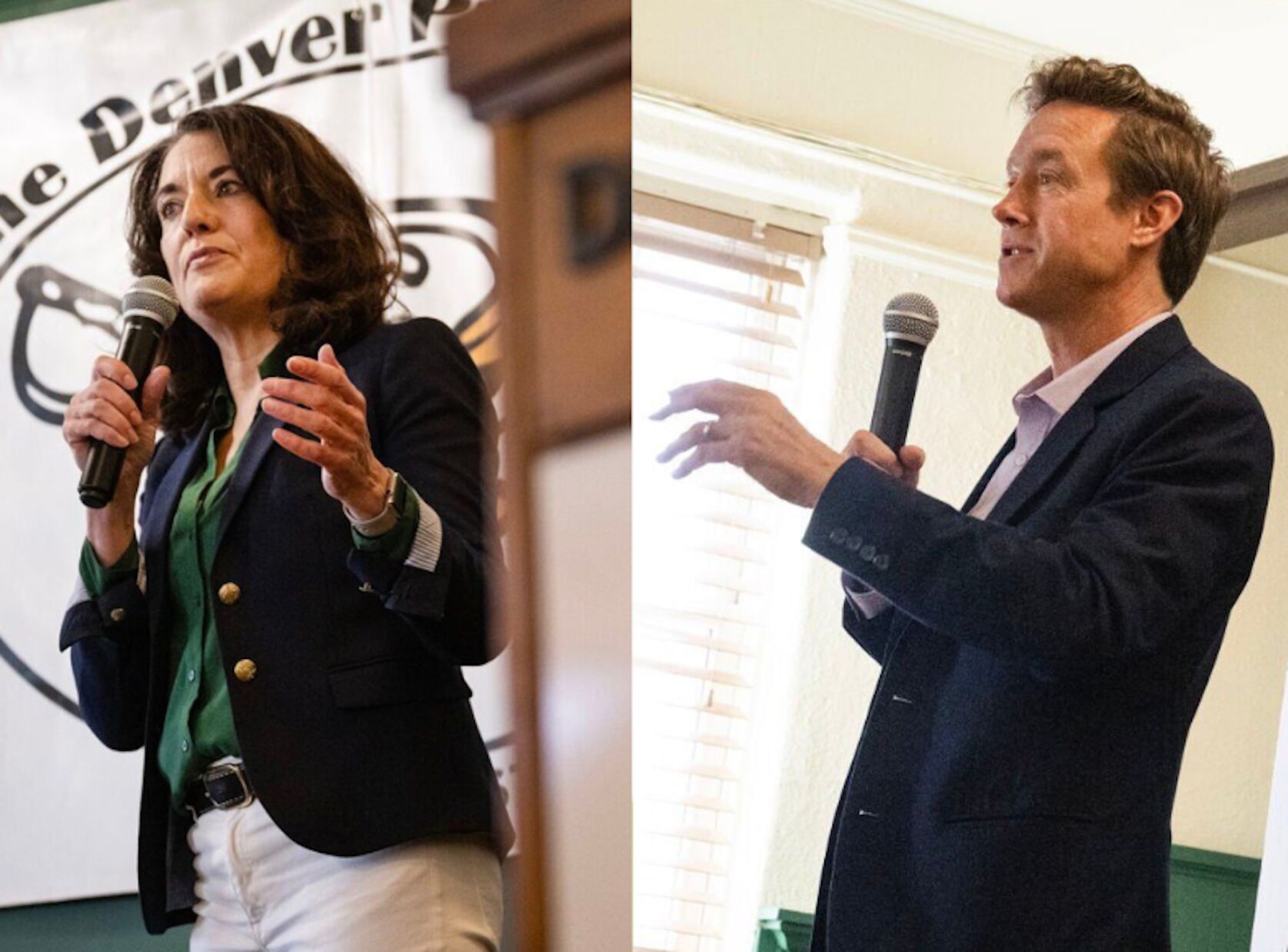
It’s down to the wire in Denver’s municipal runoff election, as voters choose between Mike Johnston and Kelly Brough to fill the office of departing Mayor Michael Hancock.
The two veteran public servants emerged from a crowded first round of voting on April 4, when none of the 16 candidates on the ballot received more than 50% of the vote, forcing the runoff.
It’s the first Denver election in 12 years without an incumbent mayor on the ballot. Hancock, a former city council president who was first elected mayor in 2011, faces term limits after serving three terms.
The municipal election is nonpartisan – candidates’ party affiliation doesn’t appear on ballots, and parties play no role in nominating candidates – though Johnston and Brough are registered Democrats and both are considered centrists.
In the course of the nearly six-month campaign, Johnston and Brough have largely avoided sharp disagreements about the issues front-and-center in this year’s race: crime, homelessness and the availability and affordability of housing for Denver residents.
Instead, much of the runoff campaign has centered around the candidates’ backgrounds and political leanings in the overwhelmingly Democratic city, with an emphasis on the endorsements they’ve received and the sources of funding for their respective independent expenditure organizations.
On May 27, the candidates wrapped up a seemingly endless series of forums and debates – their campaigns estimated they participated in as many as 80 between the first round and the runoff – and turned their attention to driving voter turnout, which appears to be up from the general election in April.
With the finish line in sight, the campaigns and outside groups supporting them have amped up their advertising, and the candidates are increasing their get-out-the-vote pushes ahead of the final weekend before the election.
Johnston’s campaign announced the “Vibrant Denver” tour of the city’s “cultural hubs, food spots and bustling neighborhoods,” with stops in all 11 city council districts, echoing the “3D” tour – shorthand for donuts, doors and drafts – he embarked on in late March before the first round of voting finished.
Brough’s calendar was filled with a steady series of meet-and-greets, neighborhood canvasses and “Coffee with Kelly!” appearances at coffee shops throughout the city.
She also held a press conference outside city hall on June 1 to slam Johnston for the high-dollar contributions from wealthy, out-of-state funders that have poured into Advancing Denver, an outside group that has raised more than $4.6 million to support his campaign, compared to more than $1.4 million raised by outside groups backing Brough.
Brough’s attack on Johnston echoed a TV ad released this week by her campaign, while Johnston’s campaign is running a TV ad describing the candidate’s proposals to find housing for Denver residents experiencing homelessness.
Among the top funders supporting Johnston are former New York Mayor Michael Bloomberg, with a reported $500,000 in contributions, Seattle-based LinkedIn co-founder Reid Hoffman, who has given more than $1.3 million to the independent committee, and Kent Thiry, the former CEO of Denver-based DaVita, with $450,000.
That compares to more than $470,000 in contributions to A Better Denver, a group supporting Brough, from the National Association of Realtors Fund, $61,000 from the Colorado Construction Industry Coalition, and $50,000 apiece from Denver-based developer Cal Fulenwider and brewery magnate Pete Coors, Colorado’s 2004 Republican nominee for U.S. Senate.
Advancing Denver and A Better Denver are both up this week with new TV ads promoting their favored candidates.
The pro-Johnston IE’s ad focuses on his endorsers, including Lisa Calderón, a social justice advocate and former two-time mayoral candidate who came in third in the initial round this year and in 2019, along with state Rep. Leslie Herod, the Denver Democrat who finished in fifth place in Denver’s general election for mayor, and state Sen. Julie Gonzales, a prominent progressive voice at the statehouse. The ad also highlights a number of local unions that have endorsed Johnston.
The group supporting Brough leans on her biography and makes a case for electing Denver’s first woman mayor, reinforcing the message of the first ad her campaign released in the runoff, which also featured appearances by prominent endorsers, including former Gov. Bill Ritter, former Denver Mayor Wellington Webb and his wife, former state Rep. Wilma Webb, and the city’s police union.
Outside groups supporting both candidates went on the attack as the election approached.
Brough’s supporters at A Better Denver provoked a stir earlier in May with a TV ad that called Johnston a “liar,” accusing him of overstating the extent of his roles in passing gun control legislation and helping set up the state’s COVID testing program. Johnston’s campaign fired back that he played crucial parts on both fronts.
While Advancing Denver has also run an ad in heavy rotation that pitches Johnston’s approach to homelessness, the group has recently sent mailers that highlight positions Brough took when she headed the chamber, including one that says her “history of helping corporate polluters is exhausting,” alongside a photo of a belching car exhaust pipe. For her part, Brough maintains she was simply doing her job representing the business group’s interests.
The group has also highlighted Brough’s recent endorsement by the Denver Republican Party in digital ads.
Johnston grew up in Vail and is a former school principal, two-term state senator and until recently headed Denver-based Gary Community Ventures, a major local philanthropic nonprofit.
After getting his undergraduate degree at Yale, Johnston taught for two years at a high school in a small town in Mississippi and later wrote a book about it. After that, he got a master’s degree in education at Harvard and a law degree at Yale before returning to Colorado, where he worked as a principal at several schools that enrolled at-risk youth in the Denver metro area. Before winning an appointment to a state Senate seat in northeast Denver in 2009, he advised Barack Obama’s first presidential campaign on education policy.
This is Johnston’s third run for office since being termed out at the legislature, including a third-place finish in the 2018 Democratic gubernatorial primary and a bid for the 2020 nomination for Colorado’s U.S. Senate seat, though he withdrew from the primary after former Gov. John Hickenlooper – also a former two-term Denver mayor – ditched his short-lived presidential campaign and got in the Senate race.
Although she considered running for mayor in previous cycles, this is Brough’s first run for office. She was chief of staff for Hickenlooper when he was mayor and was the first woman to serve as president and CEO of the Denver Metro Chamber of Commerce for a dozen years after that. Before she launched her campaign for mayor, Brough spent nearly two years as chief strategy officer at Metropolitan State University of Denver.
She grew up in rural Montana, where her father was murdered when she was an infant and her stepfather was later injured on the job, leading her family to rely on public assistance for a time. After receiving bachelor’s degree in sociology from Montana State University, she and her husband moved to Denver, where she got an MBA from the University of Colorado at Denver, though her husband suffered from addiction and later committed suicide.
Johnston and Brough finished first and second, respectively, in the April 4 general election, leading the largest field for Denver mayor in memory.
Johnston secured 24.5% of the vote, followed by Brough with 20.1% and Calderón with 18.1%.
Further back were Andy Rougeot, the lone Republican in the field, with 11.5%, Herod with 10.7%, state Sen. Chris Hansen with 4.8% and Councilwoman Debbie Ortega with 4.5%. The remaining candidates trailed in low single digits: Ean Tafoya, Terrance Roberts, Thomas Wolf, Trinidad Rodriguez, Aurelio Martinez, Al Gardner, James Walsh and Renate Behrens. Tattered Cover co-owner and CEO Kwame Spearman appeared on the ballot but withdrew weeks before votes were counted.
Denver voters cast just over 175,000 ballots for a 38% turnout rate, roughly on par with recent mayoral elections. Around 44% of the total ballots were cast on election day, with tens of thousands of those arriving in the final two hours before polls closed.
By June 1, with five days remaining to return ballots in the all-mail election, turnout stood at roughly 18%, marginally ahead of the return rate at the same point in the first round of voting.
Ballots are due by 7 p.m. on June 6. It’s too late to mail them in, but voters can drop them off at numerous secure drop boxes and vote centers, where they can also vote in person and even register to vote up to election day.


Trump pardons Tina Peters, but Colorado officials say he can’t reverse state convictions | TRAIL MIX
Ernest Luning
ernest.luning@coloradopolitics.com
Updated 2 days ago
President Donald Trump said late on Dec. 11 that he had issued a pardon for Tina Peters, the former Mesa County clerk convicted of orchestrating a scheme to breach secure election equipment, though Colorado officials and legal experts immediately countered...
Colorado Rep. Brittany Pettersen cheers President Trump signing into law 2 bipartisan bills she led
Ernest Luning
ernest.luning@coloradopolitics.com
Updated 4 days ago
President Donald Trump has signed into law two bills led by U.S. Rep. Brittany Pettersen that address a pair of the Colorado Democrat’s signature issues —opioid addiction treatment and parents traveling by air with breast milk. Known as the SUPPORT...
Palmer Lake to discuss Buc-ee’s, recall elections Thursday
Savannah Eller
savannah-eller@coloradopolitics.com
Updated 7 days ago
The newly-whole Palmer Lake Board of Trustees will have an opportunity Thursday to discuss the setting for two issues going to town voters in the new year. The first is when and how to field a ballot question on the...
Colorado vacancy panels face challenge: Replacing senator and representative from the same area
Marianne Goodland
marianne.goodland@coloradopolitics.com
Updated 1 week ago
Two vacancy committees that will convene in the next month or so will have an interesting challenge: Picking a new state senator and state representative who will represent the same geographic area. The vacancy election for Senate District 25, represented...

Colorado Democrat Julie Gonzales launches U.S. Senate primary challenge to incumbent John Hickenlooper
Ernest Luning
ernest.luning@coloradopolitics.com
Updated 1 week ago
Declaring that Colorado “needs a fighter, not a bystander,” state Sen. Julie Gonzales, a Denver Democrat, on Monday launched her long-anticipated primary challenge to U.S. Sen. John Hickenlooper. Pitching her campaign as a departure from “old-playbook politics,” Gonzales said she’s...
Democrat Shannon Bird to step down from Colorado legislature to campaign full-time for Congress
Ernest Luning
ernest.luning@coloradopolitics.com
Updated 1 week ago
State Rep. Shannon Bird, a Westminster Democrat, said Sunday that she plans to resign from the Colorado legislature next month in order to focus on running for the 8th Congressional District seat held by Republican U.S. Rep. Gabe Evans. Bird...
Colorado Supreme Court to hear case on ballot measure disclosure requirements
Marissa Ventrelli
marissa.ventrelli@coloradopolitics.com
Updated 2 weeks ago
The Colorado Supreme Court has agreed to hear a case challenging whether the state can require ballot measure committees to disclose the names of their registered agents in election communications. The case stems from a complaint filed during the 2020...
Democrat Jena Griswold lands EMILYs List endorsement in Colorado attorney general race
Ernest Luning
ernest.luning@coloradopolitics.com
Updated 2 weeks ago
EMILYs List, a national organization that works to elect pro-choice, Democratic women, this week endorsed Colorado Secretary of State Jena Griswold’s bid for attorney general in next year’s election. The 41-year-old Griswold, who is term-limited, was the first Democrat elected...
Colorado secretary of state refuses to hand over election records to DOJ
Marissa Ventrelli
marissa.ventrelli@coloradopolitics.com
Updated 2 weeks ago
Colorado will not comply with the U.S. Department of Justice’s request to share certain voter information, Secretary of State Jena Griswold said on Wednesday. Federal authorities have sought voter data from more than two dozen states, framing it as part...
Charles Johnson retains District 11 school board seat after election recount
Gazette Staff
gazette-staff@gazette.com
Updated 2 weeks ago
The order of finish for the last of three open seats on the Colorado Springs School District 11 Board of Education remained the same after a recount, according to figures released Thursday from the El Paso County Clerk and Recorder’s...
PREV
PREVIOUS
Colorado appeals court endorses, in effect, re-sentencing scheme previously deemed illegal
Colorado’s second-highest court on Thursday ruled that people serving sentences the Supreme Court recently deemed illegal can be resentenced to serve, effectively, the same problematic punishment. In 2019, the state Supreme Court handed down Allman v. People, concluding lawmakers did not give judges the authority to sentence defendants to probation in addition to prison and parole […]

Colorado progressive group attacks Lauren Boebert over voting record in new $300K ad campaign
A left-leaning Colorado nonprofit launched a six-figure ad campaign this week calling on U.S. Rep. Lauren Boebert to support lower prescription drug costs and federal social safety net programs. Rocky Mountain Values announced at a press conference in Pueblo on Thursday that the group plans to spend $300,000 this summer on TV, digital, radio, print […]