

Colorado Democrats take victory lap on 2023 legislative session ends

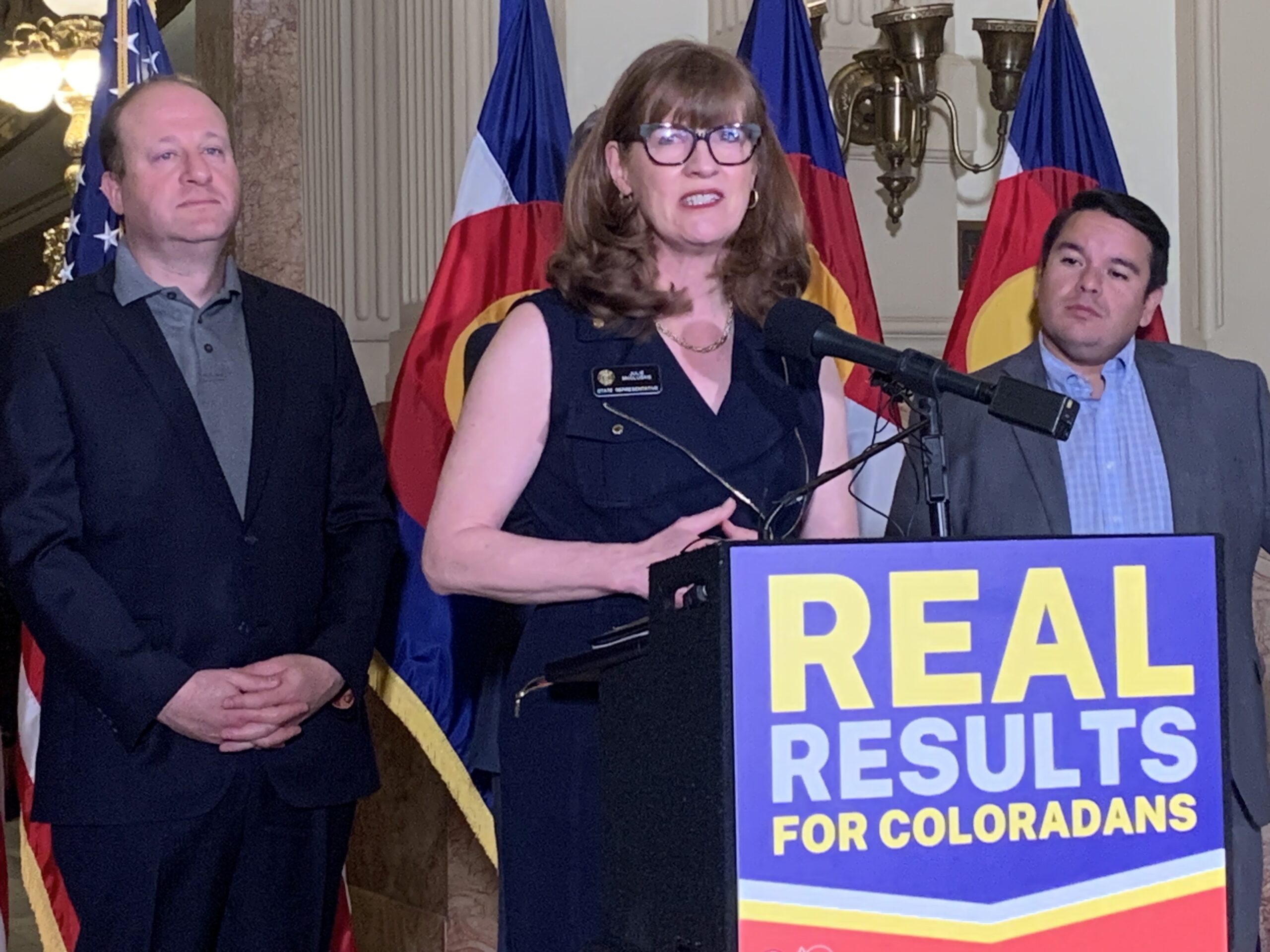
Gov. Jared Polis and the Democratic leadership of the Colorado House and Senate took something of a victory lap on Tuesday after the legislature wrapped up its 120-day session late Monday night.
But it was a victory lap tempered by the late-session failure of the governor’s top priority for 2023 – affordable housing.
Polis’ housing proposal, Senate Bill 213, died Monday after all-day negotiations failed to find a compromise between the Senate and House versions. As introduced, the bill sought to impose state mandates and effectively strip local governments of their authority over land use and zoning.
Polis told reporters in a Tuesday news conference that he will continue to work on housing during the rest of the year.
“We have a lot of work ahead to better protect the rights of homeowners to make Colorado more affordable, to purchase or rent a home,” Polis said. “We need to make sure that we are able to rise to the occasion to change the status quo, which simply isn’t working for too many Coloradans, whether it’s a senior looking to downsize, whether it’s a young family looking to have a home close to where their job is.”
The governor appeared to double-down on the House version of SB 213, stating he appreciated the work of House Democrats and opening the door to restoring concepts that failed to make it out of the Senate, such as “middle” housing. That means duplexes, triplexes and fourplexes, housing that increases density but that raised objections about changing the character of neighborhoods.
Polis noted that his efforts on universal pre-kindergarten took several years to bring to fruition, and hinted he’s in it for the long haul on housing, as well. People know he’s “deeply committed” to addressing the issue, the governor said.
Democratic leaders of the House and Senate also celebrated their agenda items that made it all the way, such as on increasing funding for K-12 education, providing opportunities for workforce credentials, bills they say would curb gun violence, renewable energy and climate legislation, abortion rights and the topic that dominated the final weekend of the session: property taxes and TABOR refunds.
House Speaker Julie McCluskie, D-Dillon, focused on education funding, pointing out that the legislature cut the debt to K-12 education by an even bigger margin the governor originally sought, with a pledge to pay it all off next year.
marianne.goodland@coloradopolitics.com
“No offense, governor, but we beat your budget,” McCluskie joked on the state spending plan’s provisions on reducing the debt.
“This session delivered real results on the issues that matter,” she said, citing legislators’ work on ensuring access to abortion and supporting the workforce, including making free credentials obtained through community colleges for industries with workforce shortages.
But closest to her heart is K-12 education funding, McCluskie said, noting the 2023 legislation increased the per pupil funding by over a thousand dollars per student, which puts resources directly into the classrooms, ensures that schools can maintain small class sizes, and increases teacher pay.
Noting the total increase of $650 million, she called it “remarkable progress and unimaginable just a few years ago.”
Senate President Steve Fenberg pointed to his long-standing priorities on climate and energy, such as fighting back against high utility bills through a mid-session task force that looked at how the state regulates investor-owned utilities, such as Xcel.
That resulted in legislation that Fenberg said would reduce consumer electric bills. Greenhouse gas emissions would come down through reduction targets, climate-aware investments and incentives on electrification, he added, cementing Colorado’s role as a leader on climate policy.
Fenberg also addressed one of the most significant issues of the session: gun violence.
In the face of tragedies, notably the Club Q shooting last November and two violent incidents at Denver’s East High, Fenberg said, “We did not throw up our hands and fail to act.”
He pointed to the five bills, four now signed into law, to strengthen the state’s red flag law, raise the minimum age for gun purchases to 21, impose a three-day waiting period for delivery of firearms and allow gun victims to sue firearms manufacturers and dealers. The fifth measure, which bans ghost guns, has not yet been signed into law.
“These are common sense, life-saving measures that make sense for the moment we find ourselves in,” Fenberg said.
The measure on raising the age for purchasing firearms is a priority for House Majority Leader Monica Duran, D-Wheat Ridge.
She also applauded the diversity of the House Democratic caucus.
“I was proud to see how we fought for inclusion of all voices throughout this session,” Duran said. “Our diversity is our strength, and as a result, we’ll pass legislation that represents all Coloradans whose voices have too often been left behind.”
Senate Majority Leader Dominick Moreno, D-Commerce City, said he is proud of how the Senate operated in a bipartisan fashion, making sure priorities got across the finish line but in a way that did not diminish anyone. As to the failure of SB 213, the housing bill, Moreno said described the session as a time when a lot of conversations got started but that some didn’t get finished.
“It was a really important role that this session played in lining up the opportunity to come back and pass strong legislation to make sure that we address our housing affordability crisis,” he said.
Despite the failure of the governor’s housing bill, there were successes on the housing front, Democrats said, such as House Bill 1255, which strikes local government growth caps, as well as legislation to save renters money on rental applications and a measure to protect lower income people who rely on safety net programs from being evicted.
Addressing the walkout by House Republicans prior to the final vote on Senate Bill 303, the property tax measure that heads to the ballot in November, Polis Polis said it “wasn’t polite.”
The governor said he always thought it is better to be there and be heard, rather than to be at a bar somewhere.
Republicans took offense to that characterization later in the day, pointing out they never left the Capitol grounds after their walkout.
McCluskie said lawmakers are hired to do one thing, and that is to cast a vote. She acknowledged the concerns over the process, but said she is disappointed by the walkout and that she would commit to working with the minority party for next session.
McCluskie said they began to recognize mid-session that what was happening was no longer respectful and productive.
“The filibustering and delay tactics, by having bills read at length, is not why we were voted into office,” she said, adding that when they started imposing limits on debate, right around Easter, the House was able to work through debate in a “more meaningful way.”
She said that ended in the last days, when Democrats needed to deliver on the expectations Coloradans had, particularly on property taxes, and led to the walkout on Monday.
Democrats also reiterated their support for the late-session tax measures.
Polis called the two measures – SB 303, which asks voters to skip a part of their TABOR refund in exchange for property tax relief, and House Bill 1311, which would equalize TABOR refunds if SB 303’s ballot measure passes – a way to provide voters with relief without worrying about the effects on school funding or cuts to other areas that rely on property taxes.
Polis said his goal was to replace the Gallagher Amendment that voters repealed in 2020 as well as address the inequities that Gallagher created. He said the legislation provides a sound mechanism for doing that, as well as keeping property taxes low over time.


Immigration reporting measure fuels debate over Colorado’s role with ICE
Marissa Ventrelli
marissa.ventrelli@coloradopolitics.com
Updated 9 hours ago
A coalition of advocacy groups and several district attorneys rallied outside the Colorado Capitol on Thursday to oppose a ballot measure that, if approved by voters in November, would require state and local law enforcement to cooperate with federal immigration...

Colorado Politics Calendar Sept. 14-20
Rachael Wright, Special to Colorado Politics
rachael.wright@coloradopolitics.com
Updated 4 days ago
CoPo’s weekly political calendar will help you find political and public-policy events throughout Colorado. It includes candidate and issue campaign events, public policy meetings, court hearings, state and local party conventions, assemblies, debates, rallies, parades, speaking engagements, traveling dignitary appearances,...
The African roots of three Colorado leaders | SONDERMANN
Eric Sondermann
eric-sondermann@coloradopolitics.com
Updated 3 days ago
Colorado’s political transformation is measured in many ways. A once reliably red state (with asterisks) became purple and is now a rather deep blue. For better or worse, probably the latter, power is ever more consolidated along the Front Range...
Federal judge green-lights civil trial against ex-Fort Collins DUI officer
Michael Karlik
michael.karlik@coloradopolitics.com
Updated 1 day ago
A federal judge ruled on Thursday that Fort Collins’ former “DUI officer” will face a civil trial for allegedly investigating a motorist for impaired driving without any reasonable suspicion to do so. In recent years, several people arrested by Officer...

Denver police reopen 13 sex assault cases after retesting Missy Woods’ CBI work
Jenny Deam
jenny.deam@gazette.com
Updated 1 day ago
Thirteen previously closed Denver sexual assault cases have been reopened after the city’s crime lab retested DNA evidence once analyzed by former Colorado Bureau of Investigation forensic analyst Yvonne Woods. A police spokesperson told The Denver Gazette the once-closed cases...

Ballot measure aims to shift Colorado sporting goods tax revenue to land, water and wildfire projects
Marissa Ventrelli
marissa.ventrelli@coloradopolitics.com
Updated 9 hours ago
Colorado voters this November will decide whether to direct a share of sales tax revenue from sporting goods — including bicycles and skiing equipment — toward land and water conservation, wildfire prevention and expanding outdoor recreation. Supporters say the measure...

Colorado Supreme Court suspends Mesa County judge pending misconduct investigation
Michael Karlik
michael.karlik@coloradopolitics.com
Updated 11 hours ago
The Colorado Supreme Court suspended Mesa County Court Judge Michael J. Grattan on Thursday amid a misconduct investigation. The court’s Sept. 10 order gave Grattan 21 days to explain why his paid suspension should not continue through the end of...

Trump honors the fallen of the 9/11 terrorist attacks during Pentagon speech
Mabinty Quarshie
mabinty-quarshie@coloradopolitics.com
Updated 2 days ago
President Donald Trump and first lady Melania Trump honored the roughly 3,000 Americans killed during the Sept. 11, 2001, terrorist attacks during a ceremony at the Pentagon. The event marking the 25th anniversary of the deadliest attack on American soil...
Colorado Supreme Court changes course, dismisses case about special district bonds
Michael Karlik
michael.karlik@coloradopolitics.com
Updated 11 hours ago
The Colorado Supreme Court declined on Friday to decide a dispute between a large-scale Commerce City development and the various districts financing it, after initially showing interest in the ongoing case. Colorado has roughly 2,800 special districts, which are local...

Colorado leaders express outrage and pain following 9/11 attacks | A LOOK BACK
Rachael Wright, Special to Colorado Politics
rachael.wright@coloradopolitics.com
Updated 2 days ago
Twenty-Five Years Ago This Week: “Responding to the 9/11 terrorist attacks, Colorado Gov. Bill Owens told reporters in a statement, “I join all Coloradans in expressing outrage and horror at the senseless terrorist bombings in New York and Washington D.C....
PREV
PREVIOUS

Colorado Republicans reflect on the 2023 session: Wins, losses and walkout
Republicans left the Colorado Capitol last May hopeful of winning more offices and even taking control of the Senate. But they returned in January to an expanded Democratic majority in both chambers instead, finding themselves at the worst legislative disadvantage the party had seen in 85 years. At the conclusion of the 2023 legislative session […]

Huge influx of migrants prompts Denver Mayor Michael Hancock to approve emergency activation
Hundreds of immigrants who have been arriving into the metro area since last Thursday are creating such a critical overcrowding problem in Denver’s shelters that Mayor Michael Hancock approved an emergency activation late Tuesday afternoon to bring in more resources to handle the crowds. “We were anticipating an influx due to Title 42, but this […]