

Putting the chill on criticism of the courts | MAES
One would think the scandal that rocked the Colorado Supreme Court in 2019 would eventually subside, move forward with proposed legislation to provide for a more transparent and impartial judicial discipline process, and begin to regain public confidence in the judiciary.
Unfortunately, that concept was quickly extinguished by Jessica Yates, attorney regulation counsel for the Colorado Supreme Court. The attorney regulation counsel serves at the pleasure of the Colorado Supreme Court. The OARC has jurisdiction over attorney discipline.
Yates previously involved the OARC in the squabble between the Supreme Court and the Colorado Commission on Judicial Discipline concerning inappropriate behavior by the Supreme Court in judicial disciplinary matters. She threatened the commission with eviction from their office space and refused the commission’s request for funding to support its allegations. Many felt the OARC was marching to the orders of the Supreme Court.
The Commission on Judicial Discipline consists of 10 members: two district judges, two county judges, two attorneys and four non-attorneys. The executive director of the commission is also an attorney.
One of the members of the commission is El Paso County District Judge David Prince. Judge Prince has been an outspoken critic of the current judicial disciplinary process and has testified before legislative committees interested in revamping the current judicial disciplinary process. During his testimony, Prince has occasionally disagreed with the perceptions of Chief Justice Brian Boatright and representatives from the judicial branch. Such was the case in February 2023 when he testified.
Yates stated in a letter written to the commission that Prince’s testimony was untrue and “that such conduct may have been in violation” of the rules of professional conduct expected to be followed by all attorneys. Her allegations also extended to the executive director “and all attorney/judge members of the Commission in a potential violation… if they assisted in the alleged violations.”
The Commission’s attorney, David Kaplan, responded to Yates’ allegation as having a “terrible chilling effect” on anyone testifying before the legislature. Both Kaplan and Yates stand behind their statements.
Yates clearly abused her authority by appointing herself as judge and jury over who is credible and who isn’t. The record clearly reflects the judiciary has not been voluntarily forthcoming in its response to the scandal until it is presented with facts which are contrary to its position. Yates, herself, in her position with OARC has vacillated between taking an active part in the various stages of the investigation and completely recusing. She obviously is presently an active participant and is dismissive when the commission speaks truth to power.
Is it too much to ask whether this recent debacle is intended to sway the chief justice when he makes his judge appointments to the commission upon the expiration of the terms of certain members who have likewise had the courage to speak out concerning much needed change and transparency?
A failure to reappoint those who are willing to continue their service would certainly appear to be retaliatory and would deprive the Commission of much needed institutional memory from those who have been involved in the process.
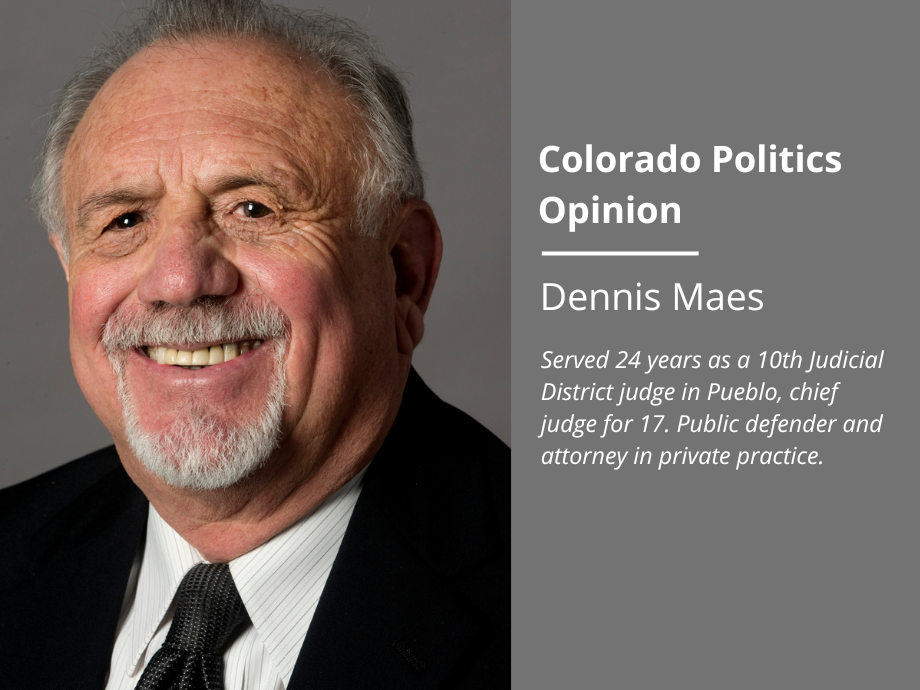
Dennis Maes served 24 years as a 10th Judicial District judge in Pueblo and was chief judge for 17 of those years. He previously served as director of Pueblo County Legal Services, Inc.; as a public defender and as an attorney in private practice.


Can deliberation save democracy? | Vince Bzdek
Vince Bzdek
vince.bzdek@gazette.com
Updated 4 hours ago
By Vince Bzdek In September 2019, 523 Americans traveled to Dallas, Texas, for an experiment called “America in One Room.” The gathering was designed to test a theory: Could representative citizens deliberate productively even in an era of intense polarization?...

Is Trump a builder or just a latter-day headhunter? | SONDERMANN
By Eric Sondermann
by-eric-sondermann@coloradopolitics.com
Updated 2 days ago
It was well under 100 hours after President Donald Trump’s overly long, overly theatrical State of the Union speech that he unleashed American bombers across Iran. As I write, it is now less than 100 hours since those bombers started...
Pueblo board violates Open Meetings Law | Dennis Maes
Dennis Maes
dennis-maes@coloradopolitics.com
Updated 23 hours ago
By Dennis Maes I recently witnessed two serious violations of the Colorado Open Meetings Law by the Pueblo Urban Renewal Authority (PURA) board. Both were brought to the attention of the board in an open meeting and entered on the...

Legislation would undermine educational opportunity | OPINION
Colorado Politics
colorado-politics@coloradopolitics.com
Updated 2 days ago
By Norton Rainey and Weston Kurz New legislation under consideration by Colorado lawmakers could have far-reaching consequences for Colorado students and families looking for new educational options. HB26-1292, currently under consideration by the Colorado General Assembly, would severely limit the...

Medicaid cuts for critical care hurts providers, reduces access to the best care for patients | OPINION
Colorado Politics
colorado-politics@coloradopolitics.com
Updated 2 days ago
By Gurdev Rai This year, the legislative session started with one thing on everyone’s minds: the state budget, and the major hole created by Congress’ HR 1 law. Costs, including for health care, have ballooned across the board, and we...
Not-so-public comment in Douglas County | Paula Noonan
Paula Noonan
paula-noonan@coloradopolitics.com
Updated 2 days ago
Let’s do some high and low history. First, the high history. England’s King George III didn’t like the complaining he heard from the American colonies, so he went to war to shut the people up. President Donald Trump doesn’t like...

Why Colorado should stop charging swipe fees on sales taxes | OPINION
Colorado Politics
colorado-politics@coloradopolitics.com
Updated 3 days ago
By William Lindstedt, Iman Jodeh, Julie McCluskie and Monica Duran Small businesses across Colorado are working harder than ever right now to keep their doors open, hire local workers and serve their communities. But every day, they are forced to...

Colorado can be a gamechanger in regulating GLP-1 weight loss drugs | OPINION
Colorado Politics
colorado-politics@coloradopolitics.com
Updated 3 days ago
By Nancy Glick “As goes California, so goes the nation” is a phrase reflecting California’s reputation as a bellwether in setting regulations that often become a precedent for national policy. Now, Colorado can play this role, setting new safety standards...
Colorado can be a gamechanger in regulating GLP-1 weight loss drugs | OPINION
Colorado Politics
colorado-politics@coloradopolitics.com
Updated 3 days ago
By Nancy Glick “As goes California, so goes the nation” is a phrase reflecting California’s reputation as a bellwether in setting regulations that often become a precedent for national policy. Now, Colorado can play this role, setting new safety standards...

The public health hazards in sports betting | PODIUM
Colorado Politics
colorado-politics@coloradopolitics.com
Updated 2 days ago
By Brandon Zelasko As Colorado lawmakers revisit sports betting policy this session, the state has an opportunity to widen the lens. Beyond revenue projections and regulatory frameworks lies a critical question: Are we fully reckoning with the human effect of...
PREV
PREVIOUS

Denver's survival in the balance | SLOAN
Kelly Sloan The news of the shooting at East High School, to which Denver and the state awoke on Wednesday morning, was a particularly cruel punctuation on the issue of crime which is gripping the city. As such, it was also one which ought to have disqualified a number of the candidates for mayor right […]

Can Dave Williams revive Colorado’s GOP? | DUFFY
Sean Duffy Who has the worst rebuilding job in Colorado: Colorado Rockies Manager Bud Black or Colorado GOP Chair Dave Williams? Both are saddled with cellar-dwelling organizations that somehow need to find a path to success. And both have rock-bottom expectations for accomplishing that. But I think Williams has the toughest road. He’s dug some […]