

Time will tell on Polis’s promise to curb air pollution | NOONAN
Location, location, location. Location is the No. 1 rule in real estate. It’s also the No. 1 rule with ozone. Stratospheric ozone is the “good” kind in the upper atmosphere that protects against the sun’s ultra violet radiation. Tropospheric ozone is the “bad” kind at ground level that causes smog. The Front Range has the seventh worst ground level ozone problem in the nation which is why the EPA is on our bum.
Gov. Jared Polis announced last week that the state will reduce the nitrogen oxide (NOx) part of ozone by 30% by 2025 and 50% by 2030. He will enlist the Colorado Oil and Gas Conservation Commission and the Air Quality Control Commission to do the hard work of regulating NOx into smaller amounts by cracking down on the oil and gas industry.
Though none of us should hold our breath on the outcome, this announcement suggests if the governor wants a crackdown on air polluters, he can make it happen.
When Polis talks up his actions, there’s a guaranteed reaction, just like in chemistry, from Dan Haley of the Colorado Oil and Gas Association. Haley objects to more pollution regulations on his industry by asserting the drilling business needs regulatory certainty. According to him, oil and gas extraction has been on the butt end of uncertainty, as if most businesses live in some other privileged context where they can predict what’s going to happen in their future.
Polis cited SB19-181, landmark legislation to protect us and the environment from pollution harm, as the basis for his NOx proclamation. Unfortunately for us, he has just now gotten around to the impact of NOx on our air. That’s three years after SB19-181 passed and many slogs of COGCC regulatory hearings with consequent small tweaks here and there on drilling regulations. Most revealing to how the governor sees the industry is his lack of intervention on the orphan well problem.
As many in the environmentalists’ world have noted, Colorado’s oil and gas operators put in woefully low amounts of money as bond to protect against the inevitable clean-up of abandoned wells. The impact of the COGCC’s mild modifications to abandoned/orphan well bonding will be felt long after the governor is out of Colorado office, but within the living timeframe of many individuals now 30 or younger who will pick up this nasty tab about a decade or two out.
Just as bad is the governor’s lack of effort on Suncor Refinery pollution that has put north Denver and Commerce City, locations closest to the huge oil and gas operator, into pollution muck day in and day out.
Perhaps some remember the yellow powder that covered cars in 2019, just after SB19-181 passed the legislature. Suncor called the event an “operational upset” as if it had a tummy ache. The powder was “catalyst” that Suncor finally admitted could cause “short term discomfort to eyes, and coughing and wheezing.” Raise your hand if you want to live where you’re forced to suck catalyst powder into your lungs that will cause “coughing and wheezing.” That’s the ongoing fate of north Denver and Commerce City residents.
As part of an agreement with Colorado’s Department of Public Health and Environment, Suncor had to make money available to Commerce City residents as remuneration for its pollution troubles. Cultivando, an organization that serves the Latina/o community in Adams County, received funds to measure the pollution coming from the Suncor Refinery. It recently provided results from its first year of continuous monitoring from multiple sites outside the plant to capture measurements of the many elements that form ozone and other health-harming pollutants.
The results aren’t pretty for the people who live near the refinery. The governor is focused on NOx. According to measurements announced at the Cultivando news conference, Suncor had 65,203 exceedances of greater than 53ppb in a recent six-month period at Cultivando’s fixed monitor site and 33,199 exceedances of greater than 53ppb from the mobile facility. More than 53ppb is bad. If the governor manages to reduce NOx by 30% in 2025, Commerce City residents can still count on about 45,400 exceedances over six months.
Particulate matter (PM2 and PM10) that contains health-harming volatile organic chemicals (VOCs) showed thousands of exceedances as well. These particles get sucked deep into the lungs causing wheezing, coughing, asthma attacks, bronchitis, high blood pressure, heart attacks, stroke and premature death.
No wonder the children from Commerce City and north Denver miss school due to lung ailments. They’re breathing out of a chemical cauldron. NOx is only one part of Colorado’s air quality stew. Summer is coming. The air will heat up. The ozone will accumulate. Don’t leave your windows open at night. That’s when the ozone pollution is at its worst.
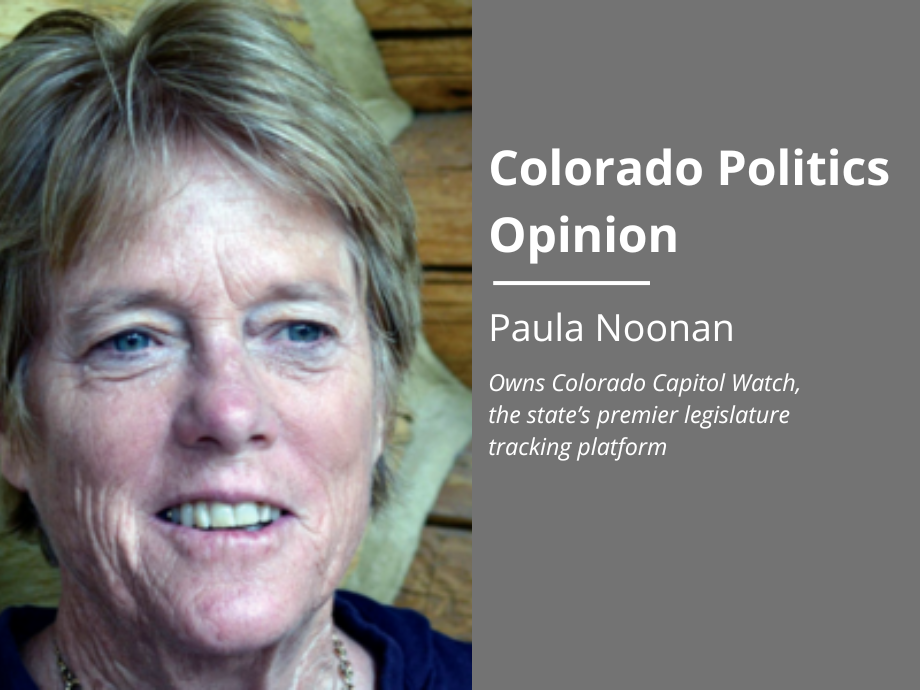
Paula Noonan owns Colorado Capitol Watch, the state’s premier legislature tracking platform.


A daring and fearless rescuer — is afraid of a debate | Dick Wadhams
Dick Wadhams
dick-wadhams@coloradopolitics.com
Updated 2 days ago
Victor Marx, the Republican nominee for governor who says he can exorcize demons and who claimed he has fearlessly rescued 45,000 women and children during 150 “high-risk” missions around the world, appears to be intimidated by the notion of debating...

Proposed EPA changes could save truckers billions | Rachel Gabel
Rachel Gabel
rachel-gabel@coloradopolitics.com
Updated 2 days ago
Agriculture is in distress across nearly every segment across much of the nation, and certainly to a more dire degree in the western United States. If it were not a historic drought, some pressures could be eased. Others can be...

Colorado Democrats, your time is coming | Jon Caldara
Jon Caldara
jon-caldara@coloradopolitics.com
Updated 2 days ago
Hey, Colorado Democrats! All the fun you’ve had watching Republican dysfunction in Colorado for the last 20 years was just a preview of what is about to happen to you. The Colorado Republican Party no longer exists as a competitive...
The relevance of Watergate more than a half-century later | SONDERMANN
By Eric Sondermann
by-eric-sondermann@coloradopolitics.com
Updated 5 days ago
It was the scandal for which all other scandals are now named. In June 1972, a small group of Cuban burglars with high-level connections broke into the headquarters of the Democratic National Committee. Those headquarters were located in the Watergate...
Colorado must continue finding common ground on wildfire policy | GUEST COLUMN
Colorado Politics
colorado-politics@coloradopolitics.com
Updated 4 days ago
By John Herrick Colorado has never lacked for opinions about wildfire policy. We debate forest management, climate change, prescribed burns, land use, air quality and budgets. Those debates are familiar territory, but a new discussion is beginning to happen around...

Proposition NN is the best investment for Colorado’s students and schools | GUEST COLUMN
Colorado Politics
colorado-politics@coloradopolitics.com
Updated 4 days ago
By Justin Ogden Colorado families know what it means to make difficult budget decisions. Inflation has driven up the cost of groceries, housing, utilities and just about everything else. Families like mine work hard to stretch every dollar while still...

Were the primaries a preview for consequential general election? | Paula Noonan
Paula Noonan
paula-noonan@coloradopolitics.com
Updated 5 days ago
Colorado’s political future will go the way of this election. Historically, the state has not had both chambers controlled by a supermajority. This election may change that. The primaries suggest how the general election may play out. Democrats had solid...
Disagreement doesn’t have to mean disrespect | GUEST COLUMN
Colorado Politics
colorado-politics@coloradopolitics.com
Updated 5 days ago
By Vincent Atchity These days, it doesn’t take long to feel overwhelmed by politics. Turn on the news, scroll through social media or read the comments on almost any political post and you’ll find anger, outrage and personal attacks. For...
Keeping Colorado’s kids’ trust online | PODIUM
Colorado Politics
colorado-politics@coloradopolitics.com
Updated 5 days ago
By Stuart Jenkins Almost every day, the kids and teens we serve across Colorado are introduced to new generative artificial intelligence and other emerging technology, including conversational AI systems designed to simulate human conversation. These tools are no longer a...

Marx’s ‘through line’ predates Trump, connects to Maes | FEEDBACK
Colorado Politics
colorado-politics@coloradopolitics.com
Updated 5 days ago
Eric Sondermann is of course correct Victor Marx is an unserious, unelectable, embarrassing Republican nominee for governor of Colorado. But I respectfully submit that the “through line,” as Mr. Sondermann describes it, is not from Trump to Marx, despite their...
PREV
PREVIOUS
Suits instead of solutions for disabled access | OPINION
Mark Hillman State Rep. David Ortiz, D-Littleton, makes a compelling advocate for the rights and struggles of disabled Coloradans. “I lived 30 years as an able-bodied leg-walker, a five-minute-mile running, hard-charging combat aviator – until a crash in Afghanistan left me paralyzed from the waist down,” he told the House Judiciary Committee. He understandably views himself […]
‘Zero accountability. Zero treatment. Zero justice.’ | BRAUCHLER
George Brauchler From 2011 to 2021, juveniles aged 10-12 committed 187 felony assaults, 191 burglaries, 16 armed robberies and more than 1,500 sex offenses, including sexual assault, incest and sexual assault on a child. This past Tuesday, 25 Democrats and two Republicans launched a bill to prevent those perpetrators of serious and aggravated crimes from […]