

House bill would bar candidates from opposing parties from running in recall elections

Ten years ago, gun rights groups launched recalls against two Democratic state senators, which resulted in the election of two Republican senators and a narrowing of the Democratic advantage by two seats.
The recalls were over the Democrats’ votes on gun control, bills that capped ammunition magazines to 15 rounds or less, required universal background checks and required those seeking firearms purchases to pay for those background checks.
With a half-dozen gun control-related bills introduced in the 2023 session, and more expected, Democrats are proposing legislation that would change the recall process. Most notably, the proposed legislation would limit who gets to be a candidate when a recall election makes it to the ballot.
House Bill 1185 would limit who can run as a candidate to replace a recalled official, if the election is for a partisan seat. Under the measure, which won an 8-3 party-line vote in the House State, Civic, Military and Veterans Affairs Committee on Monday, only a person from the same party could be a candidate for a recalled seat.
If a seat is held by an unaffiliated official who is recalled, the candidate for that seat would also have to be unaffiliated, under the bill.
The measure, which was introduced on Feb. 8, is viewed as something of a preemptive strike, should gun rights groups decide to launch recalls of Democrats supporting the gun control bills announced in the past week.
In 2013, Senate President John Morse of Colorado Springs and Sen. Angela Giron of Pueblo were both recalled by voters, and replaced by Republican Sens. Bernie Herpin and George Rivera, respectively. Neither held onto the seat for long. Rivera lost to Sen. Leroy Garcia in the 2014 election and Herpin lost to Sen. Michael Merrifield, also in 2014.
That year, Republicans took control of the Senate and held it for the next two years, the last time the General Assembly had split control.
HB 1185 also addresses what’s happening in Walsenburg, where the entire city council and mayor are facing a recall, which if successful could leave the town without any means to appoint replacements. In Florence, the entire city council resigned a year ago over allegations of corruption, leaving only the mayor, and questions about how to replace those six council members.
HB 1185 would allow the city or town clerk to call an election in the absence of a quorum.
Rep. Lindsey Daugherty, D-Arvada, told the State Affairs committee Monday that “outside interest groups” initiate recall elections at the local level. These elections are expensive and take a lot of staff time, and more often than not, these recalls fail, Daugherty said. The municipality then has to eat the election costs.
Her bill would require that members of a recall petition committee be registered electors within the municipality.
“If you can’t find three people to serve on a recall committee, the municipality shouldn’t have to spend taxpayer dollars on a recall election,” she said.
Only one person testified on the bill: Karen Goldman, a former city clerk and former secretary of the state Senate, who represented both the Colorado Municipal League and the municipal clerks association. She noted the situation in Florence, where the mayor was eventually able to call for the election.
“If you think this is a one-off, there’s a small statutory town” going through the same thing, she said, referring to Walsenburg. That recall election is scheduled for May.
Rep. Ken DeGraaf, R-Colorado Springs, initially attempted to split the bill into two, with the municipal portion in one bill and the recall in another, and later sought a title ruling, which was rejected.
Two recalls are in process in 2023, including the one in Walsenburg. A recall petition for a member of the Elizabeth School Board, in Elbert County, is currently underway. A member of the Cripple Creek City Council was recalled a month ago.
In 2022, 11 recalls were launched, including against the governor, secretary of state, state Sen. Kevin Priola, and two members of the Colorado Springs City Council. While none of those made it to the ballot, a pending recall election for the District Attorney in the San Luis Valley prompted his resignation. Only two of the 11 recall elections got in front of voters last year and were successful, for a school board member in the Buffalo School District (Logan County) and a recall of a Rio Blanco County Commissioner.
Recalls have become a common tool for disgruntled voters and special interest groups who disagree with policy positions to take out their frustrations, rather than over malfeasance or other violations of elected office. A 2019 report by the Pew Trusts on the Colorado recalls that year, which included challenges to Polis and two Democratic state senators, said “[g]rowing partisanship has made both Republicans and Democrats willing to embrace once unthinkable political tactics, such as recalls.”
Howard Schweber, a professor of political science at the University of Wisconsin-Madison also said in the Pew report that “as ideological positions become more extreme, the fact that the other party is in office becomes more intolerable.” That aversion isn’t irrational, Schweber said, as partisanship can lead the party in power to enact more extreme policies.
Kristi Burton Brown, chair of the Colorado Republican Party, said “it’s the Democrats way of preventing citizens from speaking through a recall. The point of a recall is to allow a new person to represent them, and sometimes that’s a person of a different political party.” Democrats have been angry about recalls for years, she said, and they view this as an opportunity, with overwhelming majorities, to take away the ability for Republicans to hold them accountable.
Whether the party might challenge the bill legally will be up to the next party chair, Burton Brown said, but she also said she believes the measure could be unconstitutional. “To take away the right of citizens to have the option of a second party on the ballot sounds unconstitutional,” and that she hopes the governor takes that into account should the bill arrive on his desk.
House Bill 1185 now heads to the full House.


10th Circuit to address resentencing of probation violators in rare all-judges hearing
Michael Karlik
michael.karlik@coloradopolitics.com
Updated 2 hours ago
The Denver-based federal appeals court agreed on Thursday to hold a rare all-judges hearing to determine the proper procedure for resentencing a criminal defendant who has violated the terms of his probation. In the federal appellate courts, the vast majority...

Vape shops challenge Denver’s flavored tobacco ban in court
Deborah Grigsby
deborah.smith@denvergazette.com
Updated 8 minutes ago
The smoke has yet to settle in the battle over the city’s flavored tobacco ban as local vape shop owners have sued the City and County of Denver, asking the court to declare the ordinance unconstitutional and stop its enforcement....

US officially leaves the World Health Organization
Washington Examiner Staff, Washington Examiner
washington.examiner.staff.washington.examiner@gazetteedit.wpenginepowered.com
Updated 4 hours ago
The United States officially withdrew from the World Health Organization on Thursday, slightly over a year after President Donald Trump announced his intention to withdraw the U.S. from the WHO via an executive order on the first day of his...

Report: Colorado government has grown beyond TABOR’s limits over 30 years
Marissa Ventrelli
marissa.ventrelli@coloradopolitics.com
Updated 5 hours ago
Colorado’s government has grown substantially over the past three decades despite voter-approved limits designed to restrain that expansion, according to a new report from the Independence Institute. The analysis examines state spending, revenue sources, and employment trends since the Taxpayer’s...
Appeals court overturns Adams County sex offense convictions due to prosecutor’s misconduct
Michael Karlik
michael.karlik@coloradopolitics.com
Updated 6 hours ago
Colorado’s second-highest court reversed multiple child sex assault convictions on Thursday after concluding an Adams County prosecutor committed misconduct while cross-examining the defendant. A three-judge Court of Appeals panel observed the charges against Daniel Michael Boerner depended on the jury...

ACA enrollment in Colorado sees dip amid rising costs
Nico Brambila
nico.brambila@denvergazette.com
Updated 2 hours ago
Despite handwringing over enhanced federal subsidies going away for many Coloradans enrolled in health insurance on the state’s marketplace, officials reported Friday just a 2% enrollment dip. More than 277,000 Coloradans enrolled in health insurance through the Affordable Care Act...
Rep. Ron Weinberg won’t seek reelection
Marianne Goodland
marianne.goodland@coloradopolitics.com
Updated 21 hours ago
Republican Rep. Ron Weinberg of Loveland announced on Thursday evening that he will not seek another term in the Colorado House. “Serving this community has been one of the greatest honors of my life,” the two-term state representative said on...
Colorado title board OKs ballot measures to eliminate flat income tax in favor of graduated brackets
Marianne Goodland
marianne.goodland@coloradopolitics.com
Updated 21 hours ago
Proponents hoping to change Colorado’s income tax structure from a flat rate to graduated tiers — thereby raising taxes for some brackets — walked away from a Wednesday meeting with eight ballot measures approved by the title board. The coalition...
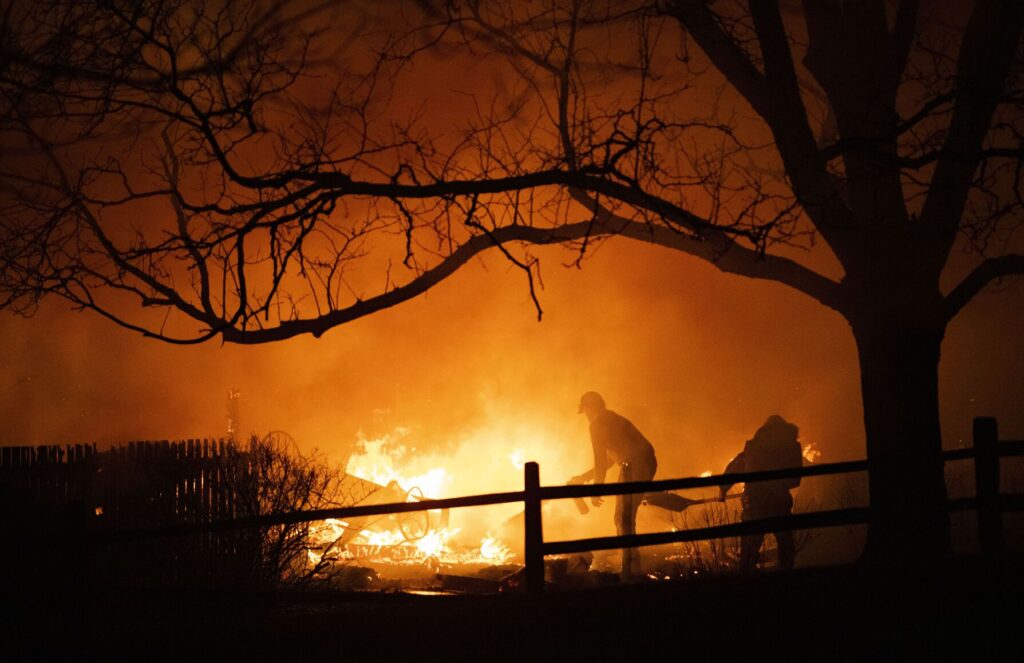
PUC schedules virtual hearing on proposed rules for public safety power shutoffs
Scott Weiser
scott.weiser@gazette.com
Updated 6 hours ago
The Colorado Public Utilities Commission will hold a virtual public comment hearing to gather input on proposed new rules for Public Safety Power Shutoff events, a wildfire prevention measure that temporarily cuts power to reduce ignition risks from utility equipment...
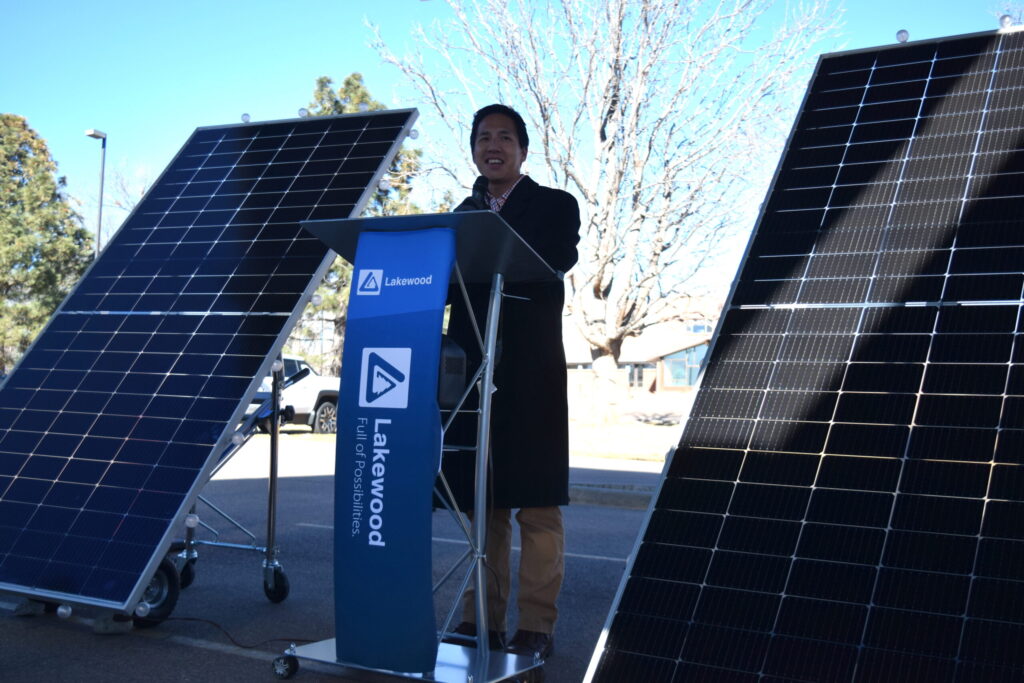
Lakewood launches first 100% solar facility
Sage Kelley
sage.kelley@denvergazette.com
Updated 5 hours ago
The new canopy covering the Charles Whitlock Recreation Center’s parking lot in Lakewood isn’t just for decoration — it’s powering the entire facility. The city of Lakewood cut the ribbon on its first on-site solar installation at a city facility...
PREV
PREVIOUS

Colorado ranks No. 32 in CDC's recommended vaccine shots for youngest children
Treating diseases that vaccines could have prevented cost Colorado $13 billion over two years, according to a new report. From 2020 to 2021, Colorado saw 420,000 hospitalizations and emergency department visits for “vaccine-preventable diseases,” such as like measles, flu and whooping cough, according to the report from Children’s Hospital Colorado and Immunize Colorado. New CU […]

Aurora city council deploys new snow removal funding source
The Aurora City Council greenlighted a plan Monday to start saving up more money for the city’s snow and ice removal services, including for residential streets. But some councilmembers cautioned residents against expecting their neighborhood streets to be cleared every year and emphasized the savings will be “a drop in the bucket” of overall snow […]