

New ‘reasonable doubt’ instruction causes uprorar, the return of Masterpiece Cakeshop | COURT CRAWL

Welcome to Court Crawl, Colorado Politics’ roundup of news from the third branch of government.
The judicial branch revised its model definition of “beyond a reasonable doubt” for jury trials, plus Masterpiece Cakeshop, the Lakewood business whose case reached the U.S. Supreme Court five years ago, was the subject of another state court decision.
Reasonable doubt definition
? The Model Criminal Jury Instructions Committee, whose updates to the template jury instructions are normally low-key affairs, generated shockwaves on Friday when it revised the definition of “beyond a reasonable doubt” for criminal trials. The small, all-judges committee didn’t consult with anyone else and didn’t provide a formal heads-up, although its meeting minutes from the summer and fall did reveal this to be an active topic of conversation.
? Prosecutors appeared supportive of the simpler wording, while defense attorneys were livid. For context, the old instruction was a mouthful and essentially told jurors that reasonable doubt is something that would “cause reasonable people to hesitate to act in matters of importance to themselves.” Now, jurors must be “firmly convinced” of a defendant’s guilt, with no “real possibility” he or she is innocent.
? The public defender’s office believes the new definition “unfairly favors the government and will lessen the burden of proof in everyday jurors’ minds.” However, the wording resembles the model instruction used in Colorado’s federal trial court. Here’s the federal instruction:
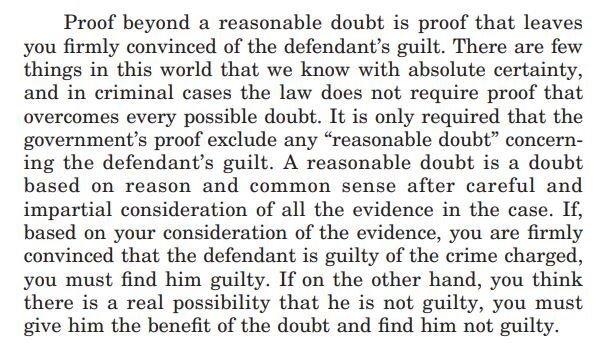
And here’s the state instruction:
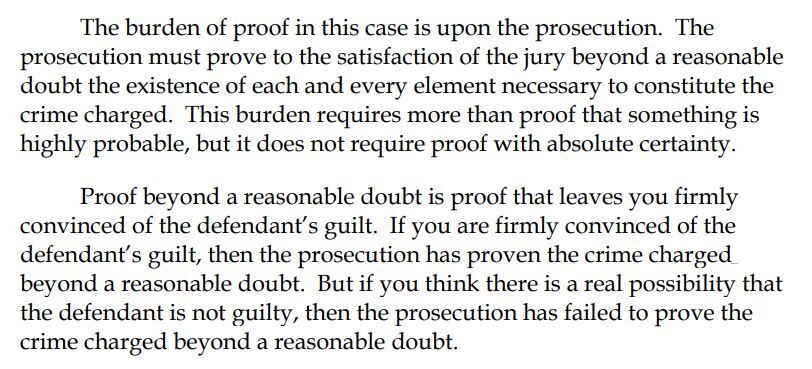
? Once trial judges start giving the new instruction to juries, there will likely be challenges on appeal, so stay tuned.
SCOTUS connection to Colorado
? In 2018, the U.S. Supreme Court issued its decision in Masterpiece Cakeshop v. Colorado Civil Rights Commission, a case ostensibly about whether state anti-discrimination laws could compel someone to speak in violation of their First Amendment rights. Specifically, whether cake maker Jack Phillips of Lakewood had to bake a cake – the “speech” – for a gay couple, even though he is religiously opposed to same-sex marriage. The Supreme Court ultimately left the question unanswered, deciding the case on narrower grounds.
? Last week, the state’s Court of Appeals found Phillips violated Colorado’s anti-discrimination law again when he declined to make a cake for a transgender customer based on her gender identity. Further, the court discerned no violation of Phillips’ First Amendment rights. Phillips’ lawyers said they will appeal, and the appeal will likely be pending when the Supreme Court hands down its decision this year in 303 Creative v. Elenis, which will answer the compelled speech question once and for all.
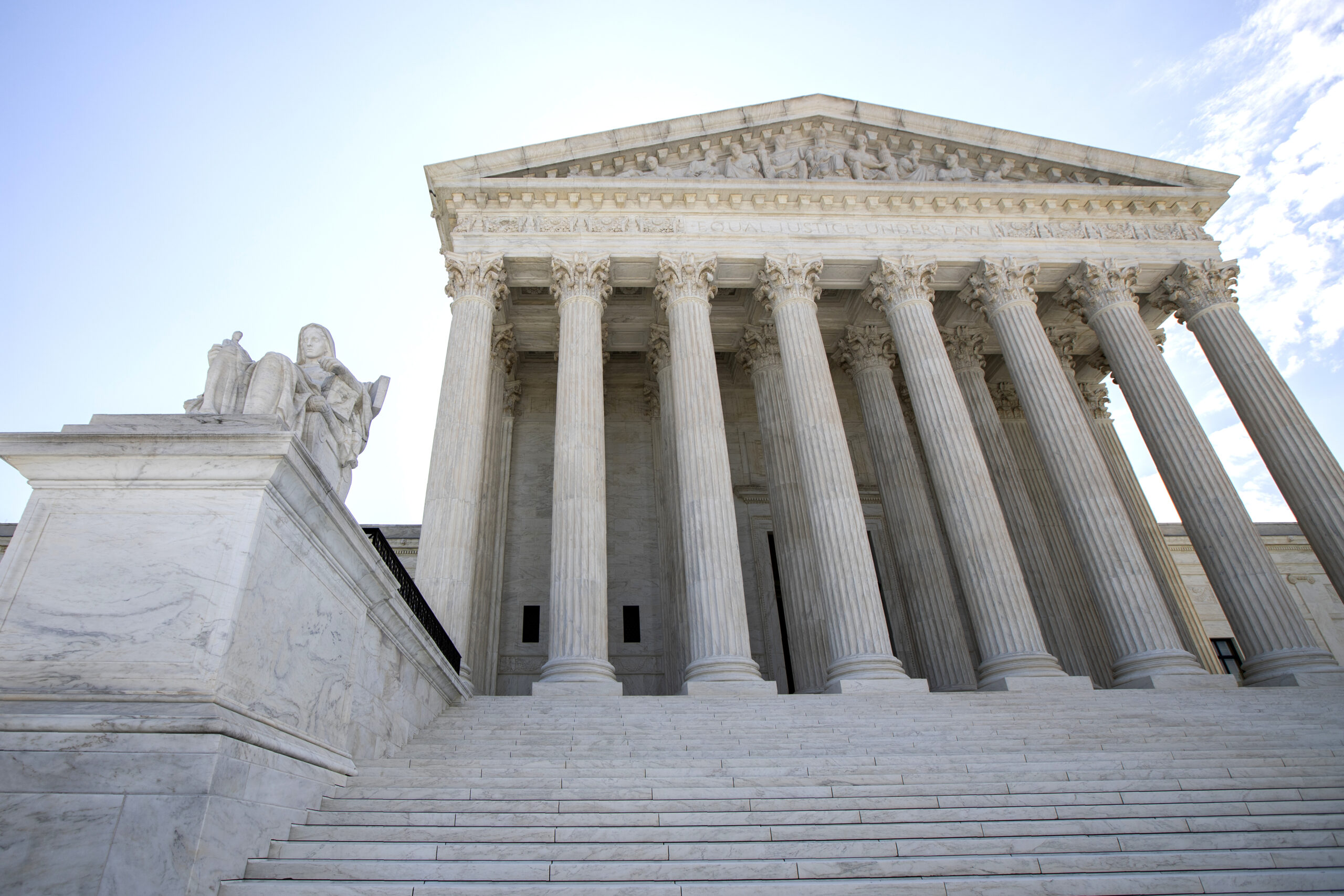
? SCOTUS also agreed to take an appeal out of Colorado earlier this month, implicating how prosecutors prove someone made a “true threat” that is not First Amendment-protected speech. Like Masterpiece Cakeshop, the justices in this appeal, People v. Counterman, will review a decision directly from the Court of Appeals, rather than Colorado’s Supreme Court. Colorado Politics looked at the recent cases that have come before SCOTUS from our state courts, and spoke with one appellate judge whose opinions appeared twice in front of the nation’s highest court.
Heard on appeal
? The Colorado Supreme Court clarified the government’s burden of proof in welfare cases for showing a child suffered a serious bodily injury and no treatment plan would help the parent become fit.
? The U.S. Court of Appeals for the 10th Circuit decided Aurora officers committed no clear constitutional violation when they entered a man’s home without a warrant to do a “protective sweep” and retrieve his sleeping infant. A trial judge had agreed the officers’ actions could violate the Fourth Amendment’s prohibition on unreasonable searches and seizures, but no prior case deemed such an entry unconstitutional.
? Even though Congress legalized hemp production in 2018 and said states can’t interfere with its transport, the 10th Circuit decided a hemp producer couldn’t sue when a police officer confiscated his plants at Denver International Airport.
? The 10th Circuit dismissed a First Amendment challenge to Northglenn’s sidewalk obstruction ordinance from a man who was cited during his routine protest of a mosque.
? A panel of 10th Circuit judges was skeptical that a former Denver custodian was fired, as she alleges, for being white, instead of the city’s stated reason for terminating her: that she represented herself as a police officer online.
? Frontier Airlines was not required to accommodate a flight attendant’s alcoholism by allowing her to piece together a schedule that would avoid layovers, the 10th Circuit decided.
? The Colorado Supreme Court will hear an appeal out of Denver that asks what type of information school administrators may rely upon to search a student without a warrant.
In federal news
? Three civic groups sued a Colorado organization that believes the 2020 presidential election was fraudulent. The defendant then turned around and sued the civic groups for defamation. A federal judge has now tossed the defamation claim.
? A woman who uses the language of the anti-government “sovereign citizen” movement is being prosecuted in Eagle County for allegedly sending fake tax documents to judges and law enforcement. She filed suit against the district attorney in federal court and asked to be put on a “Do not detain” list. A judge dismissed the lawsuit.

Vacancies and appointments
? There are two finalists to succeed former District Court Judge Mark D. Thompson in the Fifth Judicial District (Clear Creek, Eagle, Lake and Summit counties): Courtney Holm and Lake County Court Judge Jonathan Shamis.
? Three people are in the running to replace now-District Court Judge Anthony Nathaniel Baca in his old job as Dolores County Court judge: clerk of court and jury commissioner Anne Deyell-Lawrence, Ian MacLaren and Matthew Margeson.
? Applications are due by Feb. 7 to succeed District Court Judge John E. Scipione in the 18th Judicial District (Arapahoe, Douglas, Elbert and Lincoln counties). Scipione resigned in the face of a misconduct investigation into his extramarital affair with a clerk.
Miscellaneous proceedings
? A committee of the Office of Attorney Regulation Counsel released the findings in its investigation of former Chief Justice Nathan B. Coats.
? U.S. Rep. Doug Lamborn settled a federal lawsuit brought by a former staff member, who made allegations related to COVID-19 safety and misuse of office resources.
? A bill is working its way through the state legislature to modify procedures for juvenile defendants who are found incompetent to stand trial.
Court Crawl on vacation
? Court Crawl will be off next Monday, but be aware that the Colorado Supreme Court is back for oral arguments next week. Among the cases being heard is Cruz v. People, which asks whether it’s constitutional to revoke someone’s release from a mental health commitment solely for refusing to cooperate in an exam. Also, the Supreme Court will take public comment on a proposed rule change to reduce racial bias in jury selection.


Colorado’s chief federal judge orders return of wrongfully deported man, second judge to explore ‘series’ of violations
Michael Karlik
michael.karlik@coloradopolitics.com
Updated 7 hours ago
Colorado’s chief federal judge took the extraordinary step of directing the government on Tuesday to do everything it can to return a man it deported in violation of his order. At the same time, Colorado’s chief magistrate judge has set...
Denver murder, assault convictions reversed due to faulty jury instructions
Michael Karlik
michael.karlik@coloradopolitics.com
Updated 5 hours ago
Colorado’s second-highest court reversed a defendant’s convictions for murder and assault last week after concluding a Denver judge incorrectly omitted key jury instructions that could have affected the verdict and sentencing. Stephen C. Swainson fatally stabbed Israel Casillas in downtown...
‘Understand people for who they are’: 2 federal judges talk about compassion in courtroom
Michael Karlik
michael.karlik@coloradopolitics.com
Updated 13 hours ago
Before taking the bench in 2022, U.S. District Court Judge Charlotte N. Sweeney was an employment discrimination attorney. While the cases could be emotionally charged, they were different from the criminal proceedings she is now handling. “It wasn’t necessarily affecting...
Denver murder conviction reversed for incomplete self-defense instruction
Michael Karlik
michael.karlik@coloradopolitics.com
Updated 1 day ago
Colorado’s second-highest court reversed a defendant’s murder conviction last week because a Denver judge gave an incomplete instruction to the jury about the man’s right to self-defense. Donald R. Gonzales and Gary McLaughlin met up in a Capitol Hill parking...
Colorado lawmaker, House leaders named in workplace-retaliation lawsuit
Marianne Goodland
marianne.goodland@coloradopolitics.com
Updated 1 day ago
A former legislative aide has filed a lawsuit alleging she was mistreated, illegally directed to perform campaign work and harmed by a House leadership structure she charged was fragmented, politicized and ineffective at protecting employees. The lawsuit, filed by Jennifer...
Federal judge hears arguments about Colorado’s 3-day gun purchase waiting period
Michael Karlik
michael.karlik@coloradopolitics.com
Updated 2 days ago
A federal judge heard arguments on Monday about the constitutionality of a 2023 Colorado law that generally imposes a three-day waiting period on firearm purchases after the initiation of a background check. The test that the U.S. Supreme Court created...
Colorado Supreme Court intervenes in Weld County prosecution dismissed due to Missy Woods misconduct
Michael Karlik
michael.karlik@coloradopolitics.com
Updated 1 day ago
The Colorado Supreme Court ordered a Weld County trial judge last week to respond to the district attorney’s claim that he improperly dismissed a criminal case because of “outrageous” conduct by the Colorado Bureau of Investigation. Daniel Lee Eatinger stood...
Schoolchildren’s presence at child sex-related trial did not harm Arapahoe County defendant, appeals court says
Michael Karlik
michael.karlik@coloradopolitics.com
Updated 4 days ago
Colorado’s second-highest court decided on Thursday that the presence of a group of schoolchildren on the first day of a child sexual exploitation trial did not violate an Arapahoe County defendant’s constitutional right to a fair trial. Prosecutors charged Jerry...
Appeals court cites week-old Colorado law to reinstate child neglect case at child, father’s request
Michael Karlik
michael.karlik@coloradopolitics.com
Updated 4 days ago
Colorado’s second-highest court invoked a new state law for the first time on Thursday and reinstated a child neglect case that both the child and her father wished to reopen. House Bill 1227 took effect on Aug. 12, reversing a...
Colorado Supreme Court names William Hood as next chief justice
Michael Karlik
michael.karlik@coloradopolitics.com
Updated 5 days ago
The Colorado Supreme Court has selected Justice William W. Hood III to be the next chief justice, the judicial branch announced on Friday. Hood will succeed Chief Justice Monica M. Márquez, who took over the role in July 2024. “I...
PREV
PREVIOUS

THIS WEEK AT THE COLORADO CAPITOL | Week of Jan. 30, 2023
Here are legislative committee hearings and other events of note for the week ahead at the Colorado state Capitol. Committee schedules are subject to change. The daily schedule is available on the legislature’s website. Options for public testimony during committee hearings can be found here. House regulations regarding remote testimony can be found here. Senate regulations are here. Bills […]

Q&A with JoyAnn Ruscha | RTD director sets sights on accessibility, equity in public transit
JoyAnn Ruscha was sworn in on Jan. 10 as a member of the Regional Transportation District’s 15-member board of directors as the newly elected representative of District B, which covers Northeast Denver, including Park Hill, Central Park, Montbello, Green Valley Ranch, Denver International Airport and parts of Aurora and unincorporated Adams County. Ruscha lost a […]