

Pueblo’s proposed abortion law would impede doctors from providing sufficient medical care, OB-GYNs say
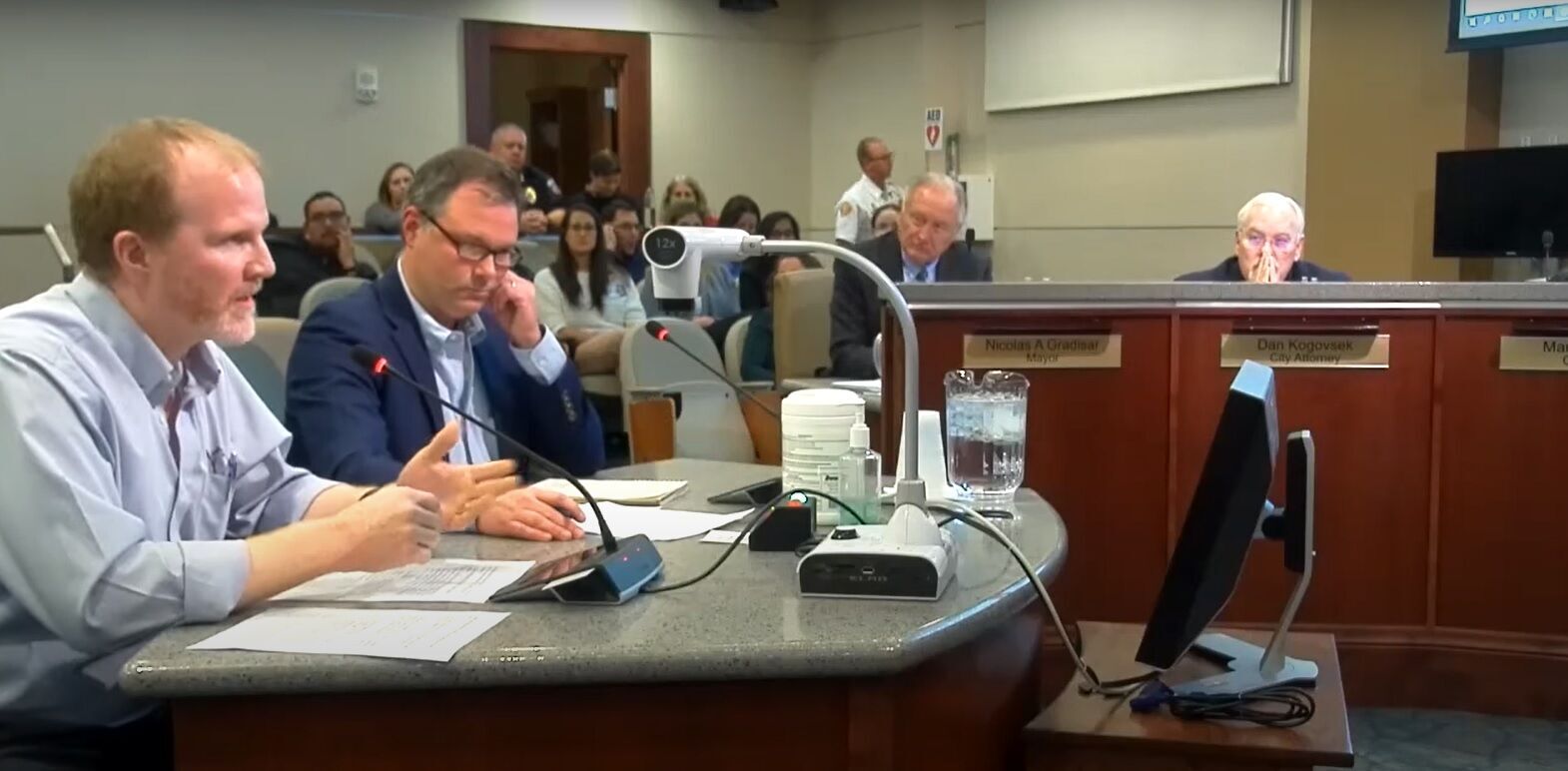
A proposed ordinance that would ban abortion in Pueblo city limits would hinder doctors’ ability to provide sufficient medical care and could harm their patients, OB-GYNs said during a work session last week.
“The ordinance you’re considering would impede our efforts to provide comprehensive medical care to women and detract from our ability to routinely provide life-saving measures for your wives, your sisters, your moms and yourself, even without elective terminations of pregnancy,” Dr. Mike Growney, an OB-GYN at Parkview Health System, which does not perform abortions, told the City Council on Wednesday.
Pueblo’s proposed anti-abortion ordinance comes with legal questions
The ordinance, which seems to be the first proposed municipal anti-abortion regulation brought forth in Colorado, says it would require abortion providers in Pueblo to comply with federal law, citing an 1873 Comstock law prohibiting the publication, distribution or possession of information about or medication or other tools for “unlawful” contraception or abortions.
Proposed ordinance requiring abortion providers in Pueblo to comply with federal law
Parts of the law banning contraception have since been overturned, but other portions regarding abortion are seemingly still on record.
Councilwoman Regina Maestri said previously she brought the ordinance before the council on behalf of residents who are concerned about a planned abortion clinic in town. There are currently no abortion clinics in Pueblo, and the nearest one is about 45 miles north in Colorado Springs.
Clinics for Abortion and Reproductive Excellence, which also has locations in Nebraska and Maryland, has purchased a building in Pueblo’s historic Bessemer neighborhood. No opening date has been announced.
Pueblo’s proposed ordinance, which Growney and other OB-GYNs from Parkview said was “overly vague,” makes exceptions for fertilization treatments, saving a baby’s life, removing a dead “unborn child,” ectopic pregnancies and emergency contraception like Plan B medication.
But if it were passed as written, doctors said, they wouldn’t be able to adequately care for their patients because the municipal law would preclude them from using “any article or thing designed, adapted or intended for producing abortion; or any article, instrument, substance, drug, medicine or thing which is advertised or described in a manner calculated to lead another to use or apply it for producing abortion.”
The ordinance would also outlaw using computers to order the equipment or receiving such tools in the mail.
But doctors use the same devices and medications that are used for abortions to treat patients experiencing other medical issues, they said Wednesday.
Colorado seeks FDA approval for cost-saving plan to import prescription drugs from Canada
“Everything we use to treat ectopic pregnancies, miscarriages, to diagnose endometrial cancers – it can all be adapted to perform abortions,” Growney said. “Half the stuff we use was adapted for clinical practice from people that do abortions. It’s hand-in-hand. It’s tools of the trade. It’s the same equipment. It’s the same medication. We just use it in different ways – not performing terminations. But this ordinance would make it so that we can’t get it.”
Some pharmacists already refuse to fill prescriptions for a drug called misoprostol, commonly used to treat stomach ulcers, because it could also be used for an abortion, Growney said. But OB-GYNs also use the drug to reduce a patient’s bleeding after giving birth or to “empty the uterus” after a miscarriage to avoid surgery, he said.
Dr. Joseph Castelli said the council’s forthcoming decision on the proposed ordinance will affect people across southern Colorado and northern New Mexico who seek medical care in Pueblo.
“You’re actually making a decision for hundreds of thousands of lives from Alamosa to Trinidad, Raton, Lamar …,” he said. “So I just want you to understand that this decision is affecting a vast swath of southern Colorado and lowering our ability to deliver the standard of care. We will not be doing state-of-the-art medicine if this happens.”
Doctors could also do harm to their patients if the ordinance were passed, Castelli said.
“If I don’t have the proper equipment, people will lose blood. People will have to have a hysterectomy because I don’t have the right equipment to evacuate the uterus the way I should be able to,” he said. “People will lose their fertility. People could lose their lives. … This is not a fun game. There’s a lot on the line here. … I think that none of us can really think of every clinical scenario that’s going to come to pass if we lose access to just the basics.”
The ordinance could also hinder the city’s ability to recruit other OB-GYNs “because of the lack of just being able to do our job with the tools that we need to do our jobs with,” Castelli said.
The ordinance would authorize the public, not the government, to enforce the law by suing abortion providers. If it were approved, residents could sue abortion providers for at least $100,000 per violation, the document states.
Colorado’s Reproductive Health Equity Act bans public state and local entities from limiting a person’s access to reproductive health care, including abortions.
The City Council is expected to consider the ordinance Monday evening. Public comment will be allowed.
A work session is scheduled for 5:30 p.m. Monday, followed by the regular City Council meeting at 7 p.m. The meetings will take place at City Hall, 1 City Hall Place in Pueblo.
The meetings can be livestreamed online at pueblo.us or on the city’s Facebook page at facebook.com/CityofPueblo. More information for how to provide public comment is available on the city’s Facebook page.
Meeting agendas are available on the city website at pueblo.us/1137/Council-Agenda.
Planned Parenthood in ‘race’ to scale up Colorado abortion access to meet out-of-state demand


Judge grants partial injunction to GEO in fight against state health inspection law
Kyla Pearce
kyla.pearce@gazette.com
Updated 2 hours ago
A judge ruled Thursday that The GEO Group does not have to follow parts of a new state law requiring more frequent health and safety inspections at the U.S. Immigration and Customs Enforcement processing center in Aurora. Under the order...
Parker man faces 20 years to life for serial sexual assaults
Nicholas Fogleman
nicholas.fogleman@denvergazette.com
Updated 5 hours ago
A 25-year-old Parker man who sexually assaulted three women in 2025 pleaded guilty Wednesday and will serve 20 years to life in prison. Javier Rodriguez-Andrade pleaded guilty to charges stemming from three sexual assaults involving women ages 19 to 24. ...

Buttigieg performs best among Democrats against Rubio or Vance in possible 2028 contest: Poll
David Zimmermann
david-zimmermann@coloradopolitics.com
Updated 6 hours ago
Former Transportation Secretary Pete Buttigieg appears to be the Democratic Party’s best chance at winning the presidency against Secretary of State Marco Rubio or Vice President JD Vance in 2028, according to a poll released on Thursday. In hypothetical matchups...

Douglas County moves to Stage 1 fire restrictions following recent rain
Nicholas Fogleman
nicholas.fogleman@denvergazette.com
Updated 4 hours ago
Douglas County has downgraded its fire restrictions from Stage 2 to Stage 1 on Thursday following recent rainfall and moderate fire conditions, according to the Douglas County Sheriff’s Office. The change applies to unincorporated Douglas County, as well as the...
Divided appeals court upholds warrantless DNA collection in Colorado cold case, cautions of government overreach
Michael Karlik
michael.karlik@coloradopolitics.com
Updated 3 hours ago
Colorado’s second-highest court upheld the warrantless collection of a suspect’s DNA from a discarded soda can as constitutional on Thursday, while warning about potential abuse of DNA privacy in the absence of further guardrails. By 2-1, a three-judge Court of...

Democratic gubernatorial candidate Phil Weiser promises to appoint rural outreach director, water adviser
Marianne Goodland
marianne.goodland@coloradopolitics.com
Updated 3 hours ago
Democratic gubernatorial candidate and current Attorney General Phil Weiser told the Colorado Water Congress Thursday he intends to appoint a rural outreach director and a water policy adviser should he win the election in November. Weiser’s speech at the Steamboat...
Man charged in Northglenn homicide of wife
Matt Kyle
matt.kyle@denvergazette.com
Updated 4 hours ago
A man has been formally charged with murder and burglary relating to a homicide last week in Northglenn. Alexei Munive-Rodriguez, 48, was arrested Sunday after he was at large following the homicide, which occurred Friday. Police were dispatched around 10:30...

Attorney General candidates present priorities at Colorado Water Congress
Marianne Goodland
marianne.goodland@coloradopolitics.com
Updated 3 hours ago
The two major-party candidates for attorney general — Republican Michael Allen, the district attorney for Teller and El Paso counties, and Democratic Secretary of State Jena Griswold — on Thursday outlined their priorities at the Colorado Water Congress. Griswold attended...

US aircraft carrier arrives in Middle East, relieving long-deployed USS Lincoln
The Associated Press
the-associated-press@coloradopolitics.com
Updated 8 hours ago
WASHINGTON (AP) — The Asia-based USS George Washington aircraft carrier is now operating in the Middle East, the U.S. military said Thursday, relieving a long-deployed carrier following reports of mental health challenges and supply shortages aboard while it was supporting...

Denver named finalist for 2028 Democratic Convention site
Thelma Grimes
thelma.grimes@coloradopolitics.com
Updated 2 hours ago
The Mile High City competes with Boston and Philadelphia The list of cities being considered to host the 2028 Democratic National Convention has narrowed even further, with Denver making the cut as one of the final three, along with Boston...
PREV
PREVIOUS

Denver schools investigated former principal over $175K in purchases, then promoted her
Officials believe Grayson’s DPS-issued credit card purchased items related to a Sweet 16 birthday party for a family member A high-powered, influential Denver Public Schools principal with a history of financial woes was investigated last year over allegations that more than $175,000 was misspent on district credit cards – nearly half of it unaccounted for […]

Denver City Council to approve $8 million in airport related contracts
The Denver City Council has 34 resolutions on its agenda ahead of today’s weekly 3:30 p.m. meeting. There are 13 bills being introduced from various committees and 11 that are on final consideration. There is one public hearing. Here’s a list of the major happenings during council today: Contracts and Resolutions: 22-1568, 22-1569 and 22-1570: […]