

As Colorado policymakers mull changes to red flag, other states offer lessons, experiences
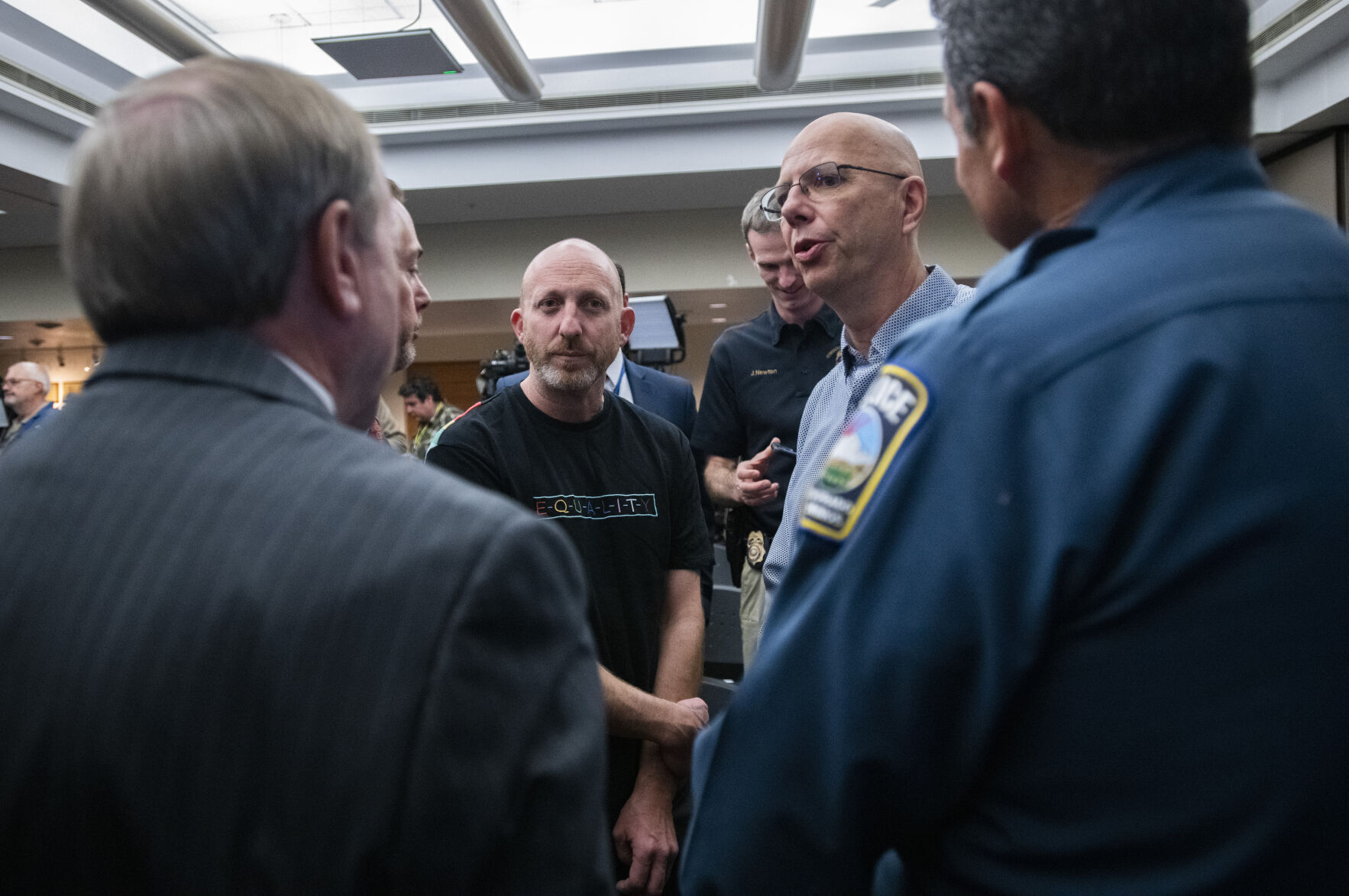
Could Colorado’s red flag law be in for some tweaks in the wake of the Club Q shooting Saturday?
Gov. Jared Polis opened the door to potential changes to the state’s three-year old Extreme Risk Protection Order law, saying more could be done to utilize it.
“Extreme Risk Protection Orders can save lives when utilized and we need to do more to ensure that these orders are used when needed to prevent self-harm and violent acts against others,” the governor said via a spokesperson. “Coloradans know Gov. Polis will work with anyone who shares his goal of keeping people safe. The Extreme Risk Protection Law he signed into law can and does save lives and the Governor believes there is more to be done to improve utilization of this live-saving tool by law enforcement to prevent gun violence.”
So what could those changes look like?
Colorado could borrow from other states, more specifically on who can pursue a red flag order from the courts.
Some also argued for more training in how the law is used.
Nineteen states and Washington, D.C., including some red states, such as Indiana and Florida, have some form of a red flag law on their books.
What defines those laws include who can petition for a protection order.
In Colorado, it’s limited to law enforcement and family or household members, including former partners. In some states, only law enforcement can seek the order. In others, however, the list is much longer, including medical professionals in Hawaii, Connecticut and New York; mental health professionals in Maryland; employers in California, and district attorneys in Virginia and New York.
Massachusetts allows gun licensing professionals to apply for the protection orders. Vermont allows its state’s attorney general to seek ERPOs.
New York recently tweaked its 2019 law to allow health care professionals to join law enforcement, family members and schools in the ability to seek a red flag order.
Sen.-elect Tom Sullivan of Centennial, one of the prime sponsors of the 2019 law, told Colorado Politics Monday that what legislators will want to know about the shooting in Colorado Springs is what law enforcement knew about the alleged shooter beforehand, why no actions were taken – assuming none was – and how lawmakers can do a better job of making sure people know what actions they could take to prevent the kind of carnage that took place Saturday.
Sullivan, along with Rep. Meg Froelich of Greenwood Village, is heading up a new gun violence prevention caucus that has already drawn 22 current and incoming members of the General Assembly. So far, all the members are Democrats but Froelich is hoping Republicans will be interested.
John Feinblatt, president of Everytown for Gun Safety, a group that advocates for stricter gun control, said Colorado’s red flag law is a strong law.
“But it’s only half the equation,” Feinblatt told Colorado Politics on Tuesday. “The other half is implementation and that’s where Colorado is falling down.”
He added that gap is magnified by sheriffs and other law enforcement personnel who are resistant to the red flag law, as is the case in El Paso County, he said.
What Colorado could do to tweak its law is to give the attorney general or state patrol jurisdiction to receive complaints, either from law enforcement or family members, and then take the information to the court for a petition.
“You’re not solely relying on law enforcement,” he said. “When we see pockets of resistance, give statewide authority in addition to local authority.”
It also takes more training, and, in states that have done that, it’s made all the difference, he said.
Stateline reported in June that even states with red flag laws aren’t using them to their full potential. Gaps include training for police officers or “a legal system that might not have the infrastructure to guide officers and judicial officials through the process.”
Take Florida, for example, Feinblatt said. In 2021, that state saw 2,586 uses of the red flag law; in Colorado, in that same year, just 147. Feinblatt said Florida doesn’t see this as a political or 2nd Amendment issue, but as a tool to keep people who are dangers to themselves and others safe.
The mass shooting in Buffalo, New York in May offers a parallel case to Colorado. New York, like Colorado, also sees differences in red flag usage on a county by county basis. Some blamed Erie County for the shooting, arguing it failed to avail itself of the red flag law. The case led to changes to New York’s law. Today, district attorneys and law enforcement agencies are required to file ERPO petitions when they receive credible information that someone is likely to harm themselves or others.
Feinblatt pointed out that other counties, such as Suffolk County, have invested significantly in training on red flag laws.
“These laws are more complicated than most. If they are triggered by family members or school officials, that requires more training,” he said, adding that also necessitates an institutional way of providing that training.
In El Paso county, the red flag orders have all been filed by family members, with few if any from law enforcement.
“You have to emphasize law enforcement training,” Feinblatt said, adding that, under these scenarios, the message for family members requires a more nuance.
“When you ask a family member to call the police, you want them to think they’re doing something positive and keeping someone safe,” he said. “We know how to do this already: if you see something, say something.”


10th Circuit dismisses Tina Peters’ challenge to confinement as moot
Michael Karlik
michael.karlik@coloradopolitics.com
Updated 14 hours ago
The Denver-based federal appeals court granted the state’s unopposed request on Wednesday to dismiss former Mesa County clerk Tina Peters’ challenge to her confinement as moot. Although Peters received a commutation of her prison sentence last month from Gov. Jared...
Federal judge declines to recuse from death penalty case after Supermax visit
Michael Karlik
michael.karlik@coloradopolitics.com
Updated 14 hours ago
A federal judge declined to recuse herself last month from a death penalty case arising out of Colorado’s “Supermax” prison, finding that her tour of the facility earlier this year did not bias her decision-making. U.S. District Court Judge Charlotte...

Colorado legislators, candidates differ over social media regulations for minors
Bethany Johnson
bethany.johnson@denvergazette.com
Updated 13 hours ago
Following the 2020 accidental overdose of her daughter, Colorado’s Patti Lujan is still pursuing a lawsuit against Snapchat, the social media platform she claims connected her daughter with a drug dealer, police said. Lujan, like many parents, is looking for...

Colorado state Senate: Meet the primary election candidates
Marianne Goodland
marianne.goodland@coloradopolitics.com
Updated 12 hours ago
Colorado’s June 30 primary features a slate of state Senate contests, with several incumbents stepping aside and competitive fields emerging in both parties. These are some of the races to watch as voters begin to submit ballots. Senate District 3:...

Top five hot mic moments from world leaders at G7 Summit
David Zimmermann Washington Examiner
davidzimmermannwashingtonexaminer@wpstage.coloradopolitics.com
Updated 16 hours ago
As the 52nd annual G7 Summit came to a close on Wednesday in France, world leaders not only discussed diplomacy front and center, but also engaged in lighter conversations on the sidelines. There were many hot-mic moments in which President Donald...
Appeals court clarifies offense of impersonating a peace officer
Michael Karlik
michael.karlik@coloradopolitics.com
Updated 19 hours ago
Colorado’s second-highest court clarified this month that a person commits the offense of impersonating a peace officer if they engage in “any conduct” while pretending to be law enforcement. In a case out of El Paso County, Richard James Coulier...

Hickenlooper raises $900K since April, heads into primary with almost $3 million on hand
Ernest Luning
ernest.luning@coloradopolitics.com
Updated 14 hours ago
U.S. Sen. John Hickenlooper raised just over $900,000 for his reelection bid in the 10-week pre-primary reporting period, the Colorado Democrat’s campaign said Wednesday. The campaign finished the period with almost $3 million in the bank, with more than 80%...
Four takeaways from Georgia, DC, Alabama, and Oklahoma primary elections
Rena Rowe, Washington Examiner
rena.rowe.washington.examiner@gazetteedit.wpenginepowered.com
Updated 18 hours ago
Voters across the country delivered a mixed verdict in a series of high-profile primary contests Tuesday, elevating political outsiders, boosting progressive candidates in deep-blue jurisdictions, and offering fresh clues about President Donald Trump’s hold on the GOP ahead of the...

Trump and Obama lock horns as White House tries to sell new Iran deal
NAOMI LIM Washington Examiner
naomi-lim-washington-examiner@coloradopolitics.com
Updated 18 hours ago
Former President Barack Obama‘s reemergence is looming over President Donald Trump‘s peace deal with Iran as the incumbent tries to sell his deal to an increasingly skeptical public after the nearly four-month war. Obama’s return to the headlines as he...

Littleton approves $1M for Starlight affordable housing project
Nicholas Fogleman
nicholas.fogleman@denvergazette.com
Updated 21 hours ago
The Littleton City Council on Tuesday approved a $1 million funding request to support construction of a new affordable housing development known as the Starlight Apartments. The council authorized the contribution from the city’s Affordable Housing Fund for the project,...
PREV
PREVIOUS

People gather in Colorado and across U.S. to mourn Club Q shooting victims
The mass shooting at a Colorado Springs nightclub that left five people dead, and 18 injured, seems to have impacted people far beyond the city – or even state – borders. People throughout the United States, and from around the world, joined or will join together to remember the lives of the people who died […]

Brother and sister recovering from Club Q attack
As he lay bleeding from a gunshot wound in a state of fear and confusion at a Colorado Springs nightclub, James Slaugh treasures the moment a gray-haired stranger with glasses told him he was going to live and kissed him on the forehead. “To me, that made all of the difference. That was when I […]