

Colorado RSV cases rise sharply, increasing hospitalizations for children
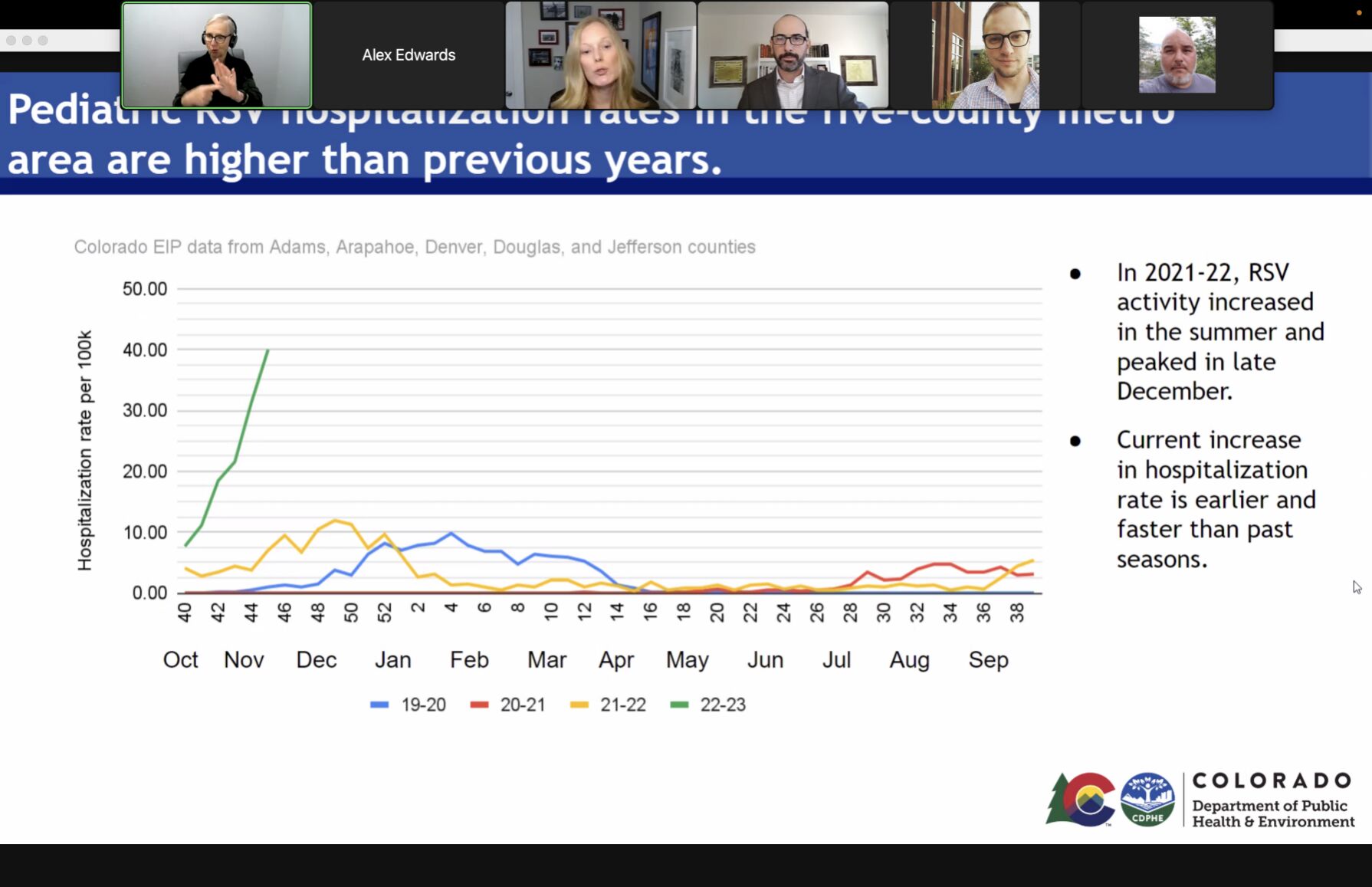
Colorado Department of Public Health and Environment officials said Monday cases of Respiratory syncytial virus (RSV) have risen sharply, especially among children.
The increased number of cases has taken its toll on the state’s healthcare system, and state Epidemiologist Rachel Herlihy said during a Monday press conference there are a limited number of pediatric intensive care unit (ICU) beds available.
Within the five county Denver Metro Area, department officials have recorded 895 hospitalizations related to RSV. The overwhelming majority of those, 836, have been children. Statewide, there have been 255 RSV outbreaks at schools or childcare facilities, according to state records.
This has put a strain on pediatric ICU resources, leaving only two beds available statewide, officials said Monday. For adults, the picture is better with 170 beds available.
Scott Bookman, director of CDPHE’s Division of Disease Control and Public Health Response, said Colorado’s hospital system officials are working to add more capacity.
“We are seeing hospitals that primarily serve adult patients offering up their support to our pediatric centers in the state and we are seeing a lot of coordination and movement of patients,” he said. “But there is extreme stress in the pediatric ICU capacity in the state of Colorado right now.”
The rise in RSV cases coincides with an upward trend of both COVID and influenza (flu) cases. But those diseases are largely preventable, and Coloradans have helped do their part in prevention of the flu, Bookman said. As of Monday, CDPHE reported over 1.5 million Coloradans have been vaccinated against the flu, more than last year at the same time.
“I thank all Coloradans who have already rolled up their sleeves and gotten this incredibly important flu dose,” he said. “I would encourage anybody who hasn’t gotten it yet, that today is a great day to go get your influenza vaccine.”
It’s also a great day to get a COVID-19 booster, he said, noting it’s the best defense against the omicron variant. Even then, there is still a chance of getting COVID-19, but breakthrough cases are nothing new and it’s still worth getting the vaccine, Herlihy said.
“The most important thing that the vaccines are doing for us right now, including the new omicron dose of vaccine, is providing protection against severe disease,” she said. “We know that (breakthrough cases are) a risk and a possibility following vaccination.”
Despite promising research and development in RSV vaccines, Herlihy told the Denver Gazette those would likely not be ready until next RSV season.
It is too early for officials to pin down exactly what’s causing the spike in RSV cases, Herlihy said.
“We know that influenza was transmitted late in the season last year… and we saw RSV rates really start to increase here in the late summer and early fall,” she said. “There’s really lots of disruption the pandemic caused, and I think we’re really still trying to fully understand all of the underlying factors that go along with that.”
The most effective methods of prevention have largely remained the same for the past two-and-a half-years, and some of the same prevention methods apply for RSV, the flu and COVID-19. Bookman stressed the importance of being smart with your health, and respectful of others’ health, especially during a major holiday week.
“We need to stay home if we’re sick,” Bookman said. “What can feel like a mild cold for one person can be a very serious illness for someone who is at higher risk, particularly infants or older adults.”


Colorado to get $615M from Meta child safety settlement
Thelma Grimes
thelma.grimes@coloradopolitics.com
Updated 11 hours ago
The parent company of Facebook and Instagram will pay hundreds of millions of dollars to Colorado, part of an $18 billion multistate deal, in which the company also agreed to adopt extensive child-safety changes to its operations. The settlement ended...

Colorado’s chief federal judge orders return of wrongfully deported man, second judge to explore ‘series’ of violations
Michael Karlik
michael.karlik@coloradopolitics.com
Updated 13 hours ago
Colorado’s chief federal judge took the extraordinary step of directing the government on Tuesday to do everything it can to return a man it deported in violation of his order. At the same time, Colorado’s chief magistrate judge has set...

Counties warn CPW that new comment limits sideline local governments
Marianne Goodland
marianne.goodland@coloradopolitics.com
Updated 11 hours ago
The September meeting of the Colorado Parks and Wildlife Commission will feature newly revised public‑comment rules — changes introduced by chair Jay Tutchton of Bent County, who announced them without first discussing the revisions publicly with the rest of the...

Controversial two-bag furbearer limit heads to CPW meeting under legal threat
Marianne Goodland
marianne.goodland@coloradopolitics.com
Updated 11 hours ago
Next week’s Colorado Parks and Wildlife Commission meeting in La Junta is likely to open under the cloud of threatened legal action. Safari Club International and the Sportsmen’s Alliance Foundation warned the commission this month that its July vote imposing...

Golden to pay $155,000 to fired city manager
Matt Kyle
matt.kyle@denvergazette.com
Updated 13 hours ago
The Golden City Council on Tuesday approved a roughly $155,000 severance payout to former city manager Scott Vargo, who was fired earlier this month following a “racist incident” at a city fire station. The payout is part of a separation...

Trump says the US doesn’t need Canada. America’s economy says otherwise.
The Associated Press
the-associated-press@coloradopolitics.com
Updated 14 hours ago
TORONTO (AP) — U.S. President Donald Trump says his country does not need Canada. But every day, roughly 4 million barrels of Canadian crude oil flow south, helping fuel American cars, trucks and airplanes and supply U.S. industry. And oil...

USPS ballot rule faces lawsuit from Colorado, other states
Thelma Grimes
thelma.grimes@coloradopolitics.com
Updated 12 hours ago
Colorado, along with 25 other states, filed a lawsuit against the U.S. Postal Service to challenge a new rule that seeks to restrict the mailing of ballots to American citizens in an eligible voters list. Colorado relies heavily on the...

FDA approves landmark pancreatic cancer drug that’s shown to improve survival
The Associated Press
the-associated-press@coloradopolitics.com
Updated 14 hours ago
WASHINGTON (AP) — The Food and Drug Administration on Wednesday approved a groundbreaking new drug for advanced pancreatic cancer, offering U.S. patients a more effective treatment against one of the deadliest types of cancer. FDA officials gave expedited approval to...
Trump defends pause on beef tariffs: Prices are ‘coming down very rapidly’
Naomi Lim
naomi-lim@coloradopolitics.com
Updated 17 hours ago
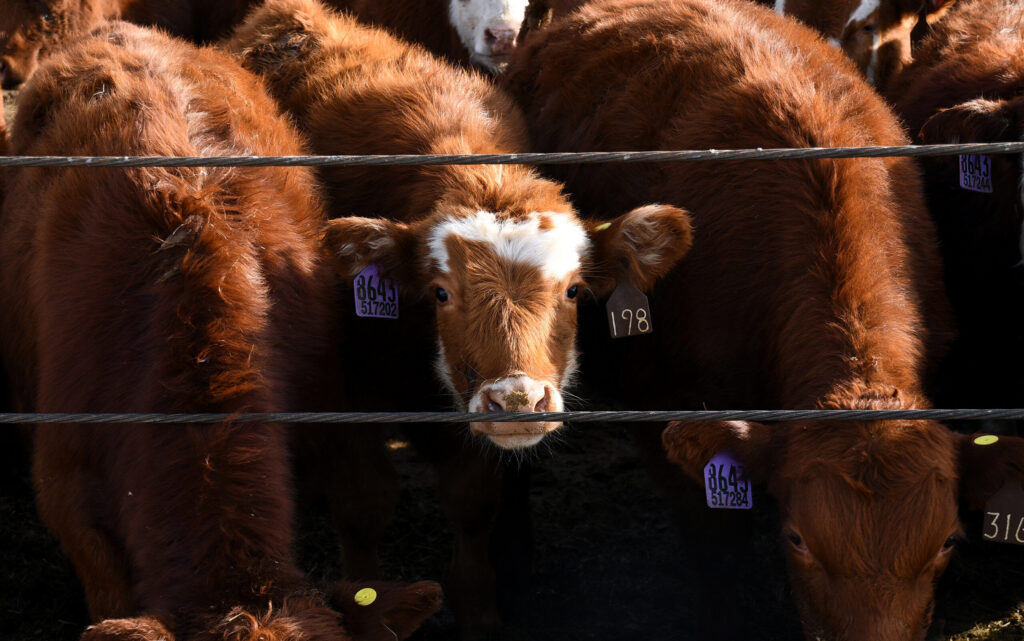
President Donald Trump defended his decision to pause tariffs on some beef imports, even as Republicans criticize the decision. “Prices are coming down very rapidly, and now beef is starting to come down,” Trump told The Glenn Beck Program on...
Denver murder, assault convictions reversed due to faulty jury instructions
Michael Karlik
michael.karlik@coloradopolitics.com
Updated 12 hours ago
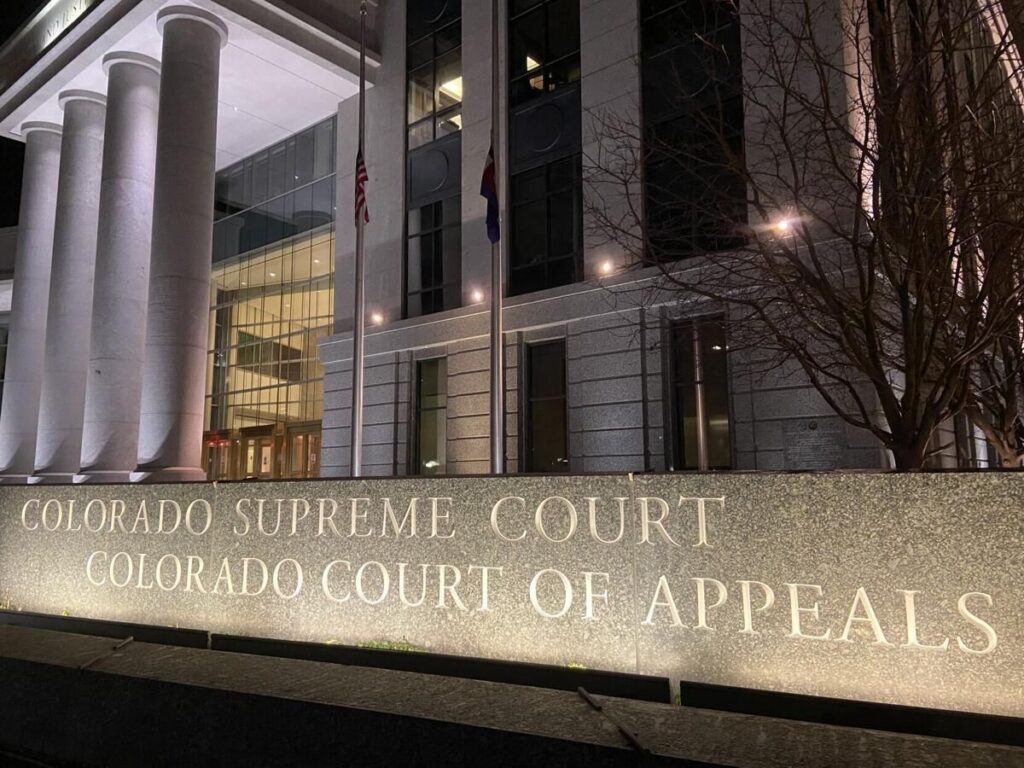
Colorado’s second-highest court reversed a defendant’s convictions for murder and assault last week after concluding a Denver judge incorrectly omitted key jury instructions that could have affected the verdict and sentencing. Stephen C. Swainson fatally stabbed Israel Casillas in downtown...
PREV
PREVIOUS
Gov. Polis orders flags flown half-staff after Colorado Springs Club Q shooting
Colorado Gov. Jared Polis ordered flags to be lowered at half-staff on all public buildings statewide from sunrise Monday morning until sunset on Nov. 26 to honor and remember victims. Polis said his administration will also be flying the Pride flag at the state Capitol for the next five days. Polis, who is gay, called […]

Did Colorado law automatically seal 2021 suspect's criminal record?
New footage obtained by The Gazette shows events during a 2021 bomb threat that lead to the arrest of 22-year-old Anderson Lee Aldrich, whose name and age match that of the suspect arrested in Saturday’s Club Q shooting. In this screen recording provided by the owner of the house where Aldrich’s mother lived at the […]