

Judge rebuffs GOP candidate’s request to be exempt from spending limits

A federal judge on Wednesday rejected a Republican candidate’s request to spend freely in the final days of the election, after he had inadvertently signed up for voluntary spending limits when he registered his candidacy.
U.S. District Court Judge Nina Y. Wang refused to grant a preliminary injunction to Paul Archer of Centennial, who is running to represent House District 37 in the General Assembly. Although Archer registered to run in February and realized in June that he had opted in to a campaign financing mechanism that requires him to limit his overall spending, Archer only sought a judge’s order to block the spending limits two days after county clerks began mailing ballots.
Wang faulted Archer and his campaign committee for the unreasonable delay.
“The evidence demonstrates that as early as February 22, 2022, Plaintiffs could have confirmed Mr. Archer’s VSL (voluntary spending limit) designation by downloading the candidate affidavit or checking the TRACER system,” she wrote, referring to the state’s online campaign finance system. “The record as it currently stands before the Court reflects no attempt by Mr. Archer or the Archer Campaign Committee to confirm his VSL status.”
Neither Archer’s attorneys nor the secretary of state’s office immediately responded to a request for comment.
Although the lawsuit implicated Colorado’s longstanding system of funding campaigns, the particular circumstances of Archer’s candidacy were unusual.
Under the Colorado constitution, state House candidates can raise $200 per donor for the primary and general elections – or $400 total. There is no limit on what they can spend. Alternatively, they may opt to voluntarily limit their spending in exchange for being able to raise twice that amount per person. This year, the voluntary spending limit is $88,225.
Archer maintained he never opted himself in to the spending limits when he registered his candidacy in February. However, Archer’s candidate affidavit, generated after his registration, contained the statement: “I also acknowledge that I am accepting Voluntary Campaign Spending Limits.” His candidate page on TRACER also advertised he was voluntarily limiting his campaign spending.
It was not until a video call on June 29 with an employee in the Colorado Secretary of State’s Office that Archer realized the limitation was in place for him. Under the constitution, the decision to accept voluntary spending limits is largely irrevocable, and the secretary of state’s office informed Archer in mid-August he needed to abide by his choice.
On Sept. 7, Archer filed a lawsuit alleging Secretary of State Jena Griswold could not apply the spending limits to him because he had not knowingly and voluntarily opted in to the system. He also claimed the use of an online affidavit form violated the Colorado constitution.
However, it took Archer an additional six weeks to file a request for a preliminary injunction, when ballots were already arriving at voters’ mailboxes. Curiously, the secretary of state’s office also received a registration from a fictitious candidate who purportedly entered the race, which is the one circumstance that would have enabled Archer to withdraw his acceptance of spending limits. Archer disavowed creating the phantom candidate himself.
Last week, Wang held a seven-hour hearing about whether to block the secretary of state from enforcing the spending limits against Archer alone. She heard testimony that roughly 30% of candidates check the voluntary spending limits box each election cycle, and that government officials had never before heard of TRACER unilaterally opting a candidate in without their knowledge, which Archer suggested had taken place.
“Candidly that explanation lacks credibility, your honor,” said Assistant Solicitor General Grant T. Sullivan. “It’s common sense that online forms, even rudimentary online forms, do not automatically click unchecked boxes and they do not transmit information unless the user clicks submit.”
Archer’s attorney countered that Archer had consistently acted since February as if he were not subject to voluntary spending limits, and the secretary of state’s office itself had delayed informing Archer that he could not revoke his inadvertent decision to opt in.
“I would submit that candidates outside of the race for House District 37 probably couldn’t care less and are not affected by this court’s decision to lift the voluntary spending limits for Mr. Archer because they are in different races,” said Scott Gessler, a Republican former secretary of state.
Wang, however, disagreed. She rooted her decision in a pair of legal doctrines, one that frowns upon a plaintiff’s “lack of diligence” and the other that cautions against court-ordered changes to election procedures too close to the voting period. The latter, known as the “Purcell principle,” is intended to guard against voter confusion.
Wang determined that allowing Archer to revoke his acceptance of voluntary spending limits eight months after the public could first see he opted in to them through his candidate registration would result in such confusion.
“To ask the Secretary to revisit the candidate affidavit process or adjust information provided to voters after ballots have issued and voting has begun is an extraordinary remedy not justified by the evidence tendered by Plaintiffs,” she wrote.
The judge added that an order to exempt Archer from spending limits could lead to lawsuits from other candidates who also wish to change their status.
As of Nov. 2, the secretary of state’s office reported 862,637 voters have returned their ballots. Archer is running against Democrat Ruby Dickson to represent a competitive district in Arapahoe County. Dickson has not accepted the voluntary spending limits.
The case is Archer et al. v. Griswold.



A new day? Colorado’s troubled guardianship office pursues ‘cultural reset’
Marianne Goodland
marianne.goodland@coloradopolitics.com
Updated 3 days ago
Colorado’s guardianship program, long criticized for mismanagement and high staff attrition, is undergoing a “cultural reset,” as its new director works to repair partnerships and prepare for a major expansion under recent legislation. Created by lawmakers in 2017, the Office...
Local party leaders, incoming judge among members of judicial performance commission that violated law
Michael Karlik
michael.karlik@coloradopolitics.com
Updated 1 day ago
A local Democratic leader and 2024 presidential elector. A legislative aide and leader in the Young Republicans. An incoming county court judge freshly appointed by the governor. They are among the eight members of the northeastern Colorado judicial performance commission...
Judge dismisses lawsuit seeking records from Colorado Democratic group
Marianne Goodland
marianne.goodland@coloradopolitics.com
Updated 2 days ago
A lawsuit seeking to obtain records from Democratic lawmakers affiliated with a caucus has been thrown out by a Denver District Court judge. On July 17, Judge Ericka Englert dismissed the April lawsuit filed by progressive activist Derrick Blanton, who...
Colorado Springs mother Deborah Nicholls’ murder conviction overturned
Nick Smith
nick-smith@coloradopolitics.com
Updated 3 days ago
A Colorado Springs mother convicted in 2008 of murdering her three children in a house fire might get a new trial after a judge ruled that prosecutors withheld key evidence that could have impacted the jury’s verdict. Deborah Nicholls, whose...
Colorado court overturns illegal $7,000 restitution order
Michael Karlik
michael.karlik@coloradopolitics.com
Updated 2 days ago
Colorado’s second-highest court overturned a Weld County defendant’s obligation to pay more than $7,000 in crime victim restitution on Thursday because a trial judge failed to issue a legally compliant restitution order at the time of sentencing. In Colorado, as...
Appeals court rejects former DougCo commissioner’s legal fee claim
Nicholas Fogleman
nicholas.fogleman@denvergazette.com
Updated 2 days ago
The Colorado Court of Appeals rejected a former Douglas County commissioner’s bid for reimbursement of attorney fees she incurred while responding to multiple investigations into her conduct. The dispute stemmed from a 2019 anonymous letter sent to county officials alleging...
Appeals court orders second look at Denver Water’s immunity for cyclist’s injury
Michael Karlik
michael.karlik@coloradopolitics.com
Updated 3 days ago
Colorado’s second-highest court ordered another look at a bicyclist’s negligence lawsuit against Denver Water on Thursday, concluding that a trial judge needed to evaluate the utility’s potential immunity using the state Supreme Court’s new guidance. Joseph A. “Joey” Scott alleged...
Labels, duration not definitive proof of ‘intimate relationship,’ Colorado court rules in domestic violence case
Michael Karlik
michael.karlik@coloradopolitics.com
Updated 2 days ago
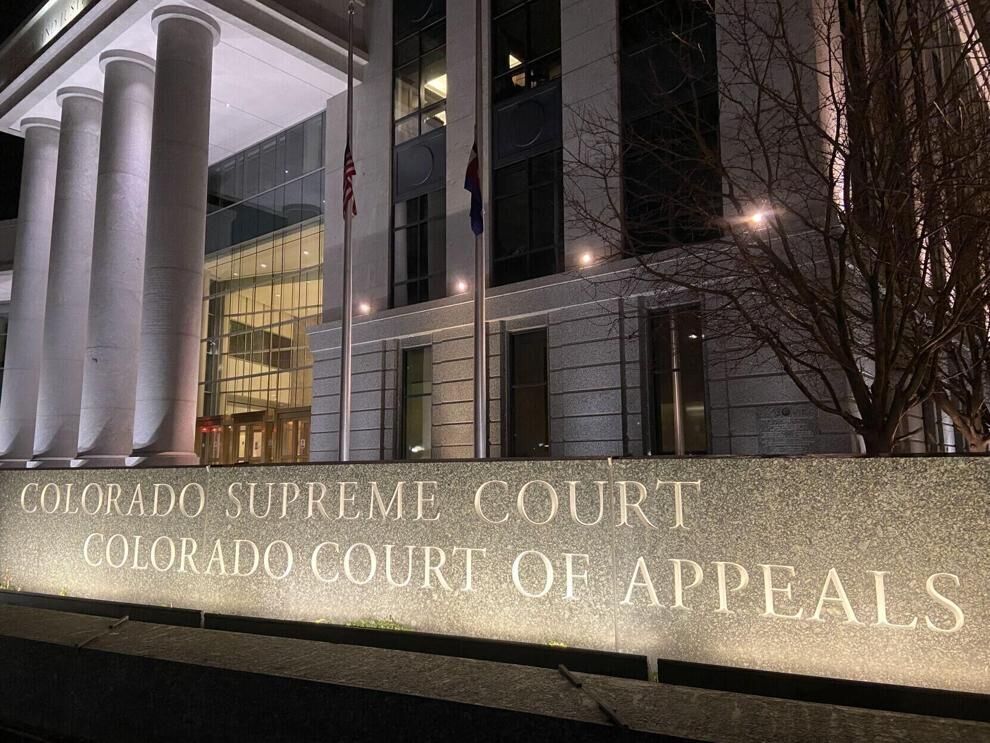
Colorado’s second-highest court clarified on Thursday that the length of a couple’s relationship and the labels they attach to it are not conclusive evidence of whether it is an “intimate relationship” that can give rise to a domestic violence prosecution....

Colorado AG urges Supreme Court to let Boulder climate lawsuit proceed
Marissa Ventrelli
marissa.ventrelli@coloradopolitics.com
Updated 3 days ago
Colorado Attorney General Phil Weiser has filed a court brief with the U.S. Supreme Court in a lawsuit brought by Boulder city officials seeking to hold oil companies liable for their environmental impact. The case began in 2018, when the...
10th Circuit says landowner cannot sue ex-Routt County judge for statements in decision
Michael Karlik
michael.karlik@coloradopolitics.com
Updated 4 days ago
A Routt County landowner cannot sue a former judge for his allegedly inaccurate statements in a case where the landowner was not a party, the Denver-based federal appeals court decided on Wednesday. Anne Fitzsimmons, who lives in Germany, owns a...
PREV
PREVIOUS
Services for Hugh McKean, Colorado House Minority Leader, scheduled
Funeral services for Colorado House Minority Leader Hugh Monroe McKean will be at 11 a.m. Saturday, Nov. 12 at Resurrection Fellowship Church, 6502 E. Crossroads Blvd., Loveland. The public is invited to attend. McKean’s remains will lie in state in the Colorado Capitol Rotunda on Thursday, Nov. 10. That service will include a military honor guard, and […]

ELECTION 2022 | CU poll shows top Democratic incumbents leading among likely Colorado voters
Top-ticket Democratic incumbents hold double-digit leads over their Republican challengers among likely Colorado voters, a new poll from the University of Colorado Boulder’s nonpartisan American Politics Research Lab shows. The annual Colorado Political Climate Survey also found strong support among likely voters for ballot measures to fund free meals for public school students and to […]