

Municipalities, state agencies warn Supreme Court against opening floodgates to lawsuits

Nearly all of the state’s municipalities and a handful of state agencies are pleading with the Colorado Supreme Court to reverse a lower court’s ruling that eliminated the strict 28-day deadline for challenging decisions of government bodies.
Liquor license denials, local governments’ discipline of personnel, and the Department of Corrections’ decisions about inmates are some of the many types of proceedings that could be subject to a court challenge months, or even years, after the fact if the Court of Appeals’ interpretation of a key procedural rule is allowed to stand, according to briefs submitted to the Supreme Court.
“This would dramatically increase municipal costs and workload, clog courts with cases, and disrupt the plans of parties to municipal proceedings around the state. The case at issue, therefore, will significantly impact the day-to-day activities of municipalities statewide,” argued the Colorado Municipal League, which represents 270 of the state’s 272 cities and towns.
Last week, the justices heard oral arguments in a case that began as a dispute out of Aurora over a storm drain development fee. But after an Arapahoe County judge tossed the lawsuit as untimely, the state’s appellate court concluded a series of judicial rules provided an exception to the 28-day filing deadline as long as the plaintiff could show a delay was due to “excusable neglect.”
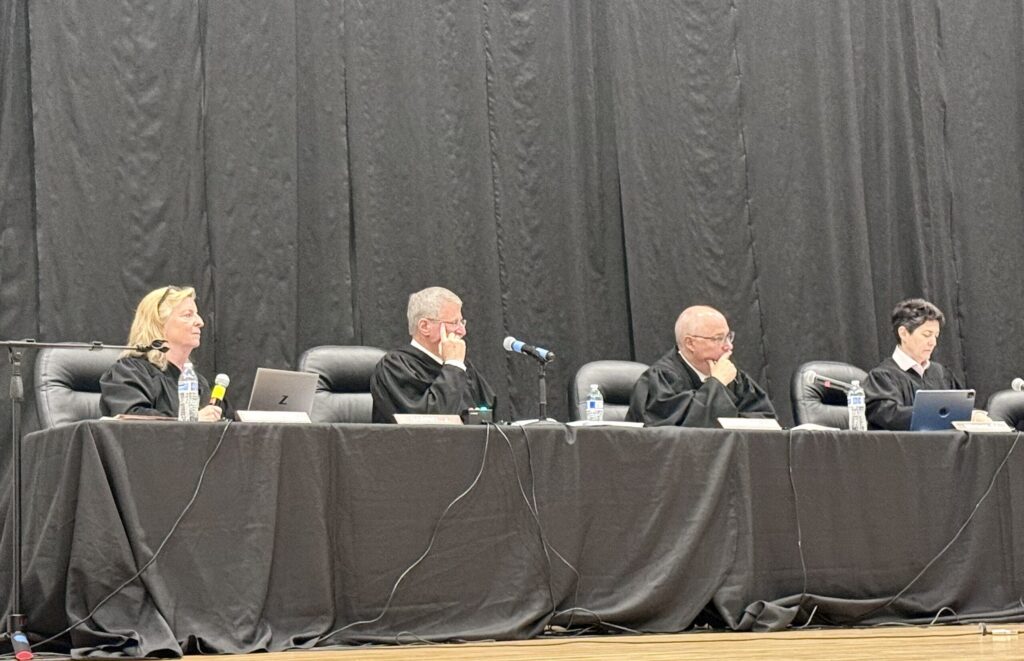
Members of the Supreme Court were sympathetic to the Court of Appeals’ interpretation, as well as the competing argument in favor of no exceptions.
“This has been a bedrock rule that everybody knows and abides by. I will say the Court of Appeals’ decision here creates a bit of a sea change in the expectations,” said Justice Monica M. Márquez. “It’s really about the volume of quasi-judicial decisions that occur every day at multiple levels of government.”
“Can you understand my discomfort, though, with having an absolute rule that no matter what, it’s 28 days no exceptions?” countered Justice Carlos A. Samour Jr.
He added: “There are exceptions to just about everything in life.”
The underlying case began in April 2019, when Aurora sent an invoice to developer Walker Commercial, Inc. for an unpaid fee on property the company purchased several years prior. The company protested, and Marshall P. Brown, the general manager of Aurora Water, scheduled a hearing for July of that year. Brown emailed the company’s lawyer the following month saying the city would accept $74,140 for the fee, in what was apparently the city’s final decision.
Walker Commercial then filed a complaint in court 30 days after Brown’s decision. Aurora’s city code provided that final agency decisions become effective 30 days after notice “is mailed to or personally served upon” the party challenging the government, unless court proceedings have begun.
Between December 2019 and January 2020, District Court Judge Elizabeth A. Weishaupl issued a series of orders dismissing Walker Commercial’s case. The company had raised multiple claims, arguing Brown had not complied with city code because he failed to mail or personally serve the company with his final decision, and also that Brown’s decision was not effective because Walker Commercial had challenged it within 30 days.
Weishaupl determined the 28-day deadline contained in the Colorado Rules of Civil Procedure prevented her from hearing the case filed two days beyond that window.
In April 2021, a three-judge panel for the Court of Appeals agreed the 28-day deadline, rather than the 30 days in Aurora’s code, applied to Walker Commercial’s lawsuit. However, the panel opened the door to the filing of untimely lawsuits by recognizing trial judges could review late-filed challenges after all by finding excusable neglect and other factors were at play.
Excusable neglect can include deaths in the family, destruction of files and other situations that would cause a reasonable person to fail to abide by a deadline. As it did in the Supreme Court, the Colorado Municipal League also raised concerns with the Court of Appeals about bypassing the 28-day window, but the appellate panel was unmoved.
“We understand the importance of firm deadlines and the need for finality so that municipalities may operate effectively. We are not, however, empowered to rewrite the rules to achieve a particular policy outcome,” wrote Judge Jaclyn Casey Brown.
Richard F. Rodriguez, the attorney for Marshall Brown, argued the Supreme Court has previously stood by a strict view of the deadline. He said there has been “no outcry” seeking to overturn the deadline, and it was realistic to give a party 28 days to simply identify to a court that a government official’s action was arbitrary or capricious.
“What type of things would be held up” if there were an exception to the deadline, asked Chief Justice Brian D. Boatright.
Rodriguez provided a hypothetical example of Amazon wanting to purchase and rezone land to construct a distribution center. The process would entail notice to nearby property owners and public hearings.
“The government just puts 28 days on its calendar and it knows if that 28 days is missed, now its approval stands and Amazon can go forward and build its project that’s gonna provide thousands of jobs and billions of dollars of revenue for the government,” he said.
Upholding the Court of Appeals’ decision would upend that certainty and enable trial court judges to evaluate whether dissatisfied parties had a good reason for filing their challenge outside of the window, Rodriguez added.
Jared M. Haynie, the lawyer for Walker Commercial, argued against forbidding late-filed challenges in all circumstances, even if there is a sudden illness or if municipalities resort to gamesmanship in their codes.
“What’s to stop every city in the state from adopting a thing that says you’ve got 30 days?” he asked. “Well, guess what? You get to court and find out you’ve got 28.”
The Colorado Attorney General’s Office also weighed in on behalf of Brown, representing the concerns of the state departments of corrections, education, regulatory agencies, revenue and higher education. In 2019, the brief reported, there were 98 challenges to the Department of Correction’ penal decisions, many of which were untimely.
However, there were a total of 16,639 penal decisions that could have been challenged, especially if the hard 28-day deadline were removed.
If the Court of Appeals’ decision stands, participating in court challenges would be “a new, expensive, and time-consuming endeavor for the (agencies) and the judicial branch for which the (agencies) have not budgeted,” wrote the attorney general’s office.
While recognizing the widespread impacts inside and outside of government, the justices were also wary of how short the 28-day deadline is, considering statutes of limitations for filing other types of civil claims are typically a matter of years.
Walker Commercial “was relying on the law. Just the wrong law,” observed Justice Melissa Hart. “Can we admit that no exceptions — that sounds very harsh.”
The case is Brown v. Walker Commercial, Inc.

Federal judge directs plaintiff to revise complaint alleging Denver officers’ constitutional violations
Michael Karlik
michael.karlik@coloradopolitics.com
Updated 41 seconds ago
A federal judge directed a defendant to revise his allegations on Wednesday to more precisely state what two Denver officers and the city itself allegedly did to violate his constitutional rights by facilitating his prosecution for murder until prosecutors dropped...
Federal judge explores new sanctions against ex-Colorado judicial discipline director
Michael Karlik
michael.karlik@coloradopolitics.com
Updated 1 hour ago
A federal judge on Wednesday directed Colorado’s former judicial discipline director, for the third time this year, to explain why she should not sanction him for his latest conduct in his litigation against the state’s judiciary. Christopher S.P. Gregory, who served...
Colorado joins lawsuit challenging changes to Endangered Species Act
Marissa Ventrelli
marissa.ventrelli@coloradopolitics.com
Updated 25 minutes ago
Colorado once more joined a coalition of states challenging the Trump administration — this time on proposed rules regarding the Endangered Species Act. The pair of lawsuits challenge new rules made under Interior Secretary Doug Burgum, who earlier said the...
10th Circuit orders second look at immunity for Kiowa County deputy over fatal vehicle crash
Michael Karlik
michael.karlik@coloradopolitics.com
Updated 42 minutes ago
The Denver-based federal appeals court directed a trial judge on Tuesday to further analyze whether a Kiowa County deputy and the sheriff’s office may be sued for a fatal vehicle collision. The Colorado Governmental Immunity Act generally shields government entities and public...
Colorado justices to hear appeal in Kendrick Castillo death lawsuit, ‘fugitive’ rule
Michael Karlik
michael.karlik@coloradopolitics.com
Updated 23 hours ago
The Colorado Supreme Court announced on Tuesday that it will decide whether it was proper to dismiss a lawsuit over the 2019 shooting death of Kendrick Castillo after the defendants paid the maximum amount of damages available to Castillo’s parents,...

Federal judge dismisses Douglas County’s challenge to collective bargaining law
Nicholas Fogleman
nicholas.fogleman@denvergazette.com
Updated 8 hours ago
A federal judge dismissed claims brought by the Douglas County Board of Commissioners alleging that a state law granting county employees the right to organize and join labor unions violates free speech protections and conflicts with federal labor law. Douglas...

Arapahoe County judge’s frustration with defense lawyer not grounds for new trial
Michael Karlik
michael.karlik@coloradopolitics.com
Updated 1 day ago
Colorado’s second-highest court decided last week that an Arapahoe County judge’s repeated rebukes of a defense attorney and orders to “be quiet” did not rise to the level of bias or a violation of the defendant’s due process rights. A...

Divided appeals court upholds vehicle theft conviction despite unclear origin of car’s value
Michael Karlik
michael.karlik@coloradopolitics.com
Updated 21 hours ago
Colorado’s second-highest court upheld a defendant’s conviction for aggravated motor vehicle theft last week, even though it was unclear how the Thornton Police Department estimated the value of the stolen car. Officer Marc Faivre encountered Ashley Shelee Gibbens-Martinez in a...
Disgraced ex-CBI analyst Missy Woods sentenced to prison in DNA scandal
Jenny Deam
jenny.deam@gazette.com
Updated 1 day ago
A Jefferson County district court judge on Tuesday sentenced a disgraced former Colorado Bureau of Investigation DNA analyst to a decade in prison for altering and deleting data in scores of criminal cases over several years. Jefferson County District Judge...

Parenting from prison: Inmates hope to be present in their children’s lives, while physically absent
Marianne Goodland
marianne.goodland@coloradopolitics.com
Updated 1 day ago
The room was decorated with balloons, the tables sparking bright with colors as the smell of pizza and cake wafted through the air. As did music. This was, after all, a father-daughter dance. Except this was not a typical father-daughter...
PREV
PREVIOUS

Several Air Force cadets listed as plaintiffs in lawsuit against Defense Department COVID-19 vaccine mandate
Several Air Force Academy cadets are named as plaintiffs in a lawsuit filed Wednesday in South Carolina that seeks a temporary restraining order and preliminary injunction against the Department of Defense’s COVID-19 vaccine mandate. The cadets face potential disenrollment, and some may be required to repay the cost of their education, the suit alleges. That […]

Court of Appeals formally welcomes 3 new judges appointed pre-pandemic
Within the state’s second-highest court, they are known as the “three amigos.” Alternately: the “three stooges,” the “three musketeers,” or “chummy, yummy and gummy.” But to everyone outside the Court of Appeals’ 22-member bench, they are known simply as “judge.” “They’re very tight. They’re very close,” said Chief Judge Gilbert M. Román during Thursday’s formal swearing-in ceremony […]