

Colorado’s snowstorm on Friday, Saturday will help – but it’s not good news for farmers, experts say
The snowstorm forecast to hit most of Colorado Friday and Saturday could improve soil moisture, reservoir levels and stream flows.
But it isn’t expected to reach the parts of the state that need it most, and it’s not really good news for farmers, either, according to presentations Thursday to the state’s Water Availability Task Force.
The group, made up of state and federal water officials and representatives of water utilities, reviewed the latest snowmelt, reservoir, temperature and precipitation data.
The group concluded the snow is melting too fast, but the storm forecasted for the weekend will help. However, it won’t help everyone, experts said.
The forecast adds “insult to injury” for agriculture producers who have been dealing with drought and will get hit over the weekend with a freeze that could damage winter wheat crops, according to a report from Joel Schneekloth of Colorado State University.
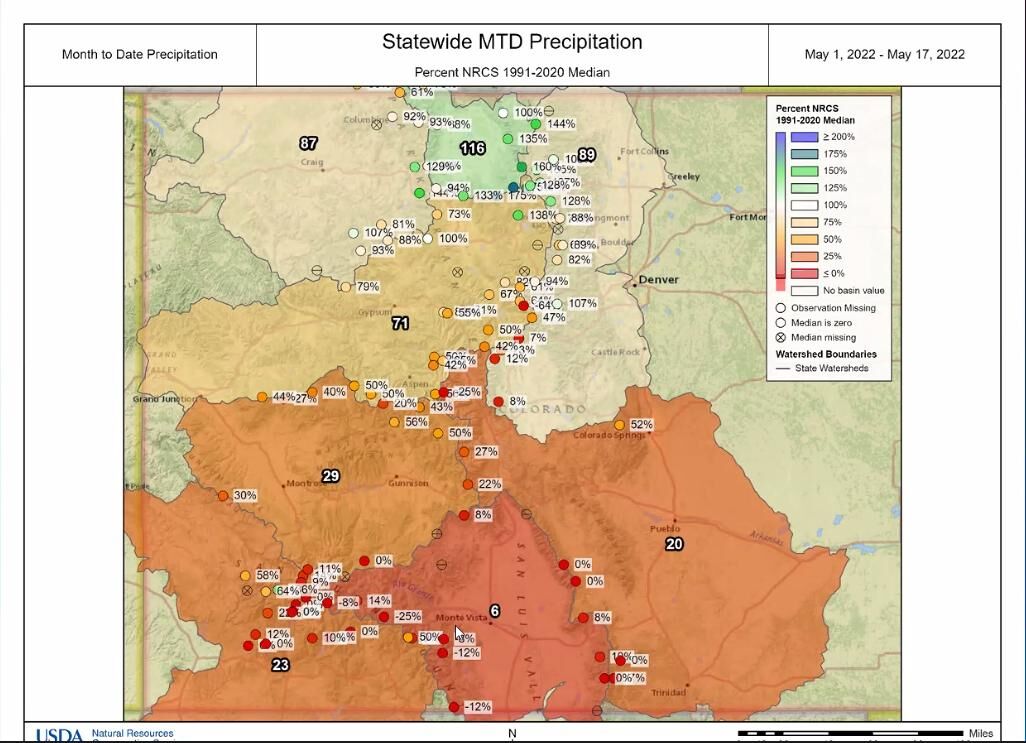
State Climatologist Russ Schumacher of the Colorado Climate Center at Colorado State University talked about the effects of the windy April on soil moisture. April is traditionally the windiest month of the year, he said, but it reached new levels in some parts of the state, notably the Eastern Plains, which is already facing growing problems with drought. The San Luis Valley and parts of the Western Slope are also now suffering from overly dry soils, he said.
“In a lot of places, it was just relentless,” Schumacher said.
The bottom line is that wind, combined with a lot of sun, little humidity and no rain for most of the state in April meant the soil, just as planting season is getting underway, was too dry. May’s warmer than average temperatures have compounded the problem – Schumacher said on average the state has been about six degrees warmer than normal. Most of the state is reporting below average rainfall since early April, with the worst conditions in southeastern Colorado, Schumacher reported.
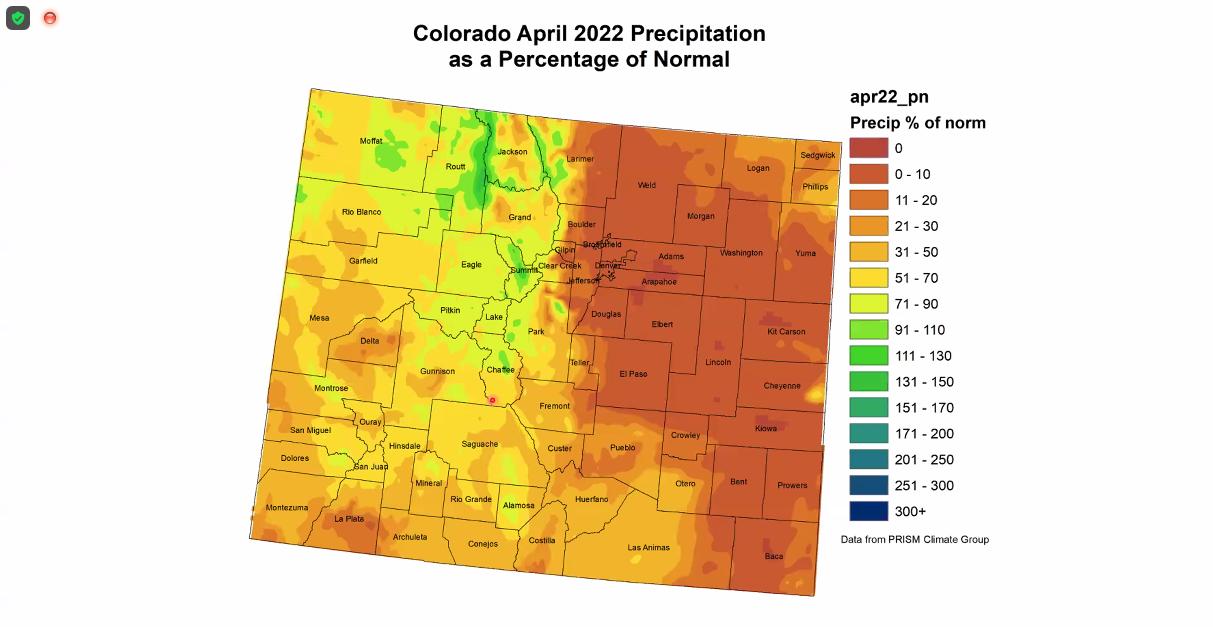
That part of the state sees little in the way of winter precipitation, the expert said, adding that he’s hopeful that the deficits could be made up in what’s traditionally the wettest time of year for southeastern Colorado – the summer monsoon season.
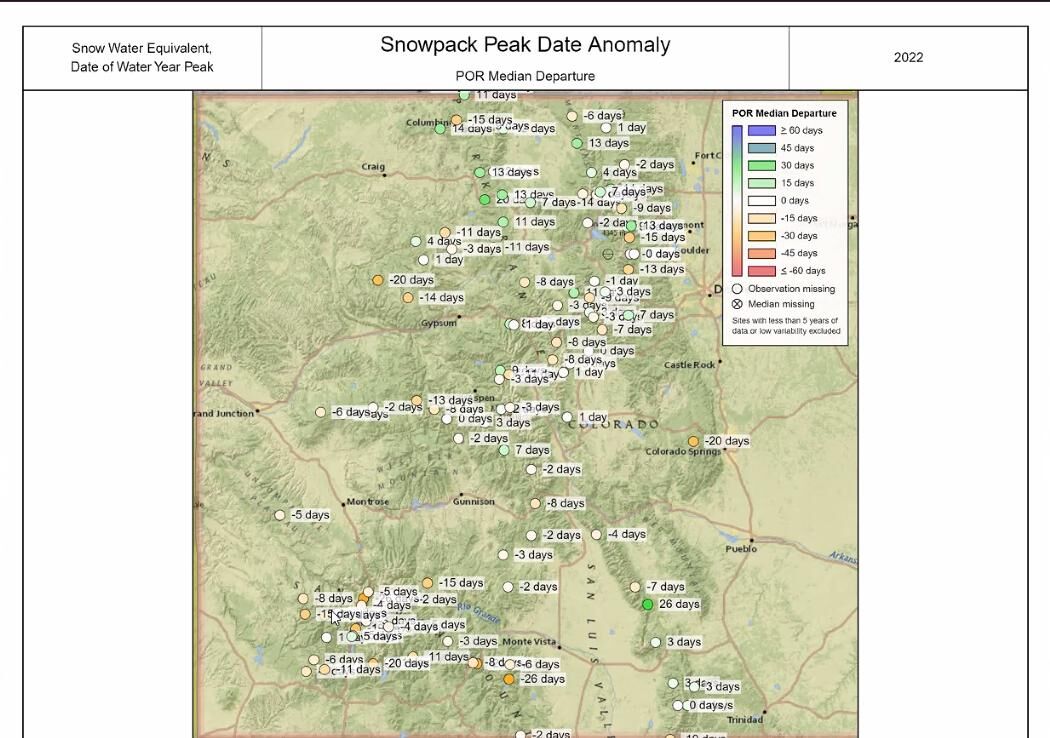
Snowpack also got a lot of attention from Schumacher and from hydrologist Brian Domonkos at the Natural Resources Conservation Service, part of the U.S. Department of Agriculture.
At a measuring station near Wolf Creek Pass, part of the state where winter snows are melting the fastest, the rate of snowmelt was an inch a day for 30 days, Schumacher said. That’s the fastest snowmelt in history, he said.
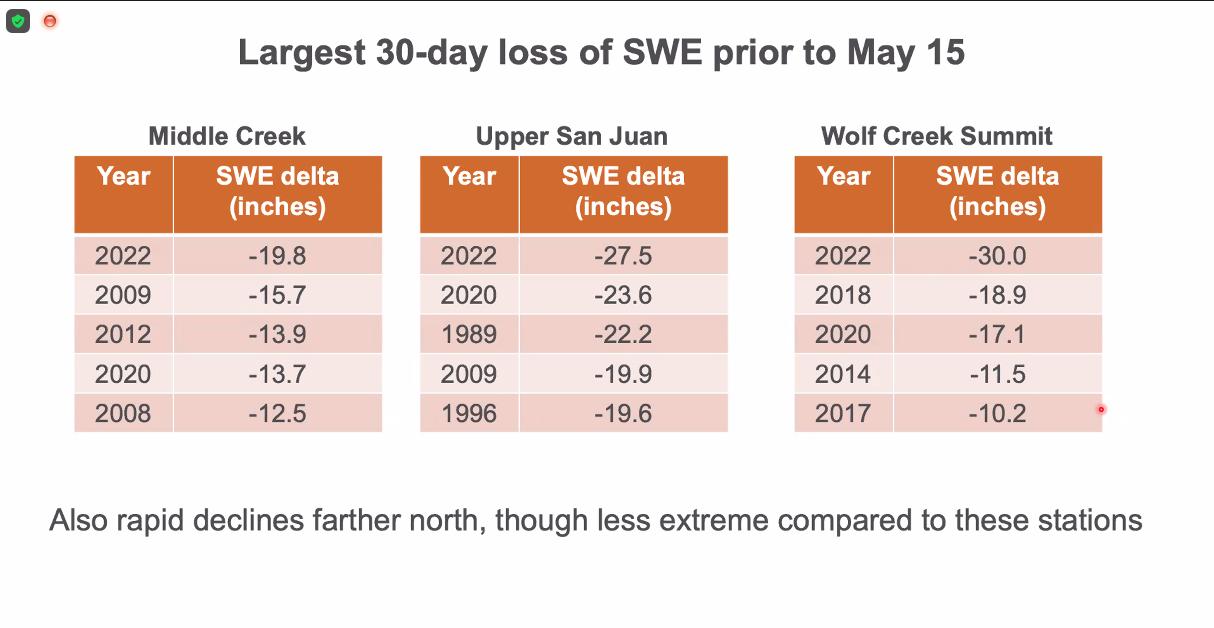
The news got worse for south central Colorado, including the San Luis Valley and the Rio Grande River basin, where snowmelt peaked on May 8. That’s a month early, the experts noted.
“At least the water was there,” Schumacher said.
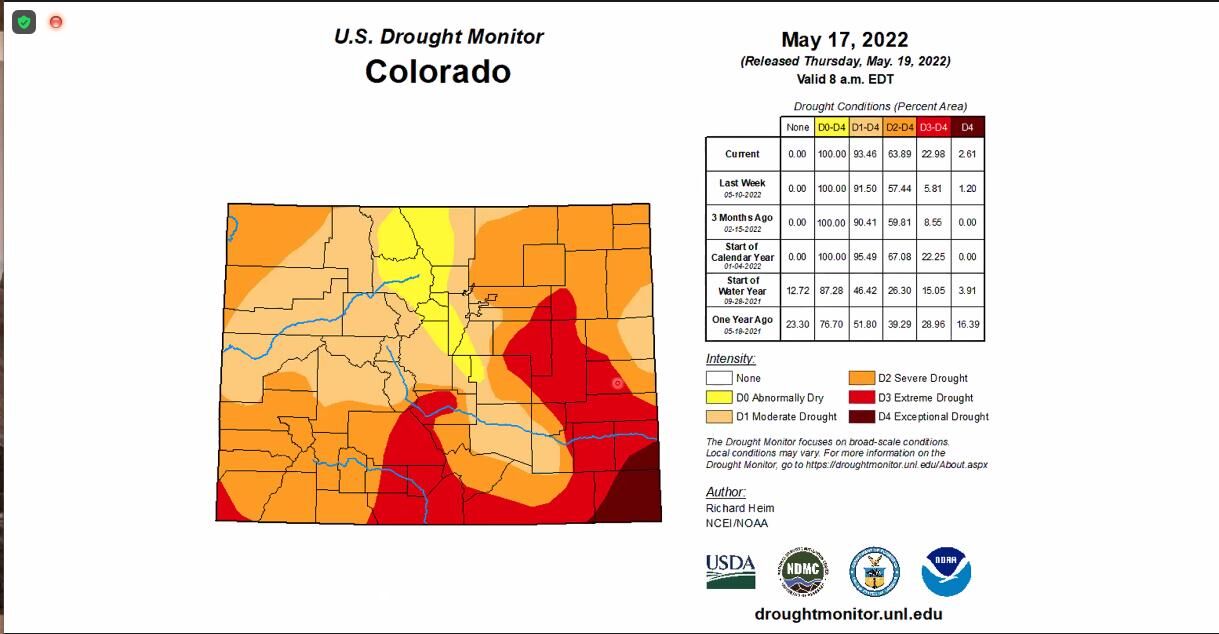
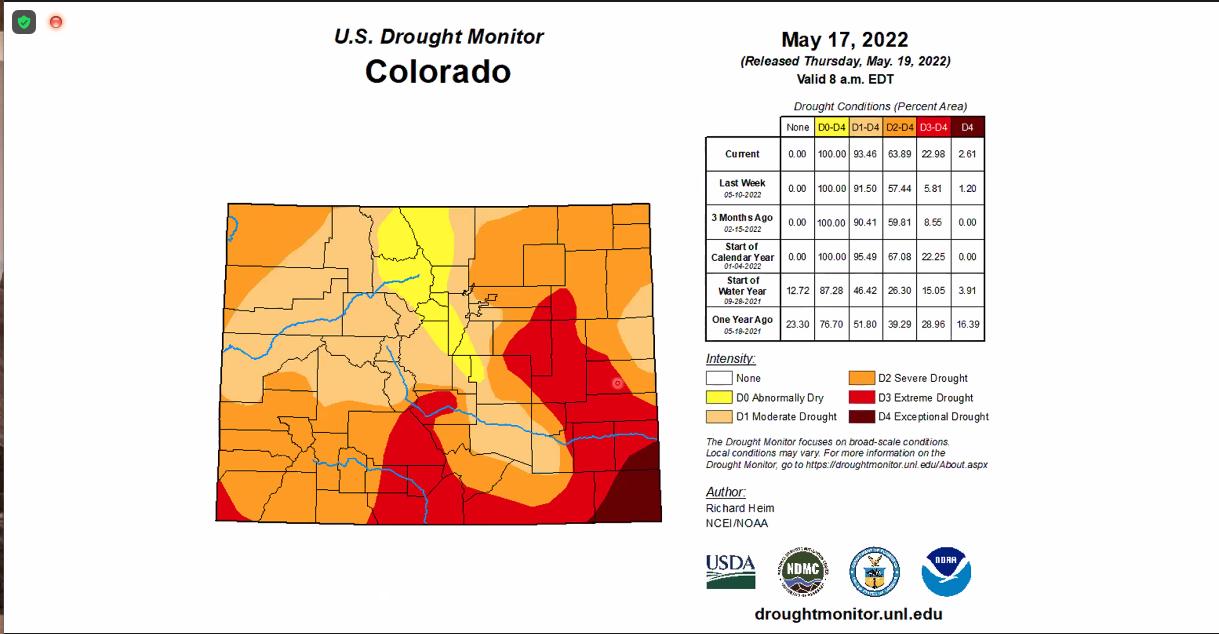
And drought is back – and bad, the experts said. Almost a quarter of the state is back to extreme drought conditions in the D3-D4 range. Just a week ago, only 6% of the state was in that extreme drought range. But it’s slightly better than a year ago, according to the May 19 report from the U.S. Drought Monitor. Most of the worst drought conditions, unsurprisingly, occur in southeastern Colorado and in the San Luis Valley.
“Up to this point, everything sounds bleak and terrible,” Schumacher said.
But there’s positive news coming, and that’s the storm forecast for Friday into Saturday, he said. The amount of snow predicted for the mountains and for some lower elevations is well above average for this time of year, he noted. Unfortunately, the storm is not forecasted to have much effect, if any, on southeastern or southwestern Colorado.
Domonkos, hydrologist, went into more details on the rapid snowmelt. The peak runoff is already over for the southern part of the state, he said, and that could mean that reservoir levels won’t recover as much.
One of the few bright spots is the Gunnison River Basin, which has had a pretty good year in precipitation compared to the last couple of years, Domonkos said.
The Gunnison is home to Blue Mesa Reservoir, the state’s largest, and a major source of water for the Colorado River and Lake Powell. The reservoir was tapped last year to send water down to Lake Powell to keep hydropower functioning at the Glen Canyon Dam, and it could be tapped again this year, according to a report from CPR News.
Almost every part of the state is reporting faster than average snowmelt, the experts noted. In the Rio Grande basin, snowmelt peaked three weeks early, and only a few portions of the state – the Gunnison and South Platte River basins are among them – are seeing anything approaching normal snowmelt.


Hickenlooper primary challenger Julie Gonzales endorsed by national progressive group Indivisible
Ernest Luning
ernest.luning@coloradopolitics.com
Updated 26 minutes ago
State Sen. Julie Gonzales’ bid to challenge U.S. Sen. John Hickenlooper in Colorado’s Democratic primary got a boost Tuesday from Indivisible when the national arm of the progressive grassroots group endorsed the Denver lawmaker. The national group’s endorsement comes less...
10th Circuit rejects ‘penalty’ for children of naturalized citizens seeking visas
Michael Karlik
michael.karlik@coloradopolitics.com
Updated 19 hours ago
The Denver-based federal appeals court joined three of its peers earlier this month and determined the child of a newly naturalized U.S. citizen is not moved to a longer visa line as a result of his parent gaining citizenship, and...
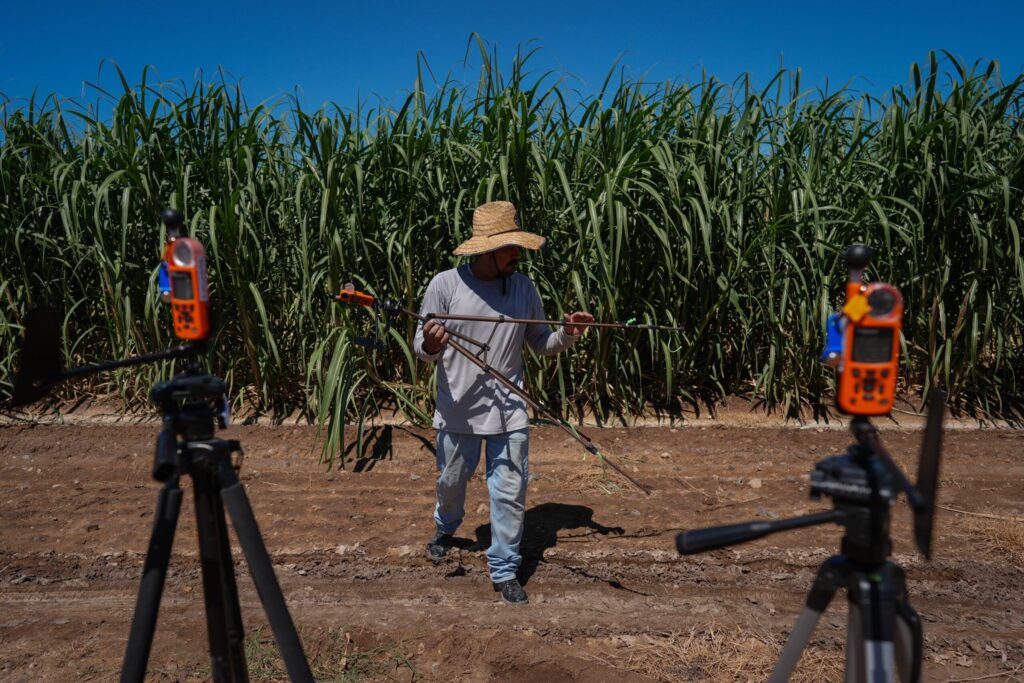
Colorado lawmakers mull renaming César Chávez Day to Farm Workers Day
Marianne Goodland
marianne.goodland@coloradopolitics.com
Updated 2 hours ago
A Colorado House committee has voted to rename the March 31 state holiday from César Chávez Day to Farm Workers Day, following a national shift prompted by sexual abuse allegations against the labor leader. The State, Civic, Veterans, and Military...
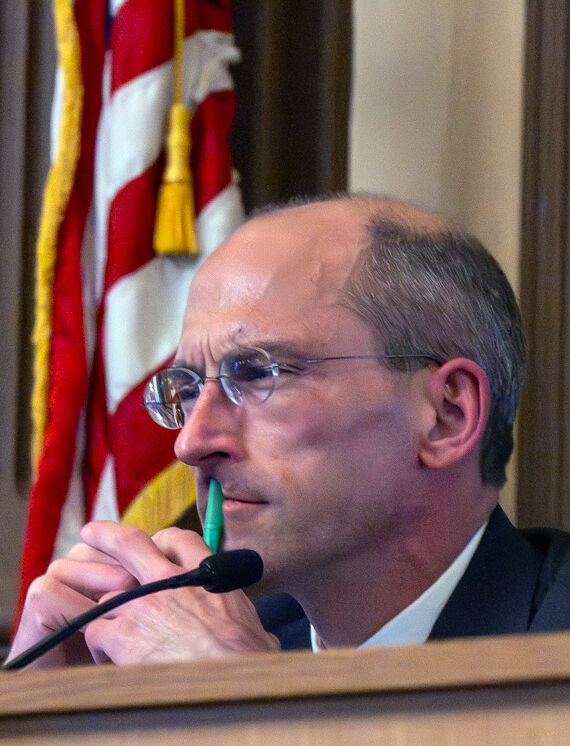
Colorado Sen. Mike Weissman calls for cold water on heated hate speech
Marianne Goodland
marianne.goodland@coloradopolitics.com
Updated 21 hours ago
Likening the recent record-setting warm temperatures to hot political rhetoric, Colorado Sen. Mike Weissman, D-Aurora, pleaded for an end to death threats and other hate speech directed at lawmakers of both parties. “The increasingly tragic reality of our politics, however, like...

Ethics panel dismisses complaint against Colorado agency chief Dan Gibbs
Marianne Goodland
marianne.goodland@coloradopolitics.com
Updated 18 hours ago
A state ethics panel has dismissed a complaint against Dan Gibbs, executive director of the Colorado Department of Natural Resources. The complaint, filed in December 2021 by the Republican-affiliated group Defend Colorado, alleged Gibbs awarded the think tank Keystone Policy...

Denver airport hasn’t had notice ICE agents will assist TSA yet. Wait times are short, though
Bernadette Berdychowski
bernadette.berdychowski@denvergazette.com
Updated 21 hours ago
As President Donald Trump deployed immigration agents to help U.S. airports manage hours‑long security lines during the partial government shutdown, Denver International Airport remained relatively calm on Monday. At the nation’s third‑busiest airport, TSA PreCheck lanes remained open to start...
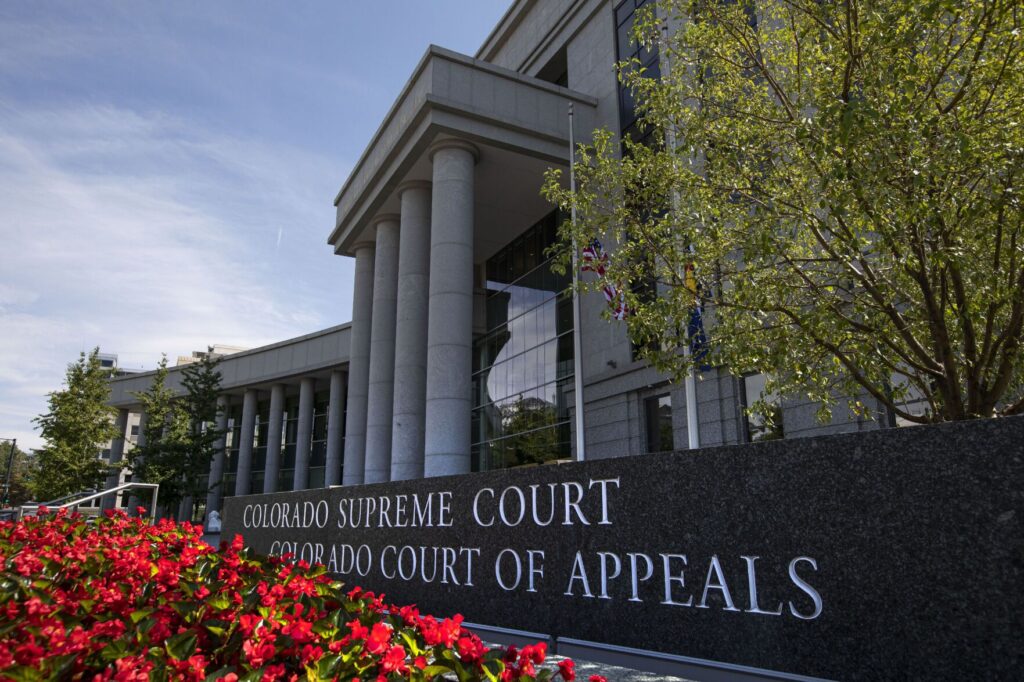
Appeals court recognizes longer window to sue insurers for withholding policy details
Michael Karlik
michael.karlik@coloradopolitics.com
Updated 14 hours ago
Colorado’s second-highest court split with its own prior decision earlier this month and concluded injured motorists have two years, not one, to sue insurance companies for withholding relevant information about an at-fault driver’s policy. In 2019, Colorado lawmakers enacted a measure to...

Trump open to $5 billion ICE funding cut if SAVE Act package passes
Zach LaChance, Washington Examiner
zach.lachance.washington.examiner@gazetteedit.wpenginepowered.com
Updated 1 day ago
President Donald Trump signaled he is open to a $5 billion funding cut for U.S. Immigration and Customs Enforcement if the Senate passes the Save America Act, along with other amendments. “I don’t think we should make any deal with...

Appeals court decides free speech cases, error-prone judge reversed again | COURT CRAWL
Michael Karlik
michael.karlik@coloradopolitics.com
Updated 1 day ago
Welcome to Court Crawl, Colorado Politics’ roundup of news from the third branch of government. The state’s Court of Appeals decided multiple cases implicating free speech rights, plus Colorado’s most error-prone judge was reversed on appeal yet again. Heard on...
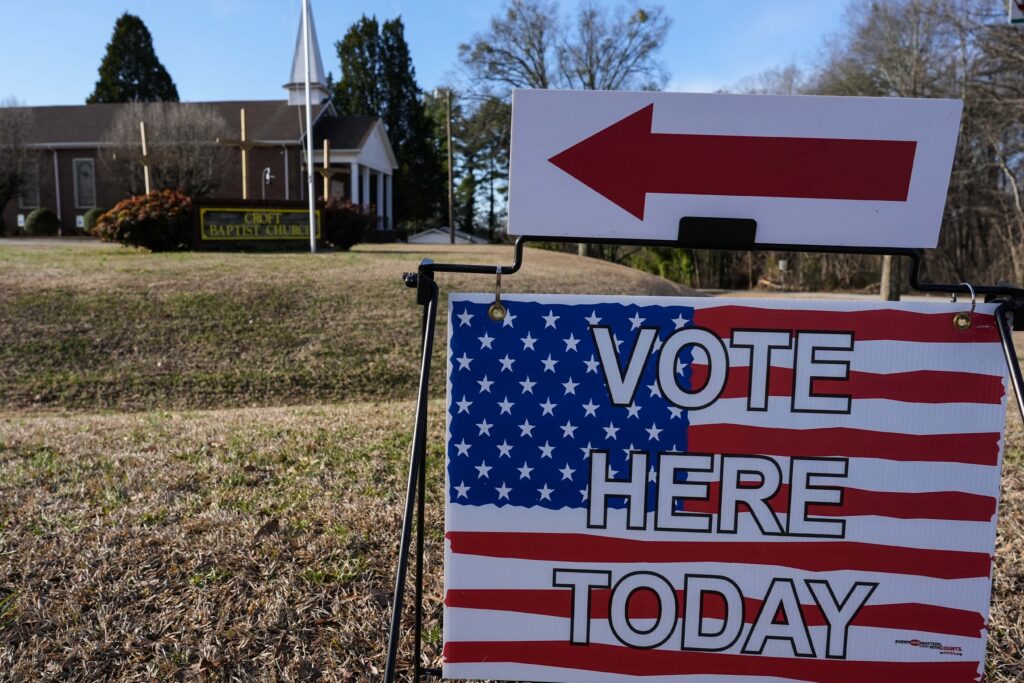
It’s time to let unaffiliated voters caucus | Vince Bzdek
Vince Bzdek
vince.bzdek@gazette.com
Updated 1 day ago
There’s no getting around it: Colorado’s 3,000 county caucuses, which just wrapped up recently, left half the electorate out in the cold. Since unaffiliated voters now make up 51% of all Colorado voters, a majority of Colorado electors are barred...
PREV
PREVIOUS

GOP congressional candidate Erik Aadland endorsed by former US Senate candidates
Three of the Colorado Republicans who unsuccessfully sought this year’s U.S. Senate nomination formally endorsed congressional candidate Erik Aadland on Thursday, calling the West Point graduate the Republicans’ best chance to win the open 7th District seat. Aadland, who jumped from the U.S. Senate race to the congressional primary in December, announced that former rivals […]

Secretary of State's Office asks El Paso County commission candidates to rectify campaign finance violations
The Secretary of State’s Office is asking El Paso County Commissioners Cami Bremer and Holly Williams to rectify alleged campaign finance violations over donations they received from a nonprofit. Colorado Springs Forward, a civic nonprofit, donated $5,000 to each of the commissioners running for reelection in September, which was prohibited under state law, letters from […]