

Justices to hear case on local government term limits

The Colorado Supreme Court agreed to bypass the Court of Appeals and directly hear a case implicating term limits for local elected officials broadly, and specifically whether Thornton’s first-term mayor is allowed to run for reelection.
The justices accepted two cases for review on Monday, one of which involves oil and gas taxation and the other hinges on an interpretation of the 1994 constitutional amendment Colorado voters adopted to place term limits on elective offices.
Cherish Salazar, a voter in Thornton, filed a lawsuit in May of last year against the city and Mayor Jan Kulmann, asking a court to declare that Kulmann is constitutionally barred from serving as Thornton’s leader beyond November 2021. That was the point, alleged Salazar, at which Kulmann would have served the equivalent of two four-year terms on the council – six as a council member and two as mayor.
One month before Kulmann hit her alleged term limit, Adams County District Court Judge Teri L. Vasquez issued a ruling agreeing partly with Salazar and partly with the defendants.
Article 18, Section 11 of the state constitution limits local elected officials to two consecutive terms in office, unless voters enact new limits. Kulmann served one-and-a-half terms as a council member before resigning in 2019 upon her election as mayor.
Vasquez decided that the nine members of the Thornton City Council, consisting of eight council members and one mayor, held the same “office” under Section 11. Therefore, the two-consecutive-term limit applied to council members elected as mayor or vice versa.
However, Vasquez did not believe that Kulmann had served two terms as a council member. Section 11 does not appear to apply to partial terms, the judge explained, meaning Kulmann could serve out the remainder of her mayoral term.
“The court acknowledges the concern that elected officials may try to circumvent term limits by resigning in their second term and running again in the next election for the same position. But, while this may be a concern in theory, it is not realistically a concern in practice,” Vasquez added in her October 29 order.
Last month, the defendants filed a petition with the Supreme Court asking the justices to review the case directly. Salazar did not oppose the request.
Kulmann and the city argued that the lawsuit met the criteria for bypassing the state’s intermediate appeals court: There was a novel question at stake, the case would have a significant effect on local governments across the state and the appeals process would not conclude in time for the 2023 mayoral election.
The absence of a final ruling, the petition argued, would create “a potential cloud on the certainty of that mayoral election, whether Ms. Kulmann seeks re-election or whether a current term-limited councilmember desires to run for mayor.” Kulmann is currently a Republican candidate to represent the Eighth Congressional District in the 2022 election.
The Supreme Court will consider, as did Vasquez, whether the positions of council member and mayor in Thornton are sufficiently similar as to constitute the same “office,” and if a partial term counts toward the two-consecutive-term limit under Section 11.
The case is Salazar v. Kulmann et al.
In the second appeal accepted for review, the Colorado Attorney General’s Office alleges the Court of Appeals misconstrued the law and jettisoned the protocol for levying property taxes on oil and gas wells when the court decided a group that owned 11% of a Montezuma County well should have been given the ability to protest a retroactive tax increase.
The county discovered in 2009 that the operator of the well, Kinder Morgan, had undervalued the well for the 2008 tax year. As a result, Kinder Morgan billed members of the CO2 Committee, Inc., which owned 11.224% of the well, an estimated $500,000 for the retroactive increase in value.
Although Kinder Morgan unsuccessfully protested the valuation, a three-judge panel for the Court of Appeals decided last year that the CO2 Committee had the ability on its own to challenge the county’s failure to provide its members with a notice of the change in well value and the ability to protest.
Montezuma County and the Colorado property tax administrator, who leads the state’s Division of Property Taxation, asked the Supreme Court for review. Their petitions argued that county assessors do not have the means to identify and contact everyone who owns a fraction of an oil or gas well, meaning the Court of Appeals’ decision would impair the ability of counties to revise their valuations.
“If allowed to stand, the decision creates an unworkable system that threatens revenue on which many local communities across the state depend,” the Attorney General’s Office wrote.
The case is Montezuma County et al. v. CO2 Committee, Inc.



Colorado Supreme Court accepts cases about reliability of gun-to-bullet matching
Michael Karlik
michael.karlik@coloradopolitics.com
Updated 12 hours ago
The Colorado Supreme Court announced on Monday that it will hear two cases questioning the reliability of expert testimony that purports to identify whether a specific bullet was fired from a specific gun. At least three of the court’s seven...

Colorado District Attorneys unveil 2026 legislative priorities | WHAT’S YOUR AGENDA?
Marissa Ventrelli
marissa.ventrelli@coloradopolitics.com
Updated 2 days ago
Welcome to What’s Your Agenda?: The Colorado Politics’ weekly publication of trade association priorities for the state’s 2026 legislative session. The Colorado District Attorneys’ Council provides training, resources, and legislative support to every prosecutor in the state. In order to...
Appeals court clarifies what materials judges may rely on for postconviction decisions
Michael Karlik
michael.karlik@coloradopolitics.com
Updated 1 day ago
Colorado’s second-highest court clarified on Thursday that trial judges who are deciding whether to grant relief to convicted defendants may rely on the materials attached to, or referenced in, the parties’ arguments. In contrast to direct appeals of criminal convictions,...
Colorado justices skeptical of challenge to water enterprises’ eminent domain power
Michael Karlik
michael.karlik@coloradopolitics.com
Updated 12 hours ago
Members of the Colorado Supreme Court appeared receptive on Wednesday to the notion that water-related enterprises have the legal authority to exercise the governmental power of eminent domain over private property. An enterprise is a government-owned business that provides fee-based...
Colorado justices skeptical that intimate messages relevant to assault case
Michael Karlik
michael.karlik@coloradopolitics.com
Updated 1 day ago
Members of the Colorado Supreme Court seemed to agree on Tuesday that a Douglas County judge acted reasonably by blocking evidence of a defendant’s BDSM-related conversations with the victim in his trial for assault and false imprisonment. Jurors found Donald Louis...
Second appeals judge voices concerns about new ‘reasonable doubt’ instruction
Michael Karlik
michael.karlik@coloradopolitics.com
Updated 2 days ago
Another member of Colorado’s second-highest court registered his concern on Thursday that a portion of the recently revised “reasonable doubt” definition improperly lowers the prosecution’s burden to prove a defendant guilty. Judge Daniel M. Taubman wrote that the current instruction...
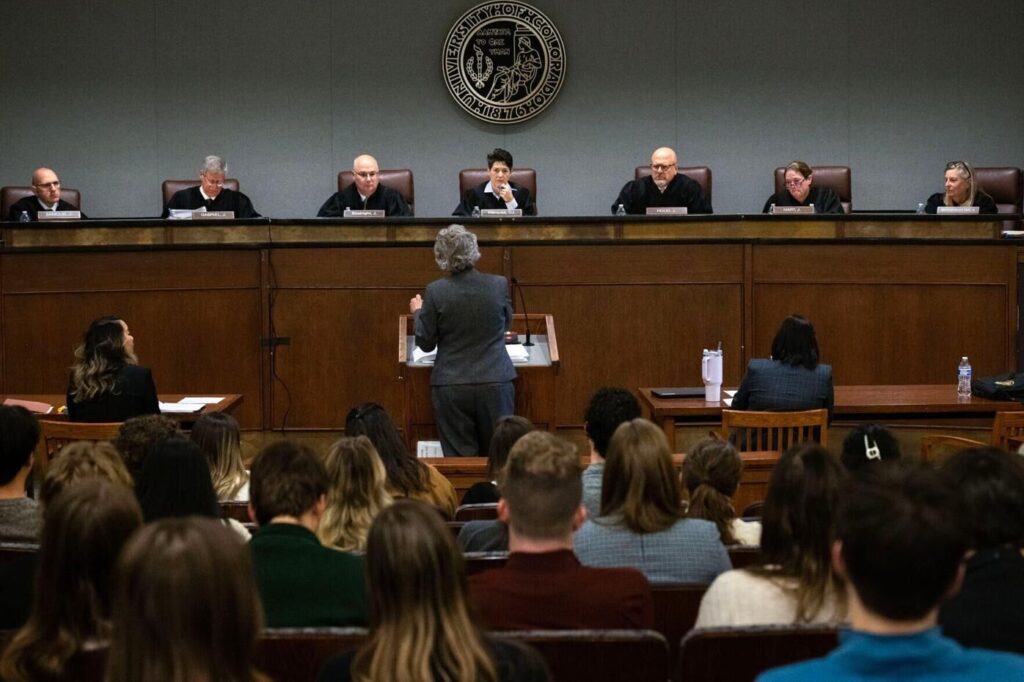
Colorado Supreme Court blocks ‘child-to-parent violence’ testimony in Boulder County case
Michael Karlik
michael.karlik@coloradopolitics.com
Updated 3 days ago
The Colorado Supreme Court concluded on Friday that a Boulder County judge incorrectly green-lit a psychologist’s expert testimony when the defendant had not laid the necessary groundwork for the evidence. State law requires criminal defendants to provide notice and undergo...
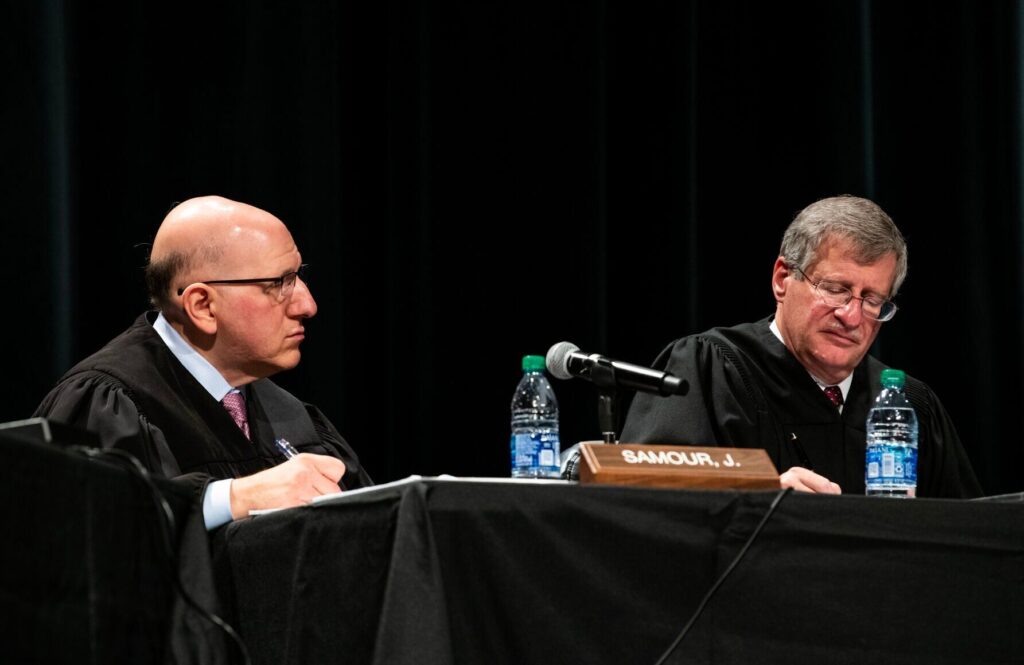
Colorado justices concerned about retrying defendant after jury signaled acquittal
Michael Karlik
michael.karlik@coloradopolitics.com
Updated 3 days ago
Some members of the Colorado Supreme Court appeared uncomfortable on Tuesday with allowing a criminal defendant to stand trial a second time after a Larimer County jury signaled it was deadlocked on some counts but had found him not guilty...

Missy Woods pleads not guilty; trial set for fall
Jenny Deam
jenny-deam@coloradopolitics.com
Updated 3 days ago
The former Colorado Bureau of Investigation DNA expert charged with more than 100 felonies entered a plea of not guilty to all of them Wednesday in a packed Jefferson County courtroom. The plea was entered by her defense attorney Tom...
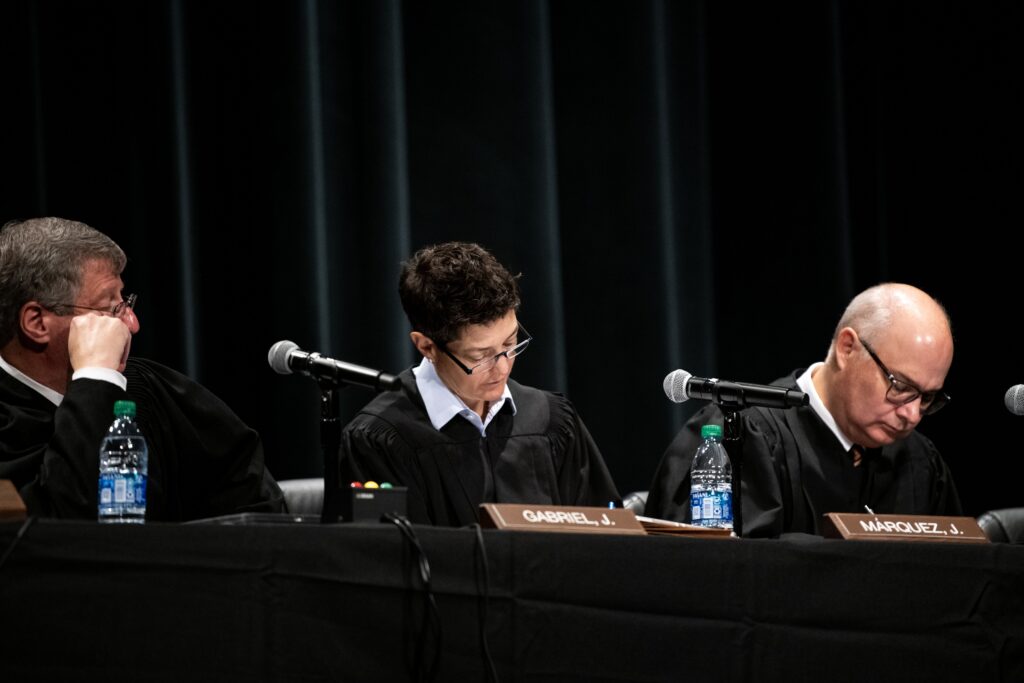
Colorado justices question process for parole board appeals
Michael Karlik
michael.karlik@coloradopolitics.com
Updated 2 days ago
The Colorado Supreme Court considered on Tuesday whether criminal defendants whose parole is revoked must appeal the decision internally to the state’s parole board before seeking review by a judge. The process for returning someone to incarceration for violating the...
PREV
PREVIOUS

Colorado legislature OKs ‘Idaho stops’ for bicyclists statewide
It may soon be legal for bicyclists to roll through stop signs in Colorado after the state legislature approved legislation to allow the “Idaho stop” statewide. If enacted, House Bill 1028 would permit bicycles, e-scooters and other non-motorized vehicles to treat stop signs as yield signs and to treat red lights as stop signs when […]

Denver council approves $1M incentive investment in proposed Pepsi facility
Denver City Council approved a $1 million Business Incentive Fund contract with Bottling Group LLC, an operating subsidiary of Pepsi that intends to build a $400 million state-of-the-art manufacturing facility in the High Point region of northeast Denver. The resolution, which only requires one vote, passed in a 12-1 vote Monday, with Councilwoman Candi CdeBaca […]