

Interstate vs. intrastate: State Supreme Court weighs meaning of overtime law for truckers

Did Colorado’s wage regulations entitle four truck drivers to overtime pay because they worked almost exclusively within state lines? Or did Colorado actually mimic federal rules for interstate truckers and render the four men ineligible?
Last week, JP Trucking, Inc., which is based in Gypsum, told the Colorado Supreme Court that the state’s minimum wage order at the time of the plaintiffs’ hiring was patterned after the federal “motor carrier exemption” that prevents drivers involved in interstate commerce from earning overtime pay. Moreover, plaintiffs Leonel Gomez, Francisco Gonzalez, Ebarardo Sanchez and Nathan Abbott all reportedly applied to JP Trucking with the understanding that they would drive in interstate commerce.
On the other hand, the plaintiffs argued that the Colorado Department of Labor and Employment, which issues minimum wage orders, wanted to provide protections to workers beyond the motor carrier exemption. They pointed to a 2020 clarification from CDLE stating the department’s “original intent” was to exempt drivers from overtime pay only if their work took them across state lines.
“The only reason they needed new language was because courts were getting it wrong,” attorney Brianne Power argued to the justices on March 8.
Current state regulations have since incorporated the federal overtime standards for drivers and their helpers. But in 2016, when the plaintiffs filed suit against their employer, it is disputed whether the state’s minimum wage order barred the four truckers – who had taken two out-of-state trips in total – from receiving overtime pay.
Under JP Trucking’s interpretation, “interstate drivers” would include those truckers who are authorized to cross state lines and could do so if an assignment required it, even if they ultimately never drive out of state. Multiple industry groups weighed in to the Supreme Court on behalf of the company, arguing that it would be burdensome for companies to track which employees cross state lines and when, so as to comply with a patchwork of state overtime requirements.
The National Armored Car Association pointed out that federal law exempted interstate drivers from overtime pay in order to remove the incentive for drivers to spend more time behind the wheel than is safe. The Colorado Motor Carriers Association reported that 32 states have overtime pay laws, and 23 of those closely track the federal exemption for interstate drivers.
Of the states that have written their own rules for drivers, “has anything bad happened there?” asked Justice Melissa Hart.
“Not that I’m aware of,” responded Jared Ellis, the attorney for JP Trucking.
Power argued that it was erroneous to interpret Colorado’s overtime pay exemption in light of federal law. Her clients worked solely inside Colorado or, in the case of two plaintiffs who took one trip apiece out of state, predominantly in Colorado.
“The phrase ‘interstate drivers’ is the way the occupation or work is defined,” she said. “So driving once (out of state) for 30 minutes would not be enough to make ‘interstate’ a defining characteristic of that driver’s work throughout the rest of their employment.”

“What would?” asked Justice William W. Hood III.
“We know one line crossing is not enough,” Power began to respond.
“Why not?” interjected Hart.
Power replied that an employer could send a driver on an interstate trip during their first week of work and forever make that employee ineligible to collect overtime pay. That maneuver, Power argued, would undermine the intent of Colorado’s wage regulations.
Originally, the plaintiffs alleged in their lawsuit that JP Trucking failed to comply with the Federal Labor Standards Act as well as Colorado’s wage laws in denying them time-and-a-half pay for overtime work. An Eagle County judge sided with the truckers, but the state’s Court of Appeals ordered a further review of the case.
In December 2019, District Court Judge Russell H. Granger determined the truckers were not entitled to overtime pay under federal law after all, but upheld the award of overtime pay pursuant to state law. The two plaintiffs who never traveled out of state were not “interstate drivers,” and the two who did cross state lines once did not qualify as working interstate. Granger awarded the plaintiffs approximately $68,000.
The following year, a three-judge panel for the Court of Appeals reversed that ruling. The panel believed that the state exemptions were patterned after federal law, and CDLE had not clearly stated it wanted to exclude only drivers who cross state lines from receiving overtime pay.
In reaching its conclusion, the panel disagreed with a different set of Court of Appeals judges who had recently ruled that a shuttle driver working out of Denver International Airport was not involved in interstate commerce because he never crossed state lines. The appellate panel in that case, Brunson v. Colorado Cab Company, noted that a decade-old advisory bulletin from CDLE defined interstate drivers to mean only those who work took them across state lines.
Now, the Supreme Court is faced with determining who interpreted the law correctly: the Brunson panel, as the plaintiffs argue, or the panel in the JP Trucking case, as the company contends.

Ellis attempted to downplay the significance of the advisory bulletin, arguing the text of the CDLE document stated that it was not meant to provide legal advice or be an “official record of action or law.”
“If that’s the point, that they really mean nothing,” asked Chief Justice Brian D. Boatright, “why issue them?”
To back up the plaintiffs’ argument that Colorado’s overtime rules covered truckers whose work occurred predominantly in-state, Power pointed to a 2020 publication from CDLE indicating the department believed the Brunson panel had reached the correct decision. The “original intent with this exemption,” CDLE elaborated, was to exempt only those drivers who crossed state lines from overtime pay.
And yet, Hart observed, CDLE had also defined intrastate drivers as those whose work occurred “entirely within” Colorado.
Ultimately, the disagreement in the case extended not just to what Colorado’s wage order meant for intrastate truckers, but whether the plaintiffs fell into that category to begin with.
“Didn’t all four of them go to work expecting they were gonna drive interstate? And is it just random who happened to get assigned to drive intrastate this time?” wondered Justice Richard L. Gabriel. “Why isn’t it true that all four of these gentlemen were hired understanding they were interstate drivers?”
The case is Gomez et al. v. JP Trucking, Inc.

Schoolchildren’s presence at child sex-related trial did not harm Arapahoe County defendant, appeals court says
Michael Karlik
michael.karlik@coloradopolitics.com
Updated 1 day ago
Colorado’s second-highest court decided on Thursday that the presence of a group of schoolchildren on the first day of a child sexual exploitation trial did not violate an Arapahoe County defendant’s constitutional right to a fair trial. Prosecutors charged Jerry...
Appeals court cites week-old Colorado law to reinstate child neglect case at child, father’s request
Michael Karlik
michael.karlik@coloradopolitics.com
Updated 1 day ago
Colorado’s second-highest court invoked a new state law for the first time on Thursday and reinstated a child neglect case that both the child and her father wished to reopen. House Bill 1227 took effect on Aug. 12, reversing a...
Colorado Supreme Court names William Hood as next chief justice
Michael Karlik
michael.karlik@coloradopolitics.com
Updated 2 days ago
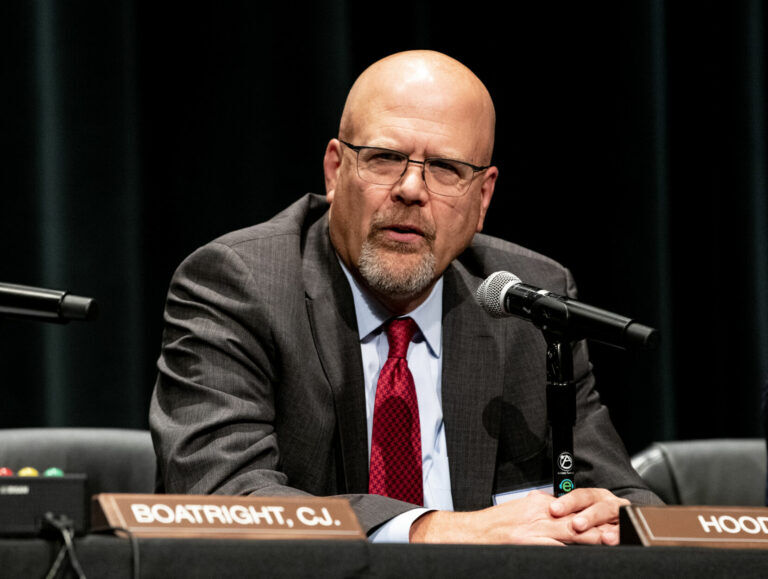
The Colorado Supreme Court has selected Justice William W. Hood III to be the next chief justice, the judicial branch announced on Friday. Hood will succeed Chief Justice Monica M. Márquez, who took over the role in July 2024. “I...

Appeals court upholds Park County trophy hunting conviction
Michael Karlik
michael.karlik@coloradopolitics.com
Updated 2 days ago
Colorado’s second-highest court clarified on Thursday that a defendant may stand convicted under the state’s trophy hunting laws if he abandons a bear carcass but returns later to remove the meat. Under Colorado law, it is a felony to detach...
Judge grants partial injunction to GEO in fight against state health inspection law
Kyla Pearce
kyla.pearce@gazette.com
Updated 3 days ago
A judge ruled Thursday that The GEO Group does not have to follow parts of a new state law requiring more frequent health and safety inspections at the U.S. Immigration and Customs Enforcement processing center in Aurora. Under the order...
Parker man faces 20 years to life for serial sexual assaults
Nicholas Fogleman
nicholas.fogleman@denvergazette.com
Updated 3 days ago
A 25-year-old Parker man who sexually assaulted three women in 2025 pleaded guilty Wednesday and will serve 20 years to life in prison. Javier Rodriguez-Andrade pleaded guilty to charges stemming from three sexual assaults involving women ages 19 to 24. ...
Divided appeals court upholds warrantless DNA collection in Colorado cold case, cautions of government overreach
Michael Karlik
michael.karlik@coloradopolitics.com
Updated 3 days ago
Colorado’s second-highest court upheld the warrantless collection of a suspect’s DNA from a discarded soda can as constitutional on Thursday, while warning about potential abuse of DNA privacy in the absence of further guardrails. By 2-1, a three-judge Court of...
Man charged in Northglenn homicide of wife
Matt Kyle
matt.kyle@denvergazette.com
Updated 3 days ago
A man has been formally charged with murder and burglary relating to a homicide last week in Northglenn. Alexei Munive-Rodriguez, 48, was arrested Sunday after he was at large following the homicide, which occurred Friday. Police were dispatched around 10:30...
10th Circuit grants immunity to officers for fatal Manitou Springs shooting
Michael Karlik
michael.karlik@coloradopolitics.com
Updated 3 days ago
The Denver-based federal appeals court ruled on Wednesday that responding officers from Manitou Springs and El Paso County cannot be held constitutionally liable for shooting and killing a man after a 20-minute standoff. Wilford Deweese allegedly pulled out a gun...
10th Circuit rejects invitation for full-court review of tax-avoidance case
Michael Karlik
michael.karlik@coloradopolitics.com
Updated 4 days ago
The Denver-based federal appeals court declined to reconsider the standards for holding entities liable for their tax-avoidance schemes, with a majority of judges voting against full-court review on Monday. In April, a three-judge panel of the U.S. Court of Appeals...
PREV
PREVIOUS

Colorado House OKs sales tax exemption for period products, diapers
The Colorado House of Representatives approved legislation Thursday to exempt period products and diapers from sales tax, sending it to the state Senate for consideration. If enacted, House Bill 1055 would expand sales tax exemptions for period products – including tampons, pads, menstrual cups, sponges, sanitary napkins and panty liners – and for adult and […]

Expanded witness intimidation protections signed into law
Colorado’s witness intimidation law is set to expand after Gov. Jared Polis on Thursday signed Senate Bill 24 into law. The bill will go into effect on July 1, expanding legal protections to cover intimidation that influences a person to withhold information or give false information to law enforcement, a defense attorney or a defense […]