

Appeals court rules police may forcibly draw blood from conscious drivers despite objection

Police may forcibly draw blood in certain circumstances over the objection of motorists, the state’s second-highest court determined, expanding upon a prior decision of the Colorado Supreme Court that found there is no constitutional right to refuse a chemical test.
Under Colorado law, people who drive in the state have expressed consent to have their blood or breath tested if police have probable cause to believe they are driving under the influence. The Supreme Court, in the 2017 case of People v. Hyde, determined the expressed consent law enabled police to perform blood alcohol testing on an unconscious driver without needing a warrant.
Last week, a three-judge panel for the Court of Appeals also agreed no constitutional protection exists for motorists who, like Christopher Oneil Tarr, consciously decline to consent to a blood draw.
“Hyde requires us to hold that Tarr consented to the blood test by virtue of the expressed consent statute and, moreover, that he had no constitutional right to refuse the test because the officers had probable cause to believe he had committed vehicular homicide,” wrote Judge Lino S. Lipinsky de Orlov in a Feb. 24 opinion.
Tarr’s case prompted one judge on the panel to take the unusual step of calling on the state Supreme Court to evaluate whether the expressed consent law by itself is still a valid basis for obtaining blood without a warrant given recent skepticism from the U.S. Supreme Court.
The nation’s highest court “appears to be moving away from implied consent created by statute,” Judge David Furman cautioned in a separate concurring opinion.
Tarr is serving a 40-year sentence for vehicular homicide, driving under the influence, second degree murder and reckless driving. Tarr killed Dalton McCreary in August 2016 after he sped through a red light in East Iliff Avenue in Aurora, striking McCreary and missing a second pedestrian.
Tarr denied to the responding officers that he had drunk alcohol, but they smelled it on Tarr’s breath. One officer asked Tarr to participate in a roadside sobriety test, but Tarr complained of a headache and went to the hospital instead.
At the Medical Center of Aurora, an officer read the expressed consent statute and told Tarr the only available test for his blood alcohol content was a blood draw. Tarr responded, “You’re not taking my blood.”
After learning that McCreary had died from his injuries, the officer told Tarr that there would be a forcible blood draw. Generally, the expressed consent law simply allows for a driver’s refusal to be introduced as evidence at trial. But the legislature has also decided that police can force the driver to take a blood test – even if they refuse – when there is probable cause of vehicular homicide.
Tarr responded that he was still not consenting to the blood draw, but he would also not resist. The hospital drew his blood, and a few hours later the police secured a signed search warrant. Testing showed Tarr’s blood alcohol content was nearly four times the legal limit at the time he struck McCreary.
The trial court judge allowed the blood evidence at trial, reasoning that Tarr had agreed to the warrantless search and seizure by nature of the expressed consent law. On appeal, Tarr argued that unlike in Hyde, a conscious driver who objects to a blood draw has not consented to a search. Further, there was no reason police could not have waited for the warrant before taking his blood.
The government disagreed, claiming that Tarr had no choice in the matter after the police established probable cause of vehicular homicide.
“Once the defendant gave his consent and accepted the benefits that were conditioned on giving that consent by driving on Colorado’s roads, the defendant had no constitutional right to withdraw that consent,” Senior Assistant Attorney General Brock J. Swanson wrote to the appeals panel.
The panel relied heavily on the Hyde ruling, which also involved the police’s decision to draw blood from a suspected drunk driver in Aurora. The defendant, Oliver Benton Hyde, similarly sought to suppress the blood-draw evidence, arguing the Fourth Amendment protected him from the warrantless search and seizure without his consent, given that he was unconscious at the time.
The state Supreme Court decided that Hyde had, in fact, given his consent merely by choosing to drive in Colorado.
“(T)here is no constitutional right to refuse a blood-alcohol test,” wrote Justice William W. Hood III.
That “sweeping language,” the Court of Appeals reasoned, also applied to conscious drivers who object to blood draws. The panel conceded that courts in other states have reached different conclusions about whether expressed consent laws by themselves allow for warrantless searches under the U.S. Constitution.
Nevertheless, “we apply Hyde as written and hold that, by driving a motor vehicle in the State of Colorado, Tarr consented to a warrantless blood draw in the event a law enforcement officer had probable cause to believe he committed vehicular homicide,” Lipinsky concluded.
In requesting the state Supreme Court to consider the issue, Furman pointed to a decision of the U.S. Supreme Court two years after Hyde. In that case, which involved Wisconsin’s version of the expressed consent law, a four-justice plurality decided that a warrantless blood draw was justified because of a Fourth Amendment exception for “exigent circumstances.”
The Wisconsin case involved an unconscious driver, like in Hyde, but did not hinge on whether the blood draw was acceptable because state law established the driver’s consent. Justice Sonia Sotomayor, writing for herself and two other justices, believed that an expressed consent law “cannot itself create the actual and informed consent that the Fourth Amendment requires.”
Furman believed the Colorado Supreme Court should clarify the Fourth Amendment rights of motorists like Tarr given the signals from the federal justices.
The case is People v. Tarr.


Bennet, Hickenlooper to vote against Trump’s 10th Circuit nominee from Colorado
Michael Karlik
michael.karlik@coloradopolitics.com
Updated 4 hours ago
Colorado’s two Democratic senators will not vote to confirm President Donald Trump’s nominee to a vacancy on the Denver-based federal appeals court. Trump has selected U.S. District Court Chief Judge Daniel D. Domenico, who he appointed as a federal trial...
U.S. government declines to oppose multiple challenges to immigration detention in Colorado
Michael Karlik
michael.karlik@coloradopolitics.com
Updated 4 hours ago
Multiple federal judges in Colorado granted petitions from people challenging the lawfulness of their immigration detention this week after the government took the unusual step of declining to submit arguments in opposition. Colorado’s federal trial court is facing a flood of...
Colorado justices discuss solution to confusion from prior criminal ruling
Michael Karlik
michael.karlik@coloradopolitics.com
Updated 2 hours ago
The Colorado Supreme Court pondered the fallout on Tuesday from its nearly six-year-old decision interpreting the state’s impaired driving laws, with the justices now addressing how defendants affected by the legal change must seek postconviction relief. In contrast to other...
Colorado justices suggest father entitled to appeal of custody decision
Michael Karlik
michael.karlik@coloradopolitics.com
Updated 1 day ago
Members of the Colorado Supreme Court signaled strongly on Tuesday that a father deserved some avenue for challenging a temporary child custody order that no lower court believed it could review due to the unusual circumstances of the case. Because...

Court snuffs out challenge to Denver’s flavored tobacco ban
Deborah Grigsby
deborah.smith@denvergazette.com
Updated 11 hours ago
The smoke finally cleared in Denver’s battle over a citywide ban on flavored tobacco products when a Denver court dismissed a challenge from local vape shop owners seeking to declare the ordinance unconstitutional and block its enforcement. On Wednesday, Denver...
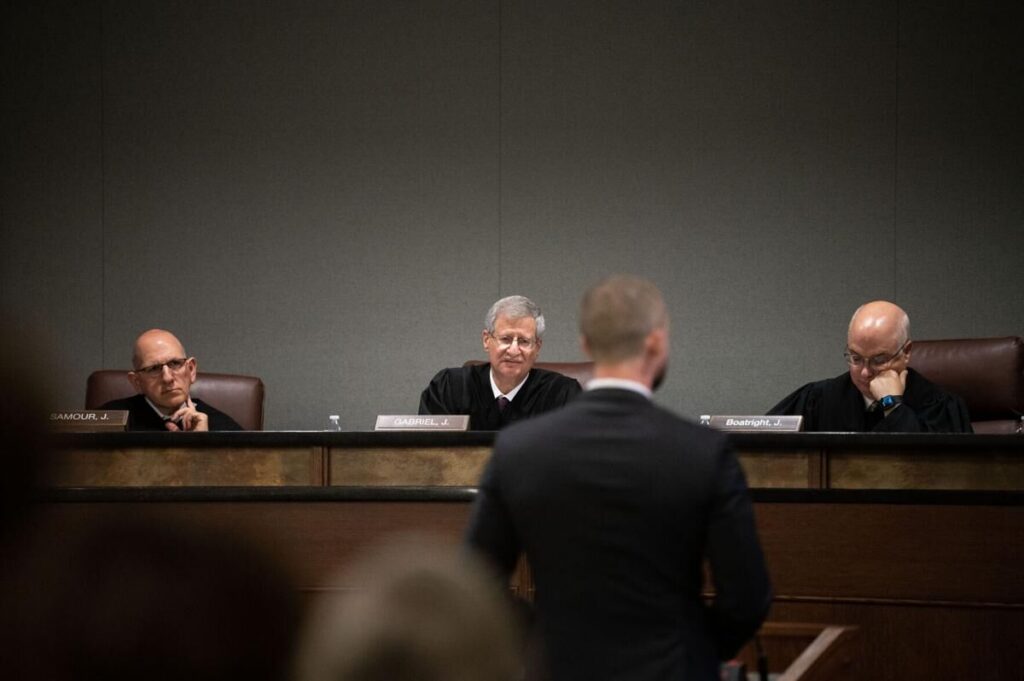
Colorado justices agree fraud claims belong in corporate dispute
Michael Karlik
michael.karlik@coloradopolitics.com
Updated 1 day ago
The Colorado Supreme Court decided on Tuesday that a corporate plaintiff validly pursued fraud claims over conduct that was not covered by a contract or by a set of interrelated business agreements leading up to the contract. Previously, the Court...
Colorado Supreme Court says intimate messages irrelevant to assault case
Michael Karlik
michael.karlik@coloradopolitics.com
Updated 1 day ago
The Colorado Supreme Court decided on Tuesday that a Douglas County judge acted reasonably by blocking evidence of a defendant’s BDSM-related conversations with the victim in his trial for assault and false imprisonment. While the Court of Appeals believed that...
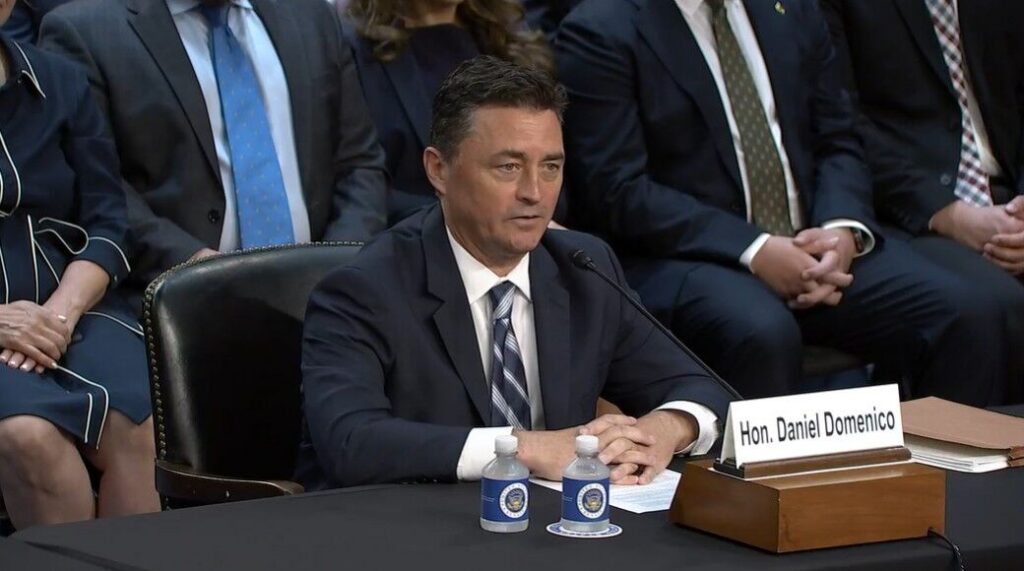
Trump’s 10th Circuit nominee declines to name 2020 election winner, defends immigration decisions
Michael Karlik
michael.karlik@coloradopolitics.com
Updated 1 day ago
President Donald Trump’s nominee to the Denver-based federal appeals court declined to say who won the 2020 presidential election during his appearance before the U.S. Senate Judiciary Committee on Wednesday, and defended his recent rulings in immigration detention cases. U.S....
Colorado law allowing lawsuits against ‘conversion therapy’ providers takes effect July 1
Marissa Ventrelli
marissa.ventrelli@coloradopolitics.com
Updated 4 hours ago
With a new law taking effect July 1, Colorado is creating a legal pathway for people to sue licensed providers of “conversion therapy,” even as debate over the practice’s constitutionality continues in the wake of a recent U.S. Supreme Court...
Colorado justices expand ability for civil defendants to avoid participating, win after trial
Michael Karlik
michael.karlik@coloradopolitics.com
Updated 2 days ago
The Colorado Supreme Court decided on Tuesday that a civil defendant, whose non-participation in the case meant that he legally admitted to the sexual assault allegations against him, could nonetheless prevail after he showed up to testify at trial. A...
PREV
PREVIOUS

Republican US Senate candidate Eli Bremer picks up endorsements from former legislative leaders
El Paso County Republican Eli Bremer, one of the candidates running in a primary to challenge Democratic U.S. Sen. Michael Bennet, announced Tuesday that he’s landed endorsements from four former leaders of the Colorado General Assembly. “Republicans have an incredible opportunity in this election,” said former Senate President Kevin Grantham, R-Cañon City, in a statement […]

Colorado Senate OKs changes to missing person investigations targeting marginalized women
Legislation advanced by the Colorado Senate aims to improve missing persons investigations involving women from marginalized groups. If enacted, Senate Bill 95 would shorten the timeframe before a person can be reported missing from 24 hours to two hours for minors and eight hours for adults. The bill would also require state law enforcement to […]