

Colorado’s Bennet, Hickenlooper notify feds, oppose Renewable Water Resources project

Sens. Michael Bennet and John Hickenlooper, both Colorado Democrats, sent a letter to two federal agencies, registering their opposition to a Douglas County water project that intends to extract thousands of acre-feet of groundwater out of the San Luis Valley.
They also reminded the two federal officials about a 1992 law they said could allow the federal government to step in under certain conditions.
Bennet hand-delivered the letter to U.S. Secretary of the Interior Deb Haaland on Saturday, while she was in Granada for a roundtable with survivors of Camp Amache. The letter was also sent to U.S. Secretary of Agriculture Tom Vilsack, who has close ties to Colorado.
“After hearing concerns from our San Luis Valley constituents about this proposal for months, the district’s letter from yesterday, and considering Colorado’s current exceptional drought, we both oppose this proposal,” wrote Bennet and Hickenlooper.
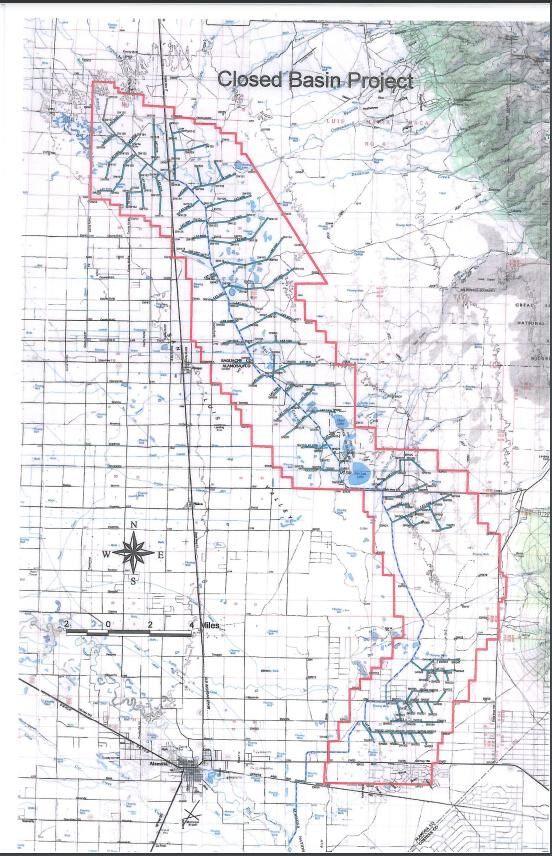
The letter from Bennet and Hickenlooper pointed to a 1992 law, known as the Public Law 102-575 or the “Wirth” amendment, that they said “provides a legal framework and elevated standard of environmental review for any transfer of groundwater out of the basin that may adversely affect public resources, such as the Great Sand Dunes National Park, Closed Basin Project, Baca National Wildlife Refuge.”
That law, which contains a section specific to the San Luis Valley, sets the following requirements:
“No agency or instrument of the United States shall issue any permit, license, right-of way, grant, loan or other authorization or assistance for any project or feature of any project to withdraw water from the San Luis Valley, Colorado, for export to another basin in Colorado or export to any portion of another State, unless the Secretary of the Interior determines, after due consideration of all findings provided by the Colorado Water Conservation Board, that the project will not (1) increase the costs or negatively affect operation of the Closed Basin Project (2) adversely affect the purposes of any national wildlife refuge or Federal wildlife habitat area withdrawal located in the San Luis Valley, Colorado; or (3) adversely affect the purposes of the Great Sand Dunes National Monument.”
“This export proposal continues to seek funding to move forward despite the fact it would exacerbate local water challenges, even with conservation efforts,” Bennet and Hickenlooper wrote.
The Renewable Water Resources (RWR) project, at an estimated cost of $600 million, would require building a pipeline from an confined aquifer in the San Luis Valley, tied to the Closed Basin project, in between Alamosa and the Great Sand Dunes National Park.
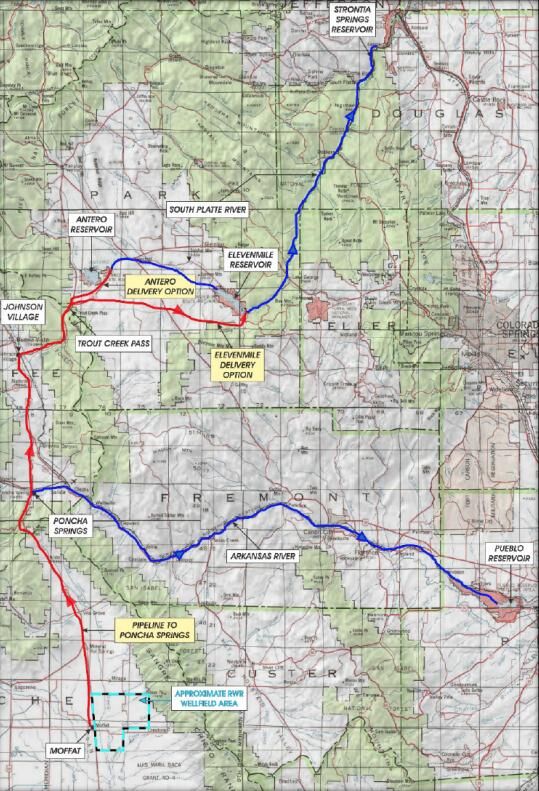
Where that pipeline would end up now appears to be in flux; the original proposal suggested the pipeline would connect with one of several reservoirs in Park County, all owned by Denver Water.
Denver Water, however, has made it clear it wants nothing to do with the project.
Two weeks ago, RWR principal Sean Tonner suggested another option – through the Lower Arkansas River and up to Douglas County through infrastructure owned by Aurora Water. But Aurora Water also dismissed the idea, telling Colorado Politics that “RWR has not asked Aurora Water to be able to use our infrastructure and Aurora Water does not have the excess system capacity to move this water.” RWR also dropped its asking price for Douglas County’s participation from $20 million to $10 million, money that would come from American Rescue Plan Act funds, due in part to concerns on whether $20 million would meet ARPA guidelines.
The project would develop 22,000 acre feet per year from 25 groundwater wells in the northern part of the San Luis Valley, according to the RWR proposal, although opponents believe the project would “buy and dry” as much as 34,000 acres of agricultural production land, about 5% of the total agricultural acreage in the valley. The total economic loss to the valley would run about $53 million per year, according to Chad Cochran, a banker with Farm Credit of Southern Colorado.
RWR proposes a one-time $50 million community fund to address a variety of needs, such as school funding, reliable broadband, food banks, senior services or job training programs. RWR argues that its proposal is a win-win solution – it would economically benefit San Luis Valley while ensuring water sustainability for Douglas County.
The RWR proposal claims the aquifer would not be harmed by the withdrawals because the groundwater would be replenished – known as recharge – by precipitation. That does not match up with what water experts from the state’s Water Availability Task Force recently reported about drought in the valley, which is worse now than it was a year ago, according to the U.S. Drought Monitor. In addition, state Climatologist Russ Schumacher said the valley has gotten only just over half of its average precipitation through mid-February.
It’s not the first time Bennet has stepped in to keep water in the valley. In 2014, along with then Sen. Mark Udall, Rep. Scott Tipton and then-Rep. Cory Gardner, Bennet penned a letter to five officials in the Department of the Interior, objecting to a proposed interbasin groundwater transfer.
Bennet and Hickenlooper also noted the longstanding drought in the valley, which they said “has placed a severe demand on local water resources.”
“Valley residents, including farmers, ranchers, and business owners, rely heavily on groundwater aquifers to support their economy and way of life. Since 2005, in response to this drought, local farmers have undertaken an ambitious, collaborative effort to reduce their own pumping with the goal of achieving sustainability. This export proposal continues to seek funding to move forward despite the fact it would exacerbate local water challenges, even with conservation efforts. In addition to concerns from the district, five San Luis Valley counties are opposed to this proposal,” they added.
The letter Bennet and Hickenlooper referenced from the Rio Grande Water Conservation District was sent to the two senators Friday on behalf of the district’s board of directors.
Board President Greg Higel asked the two senators to remind the federal government about its responsibilities under the Wirth amendment. The RWR proposal is nearly identical to the 2014 proposal that both Bennet, as U.S. Senator, and Hickenlooper, who was then governor, opposed at the time, the letter stated.
That 2014 project was under Sustainable Water Resources, which was later retitled Renewable Water Resources, which is “a mix of the previous organization and new members,” according to a 2019 report in the Alamosa Valley Courier. The plan in 2014 was to “export 2.5 percent of the Valley’s SWR-estimated 1.4 million acre-feet of surplus water to the Denver area via pipeline and the river system.”
In the past week, the project has also drawn opposition from Water for Colorado, a coalition of nine environmental groups in Colorado that includes Conservation Colorado, Western Resource Advocates, the Nature Conservancy, American Rivers and the Environmental Defense Fund.
“This controversial proposal threatens the economy and way of life for those who live in the San Luis Valley, and demonstrates a harmful use of federal funds,” the coalition said in a statement issued Feb. 17. “Water for Colorado and its nine partner organizations representing diverse interests across the state stand with the residents of the San Luis Valley and Protect our Water Coalition and join state leaders, including Governor Jared Polis, in strong opposition to the proposal and encourage the Douglas County Commissioners to reject it. Our coalition urges collaborative solutions to Colorado’s water supply concerns that do not irrevocably harm one community in favor of another.”
Bennet-Hickenlooper letter to Secretary of Interior Deb Haaland and Secretary of Agriculture Tom Vilsack, and a letter from the Rio Grande Water Conservation District, all addressing the Renewable Water Resources Project.


Trump lowers flags to half-staff for Dolly Parton: ‘The World loves you’
Naomi Lim
naomi-lim@coloradopolitics.com
Updated 3 hours ago
President Donald Trump is honoring the life of country music legend and philanthropist Dolly Parton by ordering federal buildings across the country to lower flags to half-staff for a week. “Very sad to report that Dolly Parton, one of the...
Ted Cruz suggests GOP realignment coming after Trump leaves office
Emily Hallas
emily-hallas@coloradopolitics.com
Updated 3 hours ago
Sen. Ted Cruz (R-TX) on Monday suggested the Republican Party could embrace a directional shift after President Donald Trump leaves office, a transition that promises to leave a gaping hole in the GOP. Cruz is known as a critical ally...

2 Colorado State troopers shot near Woodland Park; suspect killed
DEBBIE KELLEY
debbie-kelley@coloradopolitics.com
Updated 2 hours ago
Two Colorado State Patrol troopers were hospitalized, and a suspect is dead after a shooting during a traffic stop Tuesday. The initial incident happened at about 7:15 a.m., when a resident reported suspicious activity in the area near milepost 286...

Aurora moves forward with data center regulations
Kyla Pearce
kyla.pearce@gazette.com
Updated 2 hours ago
The Aurora City Council approved moving forward with two new regulations on data centers and directed staff to come back at the next study session with others. At a council meeting in early August, council members directed city management to...

Aurora City Council considers stricter food truck regulations
Kyla Pearce
kyla.pearce@gazette.com
Updated 2 hours ago
The Aurora City Council is considering passing laws to limit the number of food trucks on properties in the city and how and when they operate. Councilmember Angela Lawson, who sponsored the ordinance, said she understands the importance of food...

Denver murder conviction reversed for incomplete self-defense instruction
Michael Karlik
michael.karlik@coloradopolitics.com
Updated 26 minutes ago
Colorado’s second-highest court reversed a defendant’s murder conviction last week because a Denver judge gave an incomplete instruction to the jury about the man’s right to self-defense. Donald R. Gonzales and Gary McLaughlin met up in a Capitol Hill parking...
Colorado lawmaker, House leaders named in workplace-retaliation lawsuit
Marianne Goodland
marianne.goodland@coloradopolitics.com
Updated 3 hours ago
A former legislative aide has filed a lawsuit alleging she was mistreated, illegally directed to perform campaign work and harmed by a House leadership structure she charged was fragmented, politicized and ineffective at protecting employees. The lawsuit, filed by Jennifer...

Secret Service confirms awareness of Iranian state media video threatening Barron Trump’s life
The Associated Press
the-associated-press@coloradopolitics.com
Updated 8 hours ago
WASHINGTON (AP) — The U.S. Secret Service has confirmed it is aware that Iranian state media has aired a video that appears to threaten the life of Barron Trump, President Donald Trump’s youngest son. “The U.S. Secret Service is aware...

Federal judge hears arguments about Colorado’s 3-day gun purchase waiting period
Michael Karlik
michael.karlik@coloradopolitics.com
Updated 8 hours ago
A federal judge heard arguments on Monday about the constitutionality of a 2023 Colorado law that generally imposes a three-day waiting period on firearm purchases after the initiation of a background check. The test that the U.S. Supreme Court created...

Denver auditor finds oversight failures in $175.6M 16th Street project
Nico Brambila
nico.brambila@denvergazette.com
Updated 2 hours ago
Surprise historic sewer discovery delayed completion a year, cost $18M The Denver Auditor recently found significant oversight and contracting problems with the $175.6 million 16th Street Improvement Project, including an $18 million contract increase and a nearly one-year extension that...
PREV
PREVIOUS

Behind tumultuous scenes: The battles of the Douglas County Board of Education
After a tumultuous two weeks for the Douglas County School Board, an exodus of teachers has begun in the state’s third-largest school district. Thirty Douglas County teachers have resigned from the school district in the two weeks since superintendent Corey Wise was fired by the Douglas County Board of Education, 16 of whom quit the […]

Republican business owner Andrew Heaton launches primary challenge to US Rep. Doug Lamborn
Republican business owner and first-time candidate Andrew Heaton on Monday announced that he’s challenging eight-term U.S. Rep. Doug Lamborn in this year’s Republican primary in Colorado’s 5th Congressional District. Describing himself as a “Teddy Roosevelt, Ronald Reagan Republican with libertarian leanings,” Heaton told Colorado Politics he was prompted to run by Lamborn’s inability to keep the […]