

State Supreme Court broadens eligibility for court-appointed counsel

Warning that a contrary decision would risk a constitutional violation, the Colorado Supreme Court ruled 5-2 that defendants are entitled to an appointed attorney when they personally do not have access to sufficient funds – even if they live with people who do.
The Court’s majority reversed an Arapahoe County Court judge who found Nicholas Feyd Greer was not indigent because Greer, who lacked a job and an income, was financially supported by his parents. But that determination, wrote Justice Carlos A. Samour Jr., did not account for the fact that Greer had no access to his parents’ funds, and practically speaking would have proceeded to trial without an attorney.
“Balancing his assets (zero) against his liabilities (zero), as well as his income (zero) against his living expenses (zero), means that he has zero dollars to pay for an attorney,” Samour explained in the majority’s Jan. 31 opinion. “Why, then, should that income be considered in determining whether he has the necessary funds to retain counsel?”

Prosecutors in Arapahoe County charged Greer in March 2021 with careless driving and leaving the scene of an accident. Greer applied for court-appointed counsel and claimed he was indigent. He and his daughter lived with his parents, and Greer listed the household’s monthly income as $7,200.
Instructions on the court’s paperwork clarified that income from “roommates” did not count if it was unavailable to the defendant. The form was the product of a policy statement, known as a chief justice directive, originally issued in 2004 pertaining to the appointment of counsel for indigent defendants.
The public defender’s office and the 18th Judicial District Attorney’s Office both agreed Greer was entitled to a court-appointed attorney. His parents reportedly indicated they would not pay for one, and there was no legal mechanism to force them to do so.
However, County Court Judge Joshua Williford denied the request.
“He’s getting a lot of benefits” from his parents, Williford said of Greer.
The Supreme Court agreed to hear the appeal directly. The district attorney’s office changed its position, now believing Williford was correct to deny Greer an appointed attorney. The Colorado Attorney General’s Office, representing Williford, cautioned about the “gamesmanship and loopholes” that could ensue if the justices ruled that household income does not count toward a defendant’s individual ability to pay.
“A criminal defendant with ample assets could easily transfer them to a spouse, domestic partner, or parent living in the same household, have that person continue paying all of their expenses while claiming no ability to access the assets, and yet still qualify for court appointed counsel,” wrote Assistant Attorney General Emily Buckley.
Samour acknowledged the concerns about gamesmanship, but added that the application for court-appointed counsel comes under penalty of perjury. He indicated the majority would rather err on the side of granting someone a public defender, even if they were ineligible, than risk having someone who is truly indigent proceed to trial without a lawyer.
Samour invoked the U.S. Supreme Court’s landmark Gideon v. Wainwright decision, which established a right to a court-appointed attorney in felony cases and prompted the creation of the Office of the Colorado State Public Defender.
Gideon’s conclusions “ring hollow if we interpret our indigency guidelines so as to deny court-appointed counsel to an accused who, on a practical basis, lacks the necessary funds to retain an attorney,” Samour wrote.

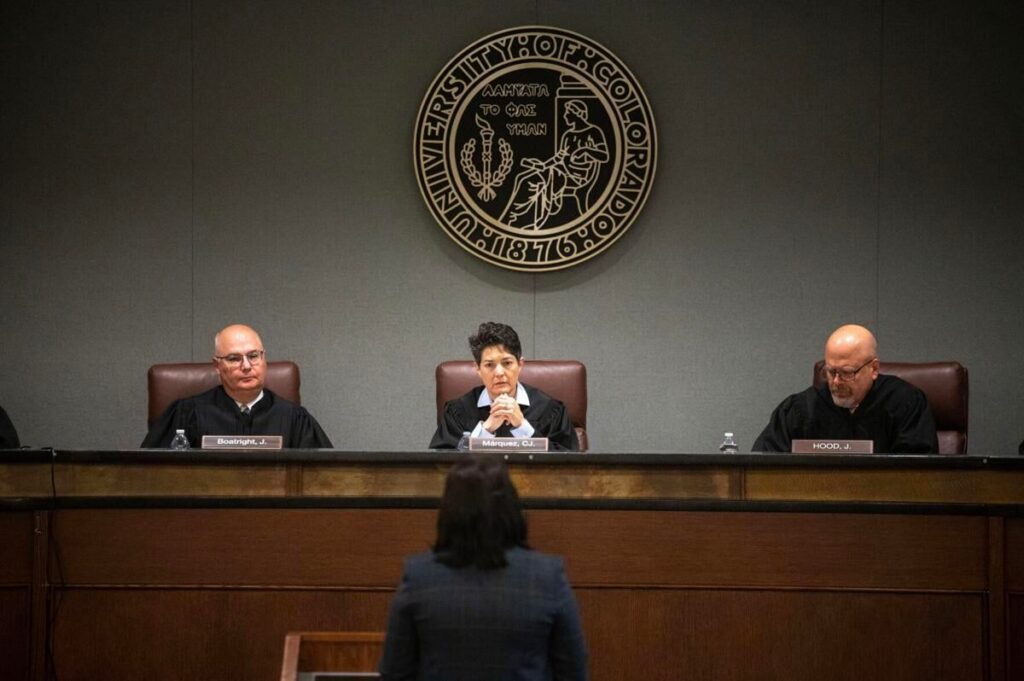
Justice William W. Hood III dissented, and Justice Monica M. Márquez joined him. Hood questioned why the chief justice could not amend the 2004 directive if the language was problematic. He also believed the new rule would lead courts to simply look at a defendant’s personal income and bank accounts, instead of the household’s income.
Hood suggested a study of how to better define indigency. Perhaps, he wrote, “we would do better to abandon the use of the federal poverty guidelines altogether and move to a more ad hoc means-testing scheme.”
The case is In re People v. Greer.


Colorado board permits state to appeal injunction against arthritis drug price cap
Marissa Ventrelli
marissa.ventrelli@coloradopolitics.com
Updated 7 hours ago
A Colorado board voted Friday to allow the Attorney General’s Office to fight an injunction against a price cap on a drug that treats arthritis. A U.S. district court judge had granted the company Amgen a preliminary injunction, temporarily blocking...

Federal judge rejects constitutional claims, ‘expressions of hatred’ by Club Q defendant
Michael Karlik
michael.karlik@coloradopolitics.com
Updated 7 hours ago
A federal judge rejected a defendant’s claims that he received constitutionally ineffective assistance of counsel while facing federal hate crime and firearms charges for murdering five people at a Colorado Springs LGBTQ nightclub in 2022. Anderson Lee Aldrich is serving...

Divided 10th Circuit upholds Colorado congestion fee on car rentals
Michael Karlik
michael.karlik@coloradopolitics.com
Updated 4 hours ago
The Denver-based federal appeals court concluded on Monday that a 2024 “congestion impact fee” that lawmakers imposed on short-term vehicle rentals did not conflict with a federal prohibition on certain airport-related charges. Beginning in the 1970s, Congress began limiting the...
10th Circuit dismisses woman’s lawsuit following 10-year attempt to undo restraining order
Michael Karlik
michael.karlik@coloradopolitics.com
Updated 3 days ago
The Denver-based federal appeals court rejected a woman’s challenge on Friday to a restraining order imposed on her more than a decade ago, finding that she cannot credibly claim she will be prosecuted for violating the restraining order through her...
10th Circuit dismisses woman’s lawsuit following 10-year attempt to undo restraining order
Michael Karlik
michael.karlik@coloradopolitics.com
Updated 3 days ago
The Denver-based federal appeals court rejected a woman’s challenge on Friday to a restraining order imposed on her more than a decade ago, finding that she cannot credibly claim she will be prosecuted for violating the restraining order through her...
Colorado equal pay law does not require plaintiffs to allege gender-based retaliation, appeals court finds
Michael Karlik
michael.karlik@coloradopolitics.com
Updated 2 days ago
The 2019 Colorado law aimed at rooting out pay discrimination on the basis of sex does not require a plaintiff to allege their employer retaliated against them for sex- or gender-related reasons, the state’s second-highest court decided on Thursday. Lawmakers...

Hudson faces lawsuit over ICE detention facility
Nicole C. Brambila
nicole-c-brambila@coloradopolitics.com
Updated 4 days ago
A nonprofit organization filed a lawsuit against the Town of Hudson Wednesday, challenging plans to reopen a former federal prison in the town as a U.S. Immigration and Customs Enforcement detention facility. Together Colorado, along with Janet E. Carlson, filed...
Senate committee advances Trump’s 10th Circuit nominee, as Domenico responds to questions about delays
Michael Karlik
michael.karlik@coloradopolitics.com
Updated 4 days ago
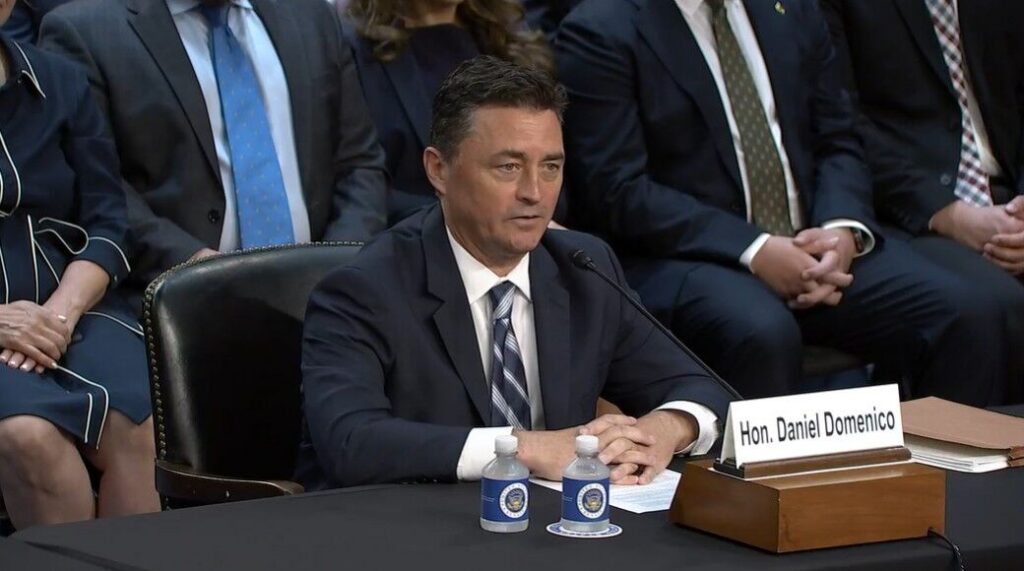
The U.S. Senate Judiciary Committee advanced President Donald Trump’s nominee to the Denver-based federal appeals court on Thursday by a party-line vote of 12-10. U.S. District Court Judge Daniel D. Domenico, who was Trump’s first-term appointee to Colorado’s federal trial...
Colorado justices to hear embryonic donation dispute
Michael Karlik
michael.karlik@coloradopolitics.com
Updated 4 days ago
The Colorado Supreme Court announced on Monday that it will decide whether lower court judges properly applied its framework for adjudicating disputes over the fate of pre-embryos, in which one person wants to use them to become a parent and...

Isolation, emotion, persona: Colorado judicial programming prepares people for life on the bench
Michael Karlik
michael.karlik@coloradopolitics.com
Updated 4 days ago
As a trial judge and now as a member of the Colorado Supreme Court, Justice Carlos A. Samour Jr. has heard the view that being a judge is isolating. “In neither court have I felt isolated. I’ve always interacted a...
PREV
PREVIOUS

Over 20 Denver businesses cited for selling tobacco products without necessary license
Denver’s Department of Excise and Licenses on Monday fined 23 businesses that sold tobacco products without the required license. The businesses were fined $150, and each was given information about the license requirement and a warning before the fines were issued, said Eric Escudero, a spokesman for the department. Denver’s City Council passed an ordinance […]