

Colorado’s justices take on five cases, ranging from insanity defense to oil and gas
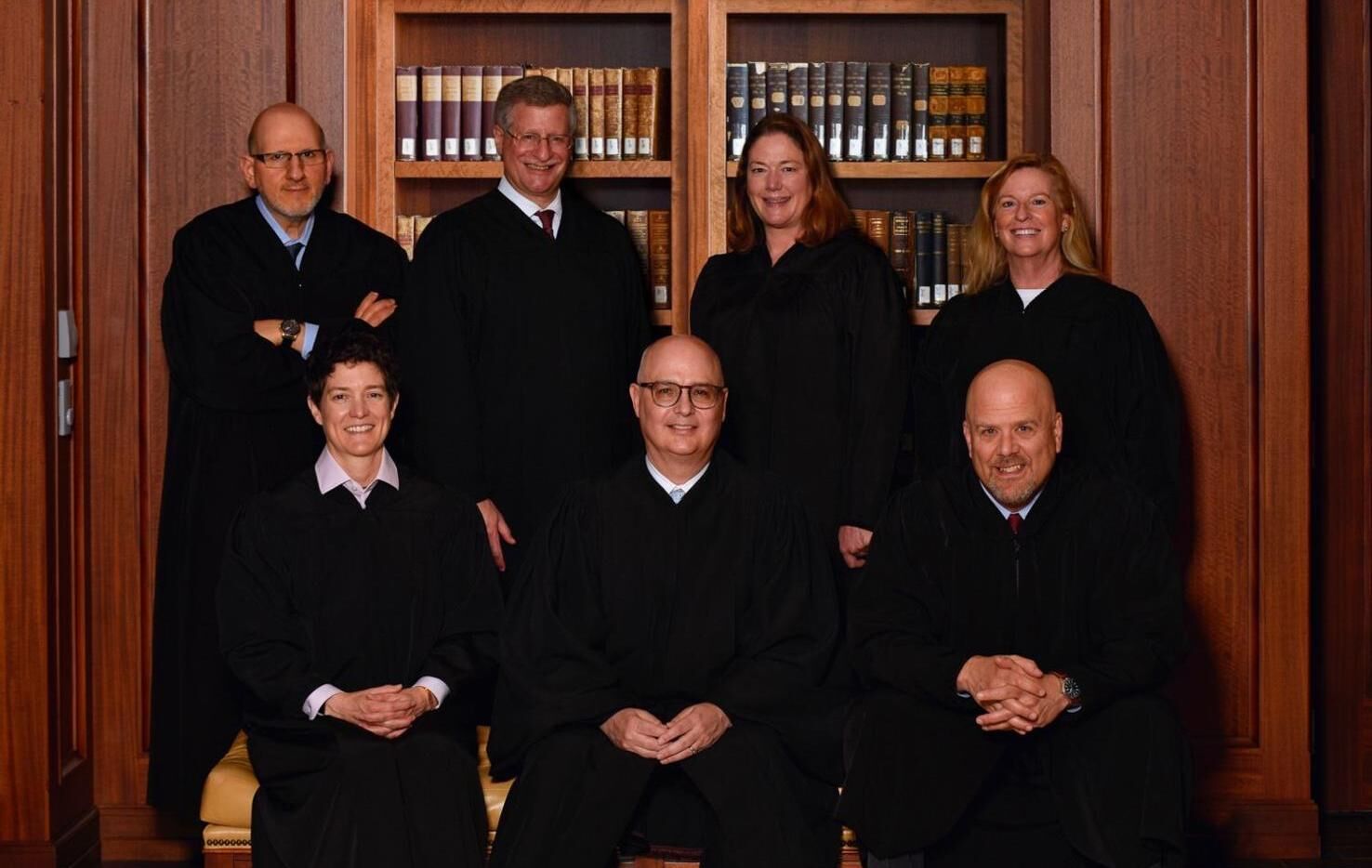
Five more cases made it onto the Colorado Supreme Court’s docket last week, implicating the insanity defense, the right of the accused to question alternate suspects at trial, and disputes over oil and gas production.
At least three of the seven members of the court must agree to hear a case in order for the court to grant review. Over fiscal year 2019-2020, the state’s highest court produced opinions in 102 cases out of the nearly 1,500 cases filed with the court in total.
Here are the latest appeals accepted for argument.
The insanity defense
Ari Misha Liggett received a sentence of life in prison for the grisly crime of killing and dismembering his mother in 2012. Police arrested Liggett while he was driving his mother’s car around with her remains in storage bins. Liggett pleaded not guilty by reason of insanity, but prosecutors in Arapahoe County told the jury that “mental illness does not equal insanity.”
In April of last year, a three-judge panel for the Court of Appeals upheld Liggett’s conviction for first-degree murder. Liggett had challenged the trial court’s decision to allow the disclosure of information from a psychiatric nurse and a licensed professional counselor who had observed Liggett.
Under Colorado law, if a defendant pleads not guilty by reason of insanity, they give up confidentiality “as to communications made by the defendant to a physician or psychologist in the course of an examination or treatment.” Liggett contended that the law said nothing about nurses or counselors, and the trial court judge mistakenly believed the waiver of confidentiality applied to a wider swath of medical professionals than is allowed.
The appeals panel disagreed with that line of thinking.
“Such a conclusion would defy common sense,” wrote Judge James S. Casebolt. “Surely, examining physicians and psychologists would want and need to consider information communicated to nurses and other persons … by the person claiming NGRI [not guilty by reason of insanity], as well as records obtained from counselors and other persons.”
The Supreme Court will evaluate whether the Court of Appeals correctly interpreted the law. It will also decide whether it was proper for the Arapahoe County judge to allow Liggett’s statements to law enforcement – given without a Miranda warning – to be admitted at trial if Liggett himself presented evidence about his insanity. Typically, such statements are not admissible without police advising a suspect in custody of their rights.
The case is Liggett v. People.
Mistaken identity?
In 2019, prosecutors in El Paso County needed to prove beyond a reasonable doubt to a jury that Enrique Ernesto Gorostieta had a conviction for a 2015 drug felony. Doing so would support his conviction for the possession of a weapon by a prior offender. A jury agreed that prosecutors had proven the four-year-old offense, and found him guilty of possessing a firearm.
By a 2-1 decision in May 2021, a Court of Appeals panel believed the district attorney’s office presented sufficient evidence to establish he had a prior felony conviction. Prosecutors had presented documents listing Gorostieta’s name, date of birth, physical description and the location of the drug offense. The panel’s majority deemed that level of proof sufficient.
“While obviously the prosecutor could have and probably should have done more to prove the prior conviction element, we nevertheless conclude that a reasonable jury could have found beyond a reasonable doubt that Gorostieta was the person convicted of the prior drug felony,” wrote Judge Michael H. Berger.
Judge Ted C. Tow III disagreed. In his view, the prosecution only had proven that someone named Enrique Ernesto Gorostieta, with a date of birth and physical description that matched Gorostieta’s, committed the previous crime. What was missing was proof that the Gorostieta being charged with weapons possession was the same Gorostieta from the drug offense.
“No one testified that Gorostieta’s fingerprints or signature matched those in the earlier court file. The jury was not provided a photograph from the earlier case file depicting the individual who was charged in that case so that a witness could testify to the comparison, or even so the jury could make its own comparison,” Tow wrote. Likewise, there was no evidence of Gorostieta’s address, no identification from his probation officer, and no other source of identification, like a driver’s license number.
“Moreover, the physical description was relatively nondescript, describing a black-haired Hispanic male of a height and weight that are essentially average – literally a description that likely matched hundreds, if not thousands, of people in El Paso County,” Tow added.
The Supreme Court has agreed to resolve what the correct standard is when evaluating whether prosecutors provided sufficient evidence.
The case is Gorostieta v. People.
The alternate suspect
Someone robbed a trailer home in Weld County, taking approximately $3,000 worth of change, plus jewelry and liquor bottles. The victim suspected his niece was the culprit. Police were unable to contact the niece and never ruled her out as a possible suspect, even as circumstantial evidence pointed towards her.
Instead, prosecutors charged Nora Hilda Rios-Vargas, after her DNA matched blood found on a latex glove left in the trailer.
Rios-Vargas’s defense was that the victim’s niece framed her. Then-District Court Judge Thomas J. Quammen informed the prosecution and the defense that the niece had a Fifth Amendment right against self-incrimination if she were called as a witness, which “trumps the defendant’s right to present a self-defense.”
After being appointed a lawyer, the niece indicated she would indeed want to remain silent, given that her statements could incriminate her. Rios-Vargas wanted the niece to take the witness stand to allow the jury to judge her credibility. But Quammen, in response, would not allow the niece to testify only to invoke her Fifth Amendment right.
The Court of Appeals last year upheld Quammen’s decision not to allow the defense to call the niece as a witness.
“Still, we recognize that the privilege against self-incrimination should be asserted in response to specific questions, not as a blanket claim,” wrote Judge Stephanie Dunn for the appeals panel.
The Supreme Court will address three issues: First, was the defense entitled to question the alternate suspect in front of the jury? Second, if a judge blocks the defense from questioning that suspect, can the defense attorney tell the jury about that decision? Finally, did the Court of Appeals correctly decide the issue or should it have sent the case back to the district court for further analysis?
The case is Rios-Vargas v. People.
Extraction in Boulder County
Encana Oil & Gas (USA), Inc. temporarily halted its oil and gas extraction in 2014 for two areas of production in Boulder County while Anadarko Petroleum Corporation addressed pipeline maintenance. The repairs lasted 122 days.
Boulder County believed the length of the pause by Encana and Anadarko (which both operate under different names now), meant the two leases had terminated. It pointed to language for one of the leases indicating that if “production on the leased premises shall cease from any cause, this lease shall not terminate provided lessee resumes operations for re-working or drilling a well within sixty (60) days.” The other lease had a window of 90 days.
The Court of Appeals rejected that argument, finding that “production” under the terms of the lease meant “capable of production.” The lease only terminated if the wells dried up or were incapable of producing commercial oil and gas. The temporary maintenance shutdown did not qualify.
The Supreme Court will review the appellate court’s reasoning.
The case is Board of County Commissioners v. Crestone Peak Resources Operating LLC.
Who is in charge?
A handful of people and corporations who were owed oil and gas royalties sued two oil and gas operators in Garfield County over an alleged failure to pay. After a judge dismissed the complaints, the plaintiffs turned to the Colorado Oil and Gas Conservation Commission, which regulates the production of oil and gas.
However, COGCC in turn decided it had no jurisdiction to hear the dispute because it involved a “bona fide” disagreement over the interpretation of the leases. Under state law, the commission cannot adjudicate that type of dispute.
That prompted the operators, Antero Resources Corporation and Ursa Operating Company, to ask a Denver District Court judge to declare that COGCC could, in fact, consider the case. A judge agreed and handed the case back to the COGCC.
The back-and-forth over jurisdiction continued when the commission and the handful of entities seeking royalties asked the Court of Appeals to reverse that ruling. They succeeded, as an appeals panel determined the appropriate place to resolve the bona fide contract dispute was the district court.
Now, in potentially another opportunity for reversal, the Supreme Court will determine whether the Court of Appeals was correct.
The case is Antero Resources Corporation v. Airport Land Partners, Ltd. et al.


10th Circuit dismisses paralyzed man’s claims against Colorado Springs, officer
Michael Karlik
michael.karlik@coloradopolitics.com
Updated 6 hours ago
The Denver-based federal appeals court upheld the dismissal last week of a man’s excessive force claims against the city of Colorado Springs and the officer who tased him, causing him to fall down a sloped surface and break his neck....
Colorado justices weigh overlap between child prostitution offenses
Michael Karlik
michael.karlik@coloradopolitics.com
Updated 9 hours ago
Members of the Colorado Supreme Court last week appeared willing to uphold a man’s conviction for an attempted child prostitution offense, which the state’s second-highest court previously found to be a violation of his right to equal protection under the...

State Supreme Court holds oral arguments, 10th Circuit revives dormant initiative | COURT CRAWL
Michael Karlik
michael.karlik@coloradopolitics.com
Updated 10 hours ago
Welcome to Court Crawl, Colorado Politics’ roundup of news from the third branch of government. The state Supreme Court heard oral arguments last week in multiple civil and criminal cases, plus the Denver-based federal appeals court is doing something unusual...
Is a pardon for Tina Peters coming? Colorado governor confirms he is weighing options
The Denver Gazette
the-denver-gazette@coloradopolitics.com
Updated 4 hours ago
Gov. Jared Polis on Friday strongly indicated he is considering clemency for Tina Peters, the former county clerk convicted of a security breach at her election office. When pressed about the matter, Polis didn’t offer an explicit answer, but he...
10th Circuit oral arguments to feature trial judges for first time in 12 years
Michael Karlik
michael.karlik@coloradopolitics.com
Updated 3 days ago
When the Denver-based federal appeals court convenes next week to hear oral arguments, six new faces will be staring down from the bench. No, the U.S. Court of Appeals for the 10th Circuit has not added six new members. It...
Federal judge says ICE cannot impose monitoring conditions beyond immigration judge’s order
Michael Karlik
michael.karlik@coloradopolitics.com
Updated 3 days ago
A federal judge told U.S. Immigration and Customs Enforcement on Thursday that it cannot impose additional restrictions or monitoring conditions beyond those ordered by an immigration judge when releasing a person on bond. In November, U.S. District Court Judge Gordon...
Colorado justices weigh constitutionality of student backpack search based on confidential tip
Michael Karlik
michael.karlik@coloradopolitics.com
Updated 2 days ago
The Colorado Supreme Court considered on Wednesday whether a tip submitted through the state’s confidential school safety system provided a Douglas County administrator with reasonable suspicion to search a student’s backpack for drugs. A trial judge blocked evidence from the...
10th Circuit rebuffs Jeffco’s attempt to expand immunity footprint
Michael Karlik
michael.karlik@coloradopolitics.com
Updated 3 days ago
The Denver-based federal appeals court confirmed on Wednesday that it would not treat a judge’s decision to move a civil case forward as the automatic equivalent of denying immunity to governmental officials. The order from the U.S. Court of Appeals...

Colorado Supreme Court to hear cases on witness retaliation, slip-and-fall
Michael Karlik
michael.karlik@coloradopolitics.com
Updated 1 day ago
The Colorado Supreme Court announced on Monday that it will decide whether defendants can be convicted of retaliating against a victim or witness when that person has not yet testified and is not scheduled to testify. At least three of...
Colorado Supreme Court struggles with rubric for significant reductions in parenting time
Michael Karlik
michael.karlik@coloradopolitics.com
Updated 3 hours ago
The Colorado Supreme Court attempted to identify on Wednesday the circumstances under which judges may reduce the number of days a parent spends with their child post-divorce without it rising to the level of a “restriction” that requires more rigorous...
PREV
PREVIOUS
Eagle County decides not to extend indoor mask order, citing improved COVID numbers
A month after its omicron surge began, Eagle County has decided not to extend its emergency indoor mask order, which expired Monday. The county’s board of health instituted the order, with a Jan. 17 expiration date, three days before Christmas, as the omicron variant surged into the area and sent positivity rates skyrocketing above 30%. […]

Four former GOP state treasurers endorse Lang Sias
The last four Republicans to hold the office of Colorado state treasurer are endorsing Lang Sias’s 2022 campaign for the office, the Arvada Republican said Monday. Sias, a former state representative and the 2018 GOP nominee for lieutenant governor, is challenging Democratic State Treasurer Dave Young’s bid for a second term. Young’s four most recent […]