

Lobby attempts to curb school choice
With election season officially over, dozens of new school board members are preparing to take their seats in school districts throughout the state of Colorado. It is the duty of these new members to make the best decisions possible for their constituents and to ensure that parents and children have access to an education that allows each student to flourish both academically and socially.
However, proposed policy resolutions under consideration by the Colorado Association of School Boards (CASB) seek to undermine this responsibility of school board members, take away control from communities, parents, and students, and lower the quality and standard of educational choice within Colorado.
CASB is a powerful interest group that lobbies heavily at the state legislature and often plays a role in influencing key education legislation. These resolutions shape and inform the organization’s legislative agenda, which means they should be of concern to supporters of public charter schools and parental choice statewide as Colorado rapidly approaches the kickoff of the 2022 legislative session.
Taken individually and as a whole, this year’s CASB resolutions aim to make the establishment of charter schools and other forms of educational choice that differ from traditional public schools much more difficult. New and old school board members alike should oppose them.
The first of the problematic measures is Resolution No. 10, proposed by Adams 12 Five Star Schools. This resolution would make the establishment and growth of public schools charter schools much more difficult than it is today. Similar to last year’s defeated HB 1295 by Denver state Rep. Jennifer Bacon, this proposal seeks to stack the deck against charter schools by changing the standard applied during appeals to the Colorado State Board of Education following the denial of a charter application or renewal by a local school district.
The resolution would require charter schools to demonstrate that the decision to deny their application was “arbitrary and capricious” – a significant change from the current standard, which instructs the State Board to consider whether a denial was “contrary to the best interests of the pupils, school district, or community.”
In addition to inappropriately shifting the focus of appeals away from the needs of students, families, and communities, this subtle change to legalese with a highly specific definition would make it substantially more difficult for charters to win on appeal with the State Board of Education and would provide additional cover to local school boards that deny charter applications for purely political reasons.
Another proposal, Resolution No. 12 from Poudre School District, calls for a requirement that charter schools provide a written rationale for seeking waivers from certain sections of Colorado education law. These waivers are the heart and soul of most charter schools, which rely on the flexibility the waivers provide to tailor their educational models, curriculum, and personnel to meet the needs of the students and communities they serve. Without them, charter schools would look no different than traditional public schools, which would deny meaningful educational choices to parents across Colorado.
While not explicitly stated in the resolution, it logically follows that having to justify any given waiver raises the possibility of that waiver being more easily rejected. Thus, this proposal could (and, we believe, is intended to) become a backdoor avenue for bureaucrats to kill or hobble new charter schools.
Finally, a proposal from Colorado Springs District 11 (which notably saw its board flip in the recent election) has nothing to do with charter schools but would seek to kill a new approach to authorizing different public schools of choice in Colorado. Existing state statute allows boards of cooperative educational services, or BOCES, to authorize brick-and-mortar schools wherever they can meet the needs of students who are otherwise not being well served by existing options – with or without the permission of a local school district.
District 11 is currently involved in a lawsuit against one BOCES, the Education ReEnvisioned BOCES, regarding a school for dyslexic students authorized within the district’s boundaries. District 11 lost the first round of that suit and is now seeking to circumvent the courts by altering the law itself – an action that will both deny choices to Colorado parents and potentially lead to harmful unintended consequences for other BOCES schools and programs statewide.
Voters spoke loudly and clearly in many districts across Colorado in November, and newly elected school board members now have a responsibility to oppose CASB resolutions or other proposals that seek to take away educational choice and opportunities from students, parents and communities.
Rob Moulton is the founder of the Education Alliance of Colorado, a coalition of public schools and parents representing nearly 20,000 students across nine school districts.


French Revolution comes to Colorado Democrats | Jon Caldara
Jon Caldara
jon-caldara@coloradopolitics.com
Updated 2 days ago
The border skirmishes are increasing, and we could be looking at full-blown combat. The simmering civil unrest inside Colorado’s Democratic ranks is heating up, and during this legislative session it might boil over into all-out civil war. If it does,...
Colorado oilmen may play key role in Trump’s Venezuelan oil takeover plan
Vince Bzdek
vince.bzdek@gazette.com
Updated 1 day ago
When President Donald Trump summoned oil executives to the White House recently to push for major investment in Venezuela, an interesting sprinkling of smaller independent companies from Denver was invited along with the big names of American oil. One of...
How best to prepare for Colorado’s energy future | OPINION
Colorado Politics
colorado-politics@coloradopolitics.com
Updated 3 days ago
By Carly West Colorado is at an inflection point on energy. As the state enters its 150th year, decisions about how energy is produced, delivered and regulated are becoming more immediate — and more consequential — for communities across the...
Big Marijuana in Colorado is all about spin, denial | PODIUM
Luke Niforatos
luke-niforatos@coloradopolitics.com
Updated 3 days ago
Where there’s weed smoke, there’s fire. In Leadville last month, this was literally the case, as a pot shop incinerated along with its mind-altering wares. The acrid smoke was so harmful to residents that homes were evacuated. The local public...
U.S. careening off the rails under Trump’s stewardship | Paula Noonan
Paula Noonan
paula-noonan@coloradopolitics.com
Updated 3 days ago
Does anyone in Colorado or the United States feel like life is anywhere near normal anymore? Our aberration is not from a pandemic. It’s from our government. It’s at war with us, the people. Let’s take Renée Good’s tragic fate....
RIP Frank Traylor — a model for political life | FEEDBACK
Colorado Politics
colorado-politics@coloradopolitics.com
Updated 5 days ago
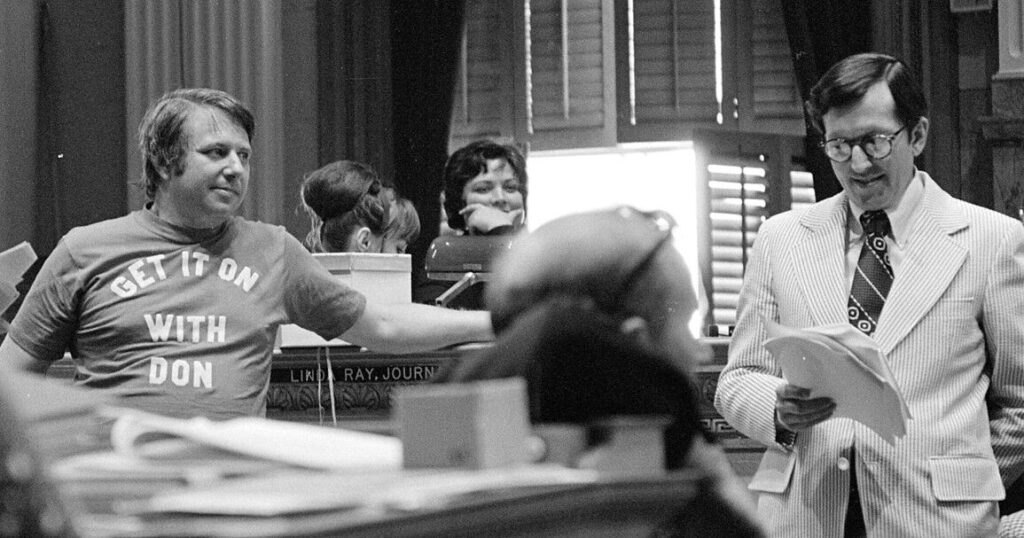
It is with great sadness I read of the death of Frank Traylor. From the moment we met at the beginning of the 1975 legislative session, I knew he was special. As a doctor, he knew medical issues better than...
Free speech isn’t a presidential call | Hal Bidlack
Hal Bidlack
hal-bidlack@coloradopolitics.com
Updated 6 days ago
There are so many things I want to write about this week. My kindly editor strongly desires that, in Colorado Politics, I write on Colorado politics (Ed: absolutely!). That’s quite reasonable and he is the boss so here goes… So,...

Modern public safety tools strengthen the freedoms we cherish | OPINION
Colorado Politics
colorado-politics@coloradopolitics.com
Updated 6 days ago
By Samuel G. Michael As someone who has spent years working alongside Ethiopian families across Colorado, I’ve heard a common story. Many of us came to this country seeking two things that define the American promise — safety and freedom....

Trump joins Dems’ assault on rural Colorado | Dick Wadhams
Dick Wadhams
dick-wadhams@coloradopolitics.com
Updated 7 days ago
Ruling Colorado Democrats have assaulted rural Colorado for the past seven years under Gov. Jared Polis and the Democratic socialists who drive their massive legislative majorities. They are destroying mining and oil-and-gas jobs while imposing wolves on Colorado ranchers and...

The art of a Trumpian Colorado deal for Tina Peters | Miller Hudson
Miller Hudson
miller-hudson@coloradopolitics.com
Updated 7 days ago
Listen up, Colorado! I have a hell of a deal for our state that’s a solid-gold work of art. We should know by now we have a president who won’t pass up any opportunity to micturate on the Centennial State....
PREV
PREVIOUS
State should make Xcel transition off Comanche plant by 2030
Alison Coombs Last week, Xcel Energy made a backroom deal with the Colorado Oil and Gas Association and state and local leaders to put forward a proposal to burn coal at Colorado’s biggest and dirtiest coal plant until 2035, recover all the costs of the broken coal plant on the backs of ratepayers, and build […]

BIDLACK | Judging judging
Hal Bidlack Most of the time, when I sit down at my computer every Monday and Thursday morning to write my column for the next day, I am inspired by a story in Colorado Politics, and that inspiration is enough for me to spew forth the 1,000 words, or so. On other days, such as […]