

‘Make My Day’ law under Supreme Court scrutiny following Colorado Springs slaying

A Colorado Springs man went into the basement of his apartment building and encountered an intruder. Within minutes, he had killed the intruder with his gun.
Although prosecutors and the defense differ on exactly what happened in the basement during that early morning in January 2017, lower courts agreed that Patrick Rau could not be prosecuted for the shooting of Donald Russell. Under a provision of Colorado law, nicknamed the “Make My Day” statute, the occupant of a dwelling may use deadly physical force against a person who enters unlawfully.
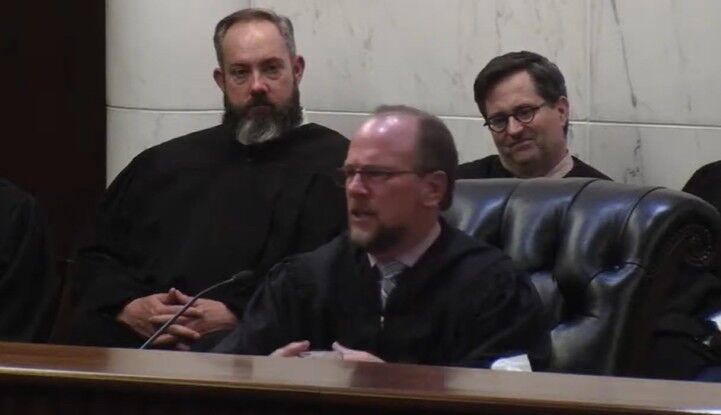
On Monday, the state Supreme Court listened as attorneys argued over whether the basement of an apartment building qualifies as a “dwelling” under the law. In doing so, the justices heard two different versions of life under “Make My Day”: either the court would be sanctioning chaos in hallways and common areas as tenants gun down anyone unfamiliar to them, or it would simply give renters the same rights to self-defense as single-family homeowners.
“‘Make My Day’ is unique. It gives uncommonly broad authority to people to use deadly physical force,” Doyle Baker of the Fourth Judicial District Attorney’s Office told the justices. “There was no indication from the interview Mr. Rau did with the detective that he recognized the man who was shot. He guessed the man was an intruder. And he guessed correctly in this case. But he could’ve been wrong.”
“Make My Day,” “Stand Your Ground” and “no duty to retreat” are legal principles that enable a person to use force, even deadly force, in self-defense without the requirement to disengage. There are several other conditions a person must satisfy in Colorado before receiving immunity from prosecution under “Make My Day.” The person using force must reasonably believe the intruder has committed, or intends to commit, a crime against people or property. They must believe the intruder might use any degree of force.
And importantly for Rau’s case, they must be in a dwelling.
“When you get into the common area of an apartment building, things get really fuzzy,” Baker explained. “And if you’re going to have this kind of law which we have, which almost gives somebody the right to a hair trigger to use physical force, it should be very clear the circumstances under which this should happen.”
The building in which the shooting took place, in the 200 block of North Wahsatch Avenue, was an old home that the owner had subdivided into seven units. The basement contained a furnace, water heaters, plumbing and other rooms that were not in use due to water damage.
Timothy Bussey, Rau’s attorney, characterized the building as “not a place any of us would really want to live.” It was reportedly subject to repeated break-ins, with intruders leaving behind syringes and feces. Police did not allegedly view the break-ins as a priority. Consequently, Rau kept a loaded handgun by his bed for protection.
According to Rau, when he went to the darkened basement after his girlfriend reported an intruder, he encountered a sleeping Russell. Rau told Russell to leave, otherwise Rau said he would use force. Russell reportedly began shouting and throwing objects, and Rau issued additional warnings that he would shoot. Finally, Rau indicated he would count backward from five, which he did, and then fired at Russell.
Both the trial court and the Court of Appeals found Rau acted according to the “Make My Day” law.
“In a single family home there would be absolutely no doubt” that the basement was part of the dwelling, Bussey said. The district attorney’s office, on the other hand, believed the Court of Appeals was wrong to ignore a three-decade-old decision that upheld the murder conviction of a man who shot someone in the stairwell of his apartment building.
“The stairwell was not part of the defendant’s apartment, but was a common area used by other tenants and their guests. We conclude that, for purposes of the ‘make-my-day’ statute, the common areas of an apartment building do not constitute a dwelling,” the appeals court decided in People v. Cushinberry.
Baker argued that if lawmakers had intended for common areas to be included as parts of a dwelling, they could have changed the law in response to the Cushinberry ruling. The fact that they did not, he added, showed the General Assembly agreed that “Make My Day” does not apply as broadly as Rau claims it does.
“A person in this situation is not defenseless. It’s not as if they have no ability to exercise self-defense. What they don’t have, if they’re not in their dwelling, is this uncommonly broad right to have deadly force,” he said.
Members of the court wondered how the use of deadly force in common areas might translate to other types of living arrangements.
“I think about how the world has changed over the past 10 years in terms of Airbnb and Vrbo, and I think about mountain resorts with common areas,” said Justice Maria E. Berkenkotter.
“Think of the many students in Boulder or Fort Collins who live in group homes,” added Justice Melissa Hart. “Would you say the kitchen in the group home is not subject to the ‘Make My Day’ defense because it’s shared by all the people living in the home? Do people living in single family homes get a different application of the law?”
Bussey argued that there is no single rule that should cover every type of dwelling. He believed “Make My Day” should apply in settings intended for habitation, where there is also some exclusive use.
Although the government maintained that expanding the “Make My Day” defense to common areas would give rise to people escalating benign encounters into outright slayings, Justice Richard L. Gabriel reminded the court that immunity from prosecution meant satisfying every criterion under the law, regardless of what dwelling means.
“A person in Mr. Rau’s place takes on significant risk. If you don’t satisfy those provisions, you stand on trial for murder,” he said.
The case is People v. Rau.


Federal judge hears arguments about Colorado’s 3-day gun purchase waiting period
Michael Karlik
michael.karlik@coloradopolitics.com
Updated 12 hours ago
A federal judge heard arguments on Monday about the constitutionality of a 2023 Colorado law that generally imposes a three-day waiting period on firearm purchases after the initiation of a background check. The test that the U.S. Supreme Court created...
Colorado Supreme Court intervenes in Weld County prosecution dismissed due to Missy Woods misconduct
Michael Karlik
michael.karlik@coloradopolitics.com
Updated 15 hours ago
The Colorado Supreme Court ordered a Weld County trial judge last week to respond to the district attorney’s claim that he improperly dismissed a criminal case because of “outrageous” conduct by the Colorado Bureau of Investigation. Daniel Lee Eatinger stood...
Schoolchildren’s presence at child sex-related trial did not harm Arapahoe County defendant, appeals court says
Michael Karlik
michael.karlik@coloradopolitics.com
Updated 3 days ago
Colorado’s second-highest court decided on Thursday that the presence of a group of schoolchildren on the first day of a child sexual exploitation trial did not violate an Arapahoe County defendant’s constitutional right to a fair trial. Prosecutors charged Jerry...
Appeals court cites week-old Colorado law to reinstate child neglect case at child, father’s request
Michael Karlik
michael.karlik@coloradopolitics.com
Updated 2 days ago
Colorado’s second-highest court invoked a new state law for the first time on Thursday and reinstated a child neglect case that both the child and her father wished to reopen. House Bill 1227 took effect on Aug. 12, reversing a...
Colorado Supreme Court names William Hood as next chief justice
Michael Karlik
michael.karlik@coloradopolitics.com
Updated 4 days ago
The Colorado Supreme Court has selected Justice William W. Hood III to be the next chief justice, the judicial branch announced on Friday. Hood will succeed Chief Justice Monica M. Márquez, who took over the role in July 2024. “I...
Family of slain Lakewood teacher releases statement as murder suspect makes first court appearance
Matt Kyle
matt.kyle@denvergazette.com
Updated 22 hours ago
Patrick Theodore Barnett, the Lakewood man accused of killing his wife, a Jeffco Public Schools art teacher, made his first court appearance Friday morning as his wife’s family looked on. The status conference hearing was held before District Court Judge...
Appeals court upholds Park County trophy hunting conviction
Michael Karlik
michael.karlik@coloradopolitics.com
Updated 4 days ago
Colorado’s second-highest court clarified on Thursday that a defendant may stand convicted under the state’s trophy hunting laws if he abandons a bear carcass but returns later to remove the meat. Under Colorado law, it is a felony to detach...

Judge grants partial injunction to GEO in fight against state health inspection law
Kyla Pearce
kyla.pearce@gazette.com
Updated 5 days ago
A judge ruled Thursday that The GEO Group does not have to follow parts of a new state law requiring more frequent health and safety inspections at the U.S. Immigration and Customs Enforcement processing center in Aurora. Under the order...
Parker man faces 20 years to life for serial sexual assaults
Nicholas Fogleman
nicholas.fogleman@denvergazette.com
Updated 5 days ago
A 25-year-old Parker man who sexually assaulted three women in 2025 pleaded guilty Wednesday and will serve 20 years to life in prison. Javier Rodriguez-Andrade pleaded guilty to charges stemming from three sexual assaults involving women ages 19 to 24. ...
Divided appeals court upholds warrantless DNA collection in Colorado cold case, cautions of government overreach
Michael Karlik
michael.karlik@coloradopolitics.com
Updated 5 days ago
Colorado’s second-highest court upheld the warrantless collection of a suspect’s DNA from a discarded soda can as constitutional on Thursday, while warning about potential abuse of DNA privacy in the absence of further guardrails. By 2-1, a three-judge Court of...
PREV
PREVIOUS
No charges will be filed against Arvada officer who killed ‘hero’ John Hurley
No criminal charges will be brought against the Arvada police officer who shot and killed John Hurley, a man who stopped a deadly mass shooting incident in Olde Town Arvada over the summer. District Attorney Alexis King announced her decision not to file charges Monday, more than four months after the incident on June 21 […]
As doses begin to flow, Polis celebrates Colorado kids who participated in vaccine trial
In a rare moment of pandemic-related celebration, Gov. Jared Polis celebrated Monday the 252 Colorado kids who participated in one of the largest trials for the pediatric vaccine. “Because of you, I was able to get my 7-year-old and 10-year-old vaccinated just this last weekend, and that wouldn’t have been possible without your help,” he […]