

Harassment of elephant importers not a reason to withhold names, appeals court rules

By a 2-1 decision, a panel of the U.S. Court of Appeals for the 10th Circuit determined the public interest supported the U.S. Fish and Wildlife Service’s disclosure of names listed on importation paperwork, even though the government tried to argue that trophy hunters and others should be protected from public shaming.
“[T]he public still has an interest in knowing the identities of the submitters to ensure that FWS is fulfilling its duty to oversee the import of elephant parts consistently with the law,” wrote Senior Judge David M. Ebel in an Oct. 13 opinion. “Negative publicity about a small number of high-profile individuals does little to demonstrate the possibility of harassment across the entire group of submitters here.”
Stephen Hernick, attorney for Friends of Animals, said the group was pleased with the majority’s decision that the federal government cannot shield information based on the possibility that people will express their dissatisfaction with individuals or businesses who choose to import animal parts. Those parts include the portions of an animal that hunters sometimes keep and display, known as trophies.
“Specifically, we intend to use this information to better understand who is importing elephant parts and to verify that the government is adhering to the regulations governing their import,” Hernick said.
The appellate victory for Friends of Animals comes roughly three years after the Fish and Wildlife Service announced it would withhold certain information in response to the group’s Freedom of Information Act (FOIA) request. Friends of Animals is based in Connecticut, and its western law office is located in Centennial. The group, which opposes hunting and the human consumption of animals, had asked the agency for paperwork used in the importation of elephant parts, known as a Form 3-177.
The form includes, among other information, the name of the importer. The Fish and Wildlife Service delivered the record with the names redacted, citing two exceptions to FOIA: first, the information would pose a “clearly unwarranted invasion” of privacy, and second, these were law enforcement records that were reasonably protected from an invasion of privacy.
After the agency failed to respond to an appeal by Friends of Animals, the advocacy group sued.
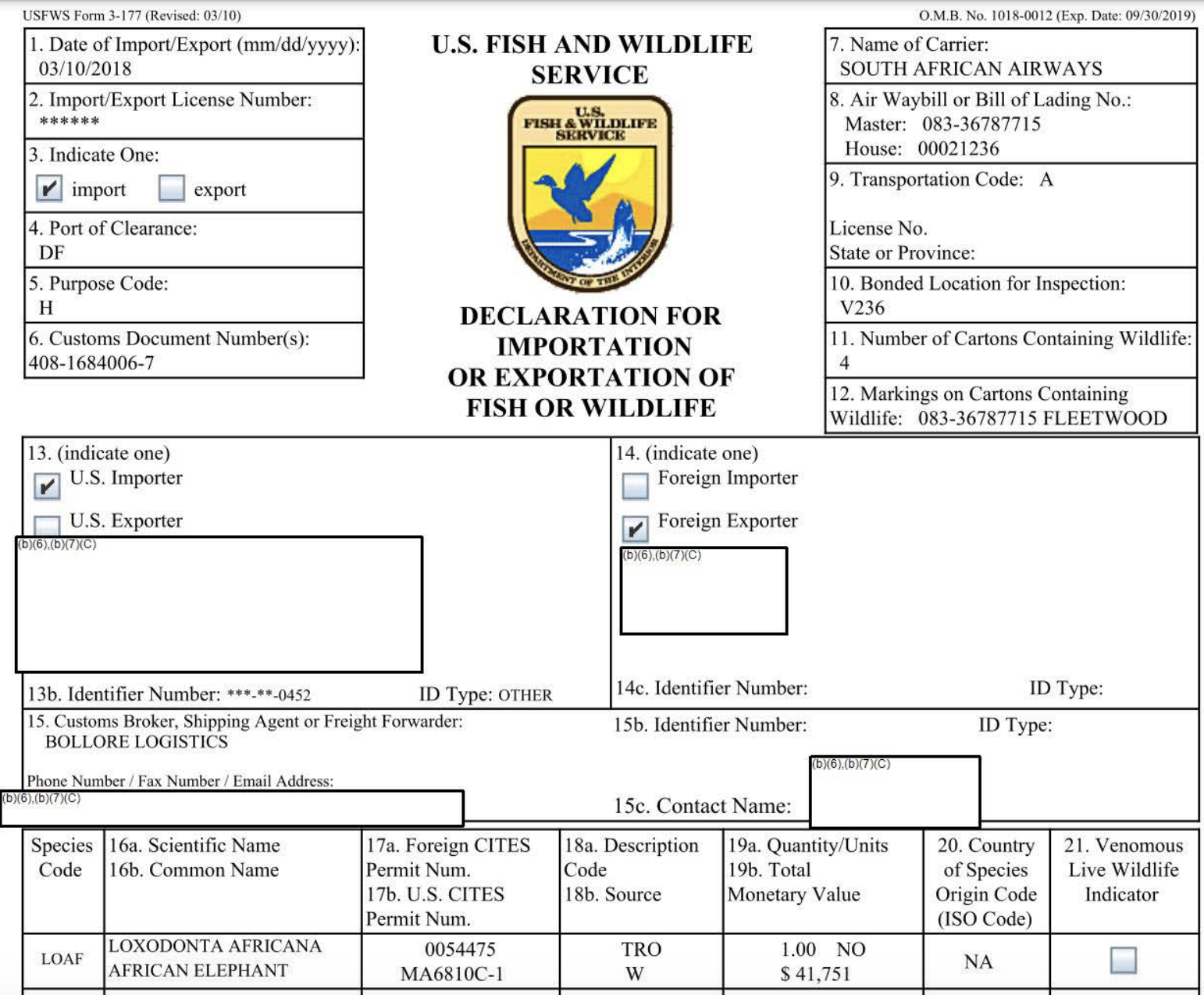
In April 2020, U.S. Magistrate Judge Michael E. Hegarty sided with the government. He found that importers had an expectation of privacy in filling out the forms. The government had pointed out that previous open records requests from Friends of Animals had resulted in the public identification of trophy hunters – who in some cases were labeled as “vile” and “bloodthirsty.”
“[T]he Court finds Defendant’s argument that releasing the names of individual submitters could reasonably lead to harassment more than speculative. Plaintiff acknowledges that it has previously published the names, cities, and states of individuals who were issued sport-hunted trophy permits,” Hegarty wrote in his decision.
But a majority of the appellate panel found that the magistrate judge “got the balance wrong” by deciding the risks of disclosure outweighed the public benefit to knowing the names of elephant importers.
During oral arguments, Hernick said his group was not alleging wrongdoing by Fish and Wildlife Service personnel. Instead, he believed it important for the public to know the circumstances surrounding government-sanctioned importation.
“Are these people who have been convicted of previous wildlife crimes? Are these people who are involved in conservation activities? Are the same individuals importing parts over and over and over again so that just a few individuals make up the vast majority of imports?” he asked.
FOIA, responded Ebel, is “strictly limited to an interest in how the agency operates….I assume what you’re saying is this information would be useful to receive if the agency has favoritism in the people they allow to do importing, or if the agency is not adequately checking on the backgrounds or the agency is allowing people to come in in a way that is somehow wrong.”
The discussion raised the case of Walter Palmer, a Minnesota dentist who reportedly paid tens of thousands of dollars to hunt and kill a well-known lion named Cecil in Zimbabwe in 2015. His actions prompted a worldwide backlash and threats to Palmer’s family.
“Couldn’t the fact that this is an activity that is scorned upon by a great deal of society itself subject the people to embarrassment?” asked Judge Robert E. Bacharach.
“Information can be disseminated so quickly and in such inflammatory ways through the Internet and social media,” added Chief Judge Timothy M. Tymkovich. “Is it legitimate for us to worry about what uses these data might be put to?”
Marissa R. Miller, representing the Fish and Wildlife Service, told the judges that the redacted names in large part involved people working for an importing business, who may in fact simply be filling out paperwork.
“We have to draw the distinction between government records that shed light on what the government is doing versus government records that contain information about private citizens,” she said.
But Ebel, writing for himself and Bacharach, determined the government had failed to show that people submitting the forms believed they were entitled to privacy, feared harassment or otherwise wished to keep their names private. Although people import elephant parts and trophies by choice, Ebel rejected the Fish and Wildlife Service’s argument that animal importation was just as shielded from disclosure as other stigmatized activities that people engage in voluntarily.
“FWS is correct that individuals still possess a privacy interest in voluntary conduct, but the examples it gives (Botox, erotic novels, strip clubs, hemorrhoid cream), do not contain an analogous level of regulation,” he wrote. “An individual is not required, for example, to apply for a special federal permit to purchase an erotic novel, and does not need an import declaration to ship that erotic novel across state or country lines.”
Tymkovich dissented, believing the lower court was properly sensitive to the privacy of trophy importers, given the social media shaming or harassment that was “almost certain” to result from Friends of Animals’ records request.
“Importing elephant and giraffe parts is controversial, as evidenced by these articles and by Friends of Animals’s work – and Friends of Animals intends to spark outrage against these individuals and their conduct,” he wrote.
Hernick expressed surprise that Tymkovich characterized his organization’s motivation as wanting to gin up antipathy towards trophy importers.
“Friends of Animals does not engage in harassment and does not condone harassment. If people are worried about their import records sparking outrage, there is a simple solution: they should not import the parts of imperiled wildlife,” he said.
According to the Great Elephant Census project, the population of elephants on the African savanna decreased by 30% between 2007 and 2014, primarily due to poaching. During roughly that same period, American recreational hunters imported 126,000 animal trophies each year to the United States. The Fish and Wildlife Service developed regulations for importation permits in accordance with the Endangered Species Act and the 1975 Convention on International Trade in Endangered Species of Wild Fauna and Flora.
In the remaining portions of the appeal, the panel members agreed that the magistrate judge incorrectly relied on a hearsay statement in upholding the redaction of an exotic leather business’s identifying information. The panel also agreed that the Fish and Wildlife Service was justified in redacting names from a similar open records request about the importation of giraffe parts. Giraffe imports were not as heavily regulated as those involving elephants, and consequently the public interest in disclosure was not as great, the panel added.
The case is Friends of Animals v. Bernhardt et al.


Colorado board permits state to appeal injunction against arthritis drug price cap
Marissa Ventrelli
marissa.ventrelli@coloradopolitics.com
Updated 5 hours ago
A Colorado board voted Friday to allow the Attorney General’s Office to fight an injunction against a price cap on a drug that treats arthritis. A U.S. district court judge had granted the company Amgen a preliminary injunction, temporarily blocking...

Federal judge rejects constitutional claims, ‘expressions of hatred’ by Club Q defendant
Michael Karlik
michael.karlik@coloradopolitics.com
Updated 5 hours ago
A federal judge rejected a defendant’s claims that he received constitutionally ineffective assistance of counsel while facing federal hate crime and firearms charges for murdering five people at a Colorado Springs LGBTQ nightclub in 2022. Anderson Lee Aldrich is serving...

Divided 10th Circuit upholds Colorado congestion fee on car rentals
Michael Karlik
michael.karlik@coloradopolitics.com
Updated 1 hour ago
The Denver-based federal appeals court concluded on Monday that a 2024 “congestion impact fee” that lawmakers imposed on short-term vehicle rentals did not conflict with a federal prohibition on certain airport-related charges. Beginning in the 1970s, Congress began limiting the...
10th Circuit dismisses woman’s lawsuit following 10-year attempt to undo restraining order
Michael Karlik
michael.karlik@coloradopolitics.com
Updated 3 days ago
The Denver-based federal appeals court rejected a woman’s challenge on Friday to a restraining order imposed on her more than a decade ago, finding that she cannot credibly claim she will be prosecuted for violating the restraining order through her...
10th Circuit dismisses woman’s lawsuit following 10-year attempt to undo restraining order
Michael Karlik
michael.karlik@coloradopolitics.com
Updated 3 days ago
The Denver-based federal appeals court rejected a woman’s challenge on Friday to a restraining order imposed on her more than a decade ago, finding that she cannot credibly claim she will be prosecuted for violating the restraining order through her...
Colorado equal pay law does not require plaintiffs to allege gender-based retaliation, appeals court finds
Michael Karlik
michael.karlik@coloradopolitics.com
Updated 2 days ago
The 2019 Colorado law aimed at rooting out pay discrimination on the basis of sex does not require a plaintiff to allege their employer retaliated against them for sex- or gender-related reasons, the state’s second-highest court decided on Thursday. Lawmakers...
Hudson faces lawsuit over ICE detention facility
Nicole C. Brambila
nicole-c-brambila@coloradopolitics.com
Updated 4 days ago
A nonprofit organization filed a lawsuit against the Town of Hudson Wednesday, challenging plans to reopen a former federal prison in the town as a U.S. Immigration and Customs Enforcement detention facility. Together Colorado, along with Janet E. Carlson, filed...
Senate committee advances Trump’s 10th Circuit nominee, as Domenico responds to questions about delays
Michael Karlik
michael.karlik@coloradopolitics.com
Updated 4 days ago
The U.S. Senate Judiciary Committee advanced President Donald Trump’s nominee to the Denver-based federal appeals court on Thursday by a party-line vote of 12-10. U.S. District Court Judge Daniel D. Domenico, who was Trump’s first-term appointee to Colorado’s federal trial...
Colorado justices to hear embryonic donation dispute
Michael Karlik
michael.karlik@coloradopolitics.com
Updated 4 days ago
The Colorado Supreme Court announced on Monday that it will decide whether lower court judges properly applied its framework for adjudicating disputes over the fate of pre-embryos, in which one person wants to use them to become a parent and...

Isolation, emotion, persona: Colorado judicial programming prepares people for life on the bench
Michael Karlik
michael.karlik@coloradopolitics.com
Updated 4 days ago
As a trial judge and now as a member of the Colorado Supreme Court, Justice Carlos A. Samour Jr. has heard the view that being a judge is isolating. “In neither court have I felt isolated. I’ve always interacted a...
PREV
PREVIOUS

Polis pleads for booster, vax uptake as hospitalizations continue to spike in Colorado
Gov. Jared Polis pleaded with Coloradans on Thursday to get vaccinated or get a booster dose, as the state faces shrinking intensive care bed capacity and rising COVID-19 hospitalizations that have stressed the its health care system to its worst levels in nearly a year. “Never in my wildest imagination did I think that there would be […]

Top Colorado health official hints at 'potential policy response' to slow pandemic; Polis remains mum
The head of Colorado’s Department of Public Health and Environment told other leading health officials Thursday that state leaders were considering a “potential policy response” to address the current pandemic surge, as hospitals fill with COVID-19 patients and the flu season nears. Since the spring, the state has entirely handed pandemic response measures to local […]