

Colorado Option bill receives preliminary approval from state Senate
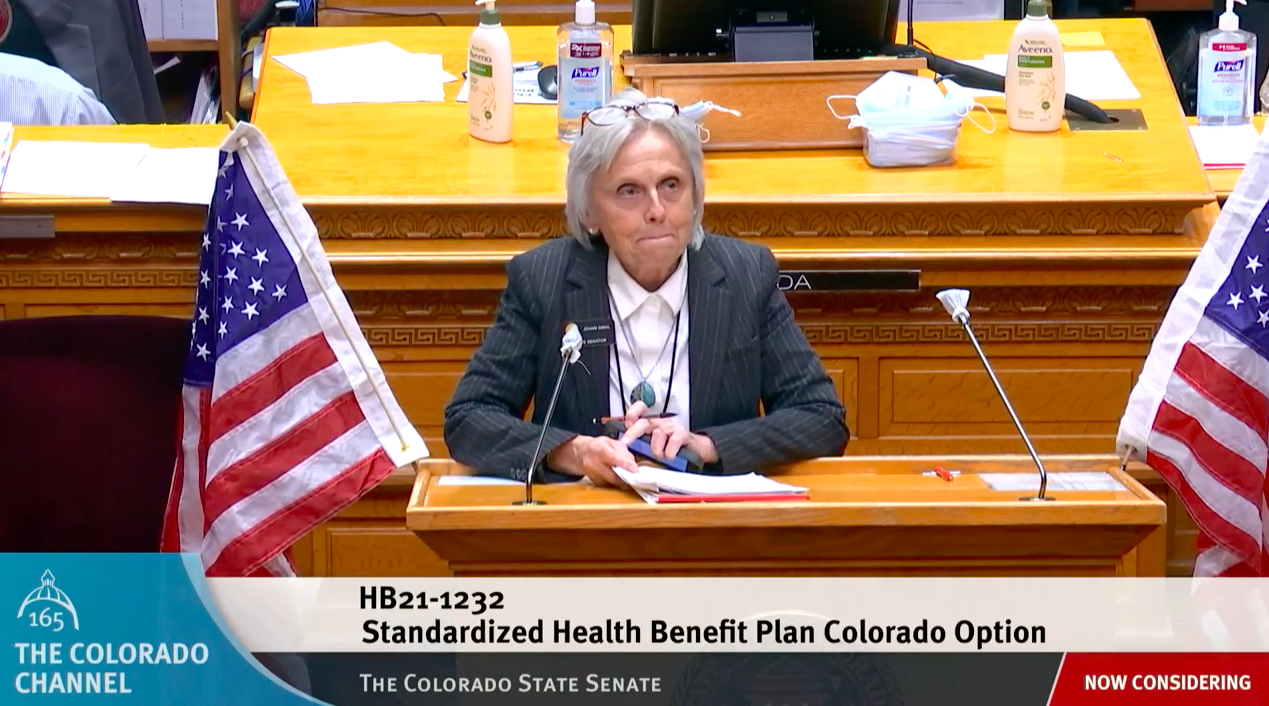
“This isn’t the silver bullet” for fixing healthcare, Senate Majority Leader Steve Fenberg, D-Boulder, told the Senate as they began debate Tuesday on House Bill 1232, the once-upon-a-time public option bill.
Senators ran through many amendments in what will be the penultimate big fight on the bill. The last will be waged within a conference committee, one that is all but certain to take over in crafting the final version of the bill.
Under HB 1232 as it arrived in the Senate, the commissioner of insurance would develop a standardized healthcare plan, despite the Division of Insurance being responsible for oversight on health insurance plans, not creating them (opponents claim it is a conflict of interest). The bill is silent on where oversight for all other health insurance plans would reside as it applies to the standardized plan, known as the Colorado Option.
Under the bill, doctors and all healthcare providers and hospitals would be mandated to accept the plan and insurance companies would be mandated to offer it. Healthcare providers who refuse would receive a warning and a $5,000 annual fine. Hospitals would face a $10,000 per day fine for 30 days and $40,000 per day after that, although the bill’s fiscal note said they do anticipate a high level of compliance.
Collectively, healthcare providers, hospitals and insurance plans would be responsible for reducing premiums by 18% over three years, although that was amended Tuesday to 15% in an amendment by sponsor Sen. Kerry Donovan, D-Vail.
Supporters claim another 18,000 Coloradans could afford health insurance under the bill.
“This bill is personal to me,” said Sen. Janet Buckner, D-Aurora. She has lots of doctors in her family, and she also knows that people of color and low-income Coloradans in her district and elsewhere have struggled with health care, and the pandemic has only made it worse. She called the bill “the art of compromise.” When this legislation passes, Buckner said, “we will make sure everyone is held accountable.”
But an amendment announced by Fenberg during a morning press availability would no longer mandate doctors to participate in the Colorado Option plan. Hospitals would still be mandated to participate, and that resulted in the Colorado Association of Health Plans moving from an amend position to flat-out opposition.
“I can be silent no longer” about the costs of healthcare, Donovan said. The first amendment she offered was the doctors’ amendment, promoted by the Colorado Medical Society. It removes the warning and fine for healthcare providers, and adds in that the commissioner shall monitor for problem areas where health care providers are not participating. While it doesn’t specifically allow doctors out of the mandate, there are no penalties if they don’t participate.
Sen. Barbara Kirkmeyer, R-Brighton, pointed out that another section of the bill allows the commissioner of insurance to hold hearings on lack of participation (and which is tied to healthcare providers) and that she believes even without the warning and fines the provider’s license could be at risk.
That amendment, later adopted, was supported by Sens. Rhonda Fields, D-Aurora, and Joann Ginal, D-Fort Collins. Doctors and hospitals did everything they could to fight the virus, Fields said. “And yet we had this bill that wanted to penalize doctors and hospitals. That’s the wrong message at the wrong time.”
She also questioned why the bill would fine doctors after they risked their lives and their family’s lives to help the state through the pandemic. But she also said the amendment doesn’t help the hospitals, and hinted she may have an amendment later to address that issue.
Ginal said it wasn’t ethical to mandate that healthcare providers participate.
Another Donovan amendment removed the bill’s language on revoking a hospital’s license for failure to participate. The bill still allows a license to be suspended and does not change the fines. Fields said that was a step in the right direction, although the bill is still punitive toward hospitals, she said.
A Kirkmeyer amendment attempted to go further by striking the section on a hospital’s license suspension but failed, despite support from Fields. An amendment from Fields, promoted by UC Health to provide a higher rate of reimbursement based on the type of cases or that the hospital provides high-quality care, also failed. Fields voted against it.
The Senate laid over the bill until later in the day because of the absence of Sen. Chris Kolker, D-Centennial, who had to leave for a preschool graduation.
When it resumed, it was Sen. Bob Rankin, R-Carbondale, who pointed out what he said was one of the bill’s major flaws. The bill doesn’t give credit to successful efforts to reduce the costs of healthcare, such as the case with the Summit County Peak Health Alliance system, a nonprofit health insurance exchange that according to the Colorado Sun “allows employers and individuals to negotiate prices directly with doctors and the local hospital and then use those prices to get a better deal from insurers.”
It has been cited as model of how to reduce premiums by Gov. Jared Polis, and it’s a model being looked at nationwide. But despite the savings it has already produced for its consumers, Peak would be required to reduce its premiums by another 18%. Rankin’s amendment, which failed, would have used a co-op’s previous five-year history of reducing costs as part of the benchmark for the 18%.
“They have to start over,” Rankin said. “That’s ridiculous.”
During debate Tuesday, Colorado’s Health Care Future released an actuarial analysis of the bill conducted by Milliman Inc. of Seattle. Colorado’s Health Care Future is a project of the Partnership for America’s Health Care Future, which gets its funding from the healthcare industry, including insurance companies, pharmaceutical companies and hospitals.
Among the findings it lists:
- HB21-1232 gives the Commissioner of the Division of Insurance the authority to reduce hospital and healthcare provider reimbursement rates to achieve target premiums, but does not provide the authority to enforce reductions in pharmacy costs or insurer retention. Insurers may choose to reduce margin or increase care management protocols to achieve a portion of the reduction, but it is also possible that the entire premium reduction is achieved through lower reimbursement to hospitals and other healthcare providers.
- HB21-1232 uses a uniform set of criteria for establishing minimum reimbursement levels for facilities across the state. The use of a uniform set of criteria will drive non-uniform results by region, since healthcare costs differ dramatically by region for a multitude of reasons.
Ginal, prior to the bill’s preliminary vote, said some of the emails she’s gotten in support indicate that people believe the bill will lead to free health insurance with no copays. “Somebody is leading them down a road that is really not the truth,” Ginal said. She also is troubled by the lack of a sunset provision in the bill, an amendment offered by Sen. Jim Smallwood, R-Parker, that was rejected.
Ginal, who campaigned on reducing the cost of health care, pointed to the Washington State public option, which has seen an increase in premiums, not lower ones. “I hope it works,” Ginal said, but she struggles with the claim that it will lower costs. “I think it needs a lot more work.”
The bill won preliminary approval on a voice vote and will be on the calendar for a final vote on Wednesday.



What courageous citizenship really looks like | Vince Bzdek
Vince Bzdek
vince.bzdek@gazette.com
Updated 2 hours ago
By Vince Bzdek What exactly is courage? Ernest Hemingway famously called it grace under pressure. Mark Twain wrote that “courage is resistance to fear, mastery of fear — not absence of fear.” C.S. Lewis refined that even more: “Courage is...
The coming election and mischief in the making | SONDERMANN
Eric Sondermann
eric-sondermann@coloradopolitics.com
Updated 3 days ago
America’s tribalism is such these days that we struggle to even agree on the basic rules. Elections have always been hotly contested. As the saying goes, “Politics ain’t beanbag.” The process has long involved elements of nastiness and underhanded conduct....
Colorado Politics Calendar Aug. 31-Sept. 6
Rachael Wright, Special to Colorado Politics
rachael.wright@coloradopolitics.com
Updated 3 days ago
CoPo’s weekly political calendar will help you find political and public-policy events throughout Colorado. It includes candidate and issue campaign events, public policy meetings, court hearings, state and local party conventions, assemblies, debates, rallies, parades, speaking engagements, traveling dignitary appearances,...

Tancredo in Running for Dept. of Ed. Position | A LOOK BACK
Rachael Wright, Special to Colorado Politics
rachael.wright@coloradopolitics.com
Updated 3 days ago
Forty-five years ago this week: “I know that my name has been placed before the Secretary of Education, and I know that I’m one of three or four being considered for the Department of Education’s Region 8,” said state Rep....
Colorado measure adding ID checks to mail-in voting qualifies for ballot
Marissa Ventrelli
marissa.ventrelli@coloradopolitics.com
Updated 22 hours ago
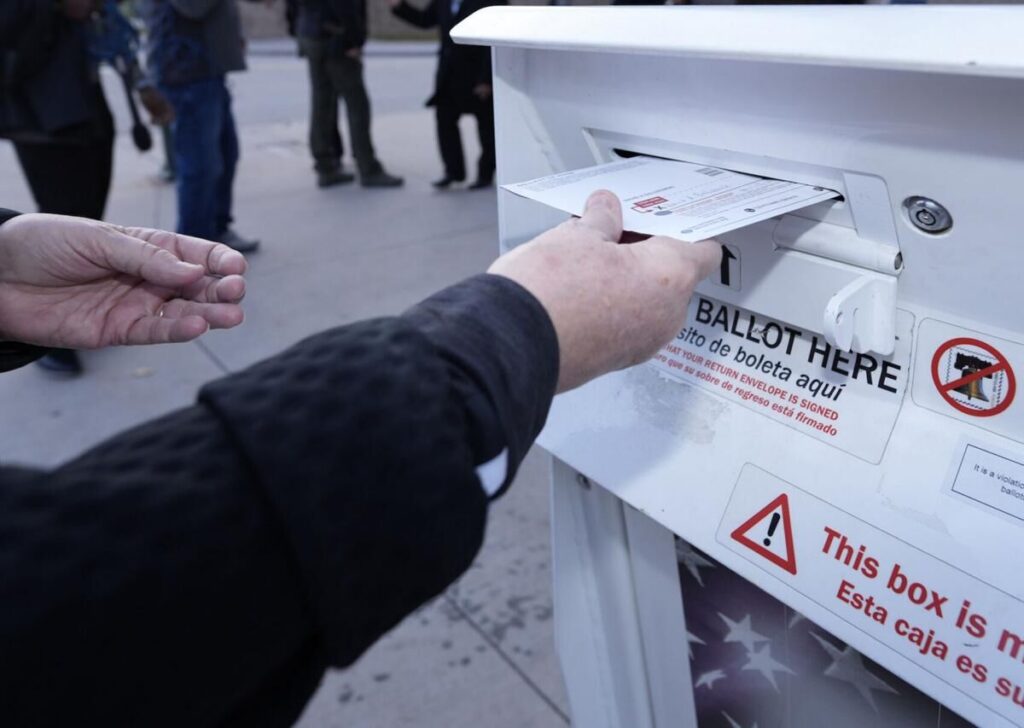
A ballot initiative that would require voters to include additional information on mail-in ballots has qualified for the November election, according to the Secretary of State’s Office. Backed by El Paso County Treasurer Chuck Broerman and former Deputy Secretary of...
Colorado election website error exposes personal data of confidential voters
Marissa Ventrelli
marissa.ventrelli@coloradopolitics.com
Updated 23 hours ago
A system update accidentally lifted protections on confidential records in Colorado, exposing dozens of voters’ personal information, according to the Secretary of State’s Office. The limit that normally blocks access to confidential voter profiles was inadvertently disabled during an update...

PUC adds weekly comment after killing private talks
Scott Weiser
scott.weiser@gazette.com
Updated 23 hours ago
The Colorado Public Utilities Commission will take public comment at the start of every commissioner’s weekly meeting beginning Sept. 9 as part of its new transparency mandate, the commission announced, expanding a slot previously limited to the second Wednesday of...
10th Circuit overturns framework for sentencing probation violators by 11-1
Michael Karlik
michael.karlik@coloradopolitics.com
Updated 58 minutes ago
In a rare decision by all 12 of its full-time judges, the Denver-based federal appeals court ruled in a lopsided vote on Friday that one of its members created a sentencing process for probation violators that was out of step...

Federal judge dismisses excessive force lawsuit against Colorado Springs, officer
Michael Karlik
michael.karlik@coloradopolitics.com
Updated 5 hours ago
A federal judge concluded last week that a Colorado Springs police officer could not be held liable for shooting a suspect three times after the man menaced two victims with a gun and fled the scene. Al’morion Germany was involved...

DeFlock started from one man’s curiosity — now Flock cameras are a midterm issue
Claire Carter
claire.carter@washingtonexaminer.com
Updated 1 day ago
Will Freeman wasn’t looking to start a national movement when he launched DeFlock after noticing Flock Safety’s automatic license plate readers along the side of the road. The software engineer was driving across the country in 2024 when the cameras...
PREV
PREVIOUS

NONPROFIT REGISTER | Denver Public Library’s free Summer of Adventure youth reading program starts today
DENVER PUBLIC LIBRARY Denver News: Enrollment opens today for the Denver Public Library’s Summer of Adventure, a program where young people from toddlers through 12th grade are challenged to complete 15 activities built around reading, making and exploring. Participants will be given a prize, while supplies last, for finishing all 15. Signups are being taken […]

Senate panel approves bills on guns, police accountability, plastics ban in late-night session
In a hearing kicking off just before 8:30 p.m. on Tuesday and wrapping just before 2 a.m. on Wednesday, a Senate panel voted to advance more than a half dozen bills, including some of the signature pieces of legislation this session. Included in the slate of bills approved by the State, Veterans and Military Affairs […]