

Legislature eyes a fund without money for higher teacher pay
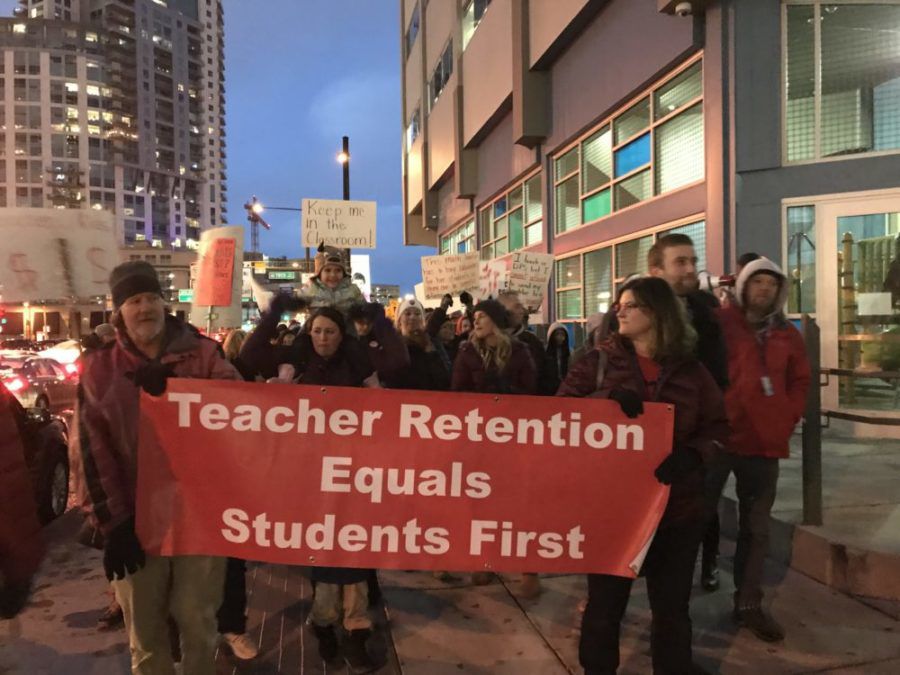
The Colorado Senate is working on a bill to create a fund to pay educators more. The hitch is that the fund doesn’t have any money in it.
Senate Bill 172 passed 5-2 out of the Education Committee Thursday afternoon. If it becomes law, a fund would be waiting at the ready for lawmakers to someday decide to put money in it.
The Democratic-led legislation is sponsored by Sen. Jessie Danielson of Wheat Ridge and Senate President Leroy Garcia of Pueblo with Reps. Julie Gonzales-Gutierrez of Denver and David Ortiz of Centennial.
Danielson ran a similar bill with Garcia and Gonzales-Gutierrez (before Ortiz was elected to the House) last year that got washed out with the health emergency tied that roiled last year’s session.
That bill, however, had money, $15 million to raise every school’s minimum teacher salary to $40,000 a year and wage-earners to a minimum of $15 an hour. The bill passed two committees on party-line votes before it was effectively tabled last year.
RELATED:
Danielson told the Senate Education Committee Thursday that this year’s version has “a lot of changes.”
“The need is still present,” she said, reminding fellow lawmakers of the oft-cited statistic that teachers make 40% less than the average income earner in Colorado, and many work second jobs and can’t afford to live in the communities where they teach.
Danielson said the state’s teacher shortage can be attributed to the educators who aren’t going into the profession or opting out for better pay.
“We don’t pay these people enough to keep qualified teachers in the classroom,” she said.
Annually lawmakers talk about putting more money into schools, but the question most often is left to local governments to pass higher property taxes for education, while rural and low-income schools fall farther behind.
Despite its empty fiscal promise, the bill was supported by education advocates, as well as by committee members who voted against it Thursday.
Amie Baca-Oehlert noted the legislature technically owes K-12 education $9 billion from the amount passed by voters and delineated in the state constitution, which is frequently talked about at the Capitol but left resolved as the state’s operating budget covers expenses and other priorities in good years and bad.
“So many teachers are not just educators and paraprofessionals, but they’re also counselors and coaches and referees and, at times they act as parents, friends and mentors,” she said. “Yet we’re at the bottom of the barrel nationally with how we pay educators for what we expect of them, not the least of which is the education of our children.”
Colorado teachers are among the lowest paid in the country, despite an economy that was annually one of the best before the pandemic, Baca-Oehlert said.
Education is often pitted against transportation funding, but neither get enough to satisfy their respective proponents, and that could be the case again this year, as Gov. Jared Polis looks for $500 million annually to cover the 10-year plan the state Department of Transportation released a year ago.
The two Republican lawmakers who voted against the bill, Sens. Paul Lundeen of Monument and Barbara Kirkmeyer of Brighton, who both supported the bill, wanted to designate that the any money that ever goes into the fund goes first to teachers, then administrators and support staff.
Danielson pushed back, saying all educators covered by the bill impact a student’s education, including bus drivers, custodians or assists the classroom teacher.
“These people are just as important as the classroom teacher,” she said. “And, unfortunately, we in Colorado underpay them as severely as we do classroom teachers.”
Lundeen said the committee on Thursday was answering the question akin to how you eat an elephant. “One bite at a time,” he said.

Colorado lawmakers push reforms for handling defendants deemed incompetent
Marissa Ventrelli
marissa.ventrelli@coloradopolitics.com
Updated 13 hours ago
Colorado lawmakers from both parties are backing a bill that would reshape how the state handles defendants found incompetent to stand trial and unlikely to regain competency, aiming to fill long-standing gaps in treatment and placement. Sponsors of Senate Bill...
Colorado title board rejects government transparency measure, backers plan appeal
Marianne Goodland
marianne.goodland@coloradopolitics.com
Updated 13 hours ago
A broad coalition’s push for stronger government transparency hit a major setback last week when Colorado’s title board rejected a proposed ballot measure that would allow more public access to most legislative deliberations. The three‑member title board on April 15...
Colorado body reviews redistricting proposals as battle heats up nationwide
Marianne Goodland
marianne.goodland@coloradopolitics.com
Updated 12 hours ago
With 60 proposals on the April 15 agenda, Colorado’s title board wrapped up its final initial hearing for the 2026 election cycle, sending forward a slate of measures that could reshape workers’ compensation and reignite partisan battles over congressional redistricting....

Colorado title board rejects government transparency measure, backers plan appeal
Marianne Goodland
marianne.goodland@coloradopolitics.com
Updated 14 hours ago
A broad coalition’s push for stronger government transparency hit a major setback last week when Colorado’s title board rejected a proposed ballot measure that would allow more public access to most legislative deliberations. The three‑member title board on April 15...

What we know about nearly a dozen scientists who went missing, died, or were murdered
Emily Hallas, Washington Examiner
emily.hallas.washington.examiner@gazetteedit.wpenginepowered.com
Updated 12 hours ago
The Trump administration is probing concerns surrounding nearly a dozen scientists said to be connected to highly secretive space research whose deaths and disappearances are under increasing scrutiny. President Donald Trump called the situation “pretty serious stuff” last Thursday, revealing...

Businesses can claim refunds starting Monday for Trump tariffs declared unconstitutional
Mae Anderson
mae.anderson@associatedpress.com
Updated 21 hours ago
NEW YORK (AP) — A refund system for businesses that paid tariffs which the U.S. Supreme Court ruled President Donald Trump imposed without the constitutional authority to do so is scheduled to launch Monday. Importers and their brokers will be...
U.S. Supreme Court will hear challenge from Colorado Catholic preschools on state funding exclusion
Lindsay Whitehurst
lindsay.whitehurst@associatedpress.com
Updated 14 hours ago
WASHINGTON (AP) — The Supreme Court will hear from Catholic preschools that say Colorado violated their religious rights by excluding them from a state-funded “universal” pre-kindergarten program over their admission policies. The court agreed on Monday to take up the...
Trump rejects energy secretary’s claim about gas prices staying high: ‘Totally wrong’
Molly Parks, Washington Examiner
molly.parks.washington.examiner@gazetteedit.wpenginepowered.com
Updated 17 hours ago
President Donald Trump rejected Energy Secretary Chris Wright’s statement that gas prices may not fall below $3 before 2027, remaining confident that prices will drop once hostilities cease between the United States and Iran. Trump told the Hill that gas...
Colorado company ready to build the lunar base, provide ‘lunar mobility’
alex-edwards
alex.edwards@gazette.com
Updated 17 hours ago
Original concepts for a moon base ranged from believable to outlandish. Following the success of Artemis II, which launched four astronauts around the moon over the course of 10 days, NASA is looking ahead as it attempts to take another...
DougCo commissioners challenging open meetings violation
Nicholas Fogleman
nicholas.fogleman@denvergazette.com
Updated 16 hours ago
The Douglas County Board of Commissioners is challenging a recent court decision that found the board violated Colorado Open Meetings Law. County commissioners filed a petition Thursday seeking a rehearing from the Colorado Court of Appeals. On April 2, the...
PREV
PREVIOUS
Biden says US will meet his goal of 100M COVID-19 shots on Friday, beating goal
President Biden announced his administration will meet its goal of administering 100 million COVID-19 shots in his first 100 days on Friday, the 58th day of his term. In an address on Thursday, he said the latest statistics showed that 99.2 million vaccinations had been delivered so far. He credited his use of the wartime […]

Adams County hoping to bump up its vaccine numbers
Adams County is among the worst counties at administering vaccines by one state metric, a trend that officials hope to reverse with uptake-minded pushes in the coming weeks. Among other vaccine distributions metrics, the state tracks how many vaccines counties have doled out per 100,000 county residents. Adams has distributed roughly 26,650 doses, which is […]