

Denver City Council begrudgingly approves police raises, blames mayor for ‘bad-faith’ negotiations

With its hands tied, Denver City Council on Monday approved a collective bargaining agreement with the Denver Police Department’s union that was decided earlier this month by an independent arbitrator after council members rejected the contract in September.
The move was the first time in recent memory that the city council had tossed out a police union contract proposal since police were granted collective bargaining rights in 1995.
The two-year deal with the Denver Police Protective Association – which the council was legally bound to approve – suspends paid holidays for police officers in 2021 but gives them two raises in 2022, including a 2% bump at the start of January, and another 1.5% raise in July. The terms mirror those the council originally voted down three months earlier in an 8-5 tally, which sent the agreement into arbitration and boiled the blood of Mayor Michael Hancock, who called the council’s decision “short-sighted and irresponsible.”
On Monday night, however, the legislative branch had no choice but to pass the agreement; otherwise, the city would face litigation, a spokeswoman from the City Attorney’s Office cautioned.
But some council members – namely Candi CdeBaca, Chris Hinds and Amanda Sawyer – nevertheless voted no, reaffirming their previous decision primarily on the basis that the deal was not reached in “good faith,” because the council was largely excluded from the negotiation process when it first kicked off.
Another point of contention throughout the process has been that city employees, who have been forced to take furloughs this year to help stem a bleeding economy, have yet to be promised a pay raise from the Hancock administration.
Council members Stacie Gilmore, Paul Kashmann, Robin Kniech, Amanda Sandoval and Jamie Torres, who had voted against the contract in September, begrudgingly agreed to pass it on Monday night. However, some council members warned that they would soon be pursuing ordinance changes to ensure the body was never left out of negotiations again.
“This outcome happened because of a disappointing failure to … negotiate with this council,” Kniech fumed, her words aimed directly at the mayor’s office. “That … was a perversion of the charter and requires a systematic solution such that the good-faith obligations extend between the branches of government in the same way that they do to our bargaining partners across the table.
“With that, I will be voting for this tonight because of the legal consequences that will occur,” she said, “but I could not remain silent in what I consider to be a bad-faith outcome between the branches of government that requires rectifying.”
“Denver’s Charter very clearly lays out the process requiring equal representation from both the mayor’s office and City Council during negotiations,” CdeBaca said in a statement. “But because Council has not safeguarded the process via an ordinance to require transparency and timely notice, we are left with an egregious back-door, bad-faith negotiation right before the city gets hit with a wave of excessive force litigation,” referring to more than 50 lawsuits headed straight for the city and the police department as a result of DPD’s response to demonstrations this summer against police brutality and racial injustice.
“Council has held our ground,” Council President Gilmore said. “We are now viewed as an equal partner in the negotiation process, which, as we all know, we haven’t been viewed as an equal partner in a very long time.”
Hancock’s office did not immediately respond to Colorado Politics’ request for comment.
The police agreement was molded during closed-door negotiations that began in July. Typically at the table, according to the city’s chief negotiator, Rob Nespor, are several union officials, advisers and a labor attorney representing the police union. On the city’s side are representatives of the mayor, the Budget Management Office, the Department of Safety, DPD, the Human Resources Department, the City Attorney’s Office and the City Council.
However, the negotiation process began without City Council representation, despite Denver’s charter deeming it the “obligation of the bargaining agent to serve written notice of request for bargaining on” the mayor and the city council, “or their representatives.”
“It was an oversight, not an intentional one,” Nespor has told council members, “which was rectified as soon as it was made.”
Because the council and the mayor’s office could not agree on police officer salary hikes, the city government did not submit a final offer to the arbitrator, who ultimately chose the police union’s original offer, which includes the reinstatement in 2022 of holiday pay premiums and the city’s full contributions to the retiree health trust.
DPD’s union has agreed in writing that, should the economic situation from the pandemic not rebound, “all that needs to be done is for the City to reopen this contract – as has been done more than once in the past – and we will partner to make sure we always do our part to make this City strong again.”
“The PPA Board thanks the Mayor, his staff, the City Attorney and her staff, as well as Council members Kevin Flynn, Kendra Black, Jolon Clark, Christopher Herndon, and Debbie Ortega who have continued to show unwavering support for the PPA’s members and the Denver Police officers by supporting this contract outcome,” the police union said in a statement.



Bennet, Hickenlooper to vote against Trump’s 10th Circuit nominee from Colorado
Michael Karlik
michael.karlik@coloradopolitics.com
Updated 5 hours ago
Colorado’s two Democratic senators will not vote to confirm President Donald Trump’s nominee to a vacancy on the Denver-based federal appeals court. Trump has selected U.S. District Court Chief Judge Daniel D. Domenico, who he appointed as a federal trial...
Who’s spending in Colorado to get your vote?
Marianne Goodland
marianne.goodland@coloradopolitics.com
Updated 1 hour ago
Groups that raise unlimited amounts of money have spent about $20 million in May and June to try and influence Colorado voters’ choices in the upcoming June 30 primaries. By law, these groups cannot coordinate with the candidates they support....
U.S. government declines to oppose multiple challenges to immigration detention in Colorado
Michael Karlik
michael.karlik@coloradopolitics.com
Updated 4 hours ago
Multiple federal judges in Colorado granted petitions from people challenging the lawfulness of their immigration detention this week after the government took the unusual step of declining to submit arguments in opposition. Colorado’s federal trial court is facing a flood of...

Tina Peters tells supporters to ‘stand up and fight back’ at Castle Rock event
Marissa Ventrelli
marissa.ventrelli@coloradopolitics.com
Updated 3 hours ago
Tina Peters, the former Mesa County clerk recently released from prison, warned supporters that what happened to her could happen to them, too, if they did not “stand up and fight back” at an event at the Douglas County Fairgrounds....

Iran strikes cargo ship in Strait of Hormuz, endangering Trump’s peace
Christian Datoc
christian-datoc@coloradopolitics.com
Updated 10 hours ago
Iran attacked a cargo ship traveling through the Strait of Hormuz on Thursday, possibly upending President Donald Trump‘s diplomatic end to the war with Iran. A U.S. official confirmed to the Washington Examiner that the Islamic Revolutionary Guard Corps “struck...

Senate GOP tries to mend fences with Trump after heated lunch
David Sivak
david-sivak@coloradopolitics.com
Updated 8 hours ago
Senate Republicans are trying to turn the page on a heated lunch with President Donald Trump that brought weeks of tensions to a new high-water mark. In a symbolic gesture, Senate Republicans took another vote on the Iran war Wednesday...
Colorado justices discuss solution to confusion from prior criminal ruling
Michael Karlik
michael.karlik@coloradopolitics.com
Updated 2 hours ago
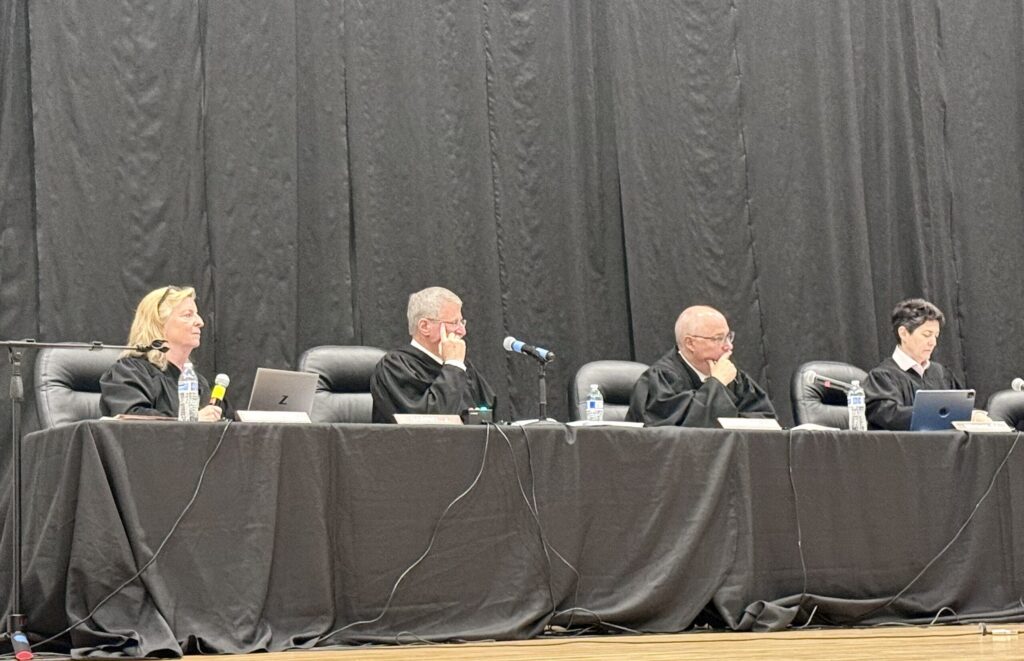
The Colorado Supreme Court pondered the fallout on Tuesday from its nearly six-year-old decision interpreting the state’s impaired driving laws, with the justices now addressing how defendants affected by the legal change must seek postconviction relief. In contrast to other...

Colorado to participate in Great American State Fair in Washington
Marissa Ventrelli
marissa.ventrelli@coloradopolitics.com
Updated 8 hours ago
Visitors to Washington, D.C. for the country’s 250th anniversary will have the opportunity to learn about Colorado’s natural beauty and culture during the Great American State Fair, a World’s Fair-style event that opened Thursday at the National Mall. While all...

RTD to reconsider service priorities as cuts, budget deficit loom
Michael Braithwaite
michael.braithwaite@gazette.com
Updated 12 hours ago
Should the Regional Transportation District aim to maximize ridership or system coverage? That question sat at the heart of the RTD Board of Directors’ first Comprehensive Operations Analysis briefing on Thursday afternoon. With the Denver transit agency facing a budget...

Mobolade, Colorado Springs leaders say election date lawsuit is attack on local voters
Brennen Kauffman
brennen.kauffman@gazette.com
Updated 10 hours ago
Mayor Yemi Mobolade and other city leaders will fight to keep Colorado Springs elections in April in the face of a new lawsuit. Mobolade, the mayor’s Chief of Staff Wayne Williams and City Councilmember Roland Rainey addressed the lawsuit in...
PREV
PREVIOUS

Denver Public Schools board outlines engagement-heavy superintendent search
Denver Public Schools hopes to announce its replacement for outgoing Superintendent Susana Cordova by the end of June, the last step in a search that board leaders say will be focused on community engagement and feedback. The board is currently working on the first phase of its search: drafting a “narrative” describing the job and […]

Denver City Council approves new housing development in Five Points for homeless
The Denver City Council unanimously approved a trio of contracts on Monday, worth $4.1 million, to establish 98 new units of supportive housing and a 75-bed recuperative medical care center in the Five Points neighborhood for people living without housing. The nine-story project will be made possible in partnership with the Colorado Coalition for the […]