

CAPITOL M | A crack in the Capitol marble leads to a sad story

When state Rep. Jonathan Singer, a Longmont Democrat, entered the state Capitol Wednesday, he took a picture.
“My last official day at the Cap. I’m wearing the shoes that I wore during the 2013 Flood and that entire legislative session. The tread is worn and the leather is beaten. They remind me of what’s really important, and they’ll carry me at least one more day.”
It’s what was beneath his shoe – the crack on the first step of the marble staircase – that’s notable.
It may surprise you that with all the millions spent on renovation in the state Capitol in the last decade or so, that this one crack never got fixed.
It may be because the crack has a story all its own, a story that doesn’t get told on Capitol tours.
According to a March 19, 1952, Denver Post article, a 52-year-old man, Benton Field Marshall, originally from St. Joseph, Missouri, leaped to his death from the third floor of the Capitol Rotunda and landed on the first floor. Given the location of the crack – the first step on the first floor staircase – it’s likely that this is where Marshall landed.
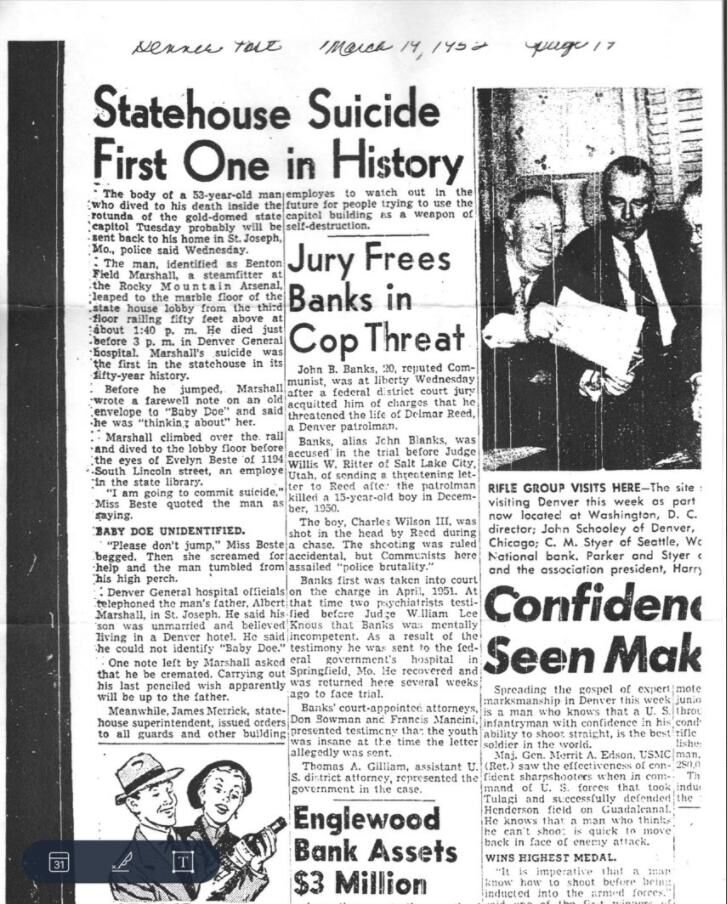
His suicide was witnessed by a Miss Evelyn Beste, a librarian at the Denver Public Library, who watched him climb over the rail and dive to the floor.
There’s little information on Marshall, and Capitol M could not find any photos of him. During World War II, Marshall worked in the Missouri Ordinance Works, according to a search on Ancestry.com. The Post article said he was a steamfitter at the Rocky Mountain Arsenal at the time of his death and unmarried, and a check of ancestry.com records could not find any records of a marriage while he lived in Missouri.
The website findagrave.com mentions that his seven brothers were named for poets and philosophers and social activists, a potential clue to his family’s interest in literature and social issues.

Marshall left behind a somewhat cryptic suicide note stating he he “was thinking” about Baby Doe. The article quotes Marshall’s father, who said he didn’t know who “Baby Doe” was.
To Colorado history buffs, however, that’s a very familiar name. Baby Doe Tabor was the wife of Horace Tabor, a Leadville silver king in the 1870s and 1880s, later postmaster general of Colorado and in 1880, a U.S. Senator. Baby Doe, whose real name was Elizabeth McCourt Doe, was Horace Tabor’s second wife, the woman he left his first wife for.
When the price of silver crashed in the 1890s, the Tabors were left with just one last working mine, the Matchless in Leadville, which is now a museum. Horace Tabor died in 1899, allegedly telling his Baby Doe to hang onto the Matchless as it would once again produce silver. Baby Doe became something of a character in Leadville, never remarried, and was found frozen to death in the mine’s office, where she lived, in 1935.
Why Baby Doe? There was a revival of interest in Baby Doe’s story in the 1950s. That revival began with the 1950 publication of “Silver Queen, the Fabulous Story of Baby Doe Tabor,” written by Denver Post reporter Caroline Bancroft. The book was a somewhat romanticized version of Baby Doe’s life and written in the first person as though told by Baby Doe, and Bancroft noted some passages were fictionalized.
Marshall’s death is the only suicide (and hopefully it stays that way) in the state Capitol, which has been rumored to be haunted by ghosts for decades.
The Post story ends with an order from statehouse superintendent James Merrick to the Capitol guards and other building employees: watch out in the future for people attempting to use the state Capitol as a “weapon of self-destruction.”
Many tips of the hat to Rep. Singer for starting this; to former state Sen. Greg Brophy for digging up the newspaper article; to former state Rep. Rob Witwer, who believed Capitol M should chronicle this for posterity; and to Colorado historian (and Capitol M daughter Jennifer Goodland) who knew about the 1950s revival and found Marshall’s draft card.


Colorado court upholds murder conviction despite jury disobeying instructions
Michael Karlik
michael.karlik@coloradopolitics.com
Updated 3 hours ago
Colorado’s second-highest court upheld an Arapahoe County defendant’s murder conviction last month, even though jurors found he was not the one who shot the victim and the evidence suggested he was not present for the shooting. A three-judge Court of...

July 1 brings new Colorado rules on ammunition purchases, wildfire‑risk scoring and wildlife enforcement
Marissa Ventrelli
marissa.ventrelli@coloradopolitics.com
Updated 6 hours ago
Colorado will usher in a new set of laws on July 1 that touch everything from ammunition sales to insurance transparency and wildlife trafficking enforcement Here is a look at some of the state’s new laws: Ammunition sales Sponsored by...
Divided appeals court reverses conviction after judge declined to define ‘bludgeon’
Michael Karlik
michael.karlik@coloradopolitics.com
Updated 8 hours ago
Colorado’s second-highest court reversed a Jefferson County defendant’s felony menacing conviction on Thursday, concluding that the trial judge’s failure to define “bludgeon” for jurors may have affected the outcome. A three-judge Court of Appeals panel divided in unusual ways in...

Poll finds majority believe US military action against Iran was a mistake
Brady Knox, Washington Examiner
brady.knox.washington.examiner@gazetteedit.wpenginepowered.com
Updated 7 hours ago
A poll found a wide majority of U.S. voters believed the decision to launch military action against Iran was a mistake. The Beacon Research and Shaw & Company Research poll for Fox News was conducted from June 12-15, meaning many...

For Vance, Iran deal presents opportunity and risk
W. James Antle III Washington Examiner
wjamesantleiiiwashingtonexaminer@wpstage.coloradopolitics.com
Updated 10 hours ago
Vice President JD Vance has a lot riding on the deal to end the war in Iran. The memorandum of understanding between the United States and Iran came together at the outset of Vance’s book tour, but that’s not the...

10th Circuit dismisses Tina Peters’ challenge to confinement as moot
Michael Karlik
michael.karlik@coloradopolitics.com
Updated 1 hour ago
The Denver-based federal appeals court granted the state’s unopposed request on Wednesday to dismiss former Mesa County clerk Tina Peters’ challenge to her confinement as moot. Although Peters received a commutation of her prison sentence last month from Gov. Jared...

Federal judge declines to recuse from death penalty case after Supermax visit
Michael Karlik
michael.karlik@coloradopolitics.com
Updated 1 hour ago
A federal judge declined to recuse herself last month from a death penalty case arising out of Colorado’s “Supermax” prison, finding that her tour of the facility earlier this year did not bias her decision-making. U.S. District Court Judge Charlotte...

Amid public pressure, Colorado candidates tackle social media regulations for minors
Bethany Johnson
bethany.johnson@denvergazette.com
Updated 9 hours ago
Following the accidental overdose of her daughter in 2020, Patti Lujan pursued a lawsuit against Snapchat, the social media platform that, she claimed, connected her daughter with a drug dealer. In a news release announcing the lawsuit, Lujan alleged that...

Denver gets more time to answer FAA questions in probe regarding Key Lime lease denial
Deborah Grigsby
deborah.smith@denvergazette.com
Updated 8 hours ago
The City of Denver has asked the Federal Aviation Administration for additional time to gather information and prepare its response to the federal agency’s investigation of the city’s 2025 denial of a Denver International Airport ground lease expansion for Key...
FDA breaks ground on new food lab at Denver Federal Center
Marissa Ventrelli
marissa.ventrelli@coloradopolitics.com
Updated 1 day ago
The U.S. Food and Drug Administration and the General Services Administration announced on Wednesday that they have officially broken ground on a new food lab at the Denver Federal Center in Lakewood. The $228 million project includes 16,500 square feet...
PREV
PREVIOUS

Crime Stoppers, BBB offer tips on spotting online fraud, including COVID-19 scams
By phone, email and online, cyber scams have infiltrated every inch of digital life, causing untold damage to those who fall victim to scammers’ tricks. The U.S. experienced a 24% rise in scams in 2020 compared to 2019 and 85% of scam victims lost money, a Pikes Peak Area Crime Stoppers and Better Business Bureau of […]

Thousands of Coloradans applied for new citizen redistricting commission
With the application period now closed, 2,500 Coloradans have applied to be part of the new voter-approved redistricting commissions, which will redraw the state’s congressional and legislative districts next year. In the coming weeks and months, the pool of applicants will be narrowed, and two groups of 12 commissioners – one for the congressional map […]