

Judges ask Colo. Supreme Court to provide guidance on child custody cases

A three-judge panel of the Colorado Court of Appeals has requested the state Supreme Court provide clear guidance for the review of child custody cases, after it noticed two conflicting directives from the high court.
“Uncertainty regarding our role in reviewing juvenile court orders in these all-too-frequent cases potentially delays much needed permanency. We respectfully urge the supreme court to provide clarity,” wrote Judge Anthony J. Navarro in the Nov. 5 opinion.
The case in question involved the Adams County Human Services Department, which became concerned in June 2017 about neglect or abuse of two children, identified as A.A. and E.A., due to parental drug use and domestic violence in the home. The mother and father also reportedly disregarded the children’s basic and educational needs.
Eventually, a juvenile court judge terminated the parental rights of both adults.
As much as possible, the goal of Colorado law is to maintain relationships between parents and minor children. When the state attempts to end parental custody, it must reasonably try to rehabilitate parents and reunite families following an out-of-home placement.
If a court receives clear evidence that a parent has not complied with a treatment plan or that the individual is unfit as a parent and unlikely to change their conduct, it may end parental rights.
However, the appeals panel noted two seemingly conflicting rulings from the Supreme Court about how it should treat the findings of a juvenile court. In a 1982 decision, the justices directed appellate judges to reverse a termination of parental rights only if the lower court’s findings were “so erroneous” as to have no factual support.
More than 30 years later, the Supreme Court issued a 2014 decision suggesting that reviewing a decision to terminate was not “purely a factual question,” but involved the underlying facts and the legal findings arising from that information.
In other words, the Court of Appeals must wrestle with whether to defer almost entirely to the work of juvenile courts, or to review their conclusions anew.
“This change, if indeed it is a change, significantly alters this court’s role in reviewing cases involving termination of parental rights,” noted Navarro.
Zaven Saroyan, a Colorado Springs attorney who represented one of the parents in the case of A.A. and E.A., believed appellate judges should be able to take a fresh look at each custody matter.
“The Court of Appeals is to be commended for taking up this question regarding the ongoing conflict in the standards of review,” he said. “In my view, the Colorado appellate courts should be reviewing the ultimate questions made by the district court, such as whether DHS made reasonable efforts to reunite a family, as a conclusion of law.”
In the Adams County case, the panel was able to sidestep the question of which standard to apply because the judges determined the court and the county agency plainly did not tailor visitation policies in a way that promoted rehabilitation and reunification of the family.
Specifically, the magistrate erred by requiring the parents’ two-week sobriety to be a condition of visiting their children, which he reasoned would prevent further harm to A.A. and E.A.
“But the magistrate did not explain how he came to this conclusion,” Navarro explained. “There was no evidence that either parent had attended a visit while intoxicated or that either parent had missed or disrupted a visit due to intoxication.”
Because the mother never showed two consecutive weeks of sobriety, she was unable to visit her children at all. In the father’s case, he did demonstrate clean drug tests and resumed visitation. But the county revoked the contact with one of his children after a report that the father became angry and acted disrespectfully.
“It is unclear why the Department took this drastic step without making any effort to help father and E.A. repair their relationship or to determine whether any other level of visitation services would meet E.A.’s needs, such as professionally supervised or monitored visitation,” the appeals court decided.
The panel also agreed the county did not provide funding or referrals for substance abuse treatment for the father that would enable his rehabilitation.
In sending the case back to the juvenile court, the judges reversed the complete cutoff of visitation between parents and children, absent sufficient information suggesting otherwise.


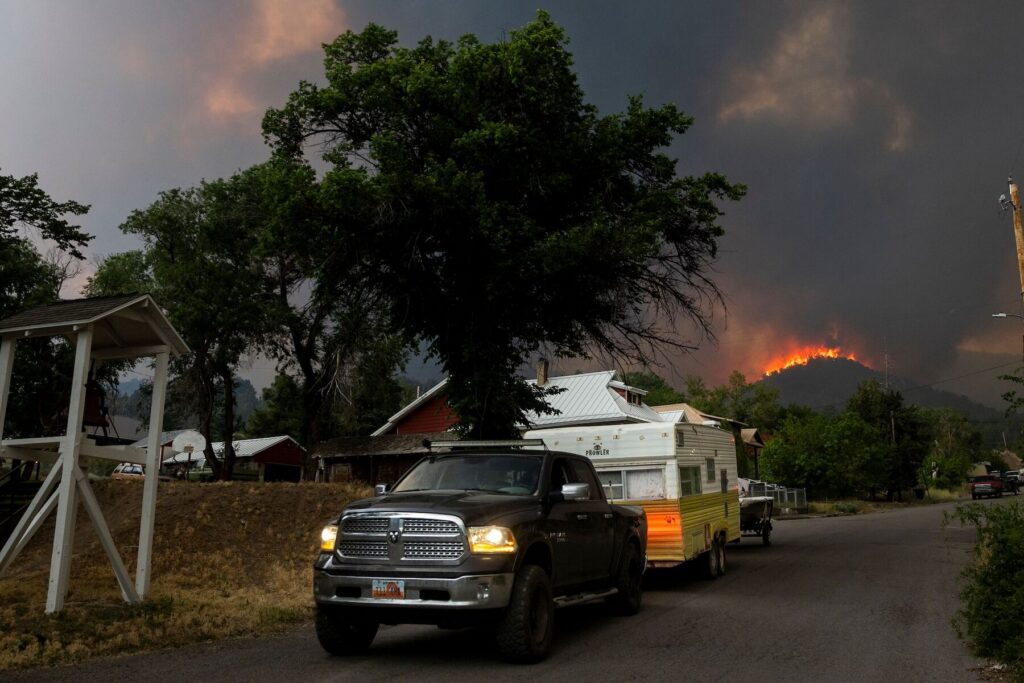
Heat, wind and drought conditions spark wildfires across US West | OUT WEST ROUNDUP
Ernest Luning
ernest.luning@coloradopolitics.com
Updated 4 days ago
Heat, drought spark wildfires Extreme heat and dry, windy conditions fueled several wildfires in the West on June 21, including an uncontained blaze in Utah that forced the evacuation of a small town southwest of Salt Lake City. The Iron...
Crank challenger Jessica Killin signs on to new centrist Democratic group’s ‘Promise to America’
Ernest Luning
ernest.luning@coloradopolitics.com
Updated 9 hours ago
Jessica Killin, one of the Democrats running in Tuesday’s primary for the chance to challenge U.S. Rep. Jeff Crank in Colorado’s 5th Congressional District, joined with more than a dozen incumbent Democratic lawmakers and candidates this week signing on to...

Colorado Politics Calendar June 29-July 5
Rachael Wright, Special to Colorado Politics
rachael.wright@coloradopolitics.com
Updated 4 days ago
CoPo’s weekly political calendar will help you find political and public-policy events throughout Colorado. It includes candidate and issue campaign events, public policy meetings, court hearings, state and local party conventions, assemblies, debates, rallies, parades, speaking engagements, traveling dignitary appearances,...

Gov. Lamm’s GOP challenger gives insights into his campaign | A LOOK BACK
Rachael Wright, Special to Colorado Politics
rachael.wright@coloradopolitics.com
Updated 4 days ago
Forty-five years ago this week: “I see Gov. (Richard) Lamm is fairly popular in general,” said gubernatorial candidate and state Sen. Bill Hughes, R-Colorado Springs. “ … And he’ll be hard to beat.” Hughes was on a whirlwind campaign trail...
Giving credit to Polis where credit is due | SONDERMANN
Eric Sondermann
eric-sondermann@coloradopolitics.com
Updated 4 days ago
It is an understatement to suggest that Gov. Jared Polis has had a tough couple of months. The bloom was already off the rose and Coloradans were paying far more attention to the choice of his replacement than they were...

Bennet, Hickenlooper to vote against Trump’s 10th Circuit nominee from Colorado
Michael Karlik
michael.karlik@coloradopolitics.com
Updated 21 hours ago
Colorado’s two Democratic senators will not vote to confirm President Donald Trump’s nominee to a vacancy on the Denver-based federal appeals court. Trump has selected U.S. District Court Chief Judge Daniel D. Domenico, who he appointed as a federal trial...
Who’s spending in Colorado to get your vote?
Marianne Goodland
marianne.goodland@coloradopolitics.com
Updated 21 hours ago
Groups that raise unlimited amounts of money have spent about $20 million in May and June to try and influence Colorado voters’ choices in the upcoming June 30 primaries. By law, these groups cannot coordinate with the candidates they support....

U.S. government declines to oppose multiple challenges to immigration detention in Colorado
Michael Karlik
michael.karlik@coloradopolitics.com
Updated 2 days ago
Multiple federal judges in Colorado granted petitions from people challenging the lawfulness of their immigration detention this week after the government took the unusual step of declining to submit arguments in opposition. Colorado’s federal trial court is facing a flood of...

Tina Peters tells supporters to ‘stand up and fight back’ at Castle Rock event
Marissa Ventrelli
marissa.ventrelli@coloradopolitics.com
Updated 1 day ago
Tina Peters, the former Mesa County clerk recently released from prison, warned supporters that what happened to her could happen to them, too, if they did not “stand up and fight back” at an event at the Douglas County Fairgrounds....

Iran strikes cargo ship in Strait of Hormuz, endangering Trump’s peace
Christian Datoc
christian-datoc@coloradopolitics.com
Updated 2 days ago
Iran attacked a cargo ship traveling through the Strait of Hormuz on Thursday, possibly upending President Donald Trump‘s diplomatic end to the war with Iran. A U.S. official confirmed to the Washington Examiner that the Islamic Revolutionary Guard Corps “struck...
PREV
PREVIOUS

State Senate holds leadership elections, keeps Garcia as prez and Holbert as minority leader
Both parties in the Colorado state Senate held leadership elections Thursday, keeping the same people in the top posts but with a few changes in some leadership positions. Democratic Sen. Leroy Garcia of Pueblo was re-elected for another two-year term as Senate President. Senate Democrats added one to their 19-16 advantage from 2018, when Sen.-elect […]

Gov. Jared Polis: COVID-19 now at its worst point since beginning of pandemic
Colorado hit milestones on Thursday that Gov. Jared Polis and public health officials hoped would never come: the highest number of daily cases of COVID-19 and worse, the highest number of people hospitalized for the virus since the pandemic began in March. Polis said 894 people are now in the hospital with the virus; the […]