

Man convicted of Aurora murder to get new trial after court finds evidence impermissible

A man serving a life sentence for an Aurora robbery and murder had his convictions reversed and will have a new trial because evidence admitted at trial suggested that it was in his character to commit such crimes.
The inference that “he intentionally robs people at gunpoint to steal drugs from them — and acted in conformity with his bad character in this case” was impermissible, wrote Judge David Furman for the three-member Colorado Court of Appeals panel on Thursday.
According to court documents, Zakaria Hussein Ali and four other men traveled from Minnesota to Denver in October 2012. They reportedly drove to the Aurora townhouse of a marijuana grower whom two of them had met previously. After the grower, Carlos Muse, told them he had no marijuana for them, one member of the group, Feisal Hassan, gave the order to rob Muse.
Hassan allegedly told Muse, “you don’t want to die for this,” and Ali shot Muse in the leg. Ali then ordered another group member to bind Muse’s hands and feet. The group robbed the victim of his wallet, phone and several cannabis plants, and drove to Minnesota, according to documents.
Muse subsequently bled to death. Ali received a lifetime prison sentence after a jury found him guilty of the murder and robbery.
Prosecutors for the 18th Judicial District Attorney’s Office had successfully asked the court to admit as evidence the fact that in December 2012, Ali was part of a planned robbery of a Minnesota drug dealer. The booking photograph that Minnesota police took of Ali matched witness descriptions of him in Colorado.
Elaborating further, prosecutors said they “have no forensic evidence tying [Ali] to the crime, no DNA, no fingerprints.” Because the two witnesses who could identify Ali were part of the Aurora robbery and had reached deals to testify, jurors might not trust them. As such, the evidence from the Minnesota robbery was “vital” to establish Ali’s motive and identity.
Ali’s attorney countered that prosecutors were merely trying to illustrate “Ali is some sort of criminal” and “he probably did this because this is the kind of thing he does.”
In 1990, the Colorado Supreme Court ruled in a similar murder case where the question was whether it was permissible to admit evidence that the defendant previously pulled a gun on a roommate.
The court devised a “Spoto test,” named after the defendant, to guide courts in admitting evidence. The judge must decide whether the potential evidence relates to relevant facts, is logical to proving the case, does not simply lead to an inference of bad character, and whether it is more probative than prejudicial.
Using the Spoto test, Arapahoe County District Court Judge Natalie T. Chase permitted the evidence of the Minnesota robbery at Ali’s trial.
“First, there was a plan to rob the victim in this case and the other case. Second, there were 4 people involved in both cases. Third, in both cases the plan involved robbing drug dealers,” she said in explaining why the evidence did more than illustrate Ali’s susceptibility to this type of crime. “An effort to rob another victim who is a drug dealer in the same manner is supportive of the requisite culpable mental state(s) required of the charges in the underlying case.”
At trial, the evidence also included testimony of a confidential informant to the Minnesota robbery, who spoke to the involvement of a Somali man with dreadlocks named “Zak.” When shown a picture of Ali, the informant positively identified him as “Zak.”
The Court of Appeals panel, in reviewing Ali’s appeal, saw two types of evidence presented about the planned Minnesota robbery: information about Ali’s appearance and details of the crime itself. The judges agreed that evidence of Ali’s hairstyle was permissible because it was relevant to his identity and did not speak to his character.
For the robbery, Furman wrote that the information was relevant and logical, in that it enabled Ali’s alleged co-conspirators in Muse’s murder to identify him as a participant in the crime. Ali’s defense argued that he was not present in the state when the murder happened.
However, the evidence still created an impermissible inference about his character.
“Ali’s involvement in a similar robbery with a similar victim, two months after the charged offenses, showed his identity in this case only if the jury inferred from this evidence that Ali has a tendency to commit this type of crime,” Furman explained.
Going further, the panel also decided the probative value of the evidence was “very low.” It failed to address Ali’s motive and intent but rather was “a high risk that the jury would convict Ali for his apparent criminal character.”
The information communicated to jurors that “Ali tried to rob a drug dealer at gunpoint in December 2012, so he probably did the same thing in this case,” Furman wrote.
The panel ultimately did not have a “fair assurance” that the jury refrained from convicting Ali on his character based on the Minnesota evidence. Furman added it was “a stretch” to label the Minnesota and Colorado robberies as nearly identical, observing that the similarities prosecutors pointed to were common to many robberies.
The 18th Judicial District Attorney’s Office did not immediately respond to a request for comment about the decision.
The case is People v. Ali.


Colorado Politics Calendar May 4-10
Rachael Wright, Special to Colorado Politics
rachael.wright@coloradopolitics.com
Updated 3 days ago
CoPo’s weekly political calendar will help you find political and public-policy events throughout Colorado. It includes candidate and issue campaign events, public policy meetings, court hearings, state and local party conventions, assemblies, debates, rallies, parades, speaking engagements, traveling dignitary appearances,...
Gov. Lamm scolds own party over losing modernization battle against GOP | A LOOK BACK
Rachael Wright, Special to Colorado Politics
rachael.wright@coloradopolitics.com
Updated 3 days ago
Forty-Five Years Ago This Week: “The Democratic Party lost the battles of ideas and political technology last November,” Gov. Dick Lamm told the Boulder County Democratic Party at the annual Harry S. Truman Memorial Dinner. Lamm argued that the Democratic...
The need for a governor to say “no” to his friends | SONDERMANN
By Eric Sondermann
by-eric-sondermann@coloradopolitics.com
Updated 2 days ago
A wise man once remarked that the real test of a governor is his willingness to turn down and reject the pleadings of political friends and allies. That gentleman knew something of what he spoke. He occupied the corner-office executive...
Dismissal sought in Michael Clark’s second trial
Jenny Deam
jenny-deam@coloradopolitics.com
Updated 3 hours ago
The murder conviction of Michael Clark should be dismissed due to a 32-year delay that led to crucial evidence being lost or destroyed, a bungled police investigation and “outrageous conduct” at the state crime lab, according to defense motion filed...

Colorado to get $75 million from opioid settlement with Purdue Pharma
Marissa Ventrelli
marissa.ventrelli@coloradopolitics.com
Updated 16 hours ago
A $7.4 billion settlement reached with the pharmaceutical company Purdue Pharma and the Sackler family — its owners — is now legally effective a decade after attorneys general from multiple states launched an investigation and seven years after Colorado filed...

Committee approves reworked version of previously vetoed rideshare bill
Marissa Ventrelli
marissa.ventrelli@coloradopolitics.com
Updated 20 hours ago
Members of the Colorado House Business Affairs and Labor Committee voted across party lines to pass a modified version of a bill establishing regulations on rideshare companies. Last year, Reps. Jenny Willford, D-Northglenn, and Meg Froelich, D-Englewood, introduced House Bill...
Fight over credit card ‘swipe fees’ attracts nearly 200 lobbyists in Colorado
Marianne Goodland
marianne.goodland@coloradopolitics.com
Updated 16 hours ago
One of the most expensive fights of the 2026 session got a little closer to being over on Friday, when the Colorado Senate took a second final vote on the proposal to eliminate “swipe fees” on sales taxes. It’s not...

Veto likely as union-backed bill heads to Colorado governor’s desk — again
Marissa Ventrelli
marissa.ventrelli@coloradopolitics.com
Updated 17 hours ago
For the second year in a row, a bill that would make it easier for labor organizations to impose fees on all workers, regardless of union membership, is headed for Gov. Jared Polis’ desk. The governor, who vetoed the legislation...

Aurora mental health nonprofit cuts 100-plus jobs after Colorado agency reduces reimbursement rate
Marianne Goodland
marianne.goodland@coloradopolitics.com
Updated 24 hours ago
A nonprofit that provides services through 11 mental health centers in Aurora announced Thursday that it is eliminating 111 jobs effective June 30, the result of federal and state budget reductions. Aurora Mental Health & Recovery said the positions being...
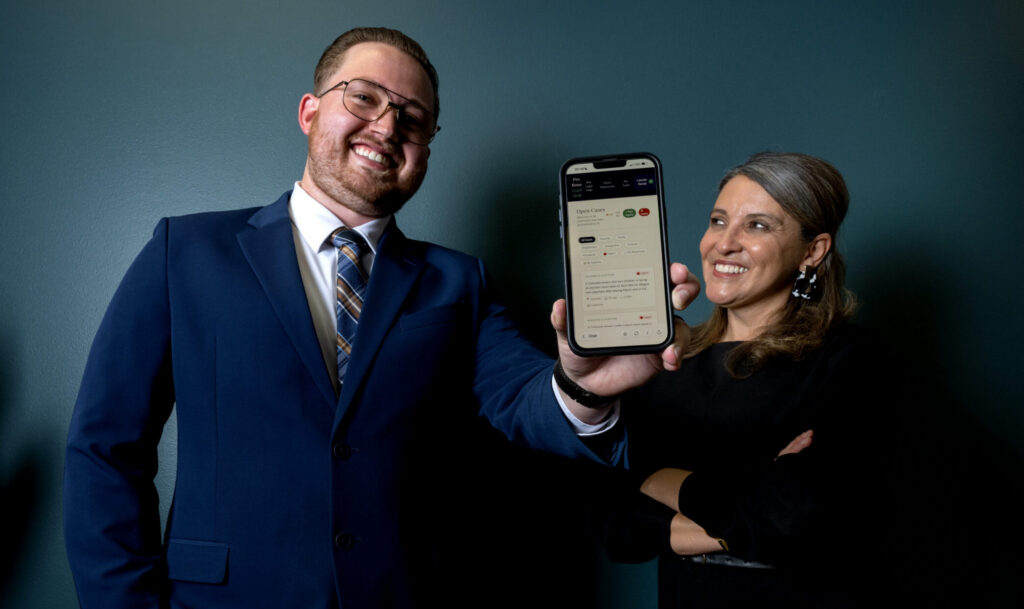
Denver law students create AI-powered tools in federal judge’s ‘design sprint’
Michael Karlik
michael.karlik@coloradopolitics.com
Updated 14 hours ago
A tenant discovered a handwritten note on his door stating he had 48 hours to move out. The landlord changed the locks without notice or court proceedings. The tenant paid rent on time and had never received any complaints about...
PREV
PREVIOUS

Judge dismisses employment discrimination claim, despite 'running counter to the interest of justice'
A federal judge “reluctantly” dismissed the lawsuit of a Kenyan healthcare worker who alleged racially-based employment discrimination because a technicality prevented the court from allowing her to sue. “Plaintiff argues that it is unfair that she is unable to pursue her employment discrimination claims because she filed a previous action to obtain her employment file,” […]
'Her memory will continue to be a blessing': Colorado AG Phil Weiser mourns Ruth Bader Ginsburg
Colorado Attorney General Phil Weiser, who clerked for Supreme Court Justice Ruth Bader Ginsburg in the mid-1990s, said Friday that he mourned the death of the legal and civil rights icon, who died of pancreatic cancer at age 87. In a statement, Weiser said: “Our nation mourns the loss of Justice Ruth Bader Ginsburg, an […]