

OPINION | Our cars are getting us through COVID. Literally.

Drive-in movies are back, joined by drive-in concerts, drive-through graduations, drive-by birthdays and car parades to honor health care workers.
The automobile has taken a central role in the pandemic; The New York Times says it serves as a “mini-shelter on wheels.”
It is an odd time to push for permanent restrictions on cars. Yet anti-car activists are using the pandemic to do just that.
“I’ve Seen a Future Without Cars, and It’s Amazing,” trumpeted a recent New York Times column that described the economic and public health carnage in New York City as a transportation utopia.
Anti-car advocates are pursuing the same vision in Denver.
They rely on comforting euphemisms like “calming” (intentionally slowing traffic) and “rebalancing” (turning car lanes over to bicycles and buses).
In the absence of new roads, which are not on the horizon, this means increased traffic congestion and longer commute times for drivers.
For the anti-car crew, that is not an unfortunate side-effect. In moments of candor, they reveal that is precisely the point.
“If you’re going to promote multimodal options, you’ve got to make single-occupancy cars more difficult,” said Curtis Edwards with Conservation Colorado, according to Westword.
This punishes the vast majority of people who need their cars.
Before the pandemic, we commissioned a live telephone survey by Magellan Strategies of 300 Denver voters (in late January and early February) and 500 voters statewide (in mid-February).
The surveys found that more than two-thirds of Denver respondents and four out of five Colorado respondents who worked outside of the home relied on a personal vehicle to get there. A majority depended on cars to commute regardless of age, income, party affiliation or race, according to the survey.
Riding a bicycle is the preferred choice for only 2% of statewide commuters and 3% of Denver commuters. Walking to work was the choice of only 3% of statewide commuters and 4% in Denver.
Only one out of five Denver daily commuters and 12% of statewide commuters reported that they used public transportation.
Those pre-pandemic transit numbers dropped precipitously as the pandemic hit Colorado, with Regional Transportation District ridership off 70%. Packing transit riders together is inconsistent with social distancing.
Already beset by budget and service problems, RTD now anticipates a 30% cut in its budget and a $1.3 billion shortfall through 2026. Prepare for dramatically worse service.
For similar reasons, ride-sharing services Lyft and Uber saw huge drop-offs in ridership and revenue.
And remember Car2Go, the car-sharing service? It disappeared from Denver last fall.
You would think that mobility advocates would be embracing the role of personal vehicles as part of the transportation mix. Instead they’re arguing that streets closed to cars to facilitate physical distancing should stay that way forever.
Common sense can prevail in these difficult times:
? I love cycling and pedal thousands of miles a year, but a bicycle is a great supplement, not a replacement, to a car. Bicycles do not work for the construction worker who needs to take supplies to the job site, the parent delivering a youth team to the game, or the shopper making a Costco run.
? Using sidewalks and streets to allow restaurants to reopen with expanded seating makes sense during a pandemic. After the pandemic, it will be problematic if diners cannot drive to these same restaurants.
? Colorado’s new car dealers employ 21,000 people directly and are responsible for nearly that many additional jobs indirectly. They also account for about 22% of state and local sales tax revenue. Right now, public services need this revenue more than ever.
Cars will help lead the way to a return to normalcy and economic recovery. They are an important part of the solution, not a problem.
Tim Jackson is president and CEO of the Colorado Automobile Dealers Association.

The outrages mount | Hal Bidlack
Hal Bidlack
hal-bidlack@coloradopolitics.com
Updated 4 hours ago
My kindly and forgiving editors understand that, from time to time, I can’t help myself from leaping atop my rickety soapbox to vent. And, like many other political commentators have already done, I could easily fill this entire missive with...
Rural Colorado deserves a tax holiday | GUEST COLUMN
Eric Mulder
jstooksberry@gmail.com
Updated 4 hours ago
Spend enough time in Colorado’s Eastern Plains, the San Luis Valley, or the Western Slope, and you’ll see boarded-up storefronts, schools consolidating classrooms, and small rural communities stretching every dollar to keep basic services afloat. Once the backbone of Colorado’s...

Weiser’s leadership crucial for rural win-win | Rachel Gabel
Rachel Gabel
rachel-gabel@coloradopolitics.com
Updated 4 days ago
Attorney General Phil Weiser is going to win the gubernatorial election. That said, Colorado agriculture and rural communities have a 30-year track record of finding the win-win be it for species or industries or habitat. Former Governor Roy Romer possessed...
A Colorado history lesson for Victor Marx | Dick Wadhams
Dick Wadhams
dick-wadhams@coloradopolitics.com
Updated 3 days ago
Victor Marx, who narrowly won the Republican nomination for governor by one half 1% after boasting of a massive 44-point lead, is just as misguided on Colorado political history. During the primary, Marx made a clumsy attempt to denigrate his...
‘Be prepared to march in the streets’ | Miller Hudson
Miller Hudson
miller-hudson@coloradopolitics.com
Updated 3 days ago
It was early in 1974 when I first met Tim Wirth as he announced his candidacy for Congress, challenging Republican incumbent Don Brotzman. Although I had only resided in Colorado two years, I was drafted to serve as a Democratic...

‘CoCo’ would take taxpayers for a ride | Jon Caldara
Jon Caldara
jon-caldara@coloradopolitics.com
Updated 15 hours ago
Colorado wants taxpayers to spend another $4.73 billion on passenger rail. Don’t worry. They have a plan. Which is a little like your brother-in-law announcing he’s launching another exciting restaurant venture after his last three restaurants ended in bankruptcy. Please....
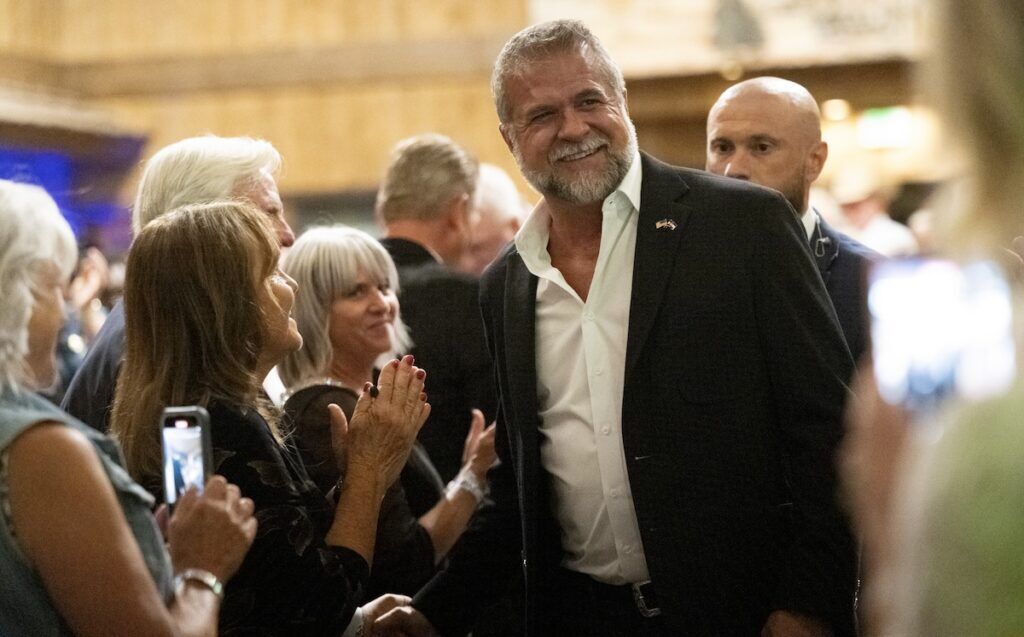
The through line from Donald Trump to Victor Marx | SONDERMANN
By Eric Sondermann
by-eric-sondermann@coloradopolitics.com
Updated 6 days ago
Over 10 years ago, before Donald Trump could ever defeat Hillary Rodham Clinton, he had to first engineer a hostile takeover of the Republican Party. Prior to his descent of that golden escalator, the previous seven Republican presidential nominees had...
Primary voters rejected big money in politics | Paula Noonan
Paula Noonan
paula-noonan@coloradopolitics.com
Updated 3 days ago
While we’re in an election campaign lull between now and Labor Day, we have time to consider the impact of $102 million in campaign contributions in the primary. In the general election, more money will fill candidate campaign coffers, and...
Colorado’s primary proved in this political climate money doesn’t buy electoral happiness | Paula Noonan
Paula Noonan
paula-noonan@coloradopolitics.com
Updated 5 days ago
To catch you up, campaign committees from this 2026 election cycle already collected and shoveled out a lot of cash: $102.64 million. That’s contributions in all forms — dollars, in kind, loans, etc. — from December 2024 to now. Total...
Protecting Colorado from wildfire starts before fire arrives | PODIUM
Colorado Politics
colorado-politics@coloradopolitics.com
Updated 5 days ago
By Rick Cables Colorado is once again being reminded of how significantly wildfires can affect the people and places we love. In southern Colorado, the Aspen Acres fire has burned through the Wet Mountains near Beulah and Rye, quickly becoming...
PREV
PREVIOUS

FEEDBACK | Hard data belies governor's hysteria
Our governor has signed a new executive order – his 135th since March 11 – mandating the use of face masks statewide in most “indoor spaces” and when using taxis or mass transit. The main justification given for this new government restriction on personal freedom was the alleged “spike” in new cases of COVID-19 in […]
THE PODIUM | Masking freedom, ignoring science
Barry Farah The governor is playing a dangerous game with COVID-19. Though some inconclusive studies reflect a potential curbing of COVID transmission with a mask mandate, there is scientific data against the efficacy of masks. Still, Gov. Polis rejects this science, calling people who don’t wear their “damn masks” “selfish bastards” and imposing a statewide mask […]