

Black Lives Matter comes to Greenwood Village
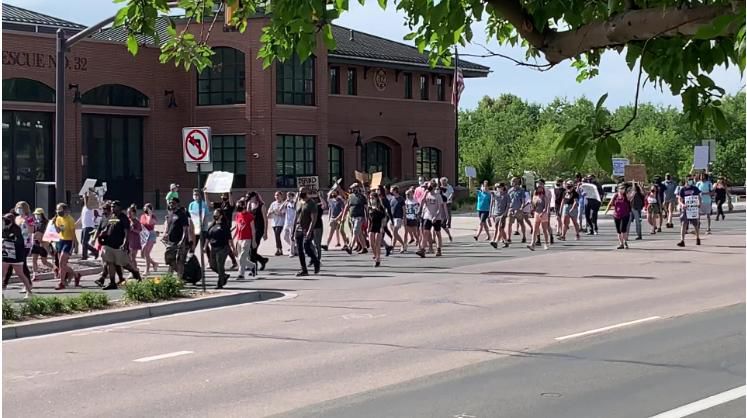
Greenwood Village is 84% white, less than 3% Black and about 5% Hispanic. But on Thursday, the latest edition of Black Lives Matters protests came to this community of just over 15,000, where the median income is more than $127,0000 and the median home price is just shy of $900,000.
Marchers briefly shut down South Quebec Street both north and south of Orchard Road. Police monitored but did not interact with protesters, as of 5 p.m.
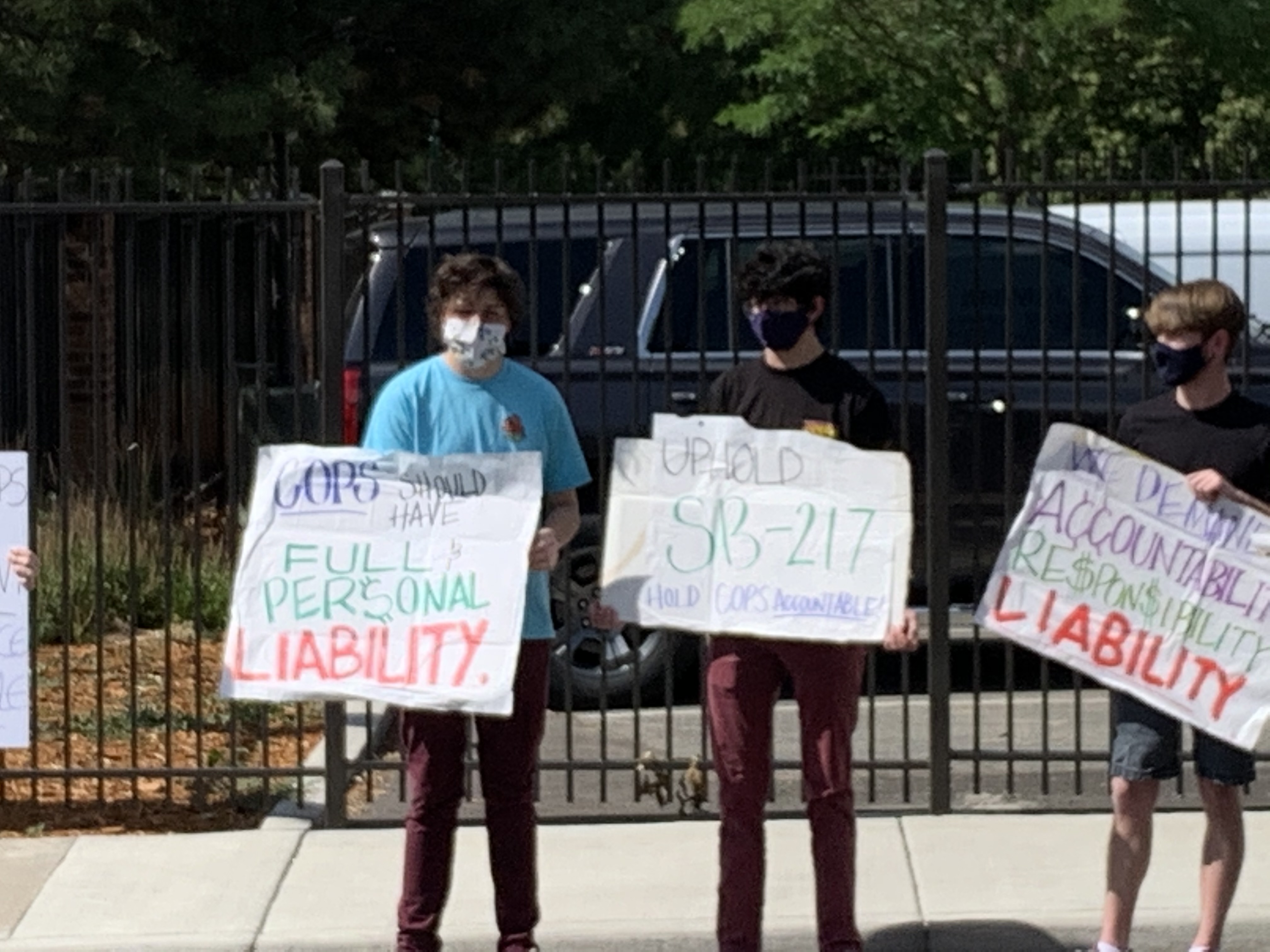
The protest came in response to a Monday resolution from the Greenwood Village City Council that said it would ignore a key provision in the police accountability law recently passed by the Colorado General Assembly and signed by Gov. Jared Polis on June 19.
The provision at issue is whether police officers who act in bad faith or who commit unlawful acts can be held personally liable for judgments, settlements or other court-related costs. The law, which was heavily negotiated in the waning days of the 2020 session, set a limit of $25,000 or 5% of the judgment, whichever is less.
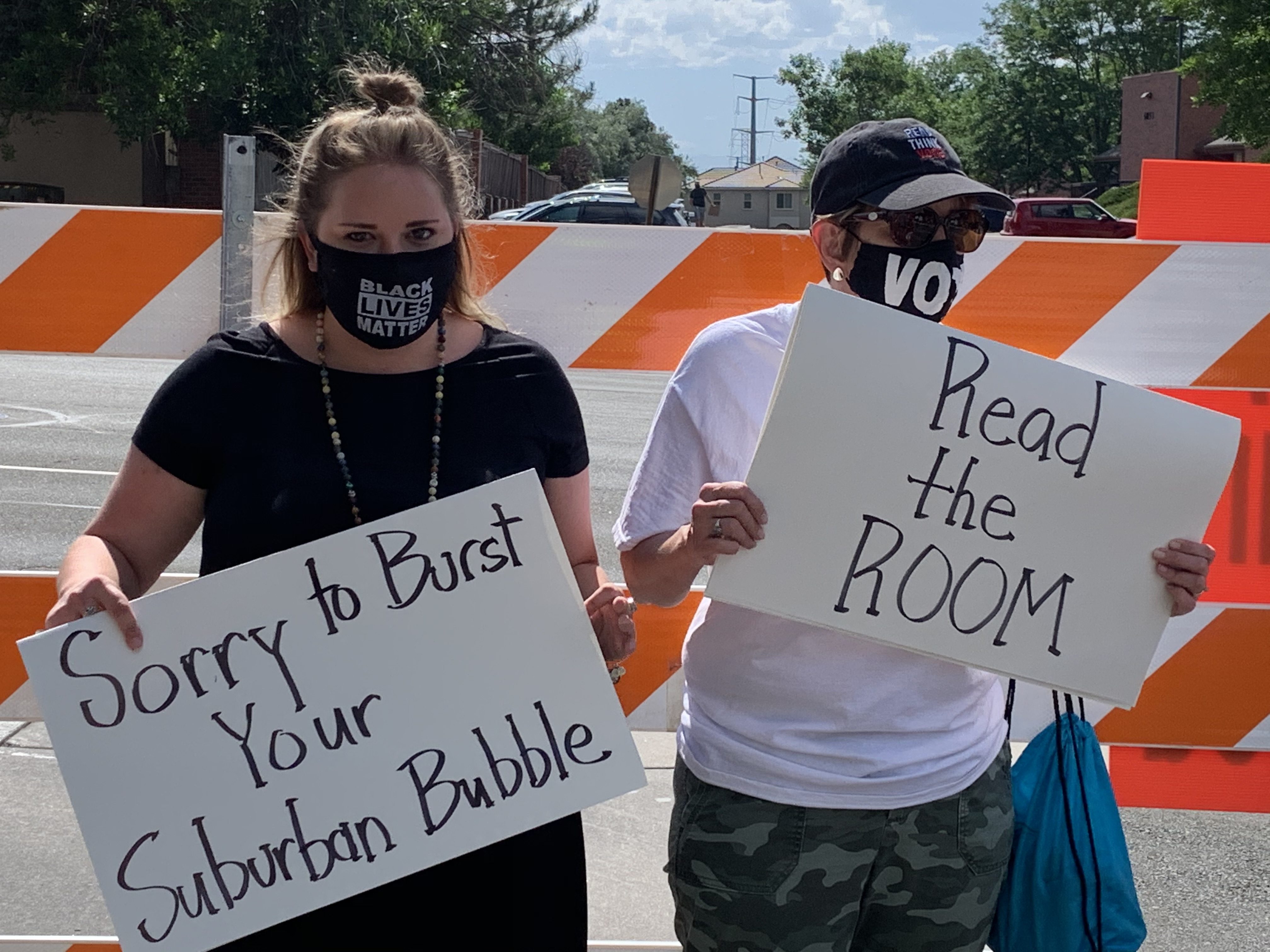
The city council’s resolution implies that no police officer will ever act in bad faith, according to protesters at Thursday’s march.
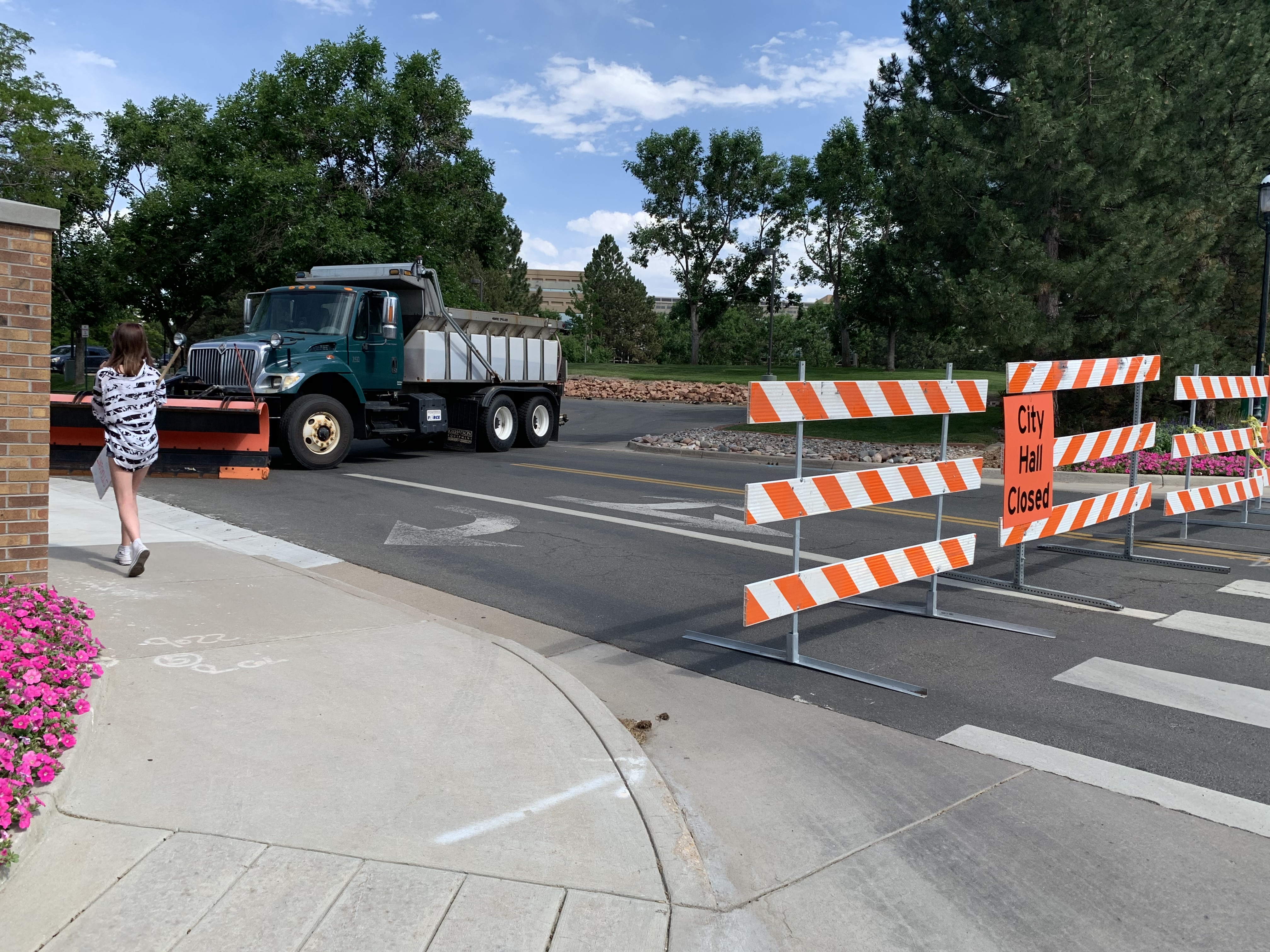
Just under 100 people, mostly white and young, showed up in the 100-degree heat, only to be met at city hall by barricades and a massive snowplow blocking the entrance, and marking city hall as “closed.”
Denver Public Schools board director Tay Anderson said he had talked to city officials earlier in the day, who said they weren’t happy but that they didn’t want this protest to turn into “another Aurora.” But he said that statement was untrue, pointing to the snowplow and barricades. “They blocked the entrance so that protesters couldn’t get into the city hall area.”
That’s a reference to protests at an Aurora police department station last month where protesters were greeted with police in riot gear and tear gas, despite claims that they were protesting peacefully, including with a violin serenade in honor of Elijah McClain.
On the night of Aug. 24, 2019, McClain was walking home from a store and did not stop when approached by Aurora police. Thinking that he was trying to get an officer’s gun, police brought him to the ground by officers and placed him in a chokehold.
While held down for 15 minutes, he began vomiting and said he could not breathe. Aurora paramedics were called to the scene and injected the 110-pound McClain with ketamine, estimated at a dose appropriate for a 220-pound man. He suffered an apparent heart attack, went into a coma and died on Aug. 30, after he was taken off life support.
Gov. Jared Polis has ordered Attorney General Phil Weiser to conduct an investigation into McClain’s death.
Thursday’s protest in Greenwood Village was organized by students at nearby Cherry Creek High School, which is located in Greenwood Village. “We need to show the city what we think of that decision,” said Ramsey Headrick, a Cherry Creek student and one of the organizers.
The resolution is illegal, said activist Terrance Roberts, a representative of the group Front-Line Party for Revolutionary Action of Aurora, who also claimed that Black people are not welcome in Greenwood Village.
Another student from Cherry Creek said Monday’s resolution shows that the system is broken in Greenwood Village, too. The names of McClain and Leo Lech, a homeowner whose home was destroyed by Greenwood Village police, also was mentioned.
Marchers then took to South Quebec Street, marching north and closing down the street to traffic. That’s when Greenwood Village police showed up, but they blocked off the street as marchers crossed the intersection with Orchard Road, headed north. They then came back to the city hall entrance.
Sara Couch, a lifelong resident of Greenwood Village, told Colorado Politics that police should be held accountable for their actions.
“It’s important we raise the issue with them. They’re not exempt from the rules,” she said.
There’s definitely an issue with how police interact with minorities versus white people in Greenwood Village, Couch said. At the high school, white students weren’t held accountable for their behavior, but Black students, what few there are, are held accountable.
“I saw firsthand” that police discriminated against Black students, she said. In her class of 1,000, perhaps fewer than 40 were Black.




Colorado Politics Calendar July 27-Aug. 2
Rachael Wright, Special to Colorado Politics
rachael.wright@coloradopolitics.com
Updated 5 days ago
CoPo’s weekly political calendar will help you find political and public-policy events throughout Colorado. It includes candidate and issue campaign events, public policy meetings, court hearings, state and local party conventions, assemblies, debates, rallies, parades, speaking engagements, traveling dignitary appearances,...

The through line from Donald Trump to Victor Marx | SONDERMANN
By Eric Sondermann
by-eric-sondermann@coloradopolitics.com
Updated 5 days ago
Over 10 years ago, before Donald Trump could ever defeat Hillary Rodham Clinton, he had to first engineer a hostile takeover of the Republican Party. Prior to his descent of that golden escalator, the previous seven Republican presidential nominees had...

Colorado districts prepare for school year amid mental health cuts. But will less cellphone distractions help?
Marissa Ventrelli
marissa.ventrelli@coloradopolitics.com
Updated 3 days ago
The signs of a new school year are everywhere — buses in the shop, teachers unpacking boxes, families ticking through supply lists — but behind the familiar rituals, Colorado districts are preparing for a year defined less by routine than...

Armstrong staffer considers congressional bid, DeGette angers rural communities with wilderness act | A LOOK BACK
Rachael Wright, Special to Colorado Politics
rachael.wright@coloradopolitics.com
Updated 3 days ago
Forty-five years ago this week: If the lines were drawn just right, Republican Sen. Bill Armstrong stood the chance of losing his office manager, Ruth Fountain. Fountain admitted she was seriously thinking about running for Colorado’s new congressional seat in...
10th Circuit dismisses woman’s lawsuit following 10-year attempt to undo restraining order
Michael Karlik
michael.karlik@coloradopolitics.com
Updated 2 days ago
The Denver-based federal appeals court rejected a woman’s challenge on Friday to a restraining order imposed on her more than a decade ago, finding that she cannot credibly claim she will be prosecuted for violating the restraining order through her...
10th Circuit dismisses woman’s lawsuit following 10-year attempt to undo restraining order
Michael Karlik
michael.karlik@coloradopolitics.com
Updated 2 days ago
The Denver-based federal appeals court rejected a woman’s challenge on Friday to a restraining order imposed on her more than a decade ago, finding that she cannot credibly claim she will be prosecuted for violating the restraining order through her...

Surprise candidate Shimon Blau cleared to face off against Melat Kiros in November
Ernest Luning
ernest.luning@coloradopolitics.com
Updated 2 days ago
Unaffiliated congressional candidate Shimon Blau, a Denver doctor, has qualified by petition for the general election in Colorado’s 1st District, where Democrat Melat Kiros defeated 15-term U.S. Rep. Diana DeGette in last month’s primary, the Colorado Secretary of State’s Office...

Colorado produce not tied to nationwide cyclospora outbreak, agriculture officials say
Marissa Ventrelli
marissa.ventrelli@coloradopolitics.com
Updated 2 days ago
There is no indication that the recent outbreak of cyclospora, a fecal parasite that has contaminated food and water across nearly every state, can be linked to produce grown in Colorado, according to the state’s Department of Agriculture. “Colorado growers...

UNC opens College of Osteopathic Medicine
Marissa Ventrelli
marissa.ventrelli@coloradopolitics.com
Updated 2 days ago
The University of Northern Colorado held a grand opening for its new College of Osteopathic Medicine on Friday, with Gov. Jared Polis in attendance to celebrate the culmination of a two-year, $127.5 million project. The project was funded through legislation...
Colorado equal pay law does not require plaintiffs to allege gender-based retaliation, appeals court finds
Michael Karlik
michael.karlik@coloradopolitics.com
Updated 2 days ago
The 2019 Colorado law aimed at rooting out pay discrimination on the basis of sex does not require a plaintiff to allege their employer retaliated against them for sex- or gender-related reasons, the state’s second-highest court decided on Thursday. Lawmakers...
PREV
PREVIOUS
Polis: Coronavirus cases rising in Colorado, so ‘wear a damn mask’
In order to avoid going back to the kinds of restrictions in place earlier this year, Colorado residents need to be more vigilant about preventing the spread of COVID-19, Gov. Jared Polis said Thursday, after three weeks of rising numbers of new coronavirus cases in the state. “We need to do better with coronavirus” Polis […]

TRAIL MIX | Brace yourself: Attack ads are already muddying up the Senate race
“If your ears are ringing and your eyes are bleeding now, just wait.” Local TV newscasters might not have been quite that graphic in recent years, but that’s the message they conveyed warning viewers about the sheer volume of negative ads filling up station breaks as Election Day approached. Brace yourselves. While Colorado doesn’t hold […]