

SONDERMANN | Renounce, don’t erase, the ugly past


Eric Sondermann
Larry Laszlo

What to keep? What to discard?
It’s the question that faces anyone who has ever undertaken a rigorous, room-by-room housecleaning.
It is now the question facing our country, on a far broader scale, at this moment of cultural and historical cleansing.
To call this a “cultural revolution” might be a tad strong, but it is not wholly in error. Fueled by understandable, even overdue outrage and further propelled by a heavy dose of division, America finds itself in the midst of a deeper awakening to some of the ugliest pages of its history. An honest taking stock should be a healthy, healing exercise.
Time will tell whether that positive construct turns out to be the case. Whether discretion and thoughtfulness are foremost or whether instinctive resentment and the so-called “madness of crowds” rule the day. Whether this is a thorough scour and rinse or an indiscriminate and revisionist purge.
The 20th century giant Winston Churchill, whose London statue is in jeopardy as a part of this upheaval, is credited with observing, “History is written by the victors.” Indeed, that is the case. But if the spirit is willing, it can be made true in degrees rather than absolutes. The United States is not Mao’s China or Soviet Russia or a host of other authoritarian societies where there is but one officially sanctioned version of historical truth and values.
Part of America’s unique history has been its charity toward those defeated and vanquished. Think of Reconstruction of the south following the Civil War and the Marshall Plan to rebuild, at substantial cost, a devastated Europe in the aftermath of World War II. Might a similar generosity evidence itself in this rewrite and purification of our historical records.
Let’s get specific here — though with no illusion that my judgment calls speak for anyone but myself.
While it would seem preferable to do it out of resident consensus than under threat of civic unrest, there is no heartburn on my part at the idea of renaming Denver’s Stapleton neighborhood. Why honor a reprobate Klan member who governed Denver into the middle part of the last century?
However, once Stapleton is replaced with a new moniker, where do the social combatants head next? George Washington was an unapologetic slave owner. Does that very fact override his vast contributions to our country’s birth and foundation? Is the name of Washington Park also up for grabs?
In short, where do you draw the line? What stays and what goes? And what is the criteria for making such determinations?
Perhaps that standard should seriously account for the context and ethos of the time in which that individual lived. Each of us should be glad to be judged by the mores of this era that we inhabit. But I, for one, would opt not to answer to unknown morals and principles two or more centuries hence.
The slave-owning Confederacy was defeated, even if it took another century or more to eliminate the worst remnants of Jim Crow and legalized segregation. But does it truly renew America to knock down every statute along Monument Avenue in the capital city of Richmond?
Some other calls: Says here that the only purpose of the Confederate flag in this age is as a racial or cultural taunt. Individuals have the free-speech right to display it along with their ignorance. But there is no good reason it should be incorporated in any state flag. Are you listening, Mississippi?
Meanwhile, Democrats years back showed the peril of applying contemporary ethics to a bygone era in their silly excess of changing the name of their traditional Jefferson-Jackson dinners due to the namesakes both having been slave-owners. Mature perspective would suggest a recognition that history’s heroes had flaws and even its villains carried redeeming qualities.
This appetite for rewriting history is a close cousin to the “cancel culture” mentality that gained steam years back on college campuses and is now permeating broader society including the corporate sector, social media and even the opinion pages of our most prestigious newspapers.
Engagement and rebuttal require thinking and hard work. How much easier to simply declare contrary opinion to be off-limits or out-of-bounds and silence it?
While there is no trace of it in our founding documents, a new American value has emerged over recent years. That is a presumed “right to comfort.” Instead of entertaining and considering multiple viewpoints, too many among us would rather shut down that which causes discomfort in favor of retreating to our “safe space.” We might joke about the proliferation of those sheltered enclaves at universities supposedly dedicated to intellectual inquiry. But how are they all that different than the media echo chambers in which so many among us choose to narrowly live their lives?
History teaches many lessons. Some of the most important ones come out of the ugliest chapters.
I flash back to my family’s three-generation trip to Europe to explore my parents’ lives during the Nazi era before their exodus to this country. That experience was so much fuller as a result of Germany’s determination not to whitewash that genocidal period.
It is one task to renounce; to condemn; to no longer glorify. Erasure is a totally different proposition. The distinction is critical. The goal is to have a societal moral code, evolving toward further enlightenment, while still being true to the historical record.
And a final note: This cleanse requires a fine balance. But some pieces are clear-cut. In that vein, how are the Washington Redskins still a thing?

Corrections officials may be sued for employee’s alleged abuse of detainee, federal judge rules
Michael Karlik
michael.karlik@coloradopolitics.com
Updated 43 minutes ago
High-level corrections officials may be sued for their own alleged failures to prevent or respond to an employee’s sexual misconduct toward a detainee, a federal judge decided last month. Rajae Bouhamidi was incarcerated at the Denver Women’s Correctional Facility. In...

Supreme Court justices to hear arguments on ending legal protections for Haitian, Syrian migrants
Associated Press
associated-press@coloradopolitics.com
Updated 28 minutes ago
The Supreme Court will weigh arguments Wednesday over the Trump administration’s push to end legal protections for Haitians and Syrians as migrants fleeing war and natural disaster. Haitians and Syrians were among those from 17 countries with Temporary Protected Status, which allows migrants already...

Proposal exempting some IT equipment from Colorado’s ‘right to repair’ law fails
Marissa Ventrelli
marissa.ventrelli@coloradopolitics.com
Updated 5 hours ago
A bill proposing an exemption to Colorado’s “right to repair” laws for “critical infrastructure” failed to pass its first committee in the House after clearing the Senate. Senate Bill 090 would have exempted information technology equipment considered “critical infrastructure” —...
Colorado GOP request to block unaffiliated voters from receiving Republican primary ballots denied by judge
Ernest Luning
ernest.luning@coloradopolitics.com
Updated 17 hours ago
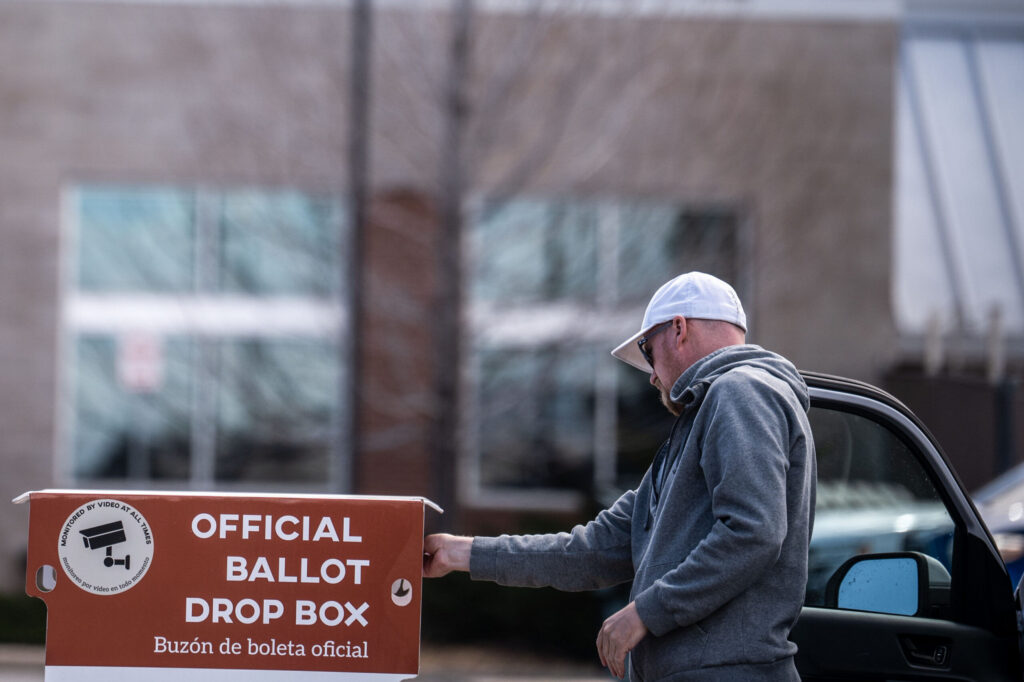
A federal judge on Tuesday denied the Colorado Republican Party’s request for an emergency injunction barring unaffiliated voters from participating in the state’s upcoming Republican primary election. U.S. District Court Judge Philip A. Brimmer said that preventing unaffiliated voters from...

Aurora not liable for suspended officer’s attack on woman, federal court rules
Michael Karlik
michael.karlik@coloradopolitics.com
Updated 18 hours ago
The Denver-based federal appeals court decided on Monday that the city of Aurora cannot be held liable for an officer’s attack on a woman while he was serving a suspension for shooting a different person. Wyoma Martinez filed suit against...

Colorado’s unprecedented AI law can’t be enforced yet, judge rules
Marianne Goodland
marianne.goodland@coloradopolitics.com
Updated 15 hours ago
A federal judge on Monday issued a delay in enforcing Colorado’s artificial intelligence law, touted by backers as a tool to protect consumers and residents from algorithmic discrimination but which critics called heavy-handed and unworkable. The lawsuit against Senate Bill...
Colorado bill dealing with administration lobbyists garners support but faces potential veto from Polis
Marianne Goodland
marianne.goodland@coloradopolitics.com
Updated 20 hours ago
A bill that would require lobbyists who work for the state government to abide by the same rules that govern their peers representing for-profit companies and organizations is winning support in both chambers of the Colorado legislature. Gov. Jared Polis,...
Colorado’s $46.8 billion budget nears finish line. Here’s what changed
Marianne Goodland
marianne.goodland@coloradopolitics.com
Updated 17 hours ago
Colorado legislators on Tuesday adopted a $46.8 billion plan to pay for state operations and programs next year after a joint panel reconciled differences between the House and Senate versions. A small group of lawmakers had resolved those differences. Lawmakers...
Colorado lawmakers propose security overhaul after rise in political attacks nationwide
Marissa Ventrelli
marissa.ventrelli@coloradopolitics.com
Updated 21 hours ago
Colorado legislators unveiled a 60‑page bill that would expand protections for elected officials, staff, and judicial employees, responding to a string of high‑profile attacks nationwide and growing safety concerns inside courthouses and the state Capitol. Part of their effort is...

Lauren Boebert’s private financial records sought by Biden’s DOJ, U.S. House committee says
Colorado Politics
colorado-politics@coloradopolitics.com
Updated 23 hours ago
A U.S. House committee is seeking documents from a Colorado bank, saying new information shows that the Biden administration might have sought the private financial records of U.S. Rep. Lauren Boebert. This comes as part of a congressional investigation into...
PREV
PREVIOUS
CU-Boulder announces action steps to address racism
The University of Colorado’s Boulder campus announced a series of steps on Thursday that it would take before the fall semester to address potential sources of systemic racism. “Many of you have told me you want immediate and sustained action to change the history of systemic racism and inequality in our country, our community and […]

CO PO Calendar | June 22-28
CoPo’s weekly political calendar will help you find political and public-policy events throughout Colorado. It includes candidate and issue campaign events, public policy meetings, court hearings, state and local party conventions, assemblies, debates, rallies, parades, speaking engagements, traveling dignitary appearances, water meetings, book signings, county commission hearings, city council meetings and more. As a subscriber, […]