

BARTELS | A high-wire act for higher education

As she traveled the globe for a dozen years, Angie Paccione got used to wearing face masks and having her temperature taken when she departed planes in Asia. But now illness is in her own backyard.
The college campuses she coordinates as the executive director of the Colorado Department of Higher Education sit empty as the state and the rest of the world grapple with the coronavirus crisis.
“It was literally like a flip of the switch where students went from being on campus to being remote, where instructors had to go from that face-to-face model to now moving their entire instruction online or some form of remote instruction,” Paccione said.
Luckily, spring break was right around the corner and most institutions extended it a week to give students and teachers time to try to adjust.
Paccione now spends most of her long workday on conference calls trying to figure out the future for a college system in which state schools already were struggling with inadequate funding.
Gov. Jared Polis appointed Paccione when he became governor in 2019. She brings an interesting background to the job.
She was raised in New York by a single mother. Her mother is black; she never knew her father, who is white. She received a scholarship to Stanford University, where she played basketball. After graduating in 1983, she went on to play pro ball for a while.
She was a high school teacher, coach and administrator at Smoky Hill High School in the Cherry Creek School District before earning a Ph.D. in education and human resource studies from Colorado State University in Fort Collins. She served on CSU’s faculty for 10 years.
She was elected in 2002 to the first of two, two-year terms in the state House as a Democrat representing Fort Collins.
When some Republican lawmakers argued for the need to ban gay marriage, Paccione reminded her colleagues that interracial marriage used to be outlawed in America. When a fellow Larimer County lawmaker wondered whether legalizing bestiality was next, Paccione took him on.
Paccione served as vice chair of the House Education Committee, where she was in regular contact with members of the state Board of Education, including a young upstart named Jared Polis.
In 2006, she decided to challenge Republican Congresswoman Marilyn Musgrave and, in a shocker, came 2.5 percentage points from unseating her in a very red district.
Beginning in 2007, Paccione worked for Verus Global in Littleton, traveling the world doing corporate training in the areas of leadership development, diversity and inclusion for a variety of companies, including Procter & Gamble and Nestle. She flew up to 150 times a year, including when the World Health Organization was dealing with swine flu, SARS and other infectious diseases.
“Now, no one’s traveling and we don’t know where it’s going to end,” she said.
She’s in regular contact with college presidents and school administrators.
Colorado has 32 public institutions of higher ed, including CSU, the University of Colorado, their systems, the community college system and area technical colleges. Colorado also has about 85 private degree-granting institutions, including Regis University, Colorado College and the University of Denver.
In addition, the Higher Ed department houses the Division of Private Occupational Schools which regulates approximately 295 schools.
Paccione is proud that Colorado’s campuses have stepped up in the fight against the virus.
Some schools involved in health care or veterinary science have donated truckloads of masks, gloves and other equipment. Research institutions are looking for cures and vaccines, and working with manufacturers that have switched to making products to help in the fight.
Paccione recently talked with her counterparts in Western states.
“They’re all feeling the same crunch,” she said. “Most states do not have a single stream of revenue for higher ed so it’s the first cut and usually the deepest cut when there’s any kind of financial crisis.”
Money is being doled out to states to help with the pandemic, and higher ed hopes to get a share, but it won’t be anywhere near what’s needed, she predicted.
“I don’t want to be an alarmist, but this really could be almost an existential threat for some of our institutions,” Paccione said.
I wondered, which type of institution is more likely to feel the crunch: a small school such as Adams State in Alamosa or a behemoth school such as the University of Colorado in Boulder?
Paccione said that state revenue is 40% of Adams State’s budget but only 5% of CU Boulder’s budget. If the legislature cuts higher ed dollars, Adams State will feel it a lot more than CU Boulder. However, if research money comes to a halt, that will significantly hurt CU and CSU.
“Right now, this virus is most likely going to impact all the sources of revenue, that’s the magnitude of it,” she said.
Colleges rely on fees from parking, dining halls, housing, conferences, summer camps, events and such. Campuses will be making individual financial decisions, Paccione said, but returning students could get a credit for fees paid this semester for their dorms. Graduating seniors would probably get a refund.
Speaking of those seniors …
Commencements everywhere are being postponed and colleges are thinking of virtual graduations.
“CSU Global has been doing that for years so they are helping, giving some tips to the other institutions,” Paccione said. “It’s such a milestone, we want to make sure it’s meaningful for the students. It’s heartbreaking.”
My column boss, Linda Shapley, the managing editor of Colorado Politics, and her husband know all too well how coronavirus is impacting higher education.
Their son, Graham, will graduate in May from CSU with a degree in journalism. For three weeks, he sheltered at his apartment in Fort Collins, attending classes remotely and working on stories for the college newspaper. He got fed up with the isolation and came home to Thornton last week.
Their daughter, Bennett, was attending Southern Oregon University in Ashland until her dad brought her home after the winter term ended in March. She opted against taking remote classes to finish out her first year, and plans to re-enroll in the fall.
These days, they all hang out in different locations of the house: Bennett and Graham in the basement, Linda in the kitchen and Ed from a spare bedroom office.
“There are those times when it would be nice to separate work life and personal life, or to get a break from each other,” Linda said. “We’re making the best of it.”
College was among the five best years of my life and I can’t imagine having it so disrupted.
Here’s to the students, faculty and staff going through all this. And here’s to Angie Paccione, for working around the clock to make sure Colorado comes out as well as it can.



What courageous citizenship really looks like | Vince Bzdek
Vince Bzdek
vince.bzdek@gazette.com
Updated 5 hours ago
By Vince Bzdek What exactly is courage? Ernest Hemingway famously called it grace under pressure. Mark Twain wrote that “courage is resistance to fear, mastery of fear — not absence of fear.” C.S. Lewis refined that even more: “Courage is...

The coming election and mischief in the making | SONDERMANN
Eric Sondermann
eric-sondermann@coloradopolitics.com
Updated 3 days ago
America’s tribalism is such these days that we struggle to even agree on the basic rules. Elections have always been hotly contested. As the saying goes, “Politics ain’t beanbag.” The process has long involved elements of nastiness and underhanded conduct....

Colorado Politics Calendar Aug. 31-Sept. 6
Rachael Wright, Special to Colorado Politics
rachael.wright@coloradopolitics.com
Updated 3 days ago
CoPo’s weekly political calendar will help you find political and public-policy events throughout Colorado. It includes candidate and issue campaign events, public policy meetings, court hearings, state and local party conventions, assemblies, debates, rallies, parades, speaking engagements, traveling dignitary appearances,...

Tancredo in Running for Dept. of Ed. Position | A LOOK BACK
Rachael Wright, Special to Colorado Politics
rachael.wright@coloradopolitics.com
Updated 3 days ago
Forty-five years ago this week: “I know that my name has been placed before the Secretary of Education, and I know that I’m one of three or four being considered for the Department of Education’s Region 8,” said state Rep....
Colorado measure adding ID checks to mail-in voting qualifies for ballot
Marissa Ventrelli
marissa.ventrelli@coloradopolitics.com
Updated 1 day ago
A ballot initiative that would require voters to include additional information on mail-in ballots has qualified for the November election, according to the Secretary of State’s Office. Backed by El Paso County Treasurer Chuck Broerman and former Deputy Secretary of...
Colorado election website error exposes personal data of confidential voters
Marissa Ventrelli
marissa.ventrelli@coloradopolitics.com
Updated 1 day ago
A system update accidentally lifted protections on confidential records in Colorado, exposing dozens of voters’ personal information, according to the Secretary of State’s Office. The limit that normally blocks access to confidential voter profiles was inadvertently disabled during an update...

PUC adds weekly comment after killing private talks
Scott Weiser
scott.weiser@gazette.com
Updated 1 day ago
The Colorado Public Utilities Commission will take public comment at the start of every commissioner’s weekly meeting beginning Sept. 9 as part of its new transparency mandate, the commission announced, expanding a slot previously limited to the second Wednesday of...
10th Circuit overturns framework for sentencing probation violators by 11-1
Michael Karlik
michael.karlik@coloradopolitics.com
Updated 4 hours ago
In a rare decision by all 12 of its full-time judges, the Denver-based federal appeals court ruled in a lopsided vote on Friday that one of its members created a sentencing process for probation violators that was out of step...
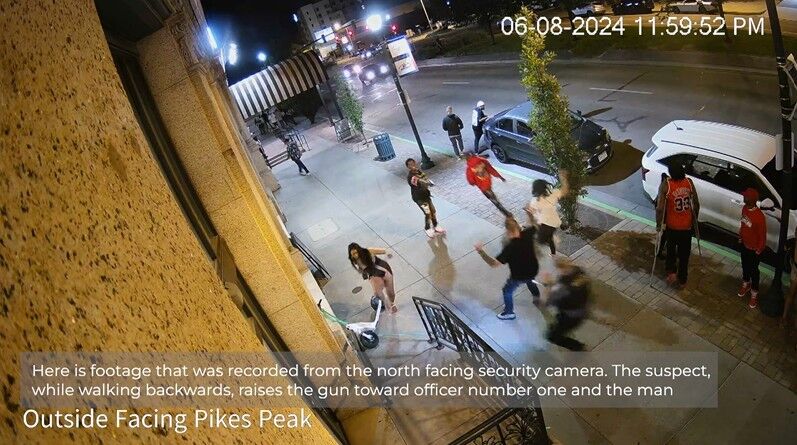
Federal judge dismisses excessive force lawsuit against Colorado Springs, officer
Michael Karlik
michael.karlik@coloradopolitics.com
Updated 9 hours ago
A federal judge concluded last week that a Colorado Springs police officer could not be held liable for shooting a suspect three times after the man menaced two victims with a gun and fled the scene. Al’morion Germany was involved...

DeFlock started from one man’s curiosity — now Flock cameras are a midterm issue
Claire Carter
claire.carter@washingtonexaminer.com
Updated 1 day ago
Will Freeman wasn’t looking to start a national movement when he launched DeFlock after noticing Flock Safety’s automatic license plate readers along the side of the road. The software engineer was driving across the country in 2024 when the cameras...
PREV
PREVIOUS

Denver will provide mental health counseling for city leadership, COVID-19 emergency response team
Denver City Council on Monday night renewed a contract that, in the past, has provided mental health support to public safety personnel and their families but will now be expanded to city leadership and staff currently stationed in the Emergency Operations Center, which coordinates the city’s COVID-19 response. Nicoletti-Flater & Associates, a Lakewood-based public safety […]
Polis administration charges $1,290 for records that would inform public on emergency response to COVID-19
Gov. Jared Polis’ administration charged $1,290 to journalists for records about how the state emergency operations center the governor established responded to the unfolding COVID-19 crisis. The Polis administration wants an additional $480 to make available records detailing Polis’ plans for providing additional ventilators to hospitals and how to conduct mass testing for COVID-19 virus […]