

OPINION | National popular vote will ensure every vote counts — in Colorado and nationwide
Imagine a presidential election in which every voter is relevant no matter where that voter lives. Presidential candidates campaign in red states, blue states, rural areas, urban areas and suburban areas. A vote for the Democratic candidate in Mississippi counts just like a vote for the Republican candidate in Illinois. One person truly equals one vote.
And the president of the United States of America governs for the entire United States of America, not just the swing states of America.
That is the future of our presidential elections if the nation adopts a national popular vote.
Coloradans should vote yes on the national popular vote this fall to make sure all of their voices are heard in future presidential elections.
Today’s Electoral College doesn’t do that. Instead, the current winner-take-all system gives 100% of Colorado’s electoral votes to the presidential candidate who gets the most popular votes in Colorado, while giving nothing to other candidates. In 2016, Hillary Clinton won 1.3 million votes and therefore won all of Colorado’s electors. Donald Trump won 1.2 million votes and other candidates won 238,000 votes. None of those other votes resulted in any electors from Colorado.
Take any of the 48 states that have a winner-take-all system and the result is the same. The votes of millions of Americans are simply tossed aside like they didn’t even happen.
We’ve heard from partisans who currently oppose the idea of one person, one vote that enacting a national popular vote will mean Colorado – in particular rural parts of Colorado – will be ignored. This claim fails for many reasons.
First, it incorrectly assumes Colorado will receive any attention at all from the presidential candidates during the 2020 general election. We enjoyed swing state status during the last three presidential elections but not anymore. Colorado has now joined over 40 other states as “flyover” territory because the candidates know who will win here. One of many analysts acknowledging that fact was columnist Ashley Herzog who recently wrote in RedState, “no credible political analysts, be they Democrat or Republican, liberal or conservative, peg the Centennial State as a truly competitive, battleground state in this year’s presidential election.”
Second, just like in any statewide election, it would be folly for presidential candidates to just focus on a big metro areas. The votes to win are simply not there. The Denver metro area accounts for 51% of Colorado’s population. That means 49% of Coloradans live outside of Denver metro. No credible statewide candidate in Colorado (including presidential candidates who wanted to win Colorado during our swing state years) has short-changed areas outside of the Denver metro area. In fact, slightly more than 49% of the presidential campaign events Colorado in 2012 and 2016 were outside metro Denver. When every vote in every state matters, the presidential candidates will have to campaign everywhere in order to win – just like statewide candidates already do in Colorado.
Partisan opponents have raised the scary picture of California and New York dominating a nationwide election under National Popular Vote. However, the facts are that these two states together contain only 18.3% of the U.S. population, voted only 61% for Clinton in 2016, and gave Clinton a margin of 6,007,000 votes. However, there is a counter-balancing group of red states in the south-central part of the country with 18.7% of the U.S. population, that voted 60% for Trump in 2016, and gave Trump a slightly larger margin of 6,038,000 votes. California and New York cannot dominate a nationwide election any more than this equally populous group of red states could. Either way, 18% is a lot less than the 50% necessary to win an election.
And, in contrast to the claim that the national popular vote is merely a reaction to the last election, the idea is far from new. In 1979 both of Colorado’s U.S. senators, Democratic Sen. Gary Hart and Republican Sen. William Armstrong, supported a national popular vote for president. Republican U.S. Sen. Bob Dole from Kansas said in support of a national popular vote during the 1979 debate:
“Candidates will soon realize that all votes are important, and votes from small states carry the same import as votes from large cities. That, to me, is one of the major attractions of direct election. Each vote carries equal importance. Direct election would give candidates incentive to campaign in states that are perceived to be single-party states.”
The first National Popular Vote interstate agreement was passed in 2007 in Maryland. The National Popular Vote agreement simply changes the way each member state’s electors are allocated under that state’s constitutional authority to ensure the presidential candidate that wins the most votes nationwide actually wins the election.
Since then, fourteen other states and Washington, D.C. have signed on. Those states have been small, medium sized, and large. The National Popular Vote is now 74 electoral votes shy of being enacted. Colorado became part of the agreement in 2019 and Colorado voters have a chance to approve that decision during this November’s election.
The National Popular Vote is the way to make sure every vote matters and every voter is relevant in our only country-wide election. Presidential candidates should care about all Americans, not just those in swing states. Vote yes on the National Popular Vote ballot measure this fall.
Mike Foote is a state senator representing District 17 and working with the Yes on National Popular Vote campaign.

Founding documents reconnect us to our shared American roots – and rebelliousness | Vince Bzdek
Vince Bzdek
vince.bzdek@gazette.com
Updated 7 hours ago
By Vince Bzdek When you first lay eyes on the actual founding documents of our country that, for the first time in history, have travelled together from their gilded cages in Washington to visit us out here in the hinterlands,...
Would you hire Jena Griswold to handle your case? | SONDERMANN
By Eric Sondermann
by-eric-sondermann@coloradopolitics.com
Updated 4 days ago
If you were in a child custody dispute with a former spouse, would you hire an attorney with experience in family law or would you trust your case to an operative with virtually zero mastery? If you were getting ready...
Trends to track as Colorado’s in precarious position pre-gubernatorial primaries | Paula Noonan
Paula Noonan
paula-noonan@coloradopolitics.com
Updated 3 days ago
As they say on Colorado Public Radio’s Marketplace, let’s do the numbers. April 2026 voter registrations continued a long-term Colorado trend with a large majority of new or changed voter registrations joining the unaffiliated cohort. Total registrations of Democrats, Republicans...
High-potency hemp products are hurting Colorado kids | GUEST COLUMN
Colorado Politics
colorado-politics@coloradopolitics.com
Updated 2 days ago
By Heidi Lawrence Six years ago, my daughter, by most metrics, was a typical overachieving teenager. She was a straight-A, pre-professional ballet dancer. She loved school and art, had lots of friends, and above all else, she was kind, funny...
Michael Fields reviews Colorado’s 2026 legislative session | The OpEdge Podcast
Tony Olivero
tony.olivero@gazette.com
Updated 3 days ago
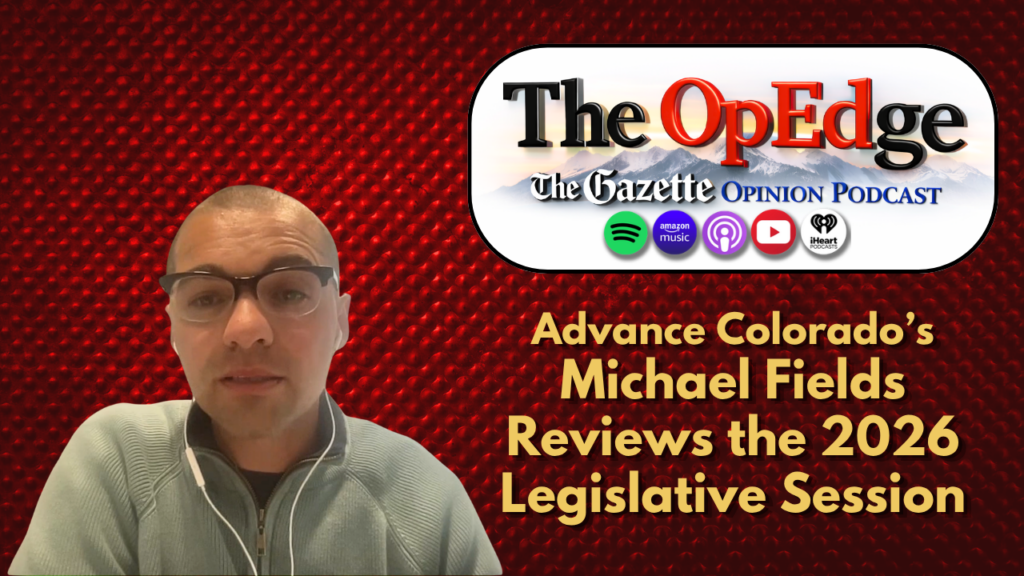
Michael Fields, executive director of Advance Colorado, joins OpEdge host and investigative columnist Jimmy Sengenberger to assess the good, the bad and the ugly of the Colorado General Assembly’s 2026 legislative session. Reflecting on the 120 bills passed in 120...
From secret huddles to Zebulon — the high cost of the Dougco BOCC’s shady governance | PODIUM
Colorado Politics
colorado-politics@coloradopolitics.com
Updated 4 days ago
By Bob Marshall, Lora Thomas and Julie Gooden In Douglas County, a new and dangerous standard of governance has taken root: if the public doesn’t like your plan, simply stop letting the public in the room. During the last year,...

Election must be decided on issues of combating public corruption, restoring integrity in government | FEEDBACK
Colorado Politics
colorado-politics@coloradopolitics.com
Updated 3 days ago
There has been considerable press and outrage regarding Gov. Jared Polis’ commutation of former Mesa County Clerk and Recorder Tina Peters’s remaining prison sentence. The outrage is reinforced by President Donald J. Trump’s creation of a $1.776 billion compensation fund...
Is the ‘penumbra of privacy’ going, going, gone in Colorado? | Hal Bidlack
Hal Bidlack
hal-bidlack@coloradopolitics.com
Updated 5 days ago
Once again, there are too many things in Colorado Politics that are newsworthy and should be written about. Unless my kindly editor will allow me to write a book-length column this week? (Ed: not so much…) First up, I’d like...

Quiet at the state Capitol doesn’t mean silence on energy policy | GUEST COLUMN
Colorado Politics
colorado-politics@coloradopolitics.com
Updated 5 days ago
By Carly West By many accounts, Colorado’s 2026 legislative session was unusually quiet on oil-and-natural-gas policy. There was no sweeping new oil-and-natural-gas package. No major new production restrictions. After years of contentious energy debates dominating the Capitol, the relative quiet...
The history, and future, of extinction in Colorado | GUEST COLUMN
Colorado Politics
colorado-politics@coloradopolitics.com
Updated 5 days ago
By Eric Washburn When I was a kid growing up in Aurora in the late 1960s and early 1970s, one of my favorite things to do was to go to the Denver Museum of Natural History and spend countless hours...
PREV
PREVIOUS
HUDSON | Carrier captain stood tall, sacrificing his career for his crew
Miller Hudson A bitterly cold wind was blowing up Narragansett Bay off the North Atlantic on Saturday, April 20, 1968. I had boarded an Eastern Airlines flight from Baltimore to Providence, Rhode Island, earlier that morning in order to attend Officer Candidate School (OCS) at the Newport Naval Base. Disembarking from a cab at the […]

BIDLACK | A pandemic of old reminds us anew to trust science
Hal Bidlack My parents used to dread the coming of summer in the 1940s and 1950s. Summer was when polio came, stalking both children and adults. Fear was ever present as there was no cure. Once in the body, polio attacked the nervous system, and can ultimately paralyze the muscles that control breathing. It was […]