

COVER STORY | The partisan politics of school choice
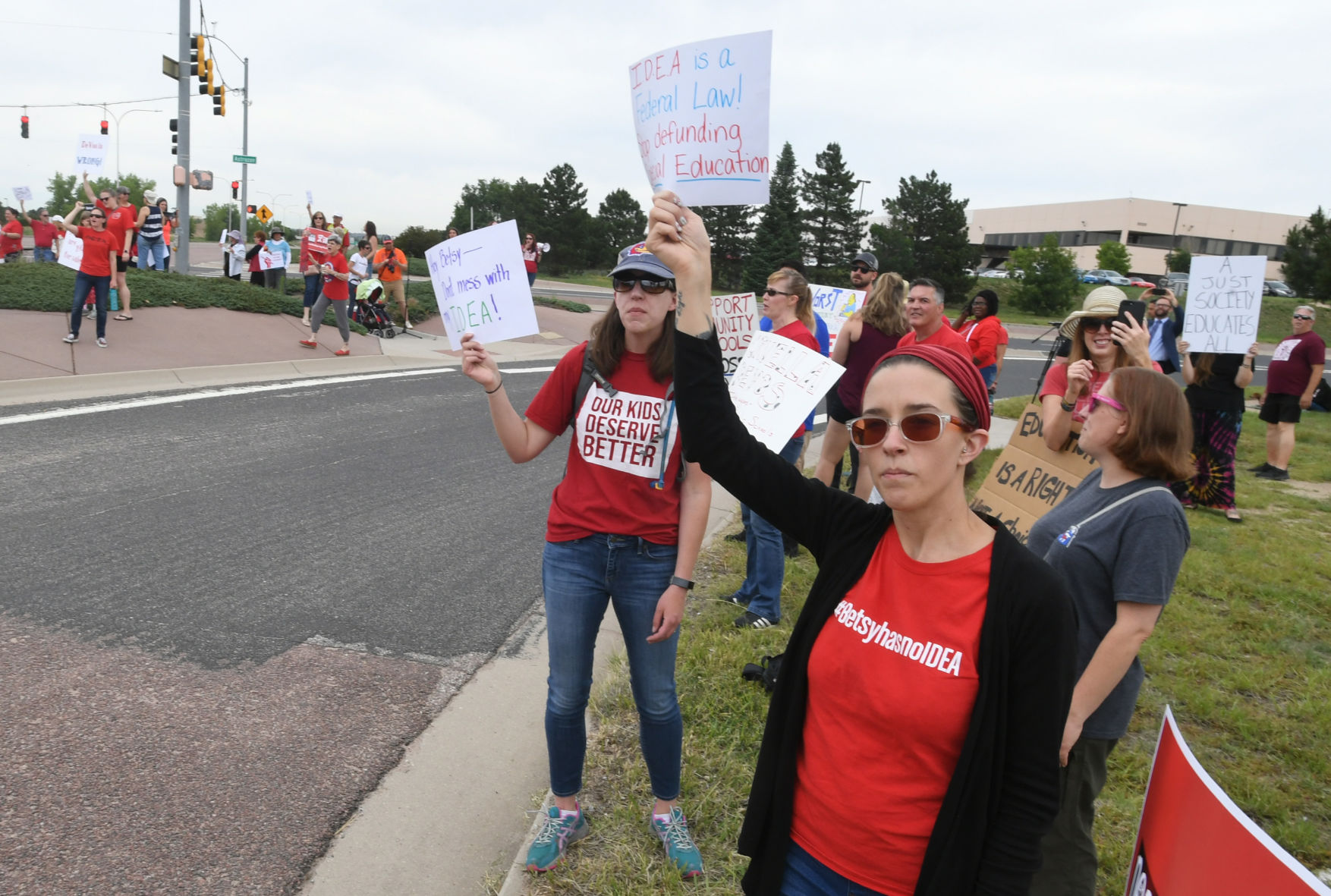
In one of the many made-for-TV moments that punctuated his third State of the Union address, President Trump admonished Congress to pass his administration’s new education reform bill by giving away a scholarship to fourth-grader Janiyah Davis.
The chamber rang with members’ applause. Speaker of the House Nancy Pelosi, who sent her son to Virginia’s Episcopal High School, a tony private school boasting a $60,900 yearly price tag, was not among them. (Incidentally, it has since been reported that Davis has attended one of Philadelphia’s most sought-after charter schools since September.)
Trump concluded his Feb. 4 address of education by calling on Congress “to give 1 million American children the same opportunity Janiyah has just received. Pass the Education Freedom Scholarships and Opportunities Act – because no parent should be forced to send their child to a failing government school.” Still no applause from the speaker, and scarce else from the other members of her party.
Charter schools are public schools that operate under an independent contract (a “charter”) and maintain greater autonomy than traditional public schools. They sprung from bipartisan roots, but like most things touching politics they’ve been shaped by rhetorical heat.
From the gold dome in Denver to the nation’s capital, charter schools remain both a solution and a problem chewed on with relish by politicians, and a quagmire that vexes policymakers on the left and right.
Policy fights over the nearly 30 years since charter schools were first authorized in Colorado have included whether they should receive a portion of the property taxes paid to local school districts (they do now), how to deal with the waivers that charter schools can obtain, including on teacher certification and sex education; and among the hottest, how the State Board of Education handles the situation when a local school board repeatedly turns down a charter school application.
“According to our recent poll in Colorado, charter schools and school choice enjoy broad and bipartisan support across all ages, races, genders and geographies,” Luke Ragland, the president of the charter-school advocacy group ReadyCO, told Colorado Politics. “School choice has always had support among Colorado Democrats and Republicans, and that continues today. Unfortunately, deep pocketed special interest groups opposed to charter schools will never stop in their quest to deprive families of school choice.
“Ready Colorado will not let their attacks go unanswered. We stand ready to hold any politician accountable, whether Republican or Democrat, that seeks to harm charter schools. There’s a long list of electoral losers sitting on their couch at home who thought opposing school choice was a smart political decision.”
RELATED: SONDERMANN | Education reform must reboot to regain traction in Colorado
With 38,000 unionized members, the Colorado Education Association says charter schools don’t do anything to address the needs of public schools: reducing class sizes, adding mental health support and ensuring educators earn a living wage, said CEA President Amie Baca-Oehlert, a high school counselor.
“As more people become aware of the unmet needs of students and educators, there is a growing concern to hold charter schools accountable to the community,” she said. “The public supports transparency measures and quality standards for all schools – including charters – so all exist on an equal playing field and are held to the same rules.
“Too many charters still operate under a veil and resist efforts by families and communities to view their daily business practices. Unlike traditional neighborhood public schools, charters have unelected school boards that don’t offer transparency into how school funds are spent, and they can accept outside gifts, grants and donations that may not align with district priorities and community values. Any school receiving taxpayer money needs to uphold strong standards of transparency and accountability.
She said charter schools are given automatic exemptions from state law, including on professional certification and licenses, as well as state standards for their performance. Teachers also serve on an at-will basis in charter schools, creating “a culture of fear and intimidation in charters that leads to poor staff retention rates and pulls quality educators away from kids,” Baca-Oehlert said.
Equal opportunities
Pointing out the political polarization of education is, of course, not a novel insight. Yet it is worth remembering that such stark partisanship is something of a new development. Until only very recently, education was a tried-and-true method for politicians to play to the middle and for candidates to show their electability. Indeed, one need only reach as far back as the Obama administration to find deep, bipartisan support for charter schools and school choice.
As Frederick M. Hess, director of education policy studies at the American Enterprise Institute, summarized recently, “Charter schools were birthed in the early 1990s as a distinctly bipartisan project, one that married Democratic concerns for equity and educator empowerment with Republican concerns for parental choice and accountability.”
In 1991, Minnesota passed the nation’s first-ever charter school law, which allowed for the creation of up to eight secular, “outcomes-based” public schools that would function outside of normal district regulations. It was the culmination of a half-decade’s worth of collaborative effort between education reformers.
This political calculus has a new equation.
Whereas President Bill Clinton in his budget for fiscal year 2000 had emphasized his administration’s commitment to investing in the growth of charter schools, candidate Hillary Clinton received boos from teacher union members in 2016 for daring to suggest that traditional public schools and charter schools should share ideas about “what’s working” in education. In the 2020 Democratic primary campaign, support for school choice and charter schools is held as virtually disqualifying.
Sens. Bernie Sanders and Elizabeth Warren have called for a complete moratorium on charter schools and for an end to the federal Charter School Program, which the Obama administration championed. And, as Jennifer Berkshire put it at the Nation, “even as ‘moderate-lane’ candidates like Buttigieg, Biden and Klobuchar try to paint their further-left counterparts as out-of-touch spendthrifts on, for example, free college or Medicare for All, the top candidates are remarkably united when it comes to charter schools: They’re over them.” Former New York Mayor Michael Bloomberg stands alone for his continued support of charter schools.
The left’s move away from school choice began with the Obama administration. Obama had taken office under the promise of “unity, compromise and post-partisanship,” and in fact represented little departure from the Bush administration’s educational agenda. But the pro-charter, pro-accountability bipartisan consensus on education he inherited masked growing political cleavages.
Teacher unions had originally treated charter schools as a far less threatening policy concession than private school vouchers. Some union leaders such even viewed charters as a potential avenue for expanding (unionized) teacher control and spurring innovation. Yet as the charter sector expanded, including into major urban school systems such as those in Chicago, New York, and New Jersey, it did so largely absent union influence.
Teacher unions began to push back at charter expansion, and this put some Democrats into a political bind. Meanwhile, conservatives and state leaders began to chafe under the onerous restrictions of No Child Left Behind and recoil from expanded federal intrusion into education.
Beginning in 2009, Obama and Secretary of Education Arne Duncan used Race to the Top, a competitive grant program paid for by $4 billion in stimulus funds, to coerce states into accepting fewer limits on school choice and more federal involvement in education.
Race to the Top also pushed states to adopt the Common Core agenda. This combination prompted backlash from both left and right. On the right, Obama’s educational agenda became inextricable from broader critiques of his executive overreach. On the left, the administration’s focus on school choice and teacher accountability further disenfranchised teacher unions, while the deficiencies of Common Core alienated the affluent and suburban communities that were becoming an increasingly important Democratic constituency.
Obama began to retreat from his support of school choice. His administration sought aggressively to defund the D.C. Opportunity Scholarship Program, which was a successful, federally funded voucher initiative serving around 1,500 students in the district. This despite the fact that an earlier evaluation of the D.C. program by the federal Institute of Education Sciences found that it “significantly improved students’ chances of graduating from high school.”
In 2013, Obama’s attorney general, Eric Holder, sued to close the state-funded Louisiana Scholarship Program, maintaining that the program violated federal desegregation laws by allowing six black students to leave their failing elementary school.
Then, In 2016, the NAACP called for a charter moratorium. High-profile Democrats, particularly those shoring up their political record in preparation for a presidential bid, began to change their tune on education.
In 2016, Warren helped campaign against raising the charter school cap in Massachusetts, reversing her support for market-driven school choice measures, despite the fact that Boston is home to the most effective charter sector in the country. During confirmation hearings for Education Secretary Betsy DeVos, Sen. Cory Booker, who was once held as the heir apparent to Obama’s education legacy, reversed his support for both school choice . In 2000, he had taken DeVos’s personal invitation to argue in favor of school vouchers at a Michigan debate and in 2012 he gave the keynote speech at the School Choice Policy Summit hosted by DeVos’s American Federation for Children, among other collaborations.
Meanwhile, as Democrats continued to turn away from school choice, Trump began to pick up its partisan mantle.
On the campaign trail, Trump routinely blasted Democrats for their opposition to school choice. The Democratic Party, he told a Cleveland audience in 2016, has “trapped millions of African American and Hispanic youth in failing government schools that deny them the opportunity to join the ladder of American success.” His appointment of DeVos, a lifelong patron of choice-based, market-driven approaches to education, excited charter school advocates almost as much as it enraged choice opponents.
Era of polarization
The politics of school choice, therefore, are politics of polarization. The Bush-Obama years federalized education as a matter of both policy and culture. Even with the passage of the Every Child Succeeds Act in 2015, which returned some power back to the states, the national focus on state and local education battles remains.
“Today, high-profile education positions are being crafted with an eye not to the persuadable middle, but to the party’s base,” Hess wrote last month. “That’s new. The information economy means that education will continue to grow in importance, but we can no longer assume that this will breed pragmatism or statesmanship. Instead, as politics have become more tribal, education’s very import has made it an appealing way to signal the base.”
For all the partisan rhetoric, neither Democrats nor Republicans are as monolithic when it comes to school choice as it may seem. There are important constituencies in both parties that cut against prevailing ideological winds.
Among Democrats, there is a sharp racial divide on charter schools and school choice. A poll commissioned last year by Democrats for Education Reform, a leftist advocacy group that backs charter schools, found that a significant gap exists between white and minority Democrats on the topic. While only 26% of white Democratic primary voters had a favorable view of charters, a majority of both black and Hispanic Democratic primary voters saw charters favorably (58% and 52%, respectively).
The most recent Education Next poll, which has tracked public opinion on charter schools for years, found similar discrepancies. Interestingly, support for charter schools among black and Hispanic Democrats held steady from 2016 to 2018. In the 2019 poll, 55% of African American Democrats and 47% of Hispanic Democrats backed charters. Among white Democrats, however, approval has dropped significantly over that time, falling from 43% to 27%.
This racial divide is consistent with other data. Zaid Jilani noted in these pages last week that “minority voters are often much more socially conservative than white voters, particularly within the Democratic coalition.” On education, too, minority Democratic voters seem to have different priorities than their white suburban counterparts. Yet at the national party level, it’s the white, suburban, union-following bloc that is driving the Democratic Party agenda on education at the expense of other Democratic coalitions. “The views of white Democratic voters seem to be a significant political impediment to parents of color gaining access to high-quality public charter schools that best serve their children,” concluded the Democrats for Education Reform survey.
GOP not united
Nor are Republicans’ views on educational choice and charter schools uniform, either. As Trump and his administration have embraced charter schools, the share of GOP voters’ support for them has increased. Sixty-one percent of Republican voters support charters, according to the 2019 Education Next poll, up from 49% in 2017.
However, not all Republicans are choice stalwarts. Sens. Lisa Murkowski of Alaska and Susan Collins of Maine broke party lines to vote against DeVos’s confirmation in 2017. To be sure, Collins and Murkowski are both centrists known to buck the GOP on difficult votes; however, they are also both from rural states.
Rural states tend to have a lower population density and their schools lower, sometimes far lower, budgets. According to the National Center for Education Statistics, only about 11% of public charter schools are located in rural communities, compared with 29% of traditional public schools. As of this year, 44 states and the District of Columbia have charter schools. The remaining states without a charter school law are overwhelmingly rural: Montana, Nebraska, North Dakota, South Dakota and Vermont.
Even outside of rural America, many communities across the country simply don’t have alternatives to traditional, local public schools. As such, calls for “school choice” that center on charter schools don’t have salience for many core Republican voters. This can hamstring the pursuit of choice policies at both the state and federal level.
Hot on the heels of his inauguration and DeVos’s partisan confirmation, Trump unveiled his initial “skinny budget,” which proposed a sweeping $20 billion school voucher program. Much was written about the proposal, but it ultimately gained little traction, even among the GOP.
And while the politics of school choice have never been more polarized, there are still a few places where compromise seems feasible. The Family Stability and Opportunity Vouchers Act, which was introduced in December by Republican Sen. Todd Young and Democratic Sen. Chris Van Hollen, has received bipartisan support from housing advocates, conservative economists, and even the NEA.
The bill proposes to give half a million “housing choice vouchers” to low-income families with children under the age of 6 to move to neighborhoods with higher-performing schools and superior job prospects. “Housing vouchers,” writes John Bailey, “might be the most viable path for federal school choice policy. It would not only create economic opportunities for families and reduce housing insecurities, but also give lower income parents the means to have their children attend better public schools, including charter schools.”
There is also ample opportunity for the president and GOP senators to shift the politics of choice in their favor. It looks unlikely that the Democrat-controlled House of Representatives will pass the Education Freedom Scholarships and Opportunity Act. The bill, which provides $5 billion in federal tax credits for contributions to state scholarship funds, has amassed 106 co-sponsors, but they are all Republicans. Yet, the disconnect between the educational views of black and Hispanic Democratic voters and the Democrats’ 2020 candidates is an electoral wedge just waiting to be exploited.
Colorado whims
Gov. Jared Polis, a Democrat of Colorado’s highest order, founded two charter schools, a position that worked against the congressman from Boulder in the primaries in 2018, where backers of the state teachers union sided with Cary Kennedy, who, of course, is now a fiscal policy adviser to Polis.
Former state Sen. Mike Johnston has struggled to get traction in both the governor’s race and his now-defunct bid for U.S. senator, partly because some in his party won’t stop questioning his loyalty to regular public schools. He sat on the advisory board of Democrats for Education Reform and his political campaigns have collected millions of dollars in donations from supporters of charter schools. He also authored Colorado’s teacher effectiveness law, linking evaluations to student performance on state assessments.
Colorado Democrats, at their state assembly two years ago, rejected DFER, even though Polis is one of the organization’s favorite success stories nationally.
But DFER and its Democratic allies still hold sway at the state Capitol. So does its money.
Colorado Politics reporters Joey Bunch and Marianne Goodland contributed to this article.
J. Grant Addison is deputy editor for the Washington Examiner magazine and the former program manager for education policy studies at the conservative-leaning American Enterprise Institute.


City of Northglenn, state fail to reach agreement on mental health facility amid safety concerns
Marissa Ventrelli
marissa.ventrelli@coloradopolitics.com
Updated 30 minutes ago
The City of Northglenn says it was unable to reach an agreement with the state on a pair of controversial transitional living facilities for individuals with mental health conditions run by the Colorado Department of Human Services. The facilities, located...
Colorado lawmakers grapple with spending cuts amid $1 billion-plus deficit
Marianne Goodland
marianne.goodland@coloradopolitics.com
Updated 14 hours ago
The battle over Colorado’s budget for next year — which stalled in the House over a procedural maneuver — entered a more difficult phase on Thursday, when legislators grappled with hundreds of millions of dollars in proposed reductions to balance...
New rules for private judges in Colorado include discipline oversight, campaign contributions
David Migoya
david.migoya@gazette.com
Updated 17 hours ago
The Colorado Supreme Court recently determined the state’s private judges — retired jurists appointed to oversee civil cases that rarely get public scrutiny — can now make political contributions freely and without reserve, overruling a prohibition that had been in...

Colorado bill reshaping RTD board advances
Marissa Ventrelli
marissa.ventrelli@coloradopolitics.com
Updated 17 hours ago
A proposal to reshape the Regional Transportation District’s leadership easily cleared a committee vote Wednesday, advancing the bill sponsors say is needed to revive a transit system still struggling to regain riders and public trust. Critics have countered that, while...

Colorado Democrat John Hickenlooper pulls in nearly $1.4M in 1st quarter, heads into primary with $4M
Ernest Luning
ernest.luning@coloradopolitics.com
Updated 14 hours ago
U.S. Sen. John Hickenlooper’s campaign raised nearly $1.4 million in the first quarter of 2026 and plans to report more than $4 million on hand heading into Colorado’s June primary, the first-term Democrat’s campaign said Thursday. That brings Hickenlooper’s total...
Republican Ron Hanks plans ‘grassroots’ primary challenge to US Rep. Jeff Hurd in Colorado’s 3rd CD
Ernest Luning
ernest.luning@coloradopolitics.com
Updated 17 hours ago
Colorado Republican Ron Hanks, a former state lawmaker, plans to challenge first-term U.S. Rep. Jeff Hurd in the 3rd Congressional District primary by seeking a spot on the June ballot at the GOP’s district assembly in Pueblo on Friday, Colorado...
Five ways Mullin is already pushing DHS in a new direction
Anna Giaritelli Washington Examiner
anna-giaritelli-washington-examiner@coloradopolitics.com
Updated 21 hours ago
The Trump administration’s newest Cabinet secretary, Markwayne Mullin, has already begun to implement major changes across the Department of Homeland Security Mullin replaced President Donald Trump’s first DHS secretary, Kristi Noem, and was an unexpected pick to lead the department...
Appeals court finds Prowers County judge incorrectly analyzed firetruck collision lawsuit
Michael Karlik
michael.karlik@coloradopolitics.com
Updated 21 hours ago
Colorado’s second-highest court directed a Prowers County judge last month to take a second look at whether a firetruck operator and the county itself can be held liable for a collision with a motorist. Donald Williamson was driving through a...
Appeals court reverses assault convictions after jury received no definition of ‘harm’
Michael Karlik
michael.karlik@coloradopolitics.com
Updated 23 hours ago
Colorado’s second-highest court reversed an Arapahoe County defendant’s assault convictions last week, concluding the trial judge neglected to define a key, ambiguous term for jurors. Police officers arrested David Cristobal Aragon at a house party for allegedly violating a restraining...
Colorado counties cannot challenge state law restricting immigration contracts, appeals court says
Michael Karlik
michael.karlik@coloradopolitics.com
Updated 18 hours ago
Colorado’s second-highest court ruled on Thursday that counties lack standing to challenge a 2023 state law that restricts their ability to contract with the federal government or private entities for immigration detention. A three-judge Court of Appeals panel agreed with...
PREV
PREVIOUS

Denver Housing Authority’s leader exiting for national nonprofit
The leader of Denver Housing Authority is stepping down to lead a national nonprofit. Ismael Guerrero, who has been the executive director of the Denver Housing Authority for more than 12 years, will become on July 1 the president and CEO of Mercy Housing, a Denver-based affordable housing nonprofit. “My career has been dedicated to […]
Jeffco attempts to preserve fairgrounds operations in face of budget cuts
The Jefferson County Board of Commissioners on Tuesday gave direction to county staff to work with the Open Space Department and nonprofits to preserve agricultural activities at the fairgrounds in the face of potential budget cuts. The fairgrounds cost the county $1.8 million annually to operate, and the county previously identified $16.1 million in budget […]