

LEGISLATIVE PREVIEW | In 2020, transforming Colorado’s criminal justice remains a priority
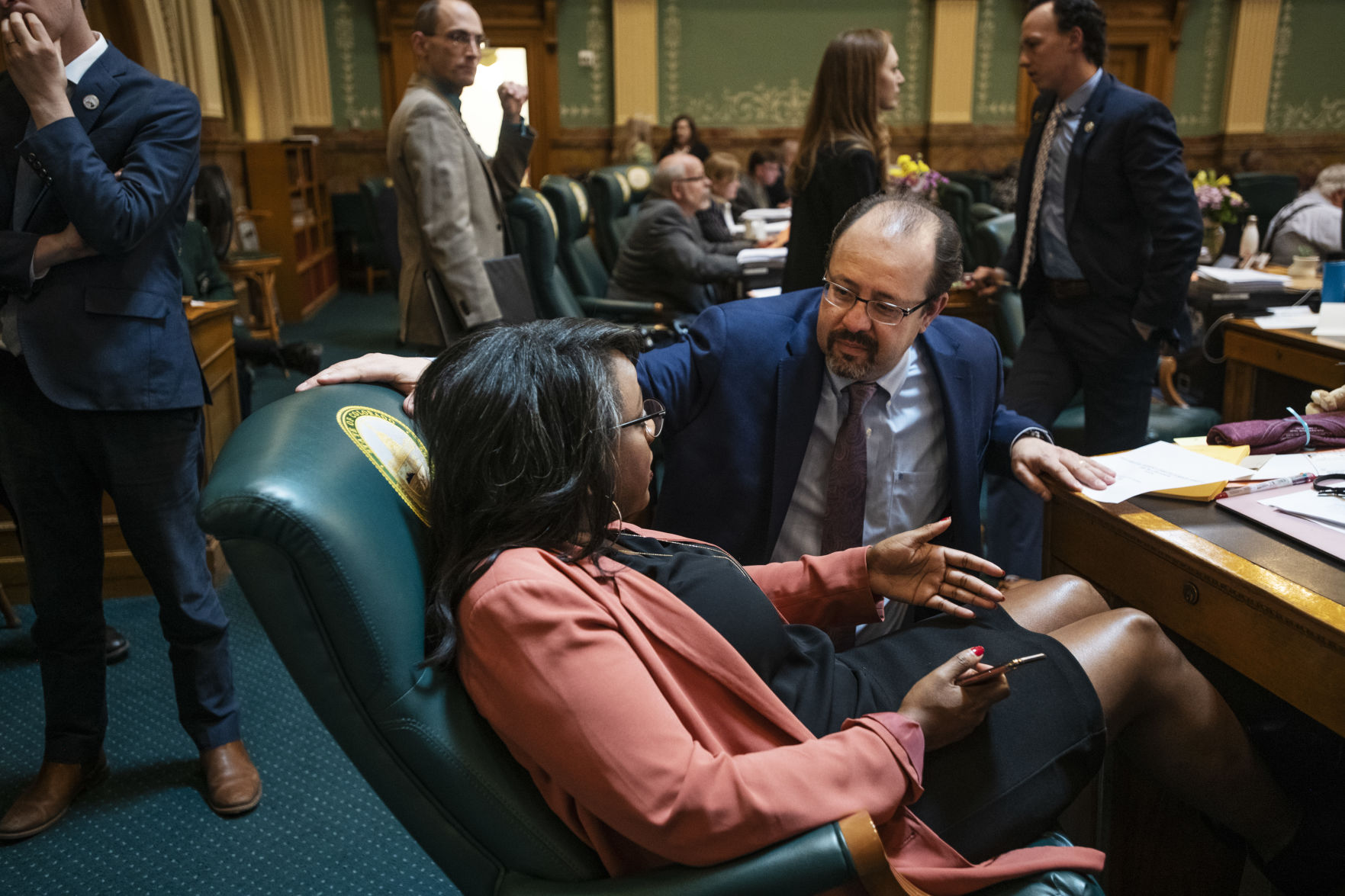
Divisions between Republicans and Democrats on core political values have widened dramatically in recent years, but through the eyes of state Rep. Leslie Herod — who homes in on Colorado justice — you may not see it that way.
Herod believes bipartisan cooperation has put the state well on its way to “righting the wrongs” within its criminal justice system. In 2020, she stands ready to keep the momentum going.
“This system was built on bias, racism and discrimination,” said the Denver Democrat, who was elected in 2016 and made history as the first known African American LGBTQ person to hold elected office in Colorado. “As you peel back the layers of the onion, we find more and more issues that need to be addressed.”
Colorado's prison population, once forecast to boom, now is expected to level
INSIGHTS | Lawmakers are quietly reshaping Colorado justice
Pete Lee is on a mission to make Colorado criminal justice more efficient, not more lenient
Aurora chief defends decision not to fire drunk officer
For her and other lawmakers committed to transforming the criminal justice system, that means preemptively tackling issues on the front end, as well as focusing on “rehabilitation and redemption,” addressing bail requirements, weakening the state’s reliance on private prisons, expanding pretrial services programs, reducing prison populations, lowering the recidivism rate and ensuring prisoners have support to be successful upon release.
Roughly half of Colorado offenders who are released from state prison will return within three years, according to state officials.
RELATED: LEGISLATIVE PREVIEW 2020: Full Colorado Politics coverage of the issues to come
“That number places us in the bottom 10 in the nation,” said Boulder County District Attorney Michael Dougherty, who added that he appreciated the legislature taking “criminal justice reform head on.”
Staggering recidivism
Herod said Colorado has a higher recidivism rate because “we are misappropriating our funding and our priorities. Instead of focusing on beds, we should be focusing on rehabilitation and redemption.”
The rate is “staggering,” echoed state Sen. Pete Lee, D-Colorado Springs, who has long advocated for restorative justice, an approach that aims to rehabilitate offenders and repair the harm caused by their criminal behavior through reconciliation with victims.
“The power of restorative justice occurs when an offender is listening to a victim and understands — often for the first time — that what they did hurt a living, sentient being,” he said.
Lee said people often go back to prisons for two reasons: They commit new crimes, or they commit technical parole violations.
Lee, along with Herod and Sen. Julie Gonzalez, D-Denver, passed legislation last session aimed at lowering parole revocations for technical violations to alleviate prison population issues. The Colorado Division of Criminal Justice expects those violations to “continue to fall at an increasing rate” because of the bill.
Herod and Sen. Steve Fenberg, D-Boulder, co-sponsored legislation in the last session that restored voting rights to nearly 11,500 parolees in the state, a measure the ACLU of Colorado championed.
Dianne Tramutola-Lawson with Colorado-CURE, a nonprofit advocating for criminal justice reform, said she wants to see that bill taken even further so that inmates “never lose their right to vote in prison or jail,” as is the law in Maine and Vermont.
Colorado, although considered a relatively progressive state, has an incarceration rate of 635 per 100,000 people, which is more than double the rates of the United States’ closest international allies, according to the Prison Policy Initiative, a nonpartisan think tank based in Easthampton, Massachusetts.
In April, Herod along with Lee and Gonzales, also helped push through a bill that lessened drug possession charges from a felony to a misdemeanor.
Legislation last session also diverted inmates with drug and alcohol addictions into treatment rather than jail cells, after a similar move was made for people with mental health issues the year before.
A “ban the box” measure sponsored by Rep. Jovan Melton, D-Aurora, and backed by Herod was signed into law this year by Gov. Jared Polis that barred private employers from inquiring about criminal history on initial job applications. Colorado joins 12 other states that have taken such a step.
“You commit a crime and then you have a felony on your record, and you want to overcome those handicaps and get education and a job,” Lee said. “But your application for either one of those has a big scarlet C for criminal or you have felon on your forehand, so you can’t get educated. You can’t get a job.”
Taxpayers foot the bill
When Lee talks to his conservative colleagues in the legislature, he puts it terms of cost: jail cells are the costliest form of treatment there is, and jails are practically colleges for criminals.
A lawyer and a graduate of the Wharton School of Finance, Lee is the chairman of the Senate Judiciary Committee vice-chair of the Finance Committee, which gives him a front row seat to see how government cash to and from the Department of Revenue, State Treasury, and the Office of State Planning and Budgeting.
Too much goes into jail cells with a terrible return on investment for the prisoner, the taxpayer and society, Lee has said since he first won a seat in the state House in 2010.
The state budget provided $982 million for corrections this year, up fro $909 million the year before. That compares to $599 million for the Department of Public Health and the Environment and $115 million for regulatory agencies.
A legislative budget analysis found it costs the state more than $43,000 a year to house an inmate. Colorado taxpayers host about 20,000 people behind bars this year.
The legislative work is starting to show results.
In a report in June, the Department of Corrections revised downward its projection for the state prison population in five years to 20,878, which is 13.9% lower than 2018 estimate for 2025.
House Bill 1263 in the last session, another bill led by Herod, reclassified several drug felonies as misdemeanors, which the Department of Corrections said in a report this summer would divert up to 295 prison commitments each year.
“While admissions to prison have decreased, releases from prison have increased,” the report states. “… This increase is not unexpected, as the Parole Board has made concerted efforts to work with the Governor’s Office to address the capacity issues of the Colorado Department of Corrections and expedite releases.”
Help over bail
This year, Lee and Herod plan to take on bills that would provide funds to jurisdictions for pretrial services programs, which would enroll people who can’t afford bail into treatment programs, such as alcohol and drug rehabilitation.
“The purpose of bail is to keep people who are a threat to the community from fleeing the jurisdiction or doing harm in the community,” but bail also may violate constitutional rights because not everyone can afford the fine, Lee said.
“Why do we have people sitting in jail cells who are not a risk to themselves or society simply for their inability to pay to get out?” Herod said. “That needs to change.”
In 2020, Herod will be looking deeper into how people get into the criminal justice system, including factors such as “over-policing.” She also told Colorado Politics she wants to ensure first-responders enlist mental health professionals who can respond to calls “when force is not necessary.”
Another bill to watch in the upcoming legislative session will revolve around compassionate release, or freeing prisoners who committed a crime early in life and are now in old age. The philosophy is that they likely are not a danger to the community or public safety, and they’re expensive to keep in prison.
“Everyone has made mistakes,” Lee said. “And to warehouse people for decades for things that they did when they were young, crazy and drug-addicted doesn’t make sense to me. It’s just not a good use of societal resources.”
Lee, with the help of the ACLU and lawmakers in the House, also plans to build on legislation that requires courts to text reminders to help people remember when to show up. The new legislation would tack on a 72-hour grace period when people fail to appear for court, although he said the details were still being worked out.
The point is to address inconsistencies around the issuing of failure-to-appear warrants, said Denise Maes, public policy director of the ACLU of Colorado.
“It varies from judge to judge, frankly, and from jurisdiction to jurisdiction,” she said. “We want to create some uniformity in the state.”
Journey to equality
Attorney General Phil Weiser said during a Dec. 12 town hall in Colorado Springs that justice “can’t be taken for granted.”
He said that it’s because of the work of lawmakers such as Lee, who stood to his left, and the Colorado community that “we are on this journey towards equality.”
“Colorado is definitely moving in the right direction when it comes to criminal justice reform,” Herod said. “It’s really imperative that we continue on.”
Despite bipartisan support, Herod still anticipates opposition in 2020 from people who “don’t want to change the old way.”
She remains an optimist, however.
“Because we have such a strong coalition, members are willing to … hit some of these issues head on,” she said. “That’s why we’re moving forward in Colorado.”
Colorado Politics Must-Reads:

Fauci’s private COVID-19 diaries: Six takeaways on fame, prize money and the lab leak debate
The Washington Examiner
the-washington-examiner@coloradopolitics.com
Updated 2 hours ago
Anthony Fauci’s private writings from 2020 and beyond portray a public health official who was fixated on his growing celebrity while privately grappling with a pandemic response he believed was chaotic, leaderless and consumed by internal rivalries. The writings of...

Denver City Council sends Xcel franchise deal to voters
Deborah Grigsby
deborah.smith@denvergazette.com
Updated 1 hour ago
This November, Denver voters will decide whether to renew the city’s longstanding franchise agreement with Xcel Energy. Members of the Denver City Council approved on Monday sending a proposed 20-year franchise agreement with Xcel that would deliver more than $180...

Denver weighs permanent restriction on low-level traffic stops
Deborah Grigsby
deborah.smith@denvergazette.com
Updated 1 hour ago
A Denver City Council committee is considering permanently limiting certain types of low-level traffic stops used to investigate unrelated crimes and requiring better public reporting about why such stops happen. Members of the Budget and Policy Committee on Monday were...

Fort Carson soldiers develop app to plan convoys as part of Next Generation Command and Control
Mary Shinn
mary-shinn@coloradopolitics.com
Updated 1 hour ago
Planning the details of a military convoy with numerous vehicles, personnel, weapons, radios and other details can take a platoon leader three days. In addition to plotting a safe route, leaders need to map out checkpoints to track the convoy’s...

Penley fire near Sedalia reaches 75% containment
Nicholas Fogleman
nicholas.fogleman@denvergazette.com
Updated 1 hour ago
Fire crews battling the Penley fire west of Sedalia made significant progress overnight, holding the wildfire at about 3 acres and reaching 75% containment Monday, according to Douglas County officials. The fire, which sparked Sunday west of Sedalia, prompted evacuation...
Colorado board permits state to appeal injunction against arthritis drug price cap
Marissa Ventrelli
marissa.ventrelli@coloradopolitics.com
Updated 52 minutes ago
A Colorado board voted Friday to allow the Attorney General’s Office to fight an injunction against a price cap on a drug that treats arthritis. A U.S. district court judge had granted the company Amgen a preliminary injunction, temporarily blocking...

Federal judge rejects constitutional claims, ‘expressions of hatred’ by Club Q defendant
Michael Karlik
michael.karlik@coloradopolitics.com
Updated 17 hours ago
A federal judge rejected a defendant’s claims that he received constitutionally ineffective assistance of counsel while facing federal hate crime and firearms charges for murdering five people at a Colorado Springs LGBTQ nightclub in 2022. Anderson Lee Aldrich is serving...

Divided 10th Circuit upholds Colorado congestion fee on car rentals
Michael Karlik
michael.karlik@coloradopolitics.com
Updated 13 hours ago
The Denver-based federal appeals court concluded on Monday that a 2024 “congestion impact fee” that lawmakers imposed on short-term vehicle rentals did not conflict with a federal prohibition on certain airport-related charges. Beginning in the 1970s, Congress began limiting the...

Space Force should measure workforce needs as it prepares to double in size, GAO report says
Mary Shinn
mary-shinn@coloradopolitics.com
Updated 22 hours ago
The Space Force needs more people. It’s just not precisely sure how many more. A Government Accountability Office report released earlier this month found that the youngest and smallest military branch does not have a process to consistently or accurately...

Colorado schools receive $24 million for free meals program
Marissa Ventrelli
marissa.ventrelli@coloradopolitics.com
Updated 17 hours ago
The Colorado Department of Education is providing Colorado schools with nearly $24 million in grant funding to implement a free lunch program. Approved by voters in 2022, the Healthy School Meals for All provides free breakfast and lunch to all...
PREV
PREVIOUS

Tenth Circuit sides with prisoner, overturns lower court’s declaration of “frivolous" lawsuit
A prisoner claiming that his constitutional rights were violated as a result of prison overcrowding and a lack of private showers will have his case heard, after the U.S. Court of Appeals for the 10th Circuit on Monday reversed a lower court’s opinion that the lawsuit was frivolous. Larry Allen Thompson is an inmate at […]

INSIGHTS | Klingenschmitt, the Christian warrior, fights on in El Paso County
PEYTON — Gordon Klingenschmitt won’t back down, and there’s a lot riding for him and his true believers in El Paso County after three political losses in three years. If a warrior for God like Dr. Chaps, as he’s called, can’t win here, where can the candidates for Christ do better? That, by no means, sells […]