

Denver’s proposed 10-cent plastic, paper bag fee heads to a vote later this month

Hundreds of laws and ordinances across the country ban or tax plastic bags – including in 11 Colorado municipalities – and Denver could be next.
An estimated 250 million bags are used by Denver residents every year, according to the city. But thanks to unanimous approval of a proposed ordinance during a City Council Finance and Governance Committee meeting Tuesday, consumers may be charged as early as July 1, 2020, a dime for every plastic or paper bag they use to carry home their goods and groceries.
“This is just a first step” said Councilwoman Kendra Black, who is leading the bill alongside council members Stacie Gilmore, Deborah Ortega and Jolon Clark. “It is time for Denver to do this. But we need to do more.”
The proposal would give retailers 4 cents from every grocery bag sold, and the city would pocket the other 60%.
This isn’t the first time the city’s considered a grocery bag tax or ban. In 2013, Ortega sponsored a measure that would have charged consumers a nickel for every non-reusable paper or plastic bag used at food stores.
But Ortega’s bill failed after Mayor Michael Hancock threatened to veto it because “he felt at the time it would negatively and disproportionately impact low-income residents,” spokeswoman Theresa Marchetta wrote in an email.
Again in 2018, City Council considered an outright ban on plastic bags, but chose to table the measure until they had support from the state legislature.
Black said she’s been assured by Colorado lawmakers that her proposed ordinance will have backing in the upcoming legislative session. In 2020, state policymakers plan to repeal a 1993 state statute, she said, which served as the basis of a 2012 lawsuit by the Colorado Union of Taxpayers against the City of Aspen over a 20-cent paper bag fee.
“No unit of local government shall require or prohibit the use or sale of specific types of plastic materials or products or restrict or mandate containers, packaging, or labeling for any consumer products,” the statute reads.
However, the legal challenge ultimately died in 2018, when the Colorado Supreme Court ruled the two dimes collected were a fee, not a tax.
Black’s proposal also has the support of Hancock, Marchetta said, although he personally prefers a ban.
“The mayor has always been more supportive of a ban, but he listened to advocates and heard a fee is more impactful to promote behavior change first,” she said. “He sees this as a step.”
Stakeholders supporting the measure include the Colorado-Wyoming Petroleum Marketers, Colorado Retail Council and the Downtown Denver Partnership, among several others.
Plastic bags take more than 500 years to decompose and are the second-most-common litter item collected along local areas like Cherry Creek and the Platte River – so why not ban them completely?
The answer, according to the city, lies in examples set by other municipalities, including Chicago, which initially passed a ban on single-use plastic bags in 2015 but repealed the ban a year later after not seeing a significant reduction in usage.
Instead, Chicago implemented a 7-cent tax that resulted in an approximately 40% decrease in non-reusable bags.
People experience loss more than gains, so having to pay a small fee for something they considered free motivated them into using their own bag or no bag at all, Black said.
At least eight states – California, Connecticut, Delaware, Hawaii, Maine, New York, Oregon and Vermont – have banned outright the use of plastic bags, according to the National Conference of State Legislatures.
Denver’s dime fee matches the City of Boulder’s, which saw a 70% reduction “immediately following” the implementation of the bag fee, although the trend “leveled off quickly,” according to the city.
As of early 2018, Boulder raked in more than a million dollars since the fee went into effect in 2013.
If Denver reduced the quarter-million bags used annually by 70%, the city would generate an estimated $2.25 million. Revenue jumps to $7.5 million if single-use bags are cut by half.
That money will be used for program education and marketing, free reusable bag giveaways through retailers, schools and city agencies, waste reduction efforts, and administrative and enforcement costs.
The upfront costs, to be reimbursed after fees are collected, will include an advertising campaign, giveaway bags and the staff needed to conduct the giveaways, as well as agency assistance for implementation, which will require the hiring of a program coordinator.
City Council will hold a public hearing on the proposal Dec. 16 and is positioned to vote on the measure Dec. 23. The proposed ordinance is likely to pass with support from 11 of 13 members. If passed, the fee is expected to go into effect mid-2020, and a task force will be formed the following year.


10th Circuit rejects ‘potential for violence’ when police arrest vehicle occupant’s romantic partner
Michael Karlik
michael.karlik@coloradopolitics.com
Updated 2 hours ago
The Denver-based federal appeals court rejected the idea on Tuesday that a vehicle occupant poses a danger to police solely because they are romantically involved with another occupant who officers are arresting. By 2-1, a three-judge panel of the U.S....

Colorado justices grill debt collector about compliance with law
Michael Karlik
michael.karlik@coloradopolitics.com
Updated 15 hours ago
The Colorado Supreme Court repeatedly pressed a debt collection company last week to explain how its lawsuit against a Boulder woman for an unpaid credit card balance complied with the specific requirements that state lawmakers have created. Portfolio Recovery Associates,...

Artificial intelligence working group agrees on framework to replace Colorado law
Marianne Goodland
marianne.goodland@coloradopolitics.com
Updated 20 hours ago
A group that has been working on artificial intelligence policy has reached an agreement on a framework that would replace the regulations adopted by Colorado legislators two years ago. The agreement has the backing of Gov. Jared Polis, who reluctantly...

Proposal to levy new fees on alcohol products in Colorado dies
Marissa Ventrelli
marissa.ventrelli@coloradopolitics.com
Updated 3 hours ago
The proposal to collect millions in new fees on alcohol products — dollars to be earmarked for Colorado programs aimed at addressing the behavioral and physical health effects of alcohol abuse — died on Tuesday. House Bill 1271 sought to...
The numbers that Republicans say show Democratic midterm targets are a ‘political hallucination’
Rob Crilly, Washington Examiner
rob.crilly.washington.examiner@gazetteedit.wpenginepowered.com
Updated 20 hours ago
Democrats keep expanding their battleground map of midterm target seats, but do they really have any chance in some of the districts they claim they can win? Of the 44 districts listed by the Democratic Congressional Campaign Committee as targets,...
Pam Bondi subpoenaed for April 14 House deposition on Epstein files handling
Kaelan Deese, Washington Examiner
kaelan.deese.washington.examiner@gazetteedit.wpenginepowered.com
Updated 22 hours ago
The House Committee on Oversight and Government Reform issued a subpoena Tuesday compelling Attorney General Pam Bondi to sit for a deposition on April 14 as part of an ongoing investigation into the Justice Department’s handling of the Jeffrey Epstein...
Capitol Police chief asks for record-breaking budget, citing 58% increase in threats to Congress
Emily Hallas, Washington Examiner
emily.hallas.washington.examiner@gazetteedit.wpenginepowered.com
Updated 22 hours ago
U.S. Capitol Police Chief Michael Sullivan on Tuesday argued sweeping threats against lawmakers justify his department’s historic budget request during a House Appropriations Committee hearing. Sullivan testified before the Legislative Branch Subcommittee on his budget proposal for fiscal 2027 funding....
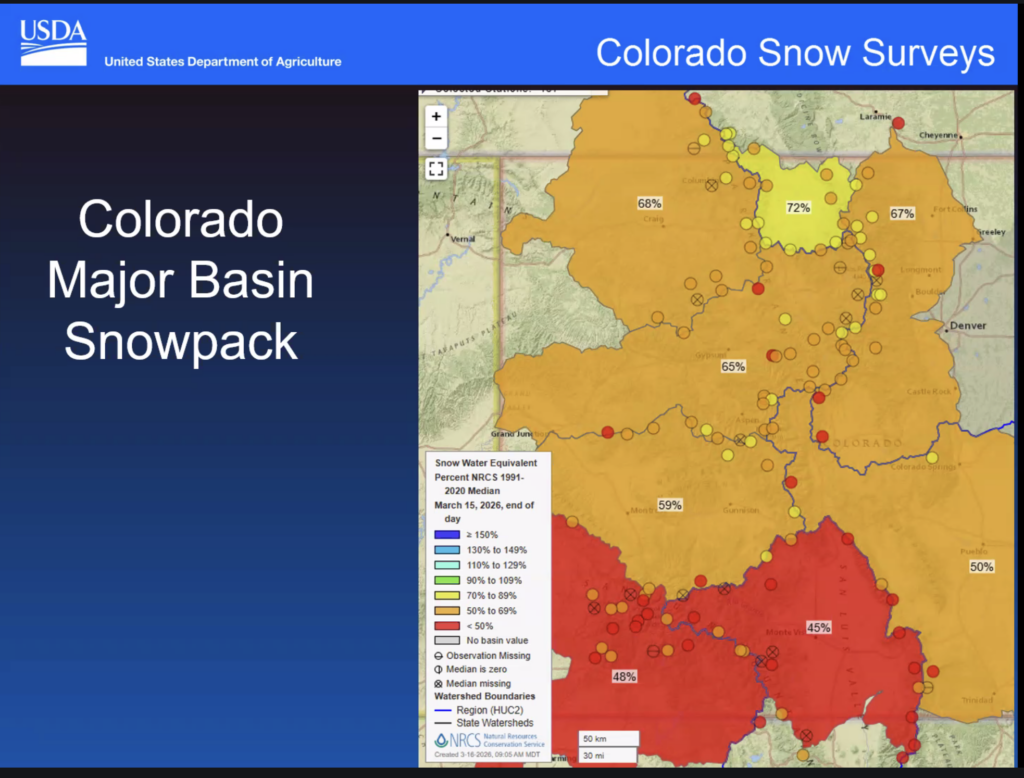
After ‘winter of defeat,’ Colorado hopes for wetter summer
Marianne Goodland
marianne.goodland@coloradopolitics.com
Updated 5 hours ago
With snowpack melt already peaking in some parts of the state and drought conditions worsening compared to last year, Colorado’s water watchers are hoping for a wetter summer, though they anticipate the situation deteriorating before getting better. Meanwhile, the governor...
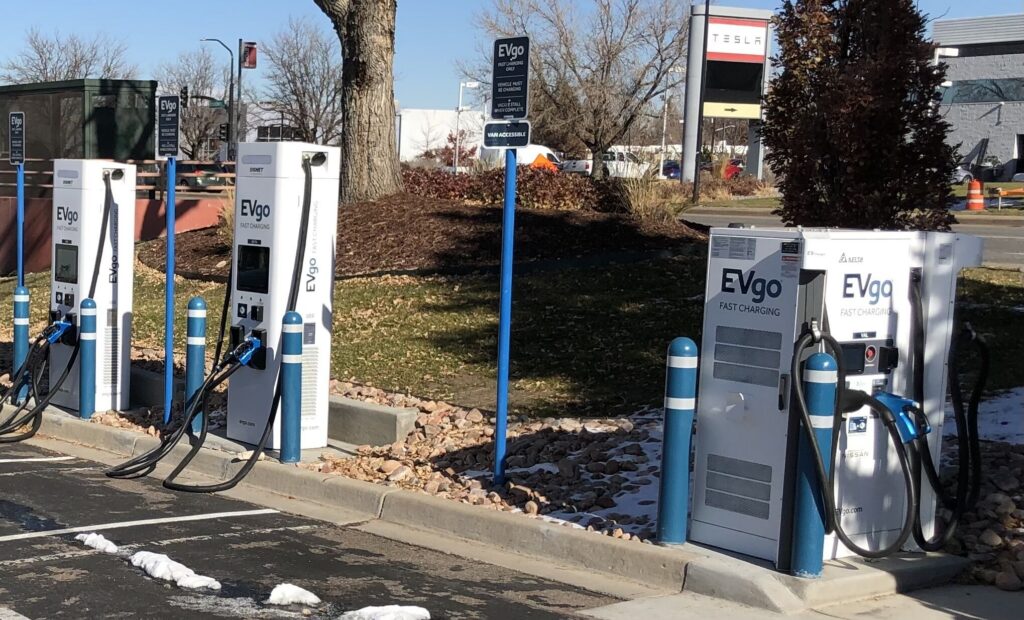
Colorado, Democrat states oppose proposal to require EV chargers be made with 100% domestic components
Scott Weiser
scott.weiser@gazette.com
Updated 24 hours ago
Colorado has joined a coalition of about 20 states in opposing a federal proposal that would require electric vehicle chargers funded with federal dollars to be made with 100% domestic components. The Federal Highway Administration is considering raising the domestic...
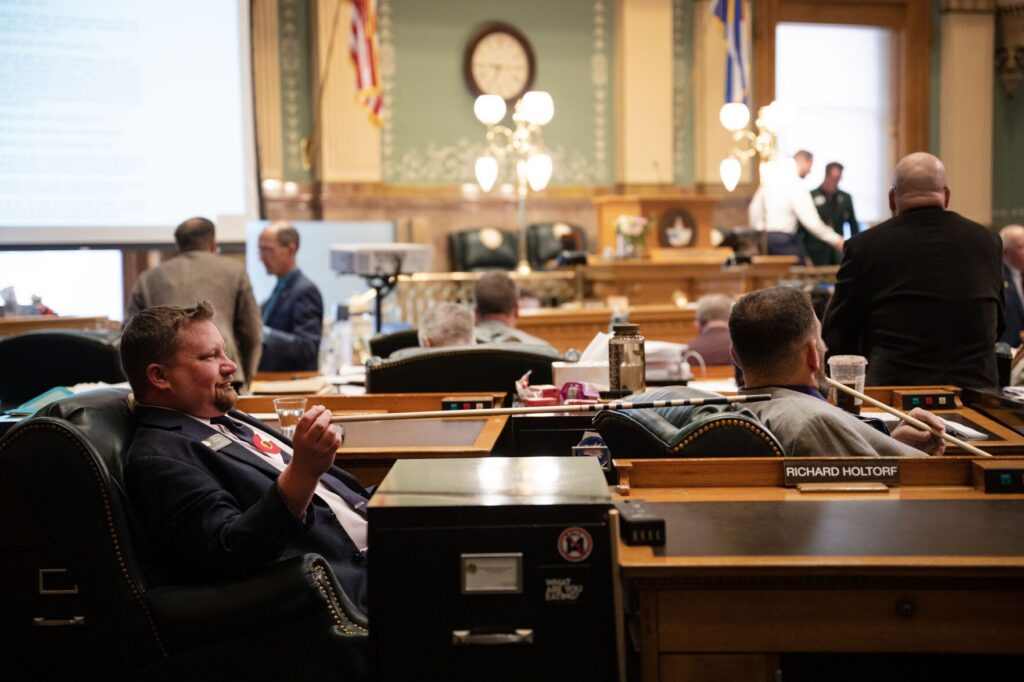
Colorado ethics panel tells legislator to attend sexual harassment training
Marianne Goodland
marianne.goodland@coloradopolitics.com
Updated 21 hours ago
Colorado’s House ethics panel admonished a Republican legislator over allegations he used a master key to access areas of the Capitol that he was not permitted to enter and that he had made sexually harassing comments to several female lawmakers....
PREV
PREVIOUS

Grand Junction company reaches settlement for allegedly selling faulty grenade launchers to military
Capco, a weapons engineering and manufacturing company based in Grand Junction, has settled for $1 million with the U.S. Army for allegedly selling grenade launchers with less-durable steel parts. The Denver Post reports that the company knowingly used the wrong material, and executives ignored – then fired – an employee who brought the issue to their attention. […]

RTD to retain retiring CEO Dave Genova until Jan. 20
Public Transportation RTD Light Rail Tram in Downtown Denver ColoradoiStock photo Time is ticking for the Regional Transportation District to replace General Manager and CEO Dave Genova, and most of its leaders are in no hurry to push him out. RTD’s board of directors agreed Tuesday night to keep Genova in the agency’s top job […]