

Denver mayor’s race: Hancock, Giellis talk business in latest debate
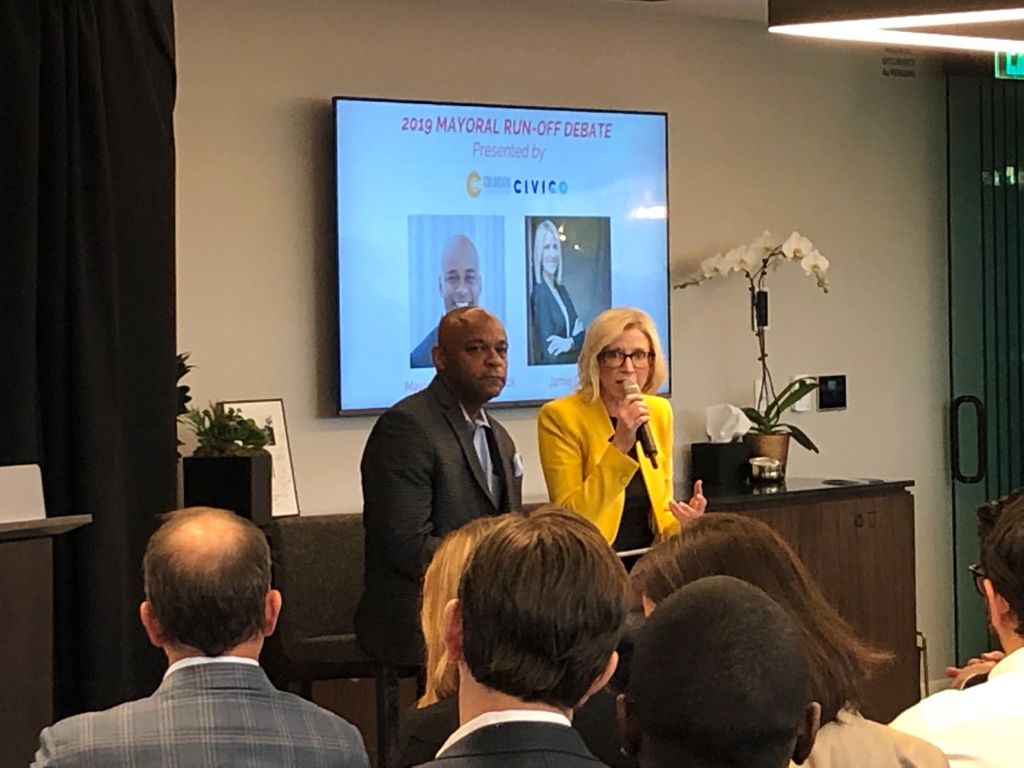
The two finalists for Denver mayor talked about business-related issues Thursday, touching on topics that have gotten scant attention thus far in the race leading up to the June 4 runoff election.
Incumbent Michael Hancock and challenger Jamie Giellis talked about tax incentives, the 16th Street Mall and what they would do as mayor during an economic slowdown during the hour-long debate co-hosted by Colorado Concern and CiviCO before about 100 people at Club CiviCo in Cherry Creek.
This reporter moderated the debate.
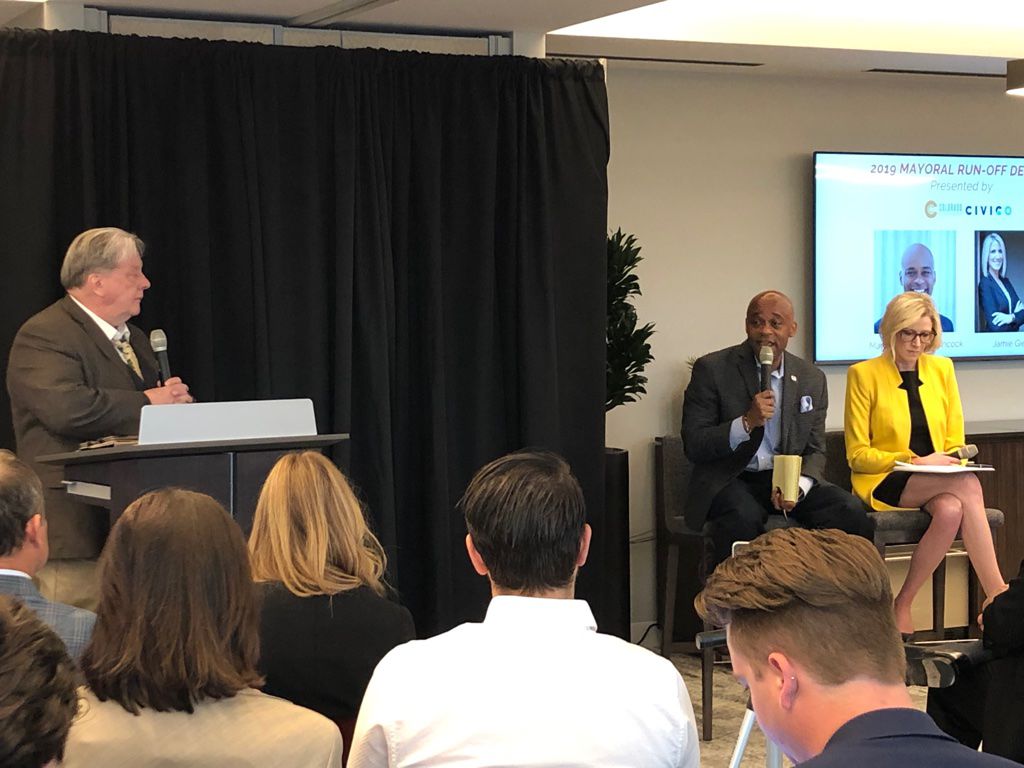
Here are some excerpts:
Delays and cost overruns at the airport?
The two candidates differed sharply in their assessment of potential delays and cost overruns on the renovation of the Great Hall at Denver International Airport.
Giellis described it as a mismanaged project that is piling up costs through change orders that are driving a 20-month delay and escalating costs.
“We need to be accountable to the taxpayers to talk about what this is really going to cost us and how we’re going to manage this project going forward,” she said.
“The construction is underway, so this is going to be a complicated one to tackle, but we cannot let taxpayers put an astronomical bill for a project that’s really about building a shopping center there,” she added. “We have so many other important things to be investing in.”
Hancock countered that by law taxpayers will never be at risk because the project is funded entirely from an airport enterprise fund.
He called the reports of cost overruns and delays premature and based upon a one-sided perspective of the developer of the project.
“And thank God we are doing the project because if we have an abnormality with the concrete at the airport, we’re going to address it,” he said.
“Safety is everyone at the airport’s number one concern,” he added. “Once we settle that we’ll deal with the delays and the potential costs may be. But at no time will taxpayers foot the bill or be at risk.”
The National Western Center project
The two candidates were asked for their vision of how the massive overhaul of the National Western Center will impact neighborhoods like Globeville and Elyria-Swansea.
Hancock said the project will be a boon to the neighborhood by creating apprenticeship opportunities and jobs during the construction period plus permanent jobs once the center opens.
He also cited a community-controlled charitable fund that will derive revenue from operations at the center.
“And so, this has been a partnership since day one,” Hancock said. “We didn’t want to do to the community, we wanted to do with the community.”
“We also set some of the members of the community on our governing board as well as our advisory board, he added. “I’m pretty excited about what we’ve done. I think it’s going to be a better project, a better effort going forward because of the communication.”
Giellis agreed that the center presents “a tremendous opportunity” if done right and that the jobs and community fund are good things.
However, she cited concerns about the center’s purpose.
“My nervousness over where we’re headed is that we build it as a complex, that it is an entertainment complex that is essentially closed down and used for a certain function,” she said. “I think we have an opportunity to turn it into an incredible center of research for modern urban agriculture, for water quality.”
She also said she’s heard complaints from community members.
“Right now it doesn’t feel integrated with the community,” she said. I was…talking to community members who still feel like they are being shut out of a conversation.”
What to do when the boom goes bust?
Giellis, an urban planner making her first run for public office, said she would take a close look at the budget, scrutinize spending and conduct an audit to prepare in the event of an economic slow down.
She said city government grew by 20% over the last eight years at the same time that the city’s population grew by 11%.
“We have to look internally at our organization,” Giellis said.
“It starts with me ensuring that we have sufficient operations at the city, that we’re prioritizing what we need to tackle most to get through a bust cycle.”
Hancock said he benefited from having previously served as city council president at a time when then-Mayor John Hickenlooper was leading the city through a recession.
“We were able to keep the central services of Denver going because we understood the budget,” Hancock said.
He noted that in a budget briefing last week, city officials advised him that sales and use tax collections had softened for the third consecutive quarter. He said that prompted city officials to prepare for a slowdown.
“And we are beginning that process right now, preparing all cabinet leads, all budget analysts to begin the process of holding the line on expenditures, beginning to make sure we can save within our allocated budget for 2019,” he said.
Dealing with developers
Both candidates were asked specifically how they would stand up to developers seeking approval for building projects.
Hancock, who is seeking a third and final four-year term, cited his work with implementing development fees.
“I’ve had quite a few conversations with developers who were not happy that we were moving to implement development fees in the city of Denver to help fund affordable housing,” Hancock said. “Those are not easy conversations.”
Giellis, a former president of the River North Arts District, said she would look at zoning, affordability requirements and design overlays to make sure that projects serve their neighborhoods.
“I’m not anti-development. We need smart development. We need smart growth,” Giellis said. “But re-zoning is the tool with which we can ask developers to do more for us. We can say to them, there’s an opportunity here for you to do more on this piece of land. And we will work with you if you give us more to do with the community.”
Hancock countered that the city already is doing that with requests from developers to address social needs. He said the next step will be to develop planning documents that are specific to each Denver neighborhood.
Revitalizing the 16th Street Mall
The candidates were asked for their reaction to an RTD plan to reconfigure the pedestrian-transit mall by channeling shuttle buses along one central lane and widening the pedestrian areas. They were also asked what they would do to revitalize the mall.
Giellis said the mall has been a topic of conversation since she first came to Denver in 2006 and that there have been numerous studies on how to revitalize it.
“I struggle with the fact that perhaps changing the configuration of the lane system will be the solution that we’re all hoping for,” she said.
“I think we need to give adequate thought to some of the other opportunities and options that were brought forth in terms of moving circulation throughout Denver,” she added. “And perhaps looking at the form and function of 16th Street as a rule.”
Hancock said the mall’s maintenance has suffered from a lack of attention over the years. He noted that a group of international experts were called upon to offered advice.
He also said only a small percentage of the people who use the free mall shuttle stop and linger in the shops along the route.
“So the goal is to revitalize and reconfigure it so that we can become more engaged in the mall and give us some versatility in terms of activities and programs,” he said.
“So you’re going to see us be creative about how we bring people on the mall and how we get people to engage along the mall,” he added. “The reconfiguration and revitalization of the mall is the first step which will begin early next year.”


The through line from Donald Trump to Victor Marx | SONDERMANN
By Eric Sondermann
by-eric-sondermann@coloradopolitics.com
Updated 4 days ago
Over 10 years ago, before Donald Trump could ever defeat Hillary Rodham Clinton, he had to first engineer a hostile takeover of the Republican Party. Prior to his descent of that golden escalator, the previous seven Republican presidential nominees had...

Colorado districts prepare for school year amid mental health cuts. But will less cellphone distractions help?
Marissa Ventrelli
marissa.ventrelli@coloradopolitics.com
Updated 2 days ago
The signs of a new school year are everywhere — buses in the shop, teachers unpacking boxes, families ticking through supply lists — but behind the familiar rituals, Colorado districts are preparing for a year defined less by routine than...

Armstrong staffer considers congressional bid, DeGette angers rural communities with wilderness act | A LOOK BACK
Rachael Wright, Special to Colorado Politics
rachael.wright@coloradopolitics.com
Updated 2 days ago
Forty-five years ago this week: If the lines were drawn just right, Republican Sen. Bill Armstrong stood the chance of losing his office manager, Ruth Fountain. Fountain admitted she was seriously thinking about running for Colorado’s new congressional seat in...
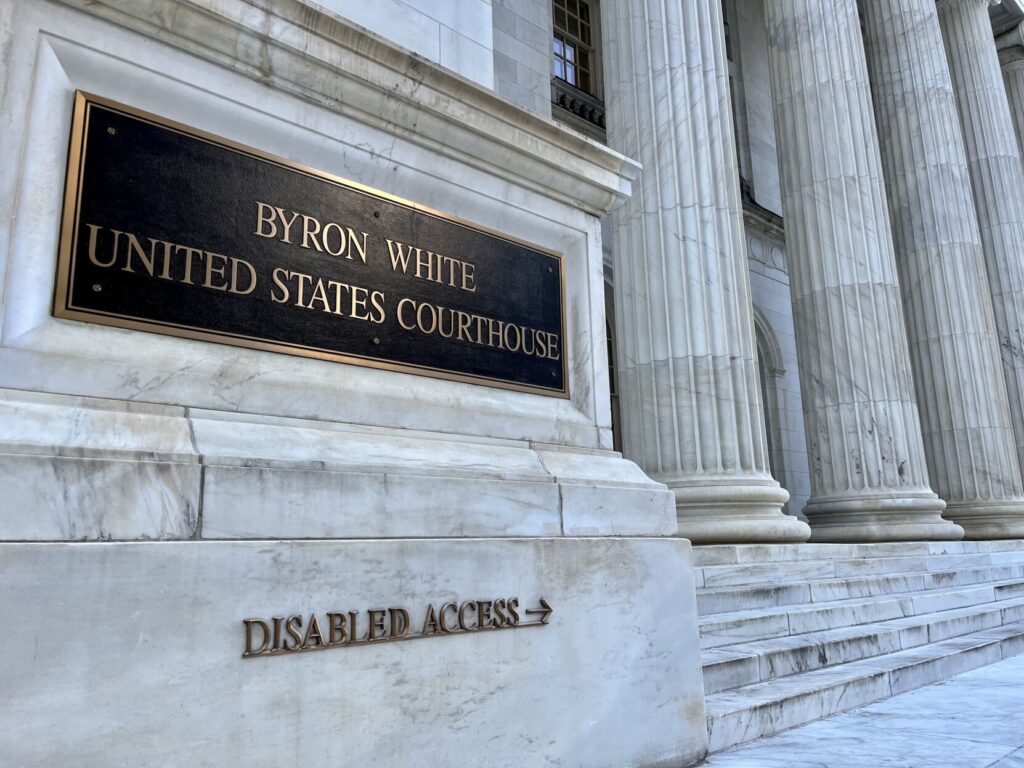
10th Circuit dismisses woman’s lawsuit following 10-year attempt to undo restraining order
Michael Karlik
michael.karlik@coloradopolitics.com
Updated 1 day ago
The Denver-based federal appeals court rejected a woman’s challenge on Friday to a restraining order imposed on her more than a decade ago, finding that she cannot credibly claim she will be prosecuted for violating the restraining order through her...
10th Circuit dismisses woman’s lawsuit following 10-year attempt to undo restraining order
Michael Karlik
michael.karlik@coloradopolitics.com
Updated 1 day ago
The Denver-based federal appeals court rejected a woman’s challenge on Friday to a restraining order imposed on her more than a decade ago, finding that she cannot credibly claim she will be prosecuted for violating the restraining order through her...
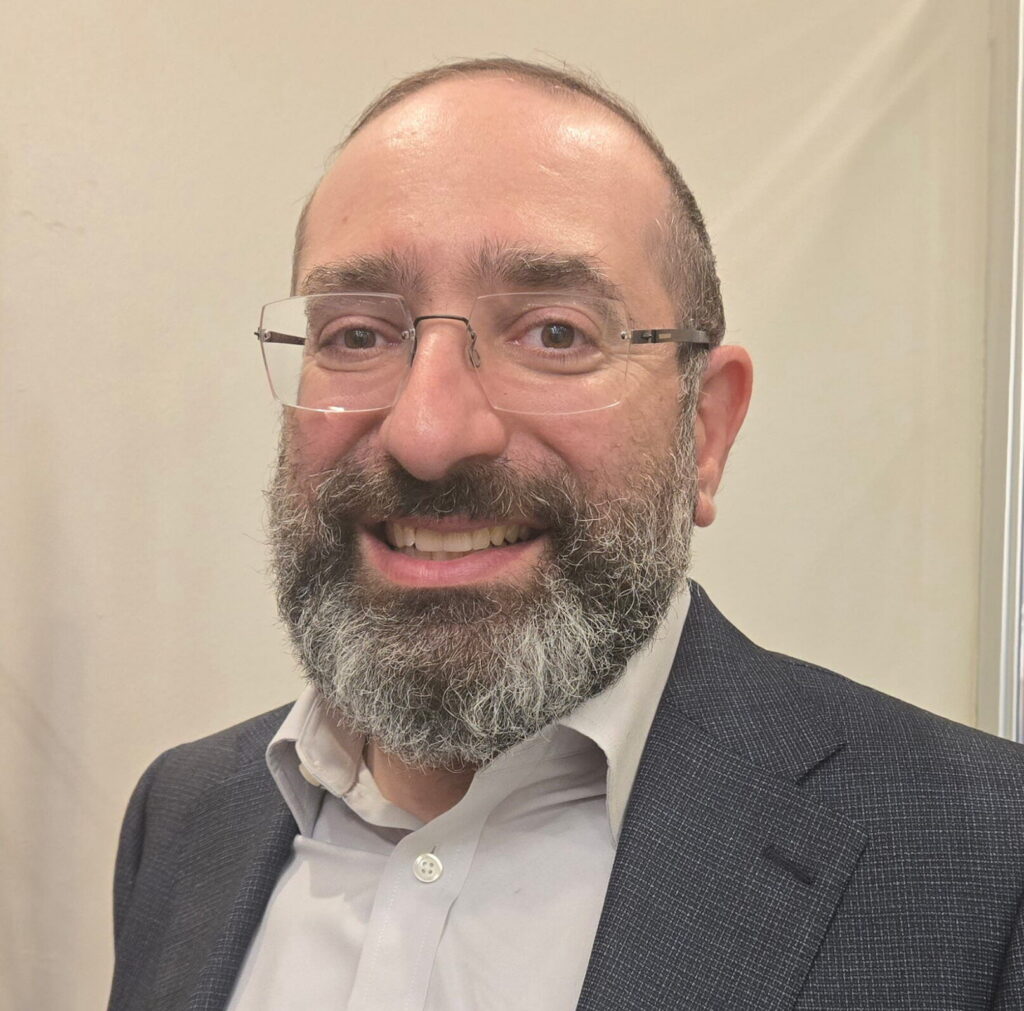
Surprise candidate Shimon Blau cleared to face off against Melat Kiros in November
Ernest Luning
ernest.luning@coloradopolitics.com
Updated 1 day ago
Unaffiliated congressional candidate Shimon Blau, a Denver doctor, has qualified by petition for the general election in Colorado’s 1st District, where Democrat Melat Kiros defeated 15-term U.S. Rep. Diana DeGette in last month’s primary, the Colorado Secretary of State’s Office...

Colorado produce not tied to nationwide cyclospora outbreak, agriculture officials say
Marissa Ventrelli
marissa.ventrelli@coloradopolitics.com
Updated 16 hours ago
There is no indication that the recent outbreak of cyclospora, a fecal parasite that has contaminated food and water across nearly every state, can be linked to produce grown in Colorado, according to the state’s Department of Agriculture. “Colorado growers...

UNC opens College of Osteopathic Medicine
Marissa Ventrelli
marissa.ventrelli@coloradopolitics.com
Updated 1 day ago
The University of Northern Colorado held a grand opening for its new College of Osteopathic Medicine on Friday, with Gov. Jared Polis in attendance to celebrate the culmination of a two-year, $127.5 million project. The project was funded through legislation...
Colorado equal pay law does not require plaintiffs to allege gender-based retaliation, appeals court finds
Michael Karlik
michael.karlik@coloradopolitics.com
Updated 11 hours ago
The 2019 Colorado law aimed at rooting out pay discrimination on the basis of sex does not require a plaintiff to allege their employer retaliated against them for sex- or gender-related reasons, the state’s second-highest court decided on Thursday. Lawmakers...

Planning Commission rejects resident appeals to stop proposed data center
alex-edwards
alex.edwards@gazette.com
Updated 1 day ago
Editor’s note: This story has been updated to reflect comment from District 11 clarifying that it has not conducted a financial review of Project Taurus. The Colorado Springs Planning Commission rejected appeals Thursday night against a proposed artificial-intelligence data center...
PREV
PREVIOUS

Greeley police cite ex-lawmaker Galindo following investigation
Greeley police said Thursday they have completed their investigation of allegations against former Colorado state Rep. Rochelle Galindo. In a news release, police said that “citations have been issued” in connection with a case involving “unlawful acts.” Documents related to the case obtained by 9News indicate that the citations were issued for allegedly serving alcohol […]

TABOR author Douglas Bruce convicted on citations in Pennsylvania over decrepit bar
Douglas Bruce was convicted in absentia Thursday on five municipal citations in Pennsylvania, opening himself up to a possible new criminal charge. Bruce, a Colorado felon, former state representative and author of the Taxpayer’s Bill of Rights, owns dozens of blighted properties around the country. One of them sits in Pittston, a small city in […]