

BETTER SCHOOLS: ROSS IZARD | ‘Parental empowerment is the new normal’

Editor’s note: Colorado Politics presents “Which way to better Colorado schools?” We’re offering seven perspectives on upgrading education in the state.
Empowered parents make empowered voters. And in many Colorado communities, thousands of these empowered voters simultaneously rejected a massive, statewide K-12 funding proposal and approved local funding initiatives.
In so doing, they provided us with evidence of a growing paradigm shift in Colorado education – a shift away from support for monolithic systems and toward support for ground-level parent choices. Lawmakers and advocates should take note.
The 2018 election brought the predictable demise of Amendment 73, the latest attempt at a massive state tax increase for Colorado’s PreK-12 public education system.
The measure included few specifics about how the proposed $1.6 billion in additional annual funding would be used, and proponents once again made no effort to broaden support by expanding options for families. Instead, they relied on vague promises of support for “public education.”
Some responded to 73’s rejection by shaking their fists at Colorado voters for not supporting education. But general disdain for education is likely not high among the reasons 73 failed. It is more probable that the amendment failed to demonstrate how it would help families at the ground level, where it matters most.
This point comes into stark relief in localities that rejected 73 but approved local funding initiatives. In conservative and historically tax-averse Douglas County, for instance, voters shot down 73 by a resounding 63 percent-37 percent. However, those same voters approved two local funding initiatives by convincing margins. Similar trends appeared in Jefferson County, Aurora, Adams 12 and Westminster, to name a few.
Why the disconnect? Certainly, many voters had concerns about the open-ended language and general lack of accountability in 73. But it likely goes deeper than that. Parents want to be assured that additional resources – their resources – are going to be applied in a way that supports their unique educational choices, not the nebulous concept of an overarching “system.”
In Douglas County, the roughly 20 percent of district parents who choose public charter schools very likely tipped the scales in favor of the local ballot questions. Many did so because proponents undertook focused outreach efforts explaining how the new resources would benefit these schools of choice. The result was the district’s first successful funding request in many years.
Writing off this evidence of parental preferences as coincidence would be a mistake. So, too, would be assuming that it stops at public charter schools. Just ask defeated Florida gubernatorial candidate Andrew Gillum, who saw 100,000 African American women defect from his base in part because he opposed state K-12 scholarship programs that provide lower-income families with access to private educational options.
True parental empowerment transcends school types and educational sectors. It draws no distinctions between traditional public, charter public, or private. It is rooted in the act of choosing by a sovereign family, not the results of that choice.
Despite its leadership in other areas of education policy, Colorado has yet to fully embrace this more holistic vision of empowerment. Our state still lags behind 26 states and the District of Columbia when it comes to enacting a K-12 private school scholarship program. The result is massive unmet demand for opportunity, particularly among less fortunate families.
ACE Scholarships currently leverages private philanthropy to serve 2,500 low-income Colorado students across nearly 150 private schools, but the organization is barely scratching the surface of the need in our state.
With just 22 percent of low-income Colorado students proficient in fourth-grade reading on national tests, 19 percent proficient in eighth-grade math, and a low-income graduation rate below 70 percent, it is clear that hundreds of thousands of students are not succeeding in their current educational environments.
A basic scholarship tax-credit program, which utilizes tax-code changes to incentivize philanthropic giving toward private school scholarships, would remove barriers for these students and help them reach their full potential. It would also reflect an acknowledgement of the inevitable: Parent empowerment is the new normal, and it will only continue to expand.
It is hard to say when state lawmakers might finally set aside educational tribalism and decide that the success of Colorado students must transcend sacred cows and loyalty to any particular type of school. Based on recent trends, however, it is less difficult to predict that those who discount the importance of choice to families will continue to see that misalignment affect numbers at the ballot box.
Ross Izard is director of policy for ACE Scholarships, a nonprofit scholarship-granting organization that provides privately funded K-12 scholarships to more than 2,000 disadvantaged Colorado students.


Colorado lawmakers push limits on data-driven pricing as critics push back
Marissa Ventrelli
marissa.ventrelli@coloradopolitics.com
Updated 2 hours ago
Colorado lawmakers are weighing a proposal to restrict the use of algorithms in setting prices and wages, as advocates warn the technology enables hidden discrimination while business groups argue the bill overreaches and interferes with legitimate data‑driven practices. House Bill...

10th Circuit upholds verdict against Denver, officer for protest-related violations
Michael Karlik
michael.karlik@coloradopolitics.com
Updated 2 hours ago
The Colorado-based federal appeals court on Tuesday turned aside multiple challenges to a 2022 jury verdict that found Denver and one of its officers violated the constitutional rights of protesters and were liable for $14 million. In the first of...

Colorado Senate candidate charged with felony child neglect after daughter nearly drowns in Florida pool, police say
Marianne Goodland
marianne.goodland@coloradopolitics.com
Updated 2 hours ago
Frederick Alfred, Jr., the sole Republican candidate for Senate District 21 in the June primary and November general election, was arrested in Key West, Florida, late Monday night. Alfred, 38, was charged with two counts of felony child neglect and...
Divided 10th Circuit takes no issue with surprise police encounter with suspect
Michael Karlik
michael.karlik@coloradopolitics.com
Updated 48 minutes ago
Police officers who unexpectedly encountered a Durango-area man while they were preparing to search his nearby home did not commit a constitutional violation by seizing his phone during the ensuing traffic stop, the Denver-based federal appeals court ruled last week....

Colorado lawmakers set Jan. 11 start date for 2027 General Assembly
Marianne Goodland
marianne.goodland@coloradopolitics.com
Updated 2 hours ago
Legislative leaders on Tuesday confirmed that the 2027 session of the Colorado General Assembly will begin on Monday, Jan. 11. Ordinarily, legislative sessions start on the second Wednesday in January. That schedule shifts in years when a new governor is...

10th Circuit rules State Farm not required to pay benefits in I‑25 swerving crash
Michael Karlik
michael.karlik@coloradopolitics.com
Updated 7 hours ago
The Denver-based federal appeals court concluded last week that two vehicle occupants who were injured while swerving to avoid a man in the middle of Interstate 25 are not entitled to insurance benefits. Plaintiffs Stephanie Mazur and Julia Wunder were...

Colorado ethics panel to review complaint alleging misuse of Democratic caucus funds by chair
Marianne Goodland
marianne.goodland@coloradopolitics.com
Updated 3 hours ago
A legislative ethics panel in Colorado is scheduled to meet Wednesday to review a complaint alleging that Aurora Democrat Rep. Mandy Lindsay misused House Democratic caucus funds. Rep. Bob Marshall, D‑Highlands Ranch, filed the complaint on Jan. 26. Marshall’s complaint...
Proposal to ban appointed Colorado legislators from serving in next term fails to advance
Marissa Ventrelli
marissa.ventrelli@coloradopolitics.com
Updated 8 hours ago
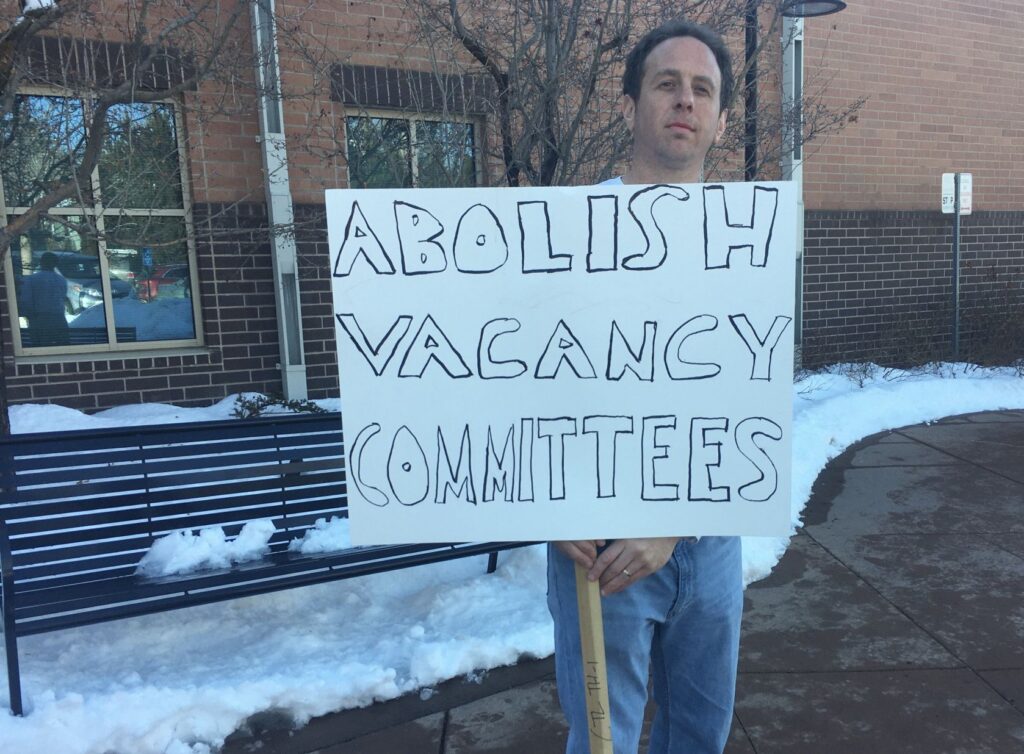
For the third year in a row, lawmakers have struck down a proposal that would have prohibited members of the Colorado General Assembly who were appointed through a vacancy committee from serving in the term immediately after. Sponsored by Rep....

Trump says Strait of Hormuz won’t reopen until Iran strikes a deal with US
Mabinty Quarshie, Washington Examiner
mabinty.quarshie.washington.examiner@gazetteedit.wpenginepowered.com
Updated 7 hours ago
President Donald Trump said in a new interview that the Strait of Hormuz will remain closed until the United States and Iran reach a peace deal to end the ongoing war. The two nations are set to begin a second...

US and Iran signal new ceasefire talks in Islamabad as truce nears end
Jon Gambrell
jon.gambrell@associatedpress.com
Updated 12 hours ago
ISLAMABAD (AP) — The United States and Iran have signaled they will hold a new round of ceasefire talks in Pakistan, two regional officials said Tuesday, as leaders on both sides warned they were prepared for more fighting if a...
PREV
PREVIOUS

BETTER SCHOOLS: LUKE RAGLAND | More money alone won’t cut it; it’s about policy, priorities
Luke Ragland Editor’s note: Colorado Politics presents “Which way to better Colorado schools?” We’re offering seven perspectives on upgrading education in the state. As the 2019 legislative session kicks off, policymakers are gearing up to tackle perennial K-12 education policy questions about funding, parent and student choice, early childhood education, and school accountability, among many […]

BETTER SCHOOLS: LISA FLORES | Among the wealthiest states, some of the most poorly funded schools
Lisa Flores Editor’s note: Colorado Politics presents “Which way to better Colorado schools?” We’re offering seven perspectives on upgrading education in the state. Denver public schoolteachers are voting on whether to go on strike. The strike could begin as early as Jan. 28, unless the state intervenes. As a Denver Public Schools board member, my […]