

Citizen legislature vs. child support? Lawmaker’s court hearing points to problems
Lawmakers elected to the Colorado General Assembly are expected to be part-time. It’s why they’re paid so little ($30,000 a year, currently), and the session only lasts for 120 days per year. The rest of the year, they’re expected to handle legislative business on a part-time basis.
Few lawmakers, if any, claim they can live on $30,000 per year, even with an allowance that pays a per diem for meetings outside of the 120-day session.
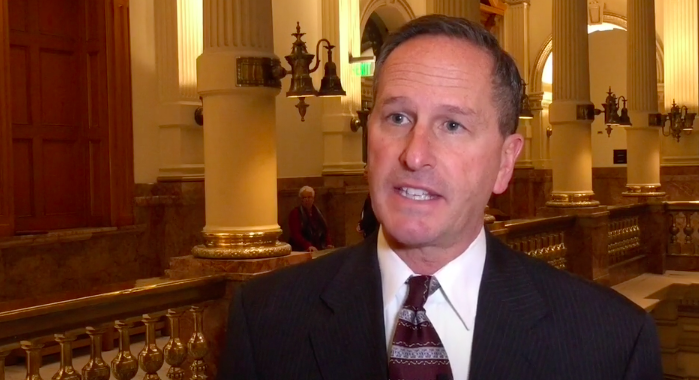
But Republican Rep. Tim Leonard of Evergreen recently made that kind of argument as he attempted to get his child and spousal support obligations reduced in a Jefferson County court.
Leonard’s argument points to an issue that looms larger with each election cycle: Serving in the legislature or any other elected office (say, governor) is increasingly available more to those who can afford it and not to a Coloradan whose average income, according to 2017 numbers from the federal Bureau of Labor Statistics, is about $54,000 per year.
Leonard told Jefferson County Judge Diego Hunt on July 3 that he’s too busy as a lawmaker to get another job that could help him pay his $2,500 per month in court-ordered family support obligations, according to a court transcript of the hearing reviewed by Colorado Politics.
Leonard lists himself as a commercial real estate business owner on the General Assembly’s website. But according to Hunt, Leonard had previously testified that he wasn’t able to “dedicate enough time to his commercial real estate business because of his legislative responsibilities that prevent him from dedicating enough uninterrupted time to projects.”
> RELATED: State lawmaker under fire for comparing women marchers to Hitler’s ‘brownshirts’
Hunt said Leonard’s monthly income between 2009 and 2014 averaged $8,200, based on tax returns. Since taking on the House District 25 seat in January 2016 and according to court records, he’s drawn a salary from the legislature of $2,500 per month, another $280 per month average in legislative per diem allowances, and other small sources of income that bring his monthly total to about $2,966.90.
According to General Assembly records, Leonard took home just under $4,700 in per diem from January through May of this year, and that was without taking the $45 per day per diem in February. That’s on top of the $2,500 per month as a lawmaker.
Lawmakers who live 50 miles or less from the Capitol get $45 per day for a per diem allowance; those who live more than 50 miles away can get $183 per day.
At the July 3 hearing, Hunt called Leonard’s decision to become a lawmaker, from the financial perspective, a “voluntary reduction in income.”
Leonard is not precluded from making a career decision that could help cover his family support obligations, Hunt said. “The court does find that (Leonard’s) decision to become a legislator was his good-faith decision, but the court does not find that this an objectively reasonable decision given the significant reduction in income. The court also concludes that (Leonard) can make significantly more from his commercial real estate business but chooses not to dedicate his time to his company and is therefore voluntarily underemployed.
“The court also finds that (Leonard’s) career choice unreasonably reduces the children’s financial support,” Hunt said.
The judge denied Leonard’s request to reduce his support obligations.
Leonard is current on his support obligations, according to court records. Leonard and his ex-wife have six children. Three of them are now adults; the other three minor children live with his ex-wife, who asked not to be identified by name.
Leonard did not respond to a request for comment.
Leonard serves on two committees outside of the 120-day session: The Legislative Audit Committee, a year-round committee that meets sporadically, both during the session and after. The committee last met in June for two days and will convene again in August, September and December for two days each and for one day in November.
He’s also on the interim committee studying changes to the state’s school finance act, which is now in its second summer of meetings. That group has been meeting about every six weeks, with its final meeting in December.
He is running for re-election in the 25th House District against Democratic challenger Lisa Cutter.
Lawmakers are paid a “nominal salary to cover part-time work,” according to political consultant Eric Sondermann. As such, lawmakers are never expected to view their responsibilities as year-round work.
Sondermann added that some lawmakers find ways to work at their full-time jobs even during the legislative session. To claim that legislative service precludes paying one’s bills “is to violate the idea of a citizen legislature,” he said. “To claim that it precludes paying child support is to violate the idea of citizenship.”
The idea of a citizen legislature is almost as old as the U.S. Constitution. It goes back to the Founding Fathers – notably, John Adams, who said lawmakers “should be an exact portrait, in miniature, of the people at large, as it should think, feel, reason, and act like them.”
Last year, James Erhard, writing for the Worcester (Massachusetts) Telegram, said “state senators and representatives should be engaged in the daily life of the private citizen, always aware of the toils and turmoils of paying the monthly bills and navigating the difficulties of the private economic system as most citizens do. Service in the legislature was not meant to be a sinecure of lifetime income and benefits not seen in the private sector. Rather, service meant a well-meaning citizen took a short time away from their daily duties each year as the legislature was in session.”
Out of the 100 lawmakers in the Colorado General Assembly, the top occupation listed is “legislator.” Twenty-five list “legislator” as their sole occupation; three more include it with another occupation, such as farmer, rancher or small-business owner.
But Colorado lawmakers point out that maintaining a business outside the Capitol is no easy feat. Senate President Pro tem Jerry Sonnenberg of Sterling told Colorado Politics that trying to run a business and be a lawmaker at the same time sometimes means neither gets done well.
He said that when he started as a member of the House in 2006, he used most of his legislative salary to hire more hands for his farm to help with the spring corn planting. It’s been a little easier since his sons grew up and are now old enough to run the operation, which also includes cattle and a trucking company.
“I’m a full-time farm and ranch manager” and a full-time lawmaker, Sonnenberg said. “I’m blessed to have two sons and a wife” who can keep the business running while he’s taking care of his legislative responsibilities.
But “both suffer because I can’t devote all the time I need to for the farm and to all the things I need to at the Capitol,” especially at harvest time.
“It’s a challenge for legislators to maintain a job and be productive outside of the legislature,” Sonnenberg said.
Rep. Hugh McKean of Loveland characterized John Adams’ view of citizen legislatures. Adams said, “We leave our families and homes and go to Philadelphia [then the nation’s Capitol] and then go home,” McKean told Colorado Politics.
“Yes, there are things you have to do, campaigns to run and other things,” McKean added. But “the focus should be on being able to come here and give your voice from a different completely perspective than as a lawmaker – as a lawyer, general contractor, farmer – offer your perspective, and then on May 10 pack up and go home and do what you did before.”
McKean, a general contractor, made those comments at an agricultural forum in Denver last week hosted by Republican gubernatorial candidate Walker Stapleton, a forum that he and two other lawmakers attended, demonstrating that there’s always work for lawmakers outside of the 120-day session.


Grand Canyon flooding threatens economy that’s still recovering from a fire | OUT WEST ROUNDUP
Ernest Luning
ernest.luning@coloradopolitics.com
Updated 3 days ago
ARIZONA Flooding slams park’s economy Deadly flooding at the Grand Canyon is damaging the area’s economy, with a washed-out pipeline severing the South Rim’s water supply and shutting down lodging at the popular tourist vista for an indefinite period. The...

Immigration reporting measure fuels debate over Colorado’s role with ICE
Marissa Ventrelli
marissa.ventrelli@coloradopolitics.com
Updated 4 hours ago
A coalition of advocacy groups and several district attorneys rallied outside the Colorado Capitol on Thursday to oppose a ballot measure that, if approved by voters in November, would require state and local law enforcement to cooperate with federal immigration...

Colorado Politics Calendar Sept. 14-20
Rachael Wright, Special to Colorado Politics
rachael.wright@coloradopolitics.com
Updated 4 days ago
CoPo’s weekly political calendar will help you find political and public-policy events throughout Colorado. It includes candidate and issue campaign events, public policy meetings, court hearings, state and local party conventions, assemblies, debates, rallies, parades, speaking engagements, traveling dignitary appearances,...
The African roots of three Colorado leaders | SONDERMANN
Eric Sondermann
eric-sondermann@coloradopolitics.com
Updated 3 days ago
Colorado’s political transformation is measured in many ways. A once reliably red state (with asterisks) became purple and is now a rather deep blue. For better or worse, probably the latter, power is ever more consolidated along the Front Range...
Federal judge green-lights civil trial against ex-Fort Collins DUI officer
Michael Karlik
michael.karlik@coloradopolitics.com
Updated 2 days ago
A federal judge ruled on Thursday that Fort Collins’ former “DUI officer” will face a civil trial for allegedly investigating a motorist for impaired driving without any reasonable suspicion to do so. In recent years, several people arrested by Officer...

Denver police reopen 13 sex assault cases after retesting Missy Woods’ CBI work
Jenny Deam
jenny.deam@gazette.com
Updated 4 hours ago
Thirteen previously closed Denver sexual assault cases have been reopened after the city’s crime lab retested DNA evidence once analyzed by former Colorado Bureau of Investigation forensic analyst Yvonne Woods. A police spokesperson told The Denver Gazette the once-closed cases...

Ballot measure aims to shift Colorado sporting goods tax revenue to land, water and wildfire projects
Marissa Ventrelli
marissa.ventrelli@coloradopolitics.com
Updated 20 hours ago
Colorado voters this November will decide whether to direct a share of sales tax revenue from sporting goods — including bicycles and skiing equipment — toward land and water conservation, wildfire prevention and expanding outdoor recreation. Supporters say the measure...

Colorado Supreme Court suspends Mesa County judge pending misconduct investigation
Michael Karlik
michael.karlik@coloradopolitics.com
Updated 22 hours ago
The Colorado Supreme Court suspended Mesa County Court Judge Michael J. Grattan on Thursday amid a misconduct investigation. The court’s Sept. 10 order gave Grattan 21 days to explain why his paid suspension should not continue through the end of...

Trump honors the fallen of the 9/11 terrorist attacks during Pentagon speech
Mabinty Quarshie
mabinty-quarshie@coloradopolitics.com
Updated 2 days ago
President Donald Trump and first lady Melania Trump honored the roughly 3,000 Americans killed during the Sept. 11, 2001, terrorist attacks during a ceremony at the Pentagon. The event marking the 25th anniversary of the deadliest attack on American soil...
Colorado Supreme Court changes course, dismisses case about special district bonds
Michael Karlik
michael.karlik@coloradopolitics.com
Updated 22 hours ago
The Colorado Supreme Court declined on Friday to decide a dispute between a large-scale Commerce City development and the various districts financing it, after initially showing interest in the ongoing case. Colorado has roughly 2,800 special districts, which are local...
PREV
PREVIOUS

Stapleton's office disputes Democrats' claim of delay on rural Colo. bill
Ryan Parsell, deputy to State Treasurer Walker Stapleton, went before a Colorado legislative committee Monday to swat down a characterization that Stapleton’s office delayed issuing lease-purchase certificates for investors, a wonky assertion with campaign-season undertones. Stapleton is the Republican candidate for governor. Democratic Reps. Daneya Esgar of Pueblo and Chris Hansen of Denver, members of […]

Senate confirms Wilkie for Veterans Affairs secretary
WASHINGTON – The U.S. Senate on Monday confirmed Pentagon official Robert Wilkie to be secretary of Veterans Affairs, charged with delivering on President Donald Trump’s campaign promises to fire bad VA employees and steer more patients to the private sector.Wilkie won approval on a bipartisan vote of 86-9, securing the backing of many Democrats after […]