

Hospital Provider Fee debate in legislature shined a light on rural Colorado
HUGO – Dotty Peterson, a 76-year-old retiree who lives in this small Eastern Plains town about 100 miles from both Denver and Colorado Springs, took a nasty spill and suffered a concussion in February.
“When she fell and hit her head, I thought she was gone,” said her husband, Pete, who sat with Dotty recently at a family cafe in this rural burg of about 650 residents.
“I’m a retired Air Force helicopter pilot. I saw too many dead ones in Vietnam. I thought I had lost her,” Pete said of his wife of 47 years. “I really did.”
Dotty was rushed to Lincoln Community Hospital, a local landmark that prides itself on the motto, “Neighbors caring for neighbors.”
The small but impressive rural hospital with a staff of 190 and a wide array of inpatient and outpatient services, was able to stabilize Dotty and board her on an AirLife helicopter to Denver.
Lincoln Community is the only hospital within an estimated 75-mile radius, and it serves an area about the size of Connecticut. It is precisely the sort of important local institution that became endangered this year as state budget writers considered slashing funding for hospitals to balance the $26.8 billion state budget.
A proposal was on the table to cut the Hospital Provider Fee by $264 million. And since the fee triggers a federal matching fund, the total loss to Colorado hospitals would have been about $528 million.
The idea of removing the Hospital Provider Fee from the state budget and restructuring it as an enterprise fund or government business was not a new one, but it has been resisted by Republicans because of its implications for the Taxpayer’s Bill of Rights.
With TABOR being considered a sort of Holy Grail for Republicans, who rely on the law to curb government spending and force taxpayer rebates, anything that would chip away at it was thought to be taboo.
But a handful of Republicans changed course this year, led mostly by Republican Sen. Jerry Sonnenberg of Sterling, joining with Democrats to pass Senate Bill 267, the omnibus bill which did indeed change the status of the Hospital Provider Fee.
Republicans were able to evolve on the issue because of its importance to rural Colorado – Lincoln Community Hospital is in Sonnenberg’s district – and because of its sweeping nature, which included some top priorities for the GOP, such as Medicaid reform and helping businesses with tax credits.
What the legislature came up with was a compromise that created a 20-year funding program to direct $1.8 billion towards critical infrastructure. Hospitals would be protected, but money also would come in for schools and roads.
Much of the conversation revolved around the “life or death” situation facing rural communities if their hospitals closed. Some believed that Lincoln Community would have been one of the hospitals to close, although hospital officials told Colorado Politics that they had a way to stay open, but with significant cuts to services.
“We weren’t standing there with the chains, but it woke our community up,” said Megan Mosher, marketing director for the hospital. “People need us. They realized that they do need us.”
A wake-up call on rural Colorado
While lawmakers responded to the dire consequences of hospitals closing, many initially may have missed the bigger picture: The fate of many a rural town is intertwined with its singular institutions, with its hospital, with its high school. Lose those, all but lose the town.
As the conversation continued, lawmakers from the urban Front Range appeared to wake up to the fact that much of the state was being forgotten in its deliberations. It’s something lawmakers like to talk about often in the legislature – that rural Colorado is ignored – but very little progress is ever made toward change.
Then came Senate Bill 267, which requires that at least 25 percent of the $1.8 billion in additional funding go toward projects in rural Colorado, with county populations of 50,000 or less. For those “forgotten” Coloradans, the Hospital Provider Fee compromise offered hope that they had finally landed on the legislature’s radar in Denver.
“There’s big money up and down the Front Range, and we’re out here, we’re the hex on the plains, we’re the afterthought,” said Pete Peterson, the husband of Dotty, who suffered the concussion in February.
Such thinking left Hugo leaders pleasantly surprised House Speaker Crisanta Duran, D-Denver, toured Lincoln Community Hospital in April. Folks couldn’t remember the last time they had the speaker of the Colorado House come to town, perhaps not since the late Rep. Bev Bledsoe from neighboring Cheyenne County, who led the House from 1981 to 1990.
“She was pushing hard,” Hugo Mayor Tom Lee, who identifies as a conservative, said of the Democratic speaker’s efforts on passing Senate Bill 267 and her stop in Hugo.
“I think I heard her say several times, ‘I had no idea,'” said Kevin Stansbury, chief executive of the hospital. “She’s a smart lady. I’m not accusing her of anything bad. But you get caught within the culture you live within.”
“They took time to go visit and see the things that definitely changed their view on a few things,” continued Linda Messer, the hospital’s laboratory director.
John Thelen, an unaffiliated voter who sits on the town board but who leans to the right, said the debate this year might even signal that it’s time to take another look at TABOR.
“What I see is TABOR is a good idea, but it needs to be modernized or readdressed and bring it into the 21st century and help us because we’re running into problems where we can’t raise tax monies to do the things that we need to get accomplished,” Thelen said.
Sustaining rural Colorado economies
The budget struggles of the state due to spending constraints also helped to drive the Hospital Provider Fee conversation toward the economic sustainability of rural Colorado, which has significantly lagged behind the urban and resort areas of the state.
Lincoln Community Hospital stood to lose about $300,000 a year had the budget-balancing maneuver moved forward by cutting the Hospital Provider Fee. Last year it lost about $600,000 due to a similar maneuver, meaning it would be missing out on nearly $1 million annually.
The move would have meant the hospital would have had to stop investing in additional staff, suspending talks it had with four doctors about two openings.
Now, said Stansbury, “We may hire all four of them.”
The hospital also would have had to curb investing in additional services, including purchasing new orthopedic equipment and expanding its behavioral health services.
The hospital is the third-largest employer in Lincoln County, according to hospital staff. While the population of Hugo is pegged between 600 and 800, depending on who’s counting, it swells to about 1,000 during the workweek because people commute to town.
The hospital pumps about $9 million in payroll into the local economy. And when people visit the hospital or come to town for work, they shop at local stores, they buy gas and food.
“From a whole macroeconomic standpoint, what rural Colorado needs is what any economy needs – we need jobs that pay well, that provide for careers for these people here,” Stansbury said. “They can’t stay here unless there’s a career for them to stay here to earn a living to then support their families.”
And in a farm and ranch community like Lincoln County, being able to attend a nearby hospital and receive outpatient services there can be the difference between making a living and losing a living.
Mayor Lee feared that losing the hospital, or even the hospital taking a major hit financially, would mean property values in the community depreciating by as much as 40 percent.
Thelen agreed, adding, “It’s a retirement town, a little bit. There’s people that move here because of the hospital, so you would lose some of that viability as well.”
Both town officials work out of a passion for the community, pointing out that the mayor is paid only $20 per month, and the town board members get half that.
‘Neighbors caring for neighbors’
Beyond the economic impacts, the residents and employees who live and work in Hugo hope lawmakers also took away the spirit of rural Colorado, where everyone knows each other and community stands above all else.
The hospital is a 15-bed critical access facility that averages about four patients a day in the hospital setting, which includes inpatient and rehabilitation services. The hospital also includes a two-bed emergency department, which averages about eight patients per day.
In addition to being served by AirLife helicopter, the hospital also has a general surgeon, who performed a gallbladder procedure just as Colorado Politics was arriving for a tour of the facility. The hospital performs as many as 10 surgeries a month.
Two primary care physicians have been doing rounds at the hospital, each for about 30 years, an impressive statistic for a rural hospital where it is hard to retain talent.
Behavioral health is integrated into all of the hospital’s services and physical, occupational and speech therapies also are provided.
The hospital includes a nursing home, which has 35 beds that are usually full. As part of its program, Lincoln Community takes in nursing students, largely from Denver, who benefit from a year of experience in a rural hospital setting.
“It’s motherhood and apple pie,” boasts Rachel Smith, director of nursing for the hospital, who at 28 years old was born in the hospital and raised in Hugo.
When Smith learned that the hospital might face additional cuts, she was less concerned for herself and more for the people who she grew up with.
“Obviously because of my passion for the community I know what this place means to the community and what kind of detriment that would have meant if the potential was on the table for us to close,” Smith said. “That probably pulled a little bit more at my heartstrings than the fact that I may have to go seek employment elsewhere.”
What hospital staff hopes lawmakers walked away with is an understanding that rural hospitals don’t function like urban hospitals. At a rural hospital, patients are well known. When a patient heads off to Denver for a major surgery, they come back to Hugo for personal care and attention.
The hospital even visits homes of patients to ensure that their living conditions are suitable for whatever medical condition the patient might be suffering from.
“We hold ourselves to a much different standard as health care providers,” Smith said, joking that she’s likely to see patients in the grocery store in town. “You don’t have a choice because the community around you holds you to that standard.”
Thanks to Colorado legislators coming together around Senate Bill 267, it probably isn’t too much to say, that’s a standard that will be carried into the future.


Colorado justices grill debt collector about compliance with law
Michael Karlik
michael.karlik@coloradopolitics.com
Updated 2 hours ago
The Colorado Supreme Court repeatedly pressed a debt collection company last week to explain how its lawsuit against a Boulder woman for an unpaid credit card balance complied with the specific requirements that state lawmakers have created. Portfolio Recovery Associates,...

Artificial intelligence working group agrees on framework to replace Colorado law
Marianne Goodland
marianne.goodland@coloradopolitics.com
Updated 4 hours ago
A group that has been working on artificial intelligence policy has reached an agreement on a framework that would replace the regulations adopted by Colorado legislators two years ago. The agreement has the backing of Gov. Jared Polis, who reluctantly...

Proposal to levy new fees on alcohol products in Colorado dies
Marissa Ventrelli
marissa.ventrelli@coloradopolitics.com
Updated 5 hours ago
The proposal to collect millions in new fees on alcohol products — dollars to be earmarked for Colorado programs aimed at addressing the behavioral and physical health effects of alcohol abuse — died on Tuesday. House Bill 1271 sought to...
The numbers that Republicans say show Democratic midterm targets are a ‘political hallucination’
Rob Crilly, Washington Examiner
rob.crilly.washington.examiner@gazetteedit.wpenginepowered.com
Updated 3 hours ago
Democrats keep expanding their battleground map of midterm target seats, but do they really have any chance in some of the districts they claim they can win? Of the 44 districts listed by the Democratic Congressional Campaign Committee as targets,...

Pam Bondi subpoenaed for April 14 House deposition on Epstein files handling
Kaelan Deese, Washington Examiner
kaelan.deese.washington.examiner@gazetteedit.wpenginepowered.com
Updated 6 hours ago
The House Committee on Oversight and Government Reform issued a subpoena Tuesday compelling Attorney General Pam Bondi to sit for a deposition on April 14 as part of an ongoing investigation into the Justice Department’s handling of the Jeffrey Epstein...
Capitol Police chief asks for record-breaking budget, citing 58% increase in threats to Congress
Emily Hallas, Washington Examiner
emily.hallas.washington.examiner@gazetteedit.wpenginepowered.com
Updated 6 hours ago
U.S. Capitol Police Chief Michael Sullivan on Tuesday argued sweeping threats against lawmakers justify his department’s historic budget request during a House Appropriations Committee hearing. Sullivan testified before the Legislative Branch Subcommittee on his budget proposal for fiscal 2027 funding....
After ‘winter of defeat,’ Colorado hopes for wetter summer
Marianne Goodland
marianne.goodland@coloradopolitics.com
Updated 7 hours ago
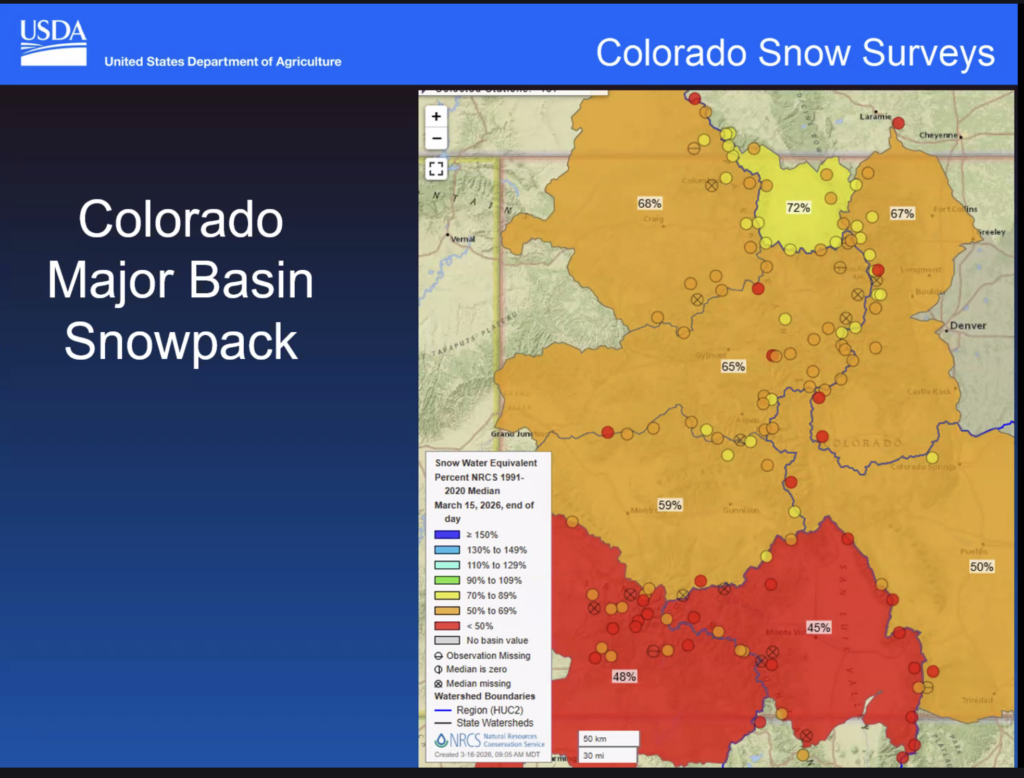
With snowpack melt already peaking in some parts of the state and drought conditions worsening compared to last year, Colorado’s water watchers are hoping for a wetter summer, though they anticipate the situation deteriorating before getting better. Meanwhile, the governor...

Colorado, Democrat states oppose proposal to require EV chargers be made with 100% domestic components
Scott Weiser
scott.weiser@gazette.com
Updated 7 hours ago
Colorado has joined a coalition of about 20 states in opposing a federal proposal that would require electric vehicle chargers funded with federal dollars to be made with 100% domestic components. The Federal Highway Administration is considering raising the domestic...
Colorado ethics panel tells legislator to attend sexual harassment training
Marianne Goodland
marianne.goodland@coloradopolitics.com
Updated 4 hours ago
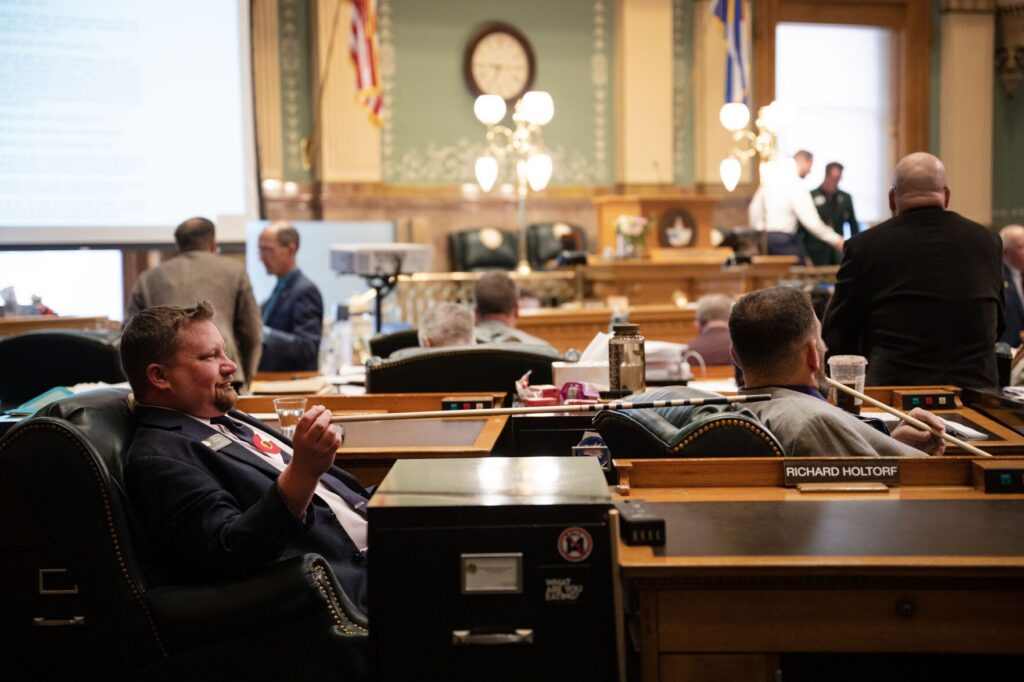
Colorado’s House ethics panel admonished a Republican legislator over allegations he used a master key to access areas of the Capitol that he was not permitted to enter and that he had made sexually harassing comments to several female lawmakers....
Appeals court agrees defendant’s speech constitutionally protected against El Paso County judge
Michael Karlik
michael.karlik@coloradopolitics.com
Updated 5 hours ago
Colorado’s second-highest court agreed last week that a defendant’s critical statements toward a 4th Judicial District judge were constitutionally protected and could not form the basis of a retaliation charge. A three-judge Court of Appeals panel concluded that, in context,...