

Not personal: Neville, Leonard on why they oppose Lynne nomination for lieutenant governor
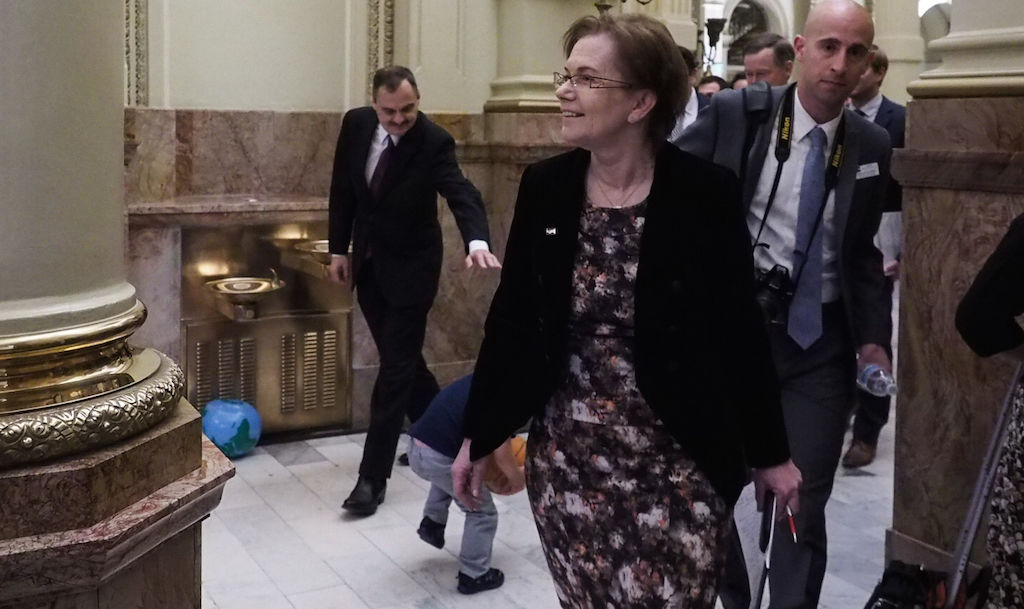
The Colorado House state affairs committee voted 6-2 to approve the nomination of Donna Lynne for lieutenant governor on Wednesday.
The hearing went smoothly. Lynne was quick with thoughtful responses to questions. She told jokes that drew laughs. She was familiar with the concerns of committee members because she had met with them individually before Wednesday to have those conversations.
Lynne won support from the five Democratic members of the committee and from Republican Rep. Cole Wist from Centennial.
She failed to win over Republican Reps. Patrick Neville from Castle Rock and Tim Leonard from Evergreen, who didn’t offer explanations during the hearing for their dissenting votes.
Neville and Leonard later told The Colorado Statesman it was Lynne’s vision of government they found lacking — mainly how she approached the state’s singular regime of taxing and spending governed by the Taxpayer Bill of Rights.
Their opposition suggests Lynne’s road to confirmation may yet grow bumpy. Over the next two weeks, she has to win majority votes in the Democratic-controlled House and the Republican-controlled Senate.
“I really like the governor’s idea of appointing a chief operating officer for the state, someone to make the government run more like a business — better, faster, cheaper,” said Leonard. “I just don’t think that Lynne is the person. She’s a very nice person. I met her and I like her. But she’s not a private-sector person. She spent 20 years in government and 20 years in health care, and I think health care is basically an arm of the government — it relies on funding and it’s not competitive. Her work (for the Kaiser Foundation) is nonprofit. That’s not the same as working for a private-sector company.”
A little more than a month ago, when Gov. John Hickenlooper announced Lynne as his choice to replace popular departing Lt. Gov. Joe Garcia, he said she would act as Chief Operating Officer for the state. It would be Lynne’s job to implement Hickenlooper’s vision of government — to get into the works and make the state departments operate effective and lean. Hickenlooper touted her experience in the private and public sectors.
Lynne directs an $8 billion budget and oversees 16,000 employees as vice president of the Kaiser Foundation Health Plan and Kaiser Foundation Hospitals. She also served in top positions in the administrations of Republican and Democratic mayors of New York City.
“It’s her health care focus, too. That concerned me,” said Leonard. “She supports the drive to expand Medicaid in Colorado, which is already breaking the state budget. That approach puts her at odds with what I think our goals should be.”
He also said he disagreed with Lynne’s approach to the Taxpayer Bill of Rights. He said she didn’t seem to grasp the spirit of the 1992 constitutional amendment written by anti-tax crusader Doug Bruce.
“What TABOR is really about is limiting government,” Leonard said. “Like the governor, (Lynne) concedes it’s the law of the land, but she thinks it’s mainly about letting people vote on tax hikes. I think her approach is to get around TABOR. She wants to set a program for the state and then find ways to fund it — to work out ways or find schemes or some other ways to pay for it. But TABOR is about the people asking us to please prioritize spending within limited revenues — to expand government only according to the increase in population and inflation.”
Neville also took issue with what he sees as Lynne’s skewed view on TABOR, as evidenced by her support for the mostly Democratic drive at the Capitol to reclassify the state’s hospital provider fee as an enterprise fund — a plan that would make room in the general fund under the TABOR spending cap to free up additional hundreds of millions of dollars for lawmakers to spend on state programs.
He also said he thinks that some of the executive branch departments are running rough shod over the legislative branch and need to be reined in by the people in charge — and he didn’t see Lynne doing that work.
“I couldn’t get a clear answer on how she’s going to handle agencies that I think have clearly overstepped their authority, like CDPHE (the Colorado Department of Health and Environment),” Neville said. “I actually had that conversation with her before the hearing, so she had plenty of time to think about the response. I think a lot of people here will have similar concerns.”
Republicans earlier this session sought to strip CDPHE of funding because they said the department was unnecessarily advancing work on the Obama administration’s carbon-cutting Clean Power Plan, which was stayed by a federal court in February.
The battle over CDPHE funding stretched for weeks during budget negotiations. Republicans originally proposed stripping the entire $8.4 million budget of the department’s clean air division. In the end, lawmakers agreed to cut $112,000 — a rough department estimate of how much it would spend this year working on the federal plan.
Edit note: The last sentence of Rep. Leonard’s comments about TABOR has been redrafted in this updated version of the story for clarity.
Colorado Politics Must-Reads:

Rep. Jeff Crank thinks Democrats are too focused on Trump, not enough on Colorado Springs | Vince Bzdek
Vince Bzdek
vince.bzdek@gazette.com
Updated 32 minutes ago
For U.S. Rep. Jeff Crank, who’s unopposed in the Republican primary for the 5th Congressional District but the main target of both candidates in the lively Democratic primary, the big question in the midterms is not who will stand up...

Colorado Politics Calendar June 22-28
Rachael Wright, Special to Colorado Politics
rachael.wright@coloradopolitics.com
Updated 3 days ago
CoPo’s weekly political calendar will help you find political and public-policy events throughout Colorado. It includes candidate and issue campaign events, public policy meetings, court hearings, state and local party conventions, assemblies, debates, rallies, parades, speaking engagements, traveling dignitary appearances,...
Vice president attends Denver event to support energy freedom; more news from the past | A LOOK BACK
Rachael Wright, Special to Colorado Politics
rachael.wright@coloradopolitics.com
Updated 3 days ago
Forty-Five Years Ago This Week: Vice President George H.W. Bush flew to Denver to address the annual meeting of the American Association of Petroleum Landmen, where he assured the audience that the Reagan administration’s strong belief was that the private...
Does character matter anymore? | SONDERMANN
By Eric Sondermann
by-eric-sondermann@coloradopolitics.com
Updated 3 days ago
The last few weeks have been illuminating in the manner of a headlamp pointing the way to some deep, dark, murky netherworld. Graham Platner, a hero to the populist set on the Democratic side, became his party’s Senate nominee in...

A special edition of Capitol M: In remembrance of the outrageous Lynn Bartels
Marianne Goodland
marianne.goodland@coloradopolitics.com
Updated 1 day ago
I had Lynn Bartels envy. For almost longer than I can remember. There, I said it. And it’s true. Lynn died Friday, age 69, after a short battle with glioblastoma. I was just heartsick when that news of her diagnosis...

Bernie Sanders endorses DeGette challenger Melat Kiros in Colorado’s 1st CD Democratic primary
Ernest Luning
ernest.luning@coloradopolitics.com
Updated 1 day ago
U.S. Sen. Bernie Sanders on Friday endorsed congressional candidate Melat Kiros, one of two Democrats challenging 15-term U.S. Rep. Diana DeGette in Colorado’s June primary. Sanders, a Vermont independent who caucuses with the Democrats, called the 29-year-old Kiros “exactly the...
Trump’s 10th Circuit nominee recuses from cases against federal government without explanation
Michael Karlik
michael.karlik@coloradopolitics.com
Updated 1 day ago
President Donald Trump’s nominee to fill a vacancy on the Denver-based federal appeals court recused himself without a clear explanation from nine cases against the executive branch while he was undergoing vetting by the White House this spring. U.S. District...

Trump’s low approval unchanged as Iran war perceptions continue to plague him
Rena Rowe, Washington Examiner
rena.rowe.washington.examiner@gazetteedit.wpenginepowered.com
Updated 1 day ago
A new poll shows most Americans disapprove of President Donald Trump’s handling of Iran, with views on the issue closely mirroring his overall job approval rating. Just 37% of U.S. adults approve of the way Trump is handling his presidency,...

Colorado Iranians express disappointment with U.S.-Iran deal
Mark Samuelson Special to The Denver Gazette
mark.samuelson@denvergazette.com
Updated 1 day ago
Iranians in Colorado worry agreement solidifies the Islamic regime’s power A group of Colorado Iranians expressed disappointment in the agreement reached between the U.S. and the Islamic Republic of Iran, arguing it preserves the government’s hold on power and any...
Adams County murder conviction reversed due to faulty jury instruction
Michael Karlik
michael.karlik@coloradopolitics.com
Updated 1 day ago
Colorado’s second-highest court overturned an Adams County defendant’s murder conviction last month because the instruction provided to the jury about a trespasser’s right to use self-defense did not accurately reflect Colorado law. A person is justified in using force to...
PREV
PREVIOUS

Beauprez campaign accuses Holtzman of breaking law with media spin
Ten Year Ago this week in The Colorado Statesman … The race for the Republican nomination for governor was steaming up. John Marshall, campaign manager for U.S. Rep. Bob Beauprez, demanded that GOP rival Marc Holtzman immediately fire his campaign manager, Dick Leggitt, and submit his campaign to a formal investigation for “the flagrant and […]

Oregon LNG terminal, pipeline seen as key to reviving Western Slope gas patch
No one even remotely involved in natural gas production on Colorado’s Western Slope wants to continue to party like it’s 1999. Back then prices were below $2 per million British thermal units and there were just 94 well starts in Garfield County. Last year, prices continued to languish below $2 per million British thermal units […]