

Bennet, Gardner split on Garland nomination to Supreme Court

Colorado’s two U.S. senators had opposite reactions to President Barack Obama’s nomination Wednesday of Judge Merrick Garland to the U.S. Supreme Court, with Republican Cory Gardner reiterating his position that the Senate should refuse to take up an Obama pick and Democrat Michael Bennet calling on the Senate to “do its job” and consider the nomination.
Most of the Republicans running for the chance to challenge Bennet in the November election also hewed the party line, although former CSU athletic director Jack Graham broke from the pack and said that the GOP-controlled Senate ought to hold hearings on the Garland nomination in order to avoid “fall[ing] into the trap of being perceived as obstructionists.”
Obama nominated Garland to fill the vacancy on the high court created when Justice Antonin Scalia died just over a month ago. Top Senate Republicans said immediately after Scalia’s death that they would not confirm a justice until after the 2016 election, while Democrats said it would be unprecedented to deny a president the chance to make a nomination with nearly a year left in his term.
“The Obama administration continues to use the judicial and regulatory systems to push through its legislative agenda, shifting the balance of power that our Founders established. That is why the next president of the United States should have the opportunity to fill the vacancy on the Supreme Court,” said Gardner in a statement released as Obama was introducing Garland.
“The President has fulfilled his constitutional obligation by selecting a nominee to fill the vacancy left by Justice Antonin Scalia on the Supreme Court,” Bennet said in a statement. “Now, it is the Senate’s constitutional responsibility to thoroughly vet Judge Garland through meetings, hearings, and a vote to confirm or deny his nomination. It is what presidents and the Senate have done throughout our history.”
Garland, 63, is chief judge on the U.S Circuit Court of Appeals for the District of Columbia and was the lead federal prosecutor on the Oklahoma City bombing case, which was tried in Denver. He was confirmed to the D.C. Circuit in 1997 by a Senate vote of 76-23.
Bennet noted in his statement that he worked alongside Garland at the Justice Department, when Bennet served as counsel to the deputy attorney general during the Clinton administration.
“Judge Garland has an excellent reputation and is eminently qualified,” Bennet said. “I worked for and with him at the Justice Department and have a firsthand appreciation for his extraordinary legal skill and respect for the law.”
Among the 13 Republican primary candidates running to take on Bennet, none had praise for Garland, though most stuck to Senate Majority Leader Mitch McConnell’s position Wednesday that blocking an Obama nominee was “about a principle, not a person.”
“It’s despicable that President Obama has used the death of Justice Scalia as a partisan political opportunity since the day that he died,” said former state Rep. Jon Keyser, R-Morrison, in a statement. “Sen. Bennet should join with Americans across our country and support efforts to have our next president nominate Justice Scalia’s replacement to the Supreme Court. The American people deserve to have a say in the choice of our next Supreme Court Justice and that’s why I’ve insisted that the next President should be the one to nominate Justice Scalia’s replacement.”
State Sen. Tim Neville, R-Littleton, said he disagreed with characterizations that Garland was “too moderate” a nominee to refuse.
“We have seen the kind of bench that Barack Obama has appointed, and every last one of them has been lock-step with the Obama agenda,” Neville told The Colorado Statesman. “The fact is that Merrick Garland avoided votes on most of the important issues of the day. Furthermore, on the Second Amendment, he emphatically opposed the ruling of the D.C. Circuit court to reinstate gun rights for D.C. residents.”
Neville made clear that he believes the Senate should refuse to consider the Garland nomination.
“As I’ve always stated, the Senate needs to stand strong against any appointment that fails to match the reputation, principles and legacy that Justice Scalia left behind,” Neville said. “The Republican Senate majority needs to do everything their power to block this nomination.”
Lakewood businessman Jerry Natividad broke out some rhymes to make a similar point.
“The president has spent the last seven years making a mockery of the Constitution,” he told The Statesman. “Mitch McConnell and the Senate Republicans should grow a spine, draw a line, hold the line and make sure the next president picks the next justice, as has been customary for generations.”
El Paso County Commissioner Peg Littleton took issue with Obama’s contention that the Constitution argues for swift consideration of a nomination by the Senate.
“Nowhere does the Constitution dictate senators ‘move quickly’ in making such an important decision,” Littleton said in a statement. “Obama made that up, and he hopes we will believe it.”
Littleton said that, as a senator, she would “not vote to approve any nominee to the Supreme Court of the United States who does not have an unwavering commitment to defend the Constitution as it was written and intended by our founders.”
But Graham called for the Senate to consider Obama’s nominee rather than being perceived as “the party of no.”
“President Obama’s Supreme Court nominee should be considered by the U.S. Senate,” Graham told The Statesman. “The consent of the Senate, controlled by the Republican Party, is required. We have made clear that, for a nominee to be approved, that person must reflect the conservative constitutional values of Justice Antonin Scalia. The hearing process is likely to reveal the judicial excesses of virtually all court nominees put forward by President Obama. The debate will be valuable to the American people. The Republican Party should not fall into the trap of being perceived as obstructionists or ‘the party of no’ by refusing to even consider a nominee.”
Bennet took a preemptive shot at the intense political pressure mounting on both sides of the Garland nomination.
“This is not the time to play politics to satisfy our political bases,” he said. “The Senate should do its job. How we manage our constitutional duty to provide serious consideration and deliberation to a rare appointment to the nation’s highest judicial office will determine whether we deserve the respect of Americans who rightly expect us to exhibit dignity, mutual respect, and wisdom on their behalf.”
Introducing Garland, Obama said his nominee planned to begin one-on-one visits with senators Thursday.
“I simply ask Republicans in the Senate to give him a fair hearing and then an up-or-down vote. If you don’t, then it will not only be an abdication of the Senate’s constitutional duty, it will indicate a process for nominating and confirming judges that is beyond repair,” Obama said.

Atop taxes, here’s how much each Colorado resident pays in fees
Marissa Ventrelli
marissa.ventrelli@coloradopolitics.com
Updated 17 minutes ago
Each Colorado resident paid nearly $5,000 in state-sanctioned fees last year, according to a report by policy think tank. The report, which analyzed how fees have affected Colorado’s economy, found that fee revenue has more than tripled since 2008 —...

Colorado National Guard, Swiss Armed Forces celebrate partnership
Marissa Ventrelli
marissa.ventrelli@coloradopolitics.com
Updated 33 minutes ago
Colorado’s National Guard marked a year of partnership with the Swiss Armed Forces at the Governor’s Mansion on Monday. “This anniversary marks one strong year of friendship and collaboration between the State of Colorado and Switzerland,” said Gov. Jared Polis....
Judge allows Trump to refile $15 billion lawsuit against the New York Times
Emily Hallas
emily-hallas@coloradopolitics.com
Updated 1 hour ago
A federal judge declined to dismiss President Donald Trump’s multibillion-dollar lawsuit against the New York Times on Monday, giving him roughly four weeks to amend his case after the outlet moved to toss it on First Amendment grounds. District Judge...

Gov. Polis celebrates Colorado’s first‑place education ranking from U.S. News
Marianne Goodland
marianne.goodland@coloradopolitics.com
Updated 1 hour ago
Colorado has something to celebrate this week, in addition to its sesquicentennial (150th) birthday on Saturday. U.S. News & World Report on Tuesday gave Colorado its top ranking for education efforts from pre-K to postsecondary. Gov. Jared Polis celebrated the...
Denver detox center did not violate man’s rights with 10-hour hold, 10th Circuit says
Michael Karlik
michael.karlik@coloradopolitics.com
Updated 2 hours ago
The Colorado-based federal appeals court concluded on Tuesday that Denver’s detoxification facility did not violate a man’s rights by holding him against his will for 10 hours until his blood alcohol content was projected to reach zero. Unusually, Brian Garrett’s...
Federal judge clarifies ex-GOP treasurer candidate’s burden to prove defamation claims
Michael Karlik
michael.karlik@coloradopolitics.com
Updated 1 hour ago
A federal judge clarified last week that businessman and former Republican statewide candidate Brian Watson will need to surmount a higher hurdle in proving his claim that a party guest’s alleged description of him as a “criminal” amounted to defamation....

Denver City Council sends Xcel franchise deal to voters
Deborah Grigsby
deborah.smith@denvergazette.com
Updated 3 hours ago
This November, Denver voters will decide whether to renew the city’s longstanding franchise agreement with Xcel Energy. Members of the Denver City Council approved on Monday sending a proposed 20-year franchise agreement with Xcel that would deliver more than $180...
Independent gubernatorial candidate Greg Lopez, a former GOP congressman, qualifies for Colorado ballot
Ernest Luning
ernest.luning@coloradopolitics.com
Updated 22 minutes ago
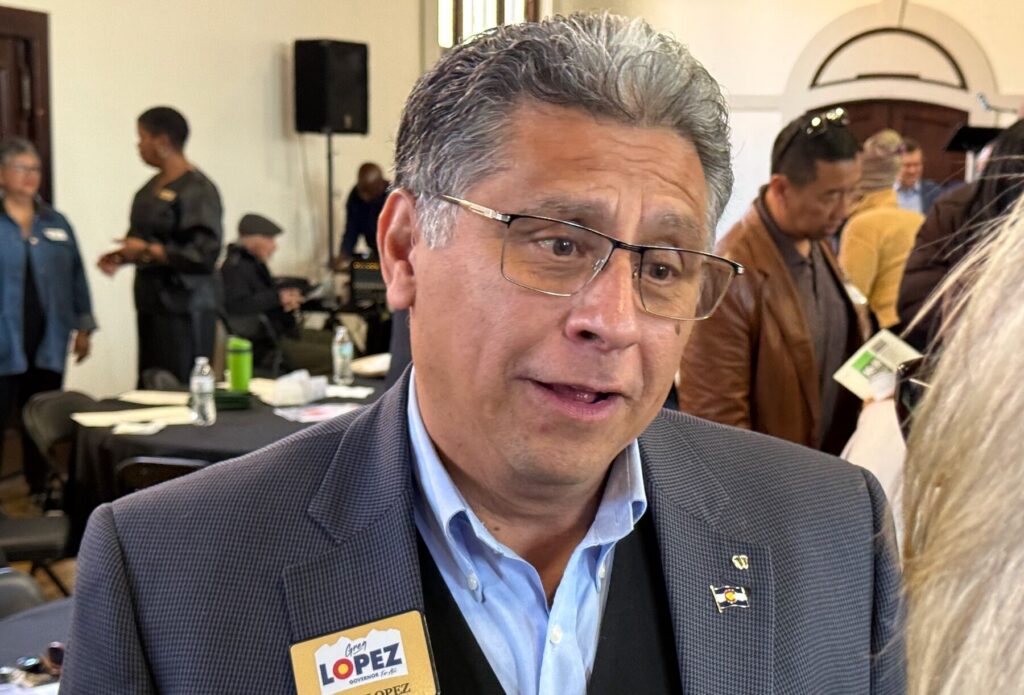
Unaffiliated gubernatorial candidate Greg Lopez, a former Republican congressman from Elizabeth who left the GOP to run as an independent, has qualified for the ballot by submitting enough petition signatures, the Colorado Secretary of State’s Office said Tuesday. He’ll face...
At Colorado’s 150th anniversary, leaders offer birthday wishes
Thelma Grimes
thelma.grimes@coloradopolitics.com
Updated 5 hours ago
As Colorado’s 150th anniversary approaches, leaders from across the state reflect on the spirit that binds the plains, mountains, Western Slope and Front Range — a shared commitment, they underscored, to opportunity, community, stewardship and personal freedom. Their tributes highlight...
Fauci’s private COVID-19 diaries: Six takeaways on fame, prize money and the lab leak debate
The Washington Examiner
the-washington-examiner@coloradopolitics.com
Updated 8 hours ago
Anthony Fauci’s private writings from 2020 and beyond portray a public health official who was fixated on his growing celebrity while privately grappling with a pandemic response he believed was chaotic, leaderless and consumed by internal rivalries. The writings of...
PREV
PREVIOUS

Hickenlooper, Mead set aside political differences to dig into sage grouse plan
While a massive five-year collaborative push by numerous government agencies, business interests, landowners and conservation groups to avoid Endangered Species Act listing of the greater sage grouse is largely heralded as a national model, it’s clear political differences remain between the neighboring Western governors who spearheaded the effort. Speaking at a two-day Western Governors’ Association […]

Colorado Rubio backers lament senator's exit from GOP race
U.S. Rep. Mike Coffman said Wednesday he was “heartbroken” that Florida Sen. Marco Rubio had ended his campaign for the Republican presidential nomination following a distant second-place loss in his home state to GOP frontrunner Donald Trump. “There’s no doubt in my mind he would have won Colorado if it had come to a vote,” […]