

Candidate Carroll, and her tracker, see college lender bill stifled by Senate GOP
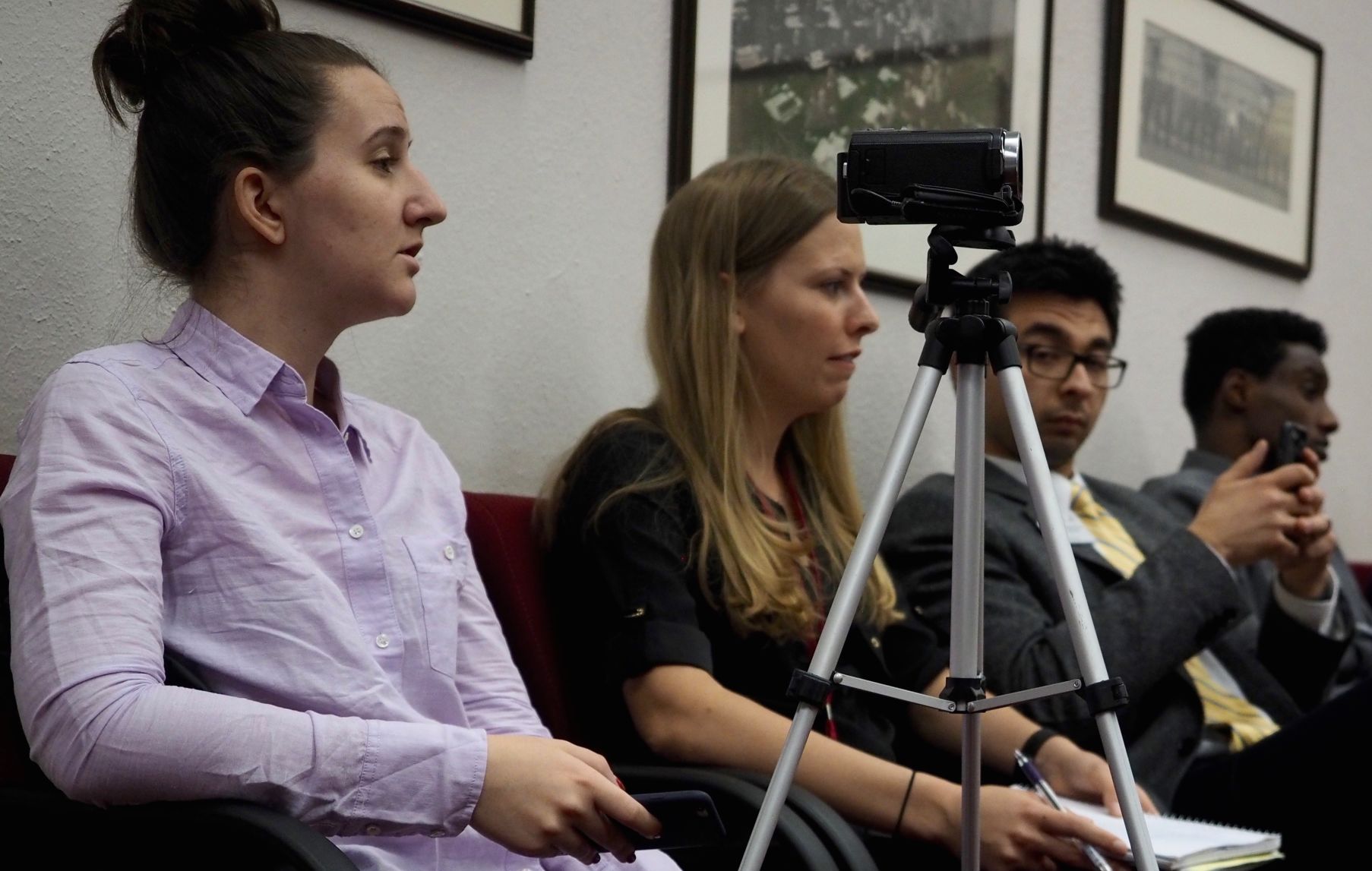
Megan Hanson, a young woman in a purple button-down Oxford shirt, came early to the Senate State Affairs Committee hearing Wednesday afternoon, sat along the wall by the door and set up a small video camera on a tripod.
One of the measures being considered by the committee was SB 43, a “Know Before You Owe” bill, aimed at protecting university students from what some say is an aggressive, predatory loan industry. But Hanson did not come to learn about the bill. She is much more interested in the bill’s sponsor, former Senate President Morgan Carroll, D-Aurora, who is now running to unseat Republican U.S. Rep. Mike Coffman in Colorado congressional swing district 6.
Hanson is a candidate tracker for America Rising, the national opposition research group aimed at “exposing the truth about Democrats.”
Hanson has followed Carroll around for months already, taping her speaking in committee, walking through the Capitol hallways, pressing her to say whether she thinks the Obama administration Iran deal “will lead to the funding of terrorism.”
Hanson’s presence in the Republican-controlled Senate “kill committee” was just a more obvious signal that the hearing on Carroll’s bill would be as much about electoral politics as about the practices of the student lending industry.
Carroll’s bill aimed to prevent private lenders from giving gifs to college and university staffers in exchange for any kind of advantage in lending to students. It would have bound lenders to tell students exactly what they would pay for any loan and it would have done away with fees charged to students who pay off their loans early. It also would have required lenders to inform students of the kind of loans that were also available through the government — usually lower interest with better payback terms — and the bill would have allowed students to cancel within three days any loan agreement they might sign with a private lender without penalty.
The committee voted along party lines to kill the bill. Ray Scott, R-Grand Junction, Jerry Sonenberg, R-Sterling, and Owen Hill, R-Colorado Springs, voted against the measure with Matt Jones, D-Louisville, and Jessie Ulibarri, D-Westminster, voting in support of the bill.
The Colorado Bankers Association testified in opposition, arguing the bill would apply to very few banks in the state and that it might violate federal regulations already in place.
Mostly students testified in favor of the bill. They argued that lenders saw them as a ripe market to mine, creating more unnecessary hurdles for them to clear in their already hectic lives, working jobs while attending classes and studying in order to get ahead in their lives.
Carroll’s Senate district — and the congressional district she hopes to represent in Washington — includes a large swath of working class, immigrant and first-generation families. Her bill would certainly play well with her current and would-be constituents, but she said she thought it should have fared better across party lines.
“I worked my way through college in multiple jobs, studied hard for my classes, and played by the rules that said if you work hard and earn a degree, you can achieve your own American dream,” Carroll said in a prepared statement. “I’ve been fortunate in my career, which makes my obligation to give those in the middle class who saw the private lending system work against them the same opportunities I had after I graduated.”
Carroll told The Colorado Statesman after the vote that she thinks the Legislature is obligated to act on student debt.
“This was a very big missed opportunity. The result was very partisan,” she said.
The committee earlier Wednesday killed another Carroll bill, SB28, the “Community Re-Investment Act,” which would have required increased reporting of demographic data in state contracts to help gauge whether contractors were hiring ethnic minorities and women in numbers that reflect the make up of Colorado communities.


Appeals court upholds Park County trophy hunting conviction
Michael Karlik
michael.karlik@coloradopolitics.com
Updated 54 minutes ago
Colorado’s second-highest court clarified on Thursday that a defendant may stand convicted under the state’s trophy hunting laws if he abandons a bear carcass but returns later to remove the meat. Under Colorado law, it is a felony to detach...

Healthcare Freefall: Longer drives, fewer options for maternity care in Colorado
Thelma Grimes
thelma.grimes@coloradopolitics.com
Updated 1 day ago
Editor’s Note: Colorado’s healthcare system is entering a period of accelerating instability — a “tsunami,” as multiple leaders describe it — driven by collapsing hospital finances, shrinking Medicaid reimbursements, disappearing services and a political fight over who is responsible for...

Healthcare freefall: Breast cancer survivor shares strain of rural treatment travel
Hap Fry, Special to The Gazette
hap-fry@gazette.com
Updated 1 minute ago
Editor’s Note: Colorado’s healthcare system is entering a period of accelerating instability — a “tsunami,” as multiple leaders describe it — driven by collapsing hospital finances, shrinking Medicaid reimbursements, disappearing services and a political fight over who is responsible for...

Judge grants partial injunction to GEO in fight against state health inspection law
Kyla Pearce
kyla.pearce@gazette.com
Updated 16 hours ago
A judge ruled Thursday that The GEO Group does not have to follow parts of a new state law requiring more frequent health and safety inspections at the U.S. Immigration and Customs Enforcement processing center in Aurora. Under the order...

Parker man faces 20 years to life for serial sexual assaults
Nicholas Fogleman
nicholas.fogleman@denvergazette.com
Updated 18 hours ago
A 25-year-old Parker man who sexually assaulted three women in 2025 pleaded guilty Wednesday and will serve 20 years to life in prison. Javier Rodriguez-Andrade pleaded guilty to charges stemming from three sexual assaults involving women ages 19 to 24. ...

Buttigieg performs best among Democrats against Rubio or Vance in possible 2028 contest: Poll
David Zimmermann
david-zimmermann@coloradopolitics.com
Updated 20 hours ago
Former Transportation Secretary Pete Buttigieg appears to be the Democratic Party’s best chance at winning the presidency against Secretary of State Marco Rubio or Vice President JD Vance in 2028, according to a poll released on Thursday. In hypothetical matchups...

Douglas County moves to Stage 1 fire restrictions following recent rain
Nicholas Fogleman
nicholas.fogleman@denvergazette.com
Updated 18 hours ago
Douglas County has downgraded its fire restrictions from Stage 2 to Stage 1 on Thursday following recent rainfall and moderate fire conditions, according to the Douglas County Sheriff’s Office. The change applies to unincorporated Douglas County, as well as the...
Divided appeals court upholds warrantless DNA collection in Colorado cold case, cautions of government overreach
Michael Karlik
michael.karlik@coloradopolitics.com
Updated 16 hours ago
Colorado’s second-highest court upheld the warrantless collection of a suspect’s DNA from a discarded soda can as constitutional on Thursday, while warning about potential abuse of DNA privacy in the absence of further guardrails. By 2-1, a three-judge Court of...

Democratic gubernatorial candidate Phil Weiser promises to appoint rural outreach director, water adviser
Marianne Goodland
marianne.goodland@coloradopolitics.com
Updated 16 hours ago
Democratic gubernatorial candidate and current Attorney General Phil Weiser told the Colorado Water Congress Thursday he intends to appoint a rural outreach director and a water policy adviser should he win the election in November. Weiser’s speech at the Steamboat...
Man charged in Northglenn homicide of wife
Matt Kyle
matt.kyle@denvergazette.com
Updated 18 hours ago
A man has been formally charged with murder and burglary relating to a homicide last week in Northglenn. Alexei Munive-Rodriguez, 48, was arrested Sunday after he was at large following the homicide, which occurred Friday. Police were dispatched around 10:30...
PREV
PREVIOUS

Keyser rips Senate primary rivals over who should name Scalia replacement
U.S. Senate candidate Jon Keyser threw down a gauntlet in the crowded Republican primary field Thursday morning, saying he was the first of Colorado’s GOP primary candidate to say the next president should nominate a replacement for Supreme Court Justice Antonin Scalia and that any of his opponents who don’t agree “can’t be trusted to […]
Lakewood High School students see “our government in action”
Lakewood High School students who traveled to Washington, D.C., as part of the Close Up program gave the experience high marks. The students had appointments to see U.S. Sens. Cory Gardner, a Republican, and Michael Bennet, a Democrat, along with their congressman, U.S. Rep. Ed Perlmutter of Jefferson County. They weren’t planning on meeting Colorado Secretary […]