

State’s first-ever water plan in homestretch
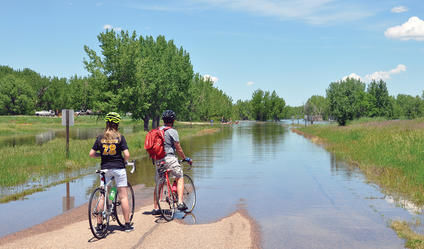
Bring up the topic of Colorado water just about anywhere across the arid state, and before long someone is bound to invoke the state’s unofficial motto, a saying attributed to Mark Twain: Whiskey is for drinking. Water, that’s for fighting.
But these days, if you happen to find yourself amid the kind of folks who never tire of cracking a smile when the adage is uttered, you’re just as likely to hear talk of the state’s first-ever water plan, set to unveil before the end of the year. Water, they just might acknowledge, could be for plenty of things. But in the meantime, there’ll still be whiskey.If state water plan developers are successful, Colorado’s water situation shouldn’t look anything like drought-ravaged California’s anytime in the near future.
For the past two years, Colorado water authorities have been working on a statewide water plan that will guide Colorado for decades to come. Under the direction of the Colorado Water Conservation Board, construction of the plan is heading into its final months.
“The drought in California has put a spotlight on how we manage the system,” said James Eklund, the state water board’s director. “It shows how one part of the system going dry, like California, runs all the way up to the headwater state (Colorado).”
History of the plan
In between dealing with two years of the worst wildfires in state history, Gov. John Hickenlooper in 2013 signed an executive order calling for creation of the water plan.
The need is based in part on data that came from the 2010 Statewide Water Supply Initiative, which said Colorado would need 500,000 more acre-feet of water by 2050. The need is greatest, the governor’s executive order said, in the South Platte River basin, the most populous and largest agriculture-producing basin. (Colorado has nine river basin districts, based on the location of the state’s eight major rivers and another district for metro Denver.)
An acre-foot is the amount of water it takes to cover one acre of land one foot deep in water, roughly 325,853 gallons. The average household in Colorado uses about 0.25 acre-feet of water each year.
But the statewide water plan really has its origins in the 2002 drought.
After that drought, lawmakers asked voters to approve a referendum to allow the state to issue up to $2 billion in bonds for water projects. Critics said the ballot measure didn’t provide sufficient detail, and voters defeated it by a 2-to-1 margin.
So it was back to the drawing board. In 2005, the Legislature passed the “Colorado Water for the 21st Century Act,” establishing the nine river-basin roundtables. These facilitate discussions between the basin areas and work out interbasin compacts to govern water transfers from one basin to another.
Roundtable members include representatives from agricultural, recreational, local and domestic water providers, industrial interests, environmental groups and owners of water rights. The groups also include representatives from water conservancy districts, counties and municipalities.
The state water plan is based on nine years of detailed work performed by these roundtable groups. To come up with the state water plan, the roundtables each submitted a basin improvement plan (the South Platte and Denver basins collaborated on theirs). Each looked at balancing long-term municipal, industrial, agricultural, environmental and recreational needs within that basin.
The CWCB plans release the next draft of the lengthy plan on July 15. The current draft calls for spending as much as $20 billion on a wide variety of water projects that require coordination between the roundtables, land-use planners and developers, agricultural interests, recreational and environmental interests, and local and state government representatives.
Once next month’s draft is released, the CWCB will collect public comment through September 17. The first draft, released in December 2014, drew more than 13,000 comments, demonstrating that the public has tremendous interest in the plan, the CWCB said. That interest, the organization said, should be leveraged to educate state residents on water use and to promote discussion.
The final plan, which will include legislative recommendations, is due to the governor by December 10. The Legislature is expected to act on those recommendations in next year’s session.
A second governing group, the Interbasin Compact Committee, examined the roundtable plans and came up with recommended actions the state must take to secure its water future. These include conservation, alternatives to a “buy-and-dry” approach to agricultural land, and more efficient water-permitting processes.
The state’s rivers
The eight major rivers that flow out of Colorado provide water not only to the state’s 5.3 million residents but also to roughly 31 million residents of four states — Arizona, New Mexico, Nevada and California. Some 10 million acre-feet of water flow out of the state every year, with about 4.4 million of it headed to those four states. The amount of water is legally governed by nine interstate compacts and two apportionment decrees from the U.S. Supreme Court.
That’s one of the reasons the water plan is so important. With California, in particular, experiencing record drought, Colorado’s water community keeps a cautious eye on the demand on the Colorado River, the state’s largest.
The state’s population-growth estimates are another key factor in the water plan. The state demographer estimated two years ago that Colorado is likely to grow to 6 million residents by 2020 and to 8 million by 2040. A good share of that growth is expected to take place along the Front Range, where 80 percent of the state’s water is used. But 80 percent of the state’s water is on the Western Slope. Twenty-four tunnels and ditches move about 500,000 acre-feet of water from the Western Slope to the Front Range and Eastern Plains every year, while another 14 million acre-feet is the result of precipitation.
Numerous challenges
Among the challenges identified in the plan:
• The projected gap between municipal supply and demand, predicted to be 500,000 acre-feet by 2050.
• Agricultural buy-and-dry, or buying agricultural land for its water rights. At the current rate, the state faces a significant loss of agricultural land, the plan says. The General Assembly has addressed some of this through temporary leasing of water rights rather than permanent sale, but this is viewed as a short-term solution. Buy-and-dry also risks the future of agricultural communities. The 2010 U.S. Census noted that the state had 17 counties with declining population. All but two of these counties are in the San Luis Valley or on the Eastern Plains, the primary areas for Colorado’s agricultural economy.
• Environmental and recreation fragility. It’s only recently that the begun to rely on recreation as a significant part of the economy. “The relative youth of water rights associated with these activities places them at risk if we realize less water,” the plan says. The state’s fish populations and aquatic habitats are at risk, and that risk will only increase if agricultural, municipal, and industrial water needs are on course to clash with environmental and recreational water needs.
• Destructive wildfires, flooding and “forest epidemics,” such as the beetle kill, all compromise the state’s water system, dam for environmental reasons as well as for water supply.
• Finally, money — it’s always about money. The draft estimates the state will need to spend $20 billion by 2050 to address projected water-related needs for everything from municipal and industrial use to agricultural, environmental and recreational needs.
‘Prior appropriation’ doctrine
Colorado is famous for its doctrine of prior appropriation as it relates to water rights. The doctrine means that the first person to use water or divert it for a beneficial use, such as agriculture, can acquire the rights to the water. That person or entity is known as the senior water-rights owner. Everyone who wants a portion of that water — in a river, stream or ditch — is junior to that right. That means that in a drought, for instance, the senior water-rights holder will have access, but the junior water rights holder might lose some or all of that access, depending how far down the junior holder is on the priority list.
Eklund told The Colorado Statesman the prior appropriation doctrine provided the CWCB and the basin roundtables with a level of certainty to do the planning. While some have called for scrapping the doctrine, Eklund said, that would create uncertainty that could be devastating to planning the state’s water future. The alternative would have been to go to a type of “public trust” doctrine, where the state makes decisions on who gets water, based on highest and best use, he said.
Collaboration, comments
The CWCB, a division of the state’s Department of Natural Resources, believes the basins are working more collaboratively now than they have in the past, due to the water plan process.
The plan also recognizes a need for more collaboration between state and local entities on water, based on Colorado’s system of local control. So in addition to the nine basin roundtables, the CWCB sought input on water and land-use issues from the Colorado Municipal League, Colorado Counties, Inc., and the Special District Association of Colorado.
The legislative interim Water Resources Review committee, which meets every summer, submitted a letter to the CWCB last October on the public testimony they’d received on the state water plan. The committee held nine hearings, one in each basin, last year. They will continue this summer to collect input on the water plan.
Trans-basin diversions — water that moves from one basin area to another — are a key concern in every basin, according to the committee’s letter. “Citizens across the state voiced great concern that their communities will be dewatered for the benefit of fueling Front Range urban population growth. This sentiment is especially prevalent among West Slope residents but is true of residents in every basin,” the letter said.
Those who attended the review committee hearings also expressed support for the state taking a larger role reducing the “water footprint” for new development and redevelopment. The General Assembly tried to address this concern with legislation in the 2014 session. It would have set a limit on the size of lawns in new developments, but the bill died after pressure from developers and concerns that residential water users were being targeted.
Residents also raised concerns at the meetings about water storage and expressed the importance of maintaining the state’s agricultural industry.
It won’t be cheap
“There is no easy or inexpensive way to provide Coloradoans with a sustainable long-term water supply,” the plan says.
Later this year, the CWCB plans to develop a priority list of projects, based on the basin improvement plan recommendations. They’re looking for “quick wins” — projects that have cross-basin and statewide benefits, are “shovel ready,” and have a possible funding plan.
One major source of funding already identified is use-rates and “tap fees,” the cost of attaching a home or business to a public sewer and water system. These fees could be the primary source of funding where the end user is directly connected to the costs and investment in a water project.
Other possible sources include a variety of CWCB funding streams, such as the board’s Water Project Loan Program, the Species Conservation Trust Fund and the Water Resources and Power Development Authority’s Water Revenue Bond Program.
These sources wouldn’t be able to fund all the projected water needs, the plan said, but they could fill gaps, when combined with other potential sources of funds. The identified sources could provide more than $100 million annually for water projects, and the revenue bond program can issue up to $500 million in low-cost bonds without legislative approval.
That’s important for municipalities, which will likely need to rely on state, federal, or bond market loans for their water projects. And over the next 35 years, the CWCB could have as much as $2 billion available through loans for municipal, industrial and agricultural projects.
That may take care of municipal projects, but there isn’t an existing funding source for environmental or recreational projects. The CWCB says it has about $385 million available in grants to pay for recreational projects, although it falls far short of what will be needed.
The IBCC also looked at a variety of partnerships, federal-funding opportunities found in other states, as well as in Colorado, and tax hikes. These include partnerships between the federal government and the state, as was formed to finance the Central Arizona Project; a public-private partnership, like those used to finance highway projects; enacting a “water” mill levy in populous Front Range counties; and increasing severance taxes, the state sales tax or even taxing Internet-based transactions.
The plan suggests the governor and General Assembly stop tapping severance taxes to balance the budget and repay the $133 million — plus the $20 million taken this year — back into the severance tax trust fund. The state could also take another look at a proposed 2010 ballot measure that would have imposed a fee on beverage containers, with that money going to water preservation. As submitted, that measure failed to clear the single-subject requirement, but could generate $100 million annually to go directly to water projects, the plan said.
Finally, would voters be willing to once again consider a ballot initiative on water? That’s another idea being floated.
A water investment fund committee — including representatives from private investment firms, the basin roundtables, the environmental community and those involved in public-private partnerships — has met several times to consider possibilities, Eklund said.
As for California, Eklund said the state’s drought has provided Colorado with a big wake-up call. It’s better to plan before you’re in a crisis than when you are in the middle of it, he said.


USPS ballot rule faces lawsuit from Colorado, other states
Thelma Grimes
thelma.grimes@coloradopolitics.com
Updated 12 minutes ago
Colorado, along with 25 other states, filed a lawsuit against the U.S. Postal Service to challenge a new rule that seeks to restrict the mailing of ballots to American citizens in an eligible voters list. Colorado relies heavily on the...
Trump defends pause on beef tariffs: Prices are ‘coming down very rapidly’
Naomi Lim
naomi-lim@coloradopolitics.com
Updated 45 minutes ago
President Donald Trump defended his decision to pause tariffs on some beef imports, even as Republicans criticize the decision. “Prices are coming down very rapidly, and now beef is starting to come down,” Trump told The Glenn Beck Program on...
Denver murder, assault convictions reversed due to faulty jury instructions
Michael Karlik
michael.karlik@coloradopolitics.com
Updated 1 hour ago
Colorado’s second-highest court reversed a defendant’s convictions for murder and assault last week after concluding a Denver judge incorrectly omitted key jury instructions that could have affected the verdict and sentencing. Stephen C. Swainson fatally stabbed Israel Casillas in downtown...

This is how much Colorado will receive from massive Meta child safety settlement
Thelma Grimes
thelma.grimes@coloradopolitics.com
Updated 5 minutes ago
As part of a sweeping multistate agreement, Meta Platforms, Inc. — the parent company of Facebook and Instagram—has agreed to pay more than $17 billion and adopt extensive child-safety reforms. Colorado Attorney General Phil Weiser on Wednesday called the deal...
‘Understand people for who they are’: 2 federal judges talk about compassion in courtroom
Michael Karlik
michael.karlik@coloradopolitics.com
Updated 3 hours ago
Before taking the bench in 2022, U.S. District Court Judge Charlotte N. Sweeney was an employment discrimination attorney. While the cases could be emotionally charged, they were different from the criminal proceedings she is now handling. “It wasn’t necessarily affecting...

Trump lowers flags to half-staff for Dolly Parton: ‘The World loves you’
Naomi Lim
naomi-lim@coloradopolitics.com
Updated 23 hours ago
President Donald Trump is honoring the life of country music legend and philanthropist Dolly Parton by ordering federal buildings across the country to lower flags to half-staff for a week. “Very sad to report that Dolly Parton, one of the...
Ted Cruz suggests GOP realignment coming after Trump leaves office
Emily Hallas
emily-hallas@coloradopolitics.com
Updated 23 hours ago
Sen. Ted Cruz (R-TX) on Monday suggested the Republican Party could embrace a directional shift after President Donald Trump leaves office, a transition that promises to leave a gaping hole in the GOP. Cruz is known as a critical ally...

2 Colorado State troopers shot near Woodland Park; suspect killed
DEBBIE KELLEY
debbie-kelley@coloradopolitics.com
Updated 22 hours ago
Two Colorado State Patrol troopers were hospitalized, and a suspect is dead after a shooting during a traffic stop Tuesday. The initial incident happened at about 7:15 a.m., when a resident reported suspicious activity in the area near milepost 286...

Aurora moves forward with data center regulations
Kyla Pearce
kyla.pearce@gazette.com
Updated 23 hours ago
The Aurora City Council approved moving forward with two new regulations on data centers and directed staff to come back at the next study session with others. At a council meeting in early August, council members directed city management to...

Aurora City Council considers stricter food truck regulations
Kyla Pearce
kyla.pearce@gazette.com
Updated 23 hours ago
The Aurora City Council is considering passing laws to limit the number of food trucks on properties in the city and how and when they operate. Councilmember Angela Lawson, who sponsored the ordinance, said she understands the importance of food...
PREV
PREVIOUS

‘Coup attempt’ rocks state GOP, House stands firm
The Colorado Republican Party was thrown into turmoil this week after three powerful Republicans attempted to persuade state GOP chair Steve House to resign. While House initially took them up on the offer, he quickly rescinded his resignation — reneged on the deal, detractors say — and fired back at Attorney General Cynthia Coffman, former […]
Cook: An open letter to candidate Jeb Bush
Dear Gov. Bush: I read, with some dismay, your announcement yesterday that you are running for president. Not that it was unexpected, mind you – you’ve been putting off this declaration for six months, apparently to skirt campaign finance laws. That makes sense since you are looking to gain the backing of this country’s elite […]