

Federal term limits get kibosh, Duke recall fizzles over fears
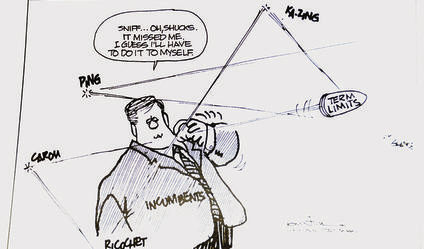
Twenty Years Ago this week in The Colorado Statesman, the U.S. Supreme Court struck down an Arkansas law that put term limits on members of Congress, bringing to a screeching halt — at least for the time being — the principle at the federal level, five years after Colorado had launched the grassroots movement. Since former state Sen. Terry Considine, R-Englewood, started things rolling with a ballot initiative, 24 states had enacted similar laws. The ruling in the Arkansas case put the decision squarely back in the hands of Congress, which could still act to limit its own terms. “This is dead in the water, as far as the senator sees it,” said Sen. Ben Nighthorse Campbell spokesman Alton Dillard. Campbell feared the court ruling might take the wind out of the sails of the movement, since a term limit resolution had failed to pass during the first 100 days of the 104th Congress. Like the Equal Rights Amendment of earlier decades, Campbell thought, the term limits movement would likely die before public support could push it across the finish line. Colorado’s other senator, fellow Republican Hank Brown, was more optimistic. Brown, chair of a subcommittee on the Constitution, planned to introduce legislation to redefine residency requirements, defining a resident as someone who has lived in the state for more than six months of every year for 12 consecutive years. While acknowledging it was a long shot and a “bizarre idea on the surface,” Brown said he thought the change would impose de facto term limits on federal lawmakers. He blasted the Supreme Court ruling, speculating that it might endanger state laws requiring that candidates be mentally competent or be free of felony convictions. Democratic Reps. Pat Schroeder and David Skaggs, on the other hand, hailed the ruling. “Recent history suggests that the term limits that we have — elections — work really well,” said Skaggs. “Over half of the House of Representatives have been elected for the first time since 1990,” he added. Schroeder, serving her 12th term in Congress, said that voters could easily limit her term in office, if they wanted, by voting for someone else. “Term limits interfere with people’s rights to do what they want,” she said. Brown’s solution, she added, would discriminate against western state lawmakers, since those who represent districts near Washington could easily shuttle back and forth, but the cost would be prohibitive for westerners. “So we would end up with a system where the East can run forever and the West can’t gain any seniority,” Schroeder said. …
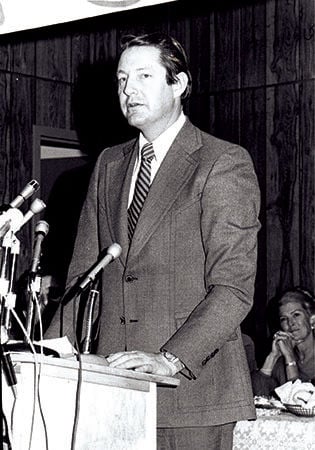
Sen. Hank Brown

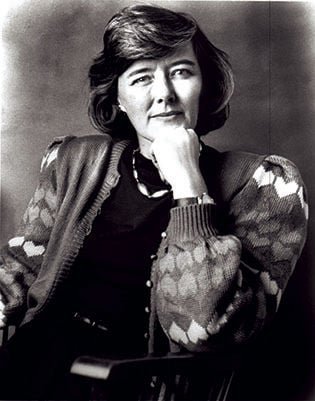

Rep. Pat Schroeder

… The “thunder” behind the effort to recall state Sen. Charlie Duke, R-Colorado Springs, had dissipated over fears that Republicans might suffer a backlash from the powerful “Patriot Movement.” Sources with the recall effort — initiated after the senator had speculated about the federal government’s complicity in the Oklahoma City bombing — said they were frustrated by the “lack of courage” exhibited by local Republicans. Folks were saying they’d be glad to sign a recall petition but balked at the thought of carrying a petition or sitting on a recall committee, fearing they’d be targeted for revenge. Consequences could include being stripped of party committee posts, losing delegate status and seeing political ambitions stymied, they said. One unidentified man said at a recent political gathering he couldn’t get involved because he was afraid “the patriot militia would shoot [his] horses and dogs.” Meanwhile, the El Paso County GOP was still receiving calls condemning Duke’s remarks, along with praise for county Republican Party chairman Bob Gardner for speaking up against Duke. Sources said a Duke aide had been “combing through” the county party’s financial records on Duke’s behalf, targeting the senator’s wrath at Gardner by hoping to find some sort of impropriety. Duke, for his part, had been “visibly upset” at Gardner during a recent interview, lambasting his fellow Republican for broadcasting his criticism rather than picking up the phone and giving Duke a call. A federal agent meanwhile swatted back speculation that Timothy McVeigh or his accomplice, so far only identified as John Doe 2, had been secret informants for the Bureau of Alcohol, Tobacco and Firearms. …
… The list of concealed-carry permit holders in El Paso County was out, and, to nobody’s surprise, Duke was on the list. So were state lawmakers Mary Anne Tebedo and Mary Allen Epps, along with Colorado Springs City Council members Cheryl Gillespie and Bill Guman. Gillespie, incidentally, had recently modeled her gold-and-silver coordinated gun, fanny weapon pack and jewelry in the pages of Time magazine.
Thirty Years Ago this week in The Colorado Statesman, state Reps. Phil Pankey, R-Littleton, and Dale Erickson, R-Fort Lupton, were right on target when they picked May 25 as the day the Legislature would finally adjourn sine die, and they came pretty close to predicting the precise time — 11:43 a.m. The two Republicans won the legislators’ pool, each taking home $65, though The Statesman guessed they probably spent it all that afternoon, treating Capitol denizens to rounds of drinks at Nick’s Congress Lounge. …
… Political parties were on the move. Democrats were moving both the state and Denver County offices from 18th and Race a few blocks west to the 1700 block of Downing Street. State Democratic Party chairman Buie Seawell told a state central committee meeting that old headquarters simply weren’t big enough to house phone banks, computers, staff and officers, so the Dems would be taking over a larger two-story, renovated house. Rent was budgeted at $12,000 for a year at the new digs. Arapahoe County Republicans celebrated the opening of new county headquarters in the 8300 block of East Prentice Avenue in the Denver Tech Center. Gubernatorial candidates Steve Schuck and Paul Powers showed up, along with furniture magnate Jake Jabs and state Sen. Martha Ezzard, R-Englewood, and her husband, Dr. John. …
… For his part, Schuck was hitting the trail in his campaign for governor. Schuck, a developer from Colorado Springs, railed against the outgoing administration of three-term Gov. Dick Lamm during a speech at a seminar on “emerging trends” in real estate. “Wouldn’t it be exciting to have a real executive in Colorado’s executive office?” he asked. “I represent a philosophy where we can move past arguing about how to get a bigger piece of the pie and talk about positive issues: the environment, quality of life and properly managing our prosperity.” While he joked that hiring a real estate developer as governor would be like engaging a chicken to guard the coop, Schuck made it clear there would be no conflict of interest if he was elected. He charged that the Lamm regime had failed to plan for the future and promised to develop a business plan addressing prisons, higher education and taxes, among other pressing concerns for the state. Schuck also argued that builders needed to sit down and talk with environmentalists in order to shed the public perception that developers are merely “exploiters and rapists.”


10th Circuit tosses Pueblo County sheriff defendants’ appeal in fatal shooting lawsuit
Michael Karlik
michael.karlik@coloradopolitics.com
Updated 2 hours ago
The Denver-based federal appeals court rejected an attempt from Pueblo County sheriff’s employees on Wednesday to rely on their own version of the facts to escape liability for fatally shooting an unarmed man outside a middle school. A trial judge...

Backers of Colorado road-funding initiative reject withdrawal deadline, negotiations with lawmakers continue
Marissa Ventrelli
marissa.ventrelli@coloradopolitics.com
Updated 8 minutes ago
The standoff over Colorado’s road‑funding initiative will continue after supporters declined state lawmakers’ request to withdraw the measure, while both sides signaled they are still willing to pursue a broader agreement ahead of the fall deadline. Initiative No. 175, backed...

US primed for summer of unpredictable gas prices as Iran war rages on: ‘Living this uncertainty’
Emily Hallas, Washington Examiner
emily.hallas.washington.examiner@gazetteedit.wpenginepowered.com
Updated 1 hour ago
The war with Iran has made summer gas prices unpredictable, as President Donald Trump’s shifting messaging on hostilities keeps the energy markets in limbo. There’s little concrete direction on where gas prices could go in the coming months, an expert...

USPS to stop delivering mail-in ballots in states that don’t hand over their voter rolls
Molly Parks, Washington Examiner
molly.parks.washington.examiner@gazetteedit.wpenginepowered.com
Updated 1 hour ago
The Postal Service proposed a new rule pushing states to turn over their mail-in and absentee voter rolls to the agency, a move in line with President Donald Trump’s March executive order tightening regulations on mail-in voting in federal elections....

Colorado justices uphold strict interpretation of consumer protection law against debt collector
Michael Karlik
michael.karlik@coloradopolitics.com
Updated 5 hours ago
The Colorado Supreme Court concluded last month that a debt collector failed to comply with state law by suing a woman for an unpaid credit card debt without documentation that it owned her account. Portfolio Recovery Associates, LLC filed a...

The Latest: US military launches strikes against Iran in response to downing of American helicopter
The Associated Press
the-associated-press@coloradopolitics.com
Updated 23 hours ago
The U.S. military announced that it has begun strikes against Iran following the crash of a U.S. Army Apache helicopter off the coast of Oman. In a statement posted to social media, U.S. Central Command said the strikes would be...
Colorado governor signs bill requiring pollution controls, cost reporting for extended coal operations
Scott Weiser
scott.weiser@gazette.com
Updated 24 hours ago
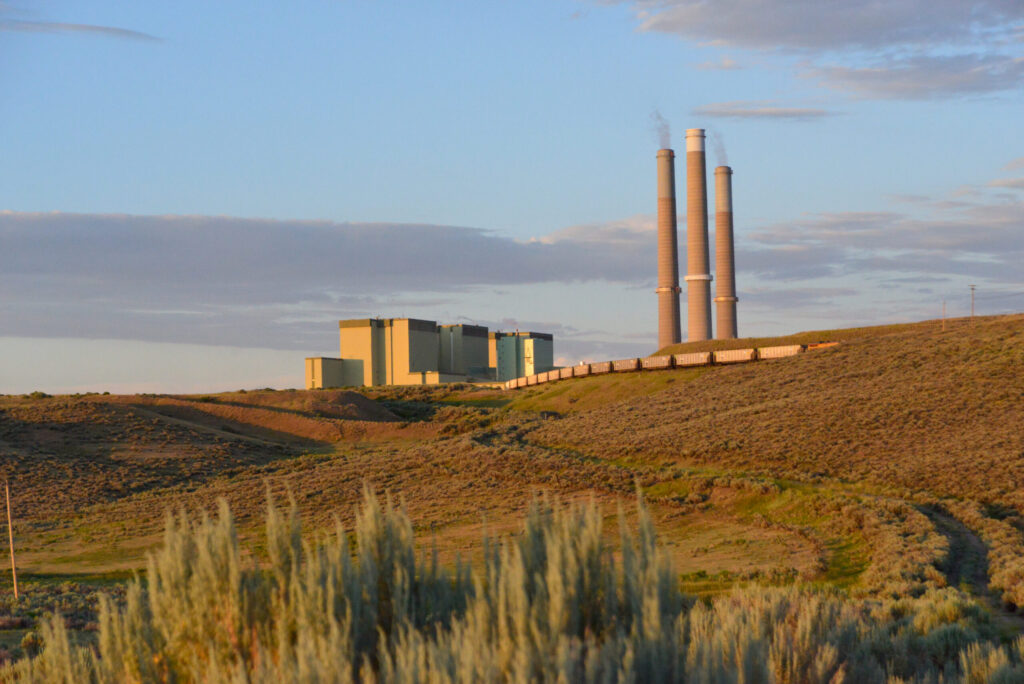
Gov. Jared Polis signed into law a bill in reaction to orders from the U.S. Department of Energy to keep older coal units online. The federal government’s instructions applied to Craig Unit 1 in Colorado, one of five coal units...

Mental Health Colorado names 2026 legislators of the year
Marissa Ventrelli
marissa.ventrelli@coloradopolitics.com
Updated 23 hours ago
Six state lawmakers have received recognition from the advocacy organization Mental Health Colorado for their work during the 2026 legislative session. “Mental Health Colorado’s work to pass laws, change practices, and build a movement depends on courageous advocates and bipartisan...
Colorado justices say judges can nearly eliminate parenting time without it being a ‘restriction’
Michael Karlik
michael.karlik@coloradopolitics.com
Updated 22 hours ago
The Colorado Supreme Court concluded last month that judges can reduce the number of days a parent spends with their child post-divorce to just above zero without it rising to the level of a “restriction” that requires more rigorous justification...

Geo Group sues Colorado over new immigration detention facility inspection law
Marissa Ventrelli
marissa.ventrelli@coloradopolitics.com
Updated 23 hours ago
The private prison company that operates the U.S. Immigration and Customs Enforcement center in Aurora has filed a lawsuit against Colorado to stop the enforcement of a new law requiring additional health and safety inspections of immigration detention facilities. The...
PREV
PREVIOUS

Ellen Roberts’ two-front abortion politics war
The potential U.S. Senate candidacy of a Durango lawmaker could pose a problem for U.S. Sen. Michael Bennet in 2016 — if she can survive her own party’s primary, according to a veteran political analyst. And if Republican state Sen. Ellen Roberts does jump in the race, it’s already become apparent that she’ll have to […]

Hick, Gardner talk energy future
Gov. John Hickenlooper told a crowd of energy industry and civic leaders on Wednesday that he doesn’t expect restrictions on hydraulic fracturing and drilling to reach the ballot next year. The former geologist contended that enthusiasm for anti-fracking measures has ebbed since a year ago, when ballot measures were at the center of hotly contested […]