

American Indian mascot bill dies in committee
The use of American Indian mascots by Colorado public schools can continue unfettered after a bill requiring tribal approval of their use died on a party-line vote during an April 29 Senate committee hearing.
House Bill 1165 would have created an approval committee made up of representatives from American Indian tribes for schools seeking to use Indian-themed mascots.
Sen. Jesse Ulibarri, an Adams County Democrat and a bill sponsor, said state dollars should not be used to fund derogatory uses of ethnic identities. Ulibarri told the Senate State, Veterans and Military Affairs Committee that names like Redskins or Savages are deplorable and have no place in our schools.
“When we talk about using state money — specifically in the use of public mascots in schools — when students show up to their class and walk through the doors of their high school or their middle school or their elementary school, to see offensive language that is derogatory to their ethnic identity sitting on the walls, it has damaging effects on those students and has deleterious effects, long-term, for those students,” Ulibarri said.
Ulibarri used examples like students painting their faces or wearing headdresses at sporting events as ways Indian culture is disrespected.“For some people who see it as harmless as it’s connected to a sports team or high school or middle school, it has very harmful origins,” Ulibarri said.
Ulibarri and other bill supporters said American Indian students are sometimes bullied because of their ethnic identity and that the use of a mocking mascot adds insult to injury.
LacyJay Left Hand Bull, a 7-year-old girl who testified with her mother and sister, said she has been picked on because of her heritage.“My friends keep calling me a pretend Indian and making fun of me,” the girl said, reading aloud from a prepared statement. “This bill should be passed because I am not your mascot.”
Ulibarri said the bill sought to strike a balance by respecting the feelings of tribal communities and school representatives who insist that Indian mascots are used out of respect to those cultures.
The senator said collaboration on this issue has worked in the past. He said that Arapahoe High School worked with Arapahoe tribal leaders to get the OK to use the Warrior as its mascot.
Ernest House Jr., a member of the Mountain Ute tribe and director of the Colorado Commission on Indian Affairs, told the committee that Montrose High School received permission from tribal communities to use an Indian as its mascot.
But opponents said the bill is unnecessary and that the Legislature should concern itself with more pressing issues.
John Sampson, a school board member with the Strasburg 31J school district, said lawmakers should spend more time dealing with school funding and student assessment issues than with this bill, which he called a “colossal waste of taxpayer funds.”
Sampson said his district’s use of an Indian mascot is done out of respect to Native culture.
“If you were to come to our district and take a walk through our schools and buildings, you will see that we are steeped in American Indian tradition and American Indian history,” Sampson said.
Sen. Jerry Sonnenberg, a Republican from Sterling who voted against the bill, asked House and Ulibarri if something should also be done about mascots like pirates and beetdiggers.
“Do you think those are viewed as derogatory as well?” Sonnenberg asked. “Help me understand the difference here.”
Ulibarri said there is a big difference.
“The difference here is that mascots based on ethnic identity are different and separate than those based on a profession,” he said. “There is no ethnic group that is a pirate or a beet harvester.”
The bill’s failure to get out of the Republican-controlled committee came as no surprise. The bill struggled to even get through the Democrat-controlled House prior to it reaching the Senate.
— Twitter @VicVela1


10th Circuit rejects ‘penalty’ for children of naturalized citizens seeking visas
Michael Karlik
michael.karlik@coloradopolitics.com
Updated 3 hours ago
The Denver-based federal appeals court joined three of its peers earlier this month and determined the child of a newly naturalized U.S. citizen is not moved to a longer visa line as a result of his parent gaining citizenship, and...
Colorado committee votes to rename César Chávez Day to Farm Workers Day
Marianne Goodland
marianne.goodland@coloradopolitics.com
Updated 4 hours ago
A Colorado House committee has voted to rename the March 31 state holiday from César Chávez Day to Farm Workers Day, following a national shift prompted by sexual abuse allegations against Chávez. House Bill 1339 was introduced on Friday and...
Colorado Sen. Mike Weissman calls for cold water on heated hate speech
Marianne Goodland
marianne.goodland@coloradopolitics.com
Updated 6 hours ago
Likening the recent record-setting warm temperatures to hot political rhetoric, Colorado Sen. Mike Weissman, D-Aurora, pleaded for an end to death threats and other hate speech directed at lawmakers of both parties. “The increasingly tragic reality of our politics, however, like...

Ethics panel dismisses complaint against Colorado agency chief Dan Gibbs
Marianne Goodland
marianne.goodland@coloradopolitics.com
Updated 3 hours ago
A state ethics panel has dismissed a complaint against Dan Gibbs, executive director of the Colorado Department of Natural Resources. The complaint, filed in December 2021 by the Republican-affiliated group Defend Colorado, alleged Gibbs awarded the think tank Keystone Policy...
Denver airport hasn’t had notice ICE agents will assist TSA yet. Wait times are short, though
Bernadette Berdychowski
bernadette.berdychowski@denvergazette.com
Updated 6 hours ago
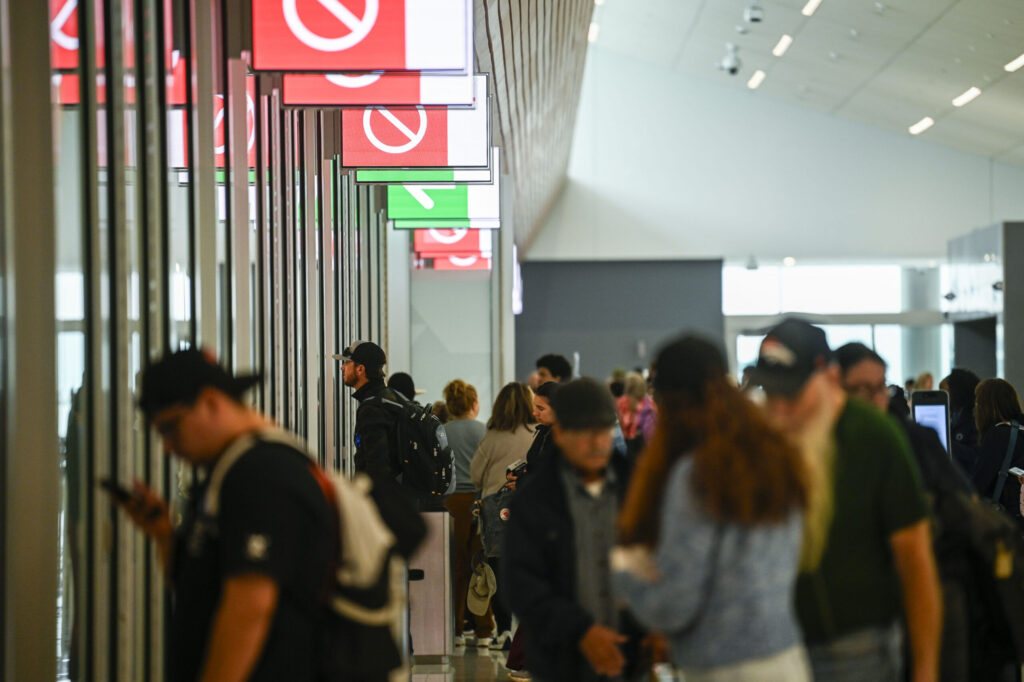
As President Donald Trump deployed immigration agents to help U.S. airports manage hours‑long security lines during the partial government shutdown, Denver International Airport remained relatively calm on Monday. At the nation’s third‑busiest airport, TSA PreCheck lanes remained open to start...
Appeals court recognizes longer window to sue insurers for withholding policy details
Michael Karlik
michael.karlik@coloradopolitics.com
Updated 9 hours ago
Colorado’s second-highest court split with its own prior decision earlier this month and concluded injured motorists have two years, not one, to sue insurance companies for withholding relevant information about an at-fault driver’s policy. In 2019, Colorado lawmakers enacted a measure to...
Trump open to $5 billion ICE funding cut if SAVE Act package passes
Zach LaChance, Washington Examiner
zach.lachance.washington.examiner@gazetteedit.wpenginepowered.com
Updated 10 hours ago
President Donald Trump signaled he is open to a $5 billion funding cut for U.S. Immigration and Customs Enforcement if the Senate passes the Save America Act, along with other amendments. “I don’t think we should make any deal with...

Appeals court decides free speech cases, error-prone judge reversed again | COURT CRAWL
Michael Karlik
michael.karlik@coloradopolitics.com
Updated 10 hours ago
Welcome to Court Crawl, Colorado Politics’ roundup of news from the third branch of government. The state’s Court of Appeals decided multiple cases implicating free speech rights, plus Colorado’s most error-prone judge was reversed on appeal yet again. Heard on...
It’s time to let unaffiliated voters caucus | Vince Bzdek
Vince Bzdek
vince.bzdek@gazette.com
Updated 11 hours ago
There’s no getting around it: Colorado’s 3,000 county caucuses, which just wrapped up recently, left half the electorate out in the cold. Since unaffiliated voters now make up 51% of all Colorado voters, a majority of Colorado electors are barred...
With new medical school set to open, Feinstein will step down as UNC president
Hap Fry, Special to The Gazette
hap-fry@gazette.com
Updated 3 hours ago
GREELEY • Dr. Andrew “Andy” Feinstein, the charismatic president of the University of Northern Colorado, has announced that he will step down from his leadership role just on the cusp of what is perhaps his signature accomplishment being realized. He’ll...