

Bill could ban water-polluting microbeads
It’s always about water in Colorado, and the present Legislative Session is no exception. A bill headed for the House Public Health Care and Human Services Committee will attempt to make sure Colorado doesn’t wind up with the same water pollution problem as other states.
House Bill 15-1144 will be heard on Tuesday, Feb. 10, at 1:30 p.m. in the public health committee. Its sponsor is Rep. Dianne Primavera, D-Broomfield, the committee’s chair.
The bill would ban the production, manufacture and sale of personal care products that contain synthetic plastic microbeads less than 5 millimeters in size. The ban would be phased in over two years, beginning Jan. 1, 2018, and completed Jan. 1, 2020. Penalties for each violation range from $1,000 to $10,000. The Colorado Department of Public Health and Environment would levy the violations, with financial penalties assessed by the district court where the violation took place.
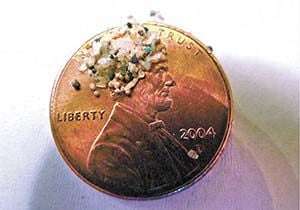
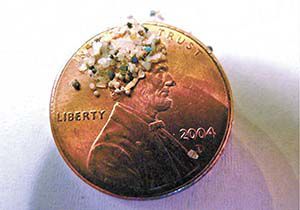
A penny covered in beads similar to the ones used as exfoliants in personal care products, shows the microplastics found in the Great Lakes during a 2012 research study conducted by the 5 Gyres Institute. Photo by 5 Gyres Institute
Carolyn Box

This type of legislation that involves the courts and a public agency usually carries a fiscal note; however, that fiscal note is not yet available.


Primavera told The Colorado Statesman this week that the request to carry legislation came from Johnson & Johnson, one of the world’s largest manufacturers of personal care products. While Johnson & Johnson has already pledged to remove microbeads from their products, they wanted to make sure smaller companies also take that action. “There may be some small companies [that use microbeads], and we also want to make sure none start up,” said Primavera. There’s also a concern that these products could come into Colorado from foreign countries, like China, Primavera said.
About two years ago, 5 Gyres, an environmental group devoted to ridding the world of plastics in the water supply, discovered tiny plastic beads were showing up in water samples. These tiny beads, referred to as microbeads, are used in a variety of personal care products, from body wash to facial scrubs to toothpaste. Last year Modern Hygienist magazine warned their readers that these microbeads were showing up in the gums of dental patients.
Microbeads have been around since the 1970s, but only in the last decade have they been used as exfoliants. The beads are plastic, made of polyethylene and related materials, including nylon. A bottle of Clear & Clean facial scrub, for example, contains 330,000 beads. In some products they’re so small that they bypass the filters in wastewater treatment plants and head into the water supply.
That’s what has some state legislatures and Congress in a lather.
Once in the water supply, these beads settle on the floor of rivers, lakes and oceans. Small fish may mistake them for fish eggs and eat them. The beads eventually kill the fish, either by damage to the internal organs or when the small fish are eaten by larger fish. When that happens, microbeads can get into the food chain and be consumed by humans. Microbeads also choke plant life and can absorb motor oil and pesticides.
Research from 5 Gyres was published in 2013 in Marine Pollution Bulletin. Researchers took samples from the Great Lakes and found that Lake Michigan, for example, had about 17,000 microbeads per square kilometer. In Lake Ontario, however, samples were as high as 1.1 million per square kilometer.
Primavera said microbeads are starting to show up in Colorado’s water systems. Last year a KMGH investigation found microbeads in water samples taken from the South Platte River.
Mark Salley, spokesman for the Colorado Department of Public Health and Environment, told The Statesman that microbeads are not regulated and therefore not routinely monitored in water, nor is the department aware of any specific issues related to microbeads.
Illinois became the first state to ban microbeads, in legislation passed in 2014. This year, more state legislatures are getting involved; in addition to Colorado, legislatures in Michigan, California, New York, Vermont and Minnesota have or are looking at the issue. In Congress, legislation to ban microbeads was introduced but not passed in 2014.
Some of the world’s largest personal care products manufacturers have already pledged to stop using microbeads. In addition to Johnson & Johnson, Proctor & Gamble, Colgate, Unilever and L’Oreal have agreed to remove microbeads from their products.
There are biodegradable alternatives, which are already being brought into personal care products. Manufacturers can use cacao beans, coffee grounds, ground-up apricot shells, salt or sugar.
— Marianne@coloradostatesman.com
Colorado Politics Must-Reads:


Trump lowers flags to half-staff for Dolly Parton: ‘The World loves you’
Naomi Lim
naomi-lim@coloradopolitics.com
Updated 14 hours ago
President Donald Trump is honoring the life of country music legend and philanthropist Dolly Parton by ordering federal buildings across the country to lower flags to half-staff for a week. “Very sad to report that Dolly Parton, one of the...
Ted Cruz suggests GOP realignment coming after Trump leaves office
Emily Hallas
emily-hallas@coloradopolitics.com
Updated 14 hours ago
Sen. Ted Cruz (R-TX) on Monday suggested the Republican Party could embrace a directional shift after President Donald Trump leaves office, a transition that promises to leave a gaping hole in the GOP. Cruz is known as a critical ally...

2 Colorado State troopers shot near Woodland Park; suspect killed
DEBBIE KELLEY
debbie-kelley@coloradopolitics.com
Updated 13 hours ago
Two Colorado State Patrol troopers were hospitalized, and a suspect is dead after a shooting during a traffic stop Tuesday. The initial incident happened at about 7:15 a.m., when a resident reported suspicious activity in the area near milepost 286...

Aurora moves forward with data center regulations
Kyla Pearce
kyla.pearce@gazette.com
Updated 14 hours ago
The Aurora City Council approved moving forward with two new regulations on data centers and directed staff to come back at the next study session with others. At a council meeting in early August, council members directed city management to...

Aurora City Council considers stricter food truck regulations
Kyla Pearce
kyla.pearce@gazette.com
Updated 14 hours ago
The Aurora City Council is considering passing laws to limit the number of food trucks on properties in the city and how and when they operate. Councilmember Angela Lawson, who sponsored the ordinance, said she understands the importance of food...

Denver murder conviction reversed for incomplete self-defense instruction
Michael Karlik
michael.karlik@coloradopolitics.com
Updated 12 hours ago
Colorado’s second-highest court reversed a defendant’s murder conviction last week because a Denver judge gave an incomplete instruction to the jury about the man’s right to self-defense. Donald R. Gonzales and Gary McLaughlin met up in a Capitol Hill parking...
Colorado lawmaker, House leaders named in workplace-retaliation lawsuit
Marianne Goodland
marianne.goodland@coloradopolitics.com
Updated 14 hours ago
A former legislative aide has filed a lawsuit alleging she was mistreated, illegally directed to perform campaign work and harmed by a House leadership structure she charged was fragmented, politicized and ineffective at protecting employees. The lawsuit, filed by Jennifer...

Secret Service confirms awareness of Iranian state media video threatening Barron Trump’s life
The Associated Press
the-associated-press@coloradopolitics.com
Updated 19 hours ago
WASHINGTON (AP) — The U.S. Secret Service has confirmed it is aware that Iranian state media has aired a video that appears to threaten the life of Barron Trump, President Donald Trump’s youngest son. “The U.S. Secret Service is aware...

Federal judge hears arguments about Colorado’s 3-day gun purchase waiting period
Michael Karlik
michael.karlik@coloradopolitics.com
Updated 19 hours ago
A federal judge heard arguments on Monday about the constitutionality of a 2023 Colorado law that generally imposes a three-day waiting period on firearm purchases after the initiation of a background check. The test that the U.S. Supreme Court created...

Denver auditor finds oversight failures in $175.6M 16th Street project
Nico Brambila
nico.brambila@denvergazette.com
Updated 14 hours ago
Surprise historic sewer discovery delayed completion a year, cost $18M The Denver Auditor recently found significant oversight and contracting problems with the $175.6 million 16th Street Improvement Project, including an $18 million contract increase and a nearly one-year extension that...
PREV
PREVIOUS

Bennet’s Keystone approval farsighted, not noxious
U.S. House Republicans are poised to push their legislative pet issue, the Keystone XL pipeline bill, down Pennsylvania Avenue and onto the President’s desk this week after a 62-36 Senate majority okayed the amended measure on Jan. 29. The White House has consistently hurled veto threats at lawmakers. But the GOP-led Congress has rolled up […]

Sias is top gun in House vacancy election
A Republican vacancy committee on Saturday named former Navy fighter pilot Lang Sias to fill the House District 27 seat left open when former Assistant Minority Leader Libby Szabo, R-Arvada, was appointed earlier in January to fill a vacancy on the Jefferson County Board of Commissioners. Calling himself “very pleased and very humbled” by the […]