

DPS board sends $44 million tax increase to Denver voters
The Denver Public Schools board on Thursday unanimously voted to place a mill levy override on the November ballot that — if approved by voters — would raise taxes by $43.9 million annually, largely to fund employee raises.
The request comes as Denver taxpayers are already paying hundreds of millions of dollars annually through seven previous mill levy overrides, some of which were approved for similar purposes.
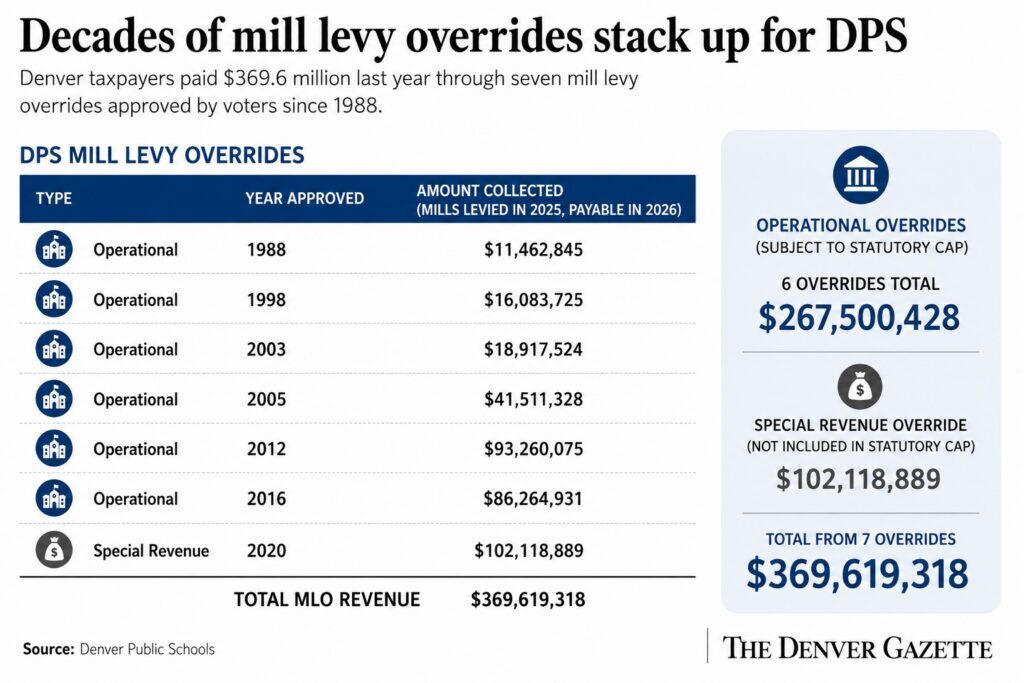
DPS collected $369.6 million last year from voter-approved overrides dating to 1988, according to figures provided by the district.
“All of our mill levy overrides are still in effect and will continue in perpetuity,” Bill Good, a DPS spokesperson, said in an email.
A mill levy override allows voters to authorize their school district to collect property tax revenue beyond what it could otherwise collect under Colorado’s school finance system.
Six of Denver’s existing overrides are operational levies subject to a statutory cap. Those generated about $267.5 million last year, according to district figures.
A seventh override, approved by voters in 2020, is classified by the school district as a special-revenue mill levy and is not included in that cap. It generated another $102.1 million last year, bringing total collections from the seven overrides to $369.6 million.
The district currently calculates its maximum operational mill levy override revenue at $288.9 million, according to a presentation to the board on Thursday. Changes in state law allow DPS, with voter approval, to increase that maximum to $332.9 million — an additional $44 million annually.
The proposed tax increase would provide:
• $25.8 million for raises for all district employees, amounting to $1,750 per employee
• $4 million to expand career and technical education in high-demand fields
• $4.9 million for mental health and special education support
• $9.3 million for charter schools
The Mill Levy Override Advisory Committee settled on a $1,750 base increase for all employees, which would give lower-paid workers a larger percentage raise, Chief Financial Officer Chuck Carpenter said.
“We have great people who deserve to be compensated in great ways,” said Vernon Jones Jr., co-chair of the advisory committee, which recommended the mill levy override.
Jones added, “We cannot be the district that we dream to be without this investment.”
Nearly a dozen speakers during public comment before the vote spoke in favor of the tax increase, many of them students and teachers.
Longtime DPS educator Amber Wilson, an English teacher at Thomas Jefferson High School, helped welcome new teachers to the district on Tuesday.
She said educators are constantly being asked to do more with less — teach increasingly crowded classrooms, give up more of their evenings and weekends and meet greater student needs with fewer supports — which makes teaching difficult to sustain as a career.
“We don’t have a shortage of qualified teachers,” Wilson said. “We have a shortage of the conditions that make them stay.”
Wilson urged the board to support the mill levy override to provide more competitive compensation.
‘A growing reliance on local taxes’
Some of the purposes identified in the proposed override have also appeared in previous mill levy questions approved by Denver voters.
In 2005, voters approved a $25 million annual override, adjusted for inflation, “solely and exclusively” to fund the district’s teacher compensation system known as ProComp. The measure included additional compensation for teachers working in hard-to-staff schools and hard-to-fill positions, as well as compensation tied to training and performance.
That override generated $41.5 million last year.
A $56.6 million override approved in 2016 included money for additional mental health professionals and school counselors, teacher recruitment and support and expanded college and career programs, including apprenticeships, work experience and career-focused curriculum. It generated $86.3 million last year.
Four years later, voters approved another override that included adding and maintaining mental health professionals and school counselors, increasing the minimum wage for school support staff and providing cost-of-living funds “to pay educators a living wage.”
The 2020 measure generated $102.1 million last year.
The proposed 2026 ballot language again identifies increasing educator pay, career and technical education, and student mental health among the purposes for which the new revenue could be spent.
The language says the money would be used for educational purposes “including, but not limited to” those areas.
“I want to thank our Denver voters, and I say that genuinely because they have always stepped up when it comes to education in Denver Public Schools,” Superintendent Alex Marrero said.
If voters approved the measure, DPS estimates the average Denver homeowner would pay an additional $72 annually.
Denver homeowners are already seeing substantially larger DPS property tax bills, driven largely by rising property values.
The DPS portion of the property tax bill for a typical Denver single-family home has increased nearly 54% since 2020, from $1,480 to a projected $2,276 in 2026, district figures show.
The latest request also comes less than two years after Denver voters approved a nearly $1 billion school bond. Officials told voters at the time that the bond would not increase the district’s tax rate.
If voters had rejected the $975 million bond, taxpayers would have saved about $20 million a year in “five or six years,” Carpenter has said.
District officials have blamed a tighter budget on shrinking state support.
The revenue mix supporting Colorado’s largest school district has changed significantly over the past two decades.
In 2005, a little more than one-third of DPS revenue came from the state, while about 58% came from local property taxes, a Denver Gazette review of district audits found. Twenty years later, the state’s share has fallen to about 17%, while property taxes account for roughly three-quarters of district revenue.
That shift largely reflects Colorado’s school finance formula: As local property tax collections rise, the amount the state must contribute toward funding the district declines.
Colorado’s school finance system, coupled with TABOR’s restrictions on tax increases, has left school districts increasingly reliant on voter-approved mill levy overrides and bonds to raise money beyond what they receive through the state funding formula.
And DPS may soon ask Denver voters for another bond.
District officials are already laying the groundwork for a future bond measure, potentially within the next two years.
Denver’s existing operational overrides illustrate how those local dollars have accumulated over time.
In addition to the measures approved in 2005, 2016 and 2020, voters approved overrides in 1988, 1998, 2003 and 2012. The 2012 measure, which generated $93.3 million last year, was approved for programs including art, music and physical education, tutoring and counseling, classroom technology and early childhood education.
The proposed override approved Thursday will go before voters in November and, if approved, would be collected beginning next year.

Boulder Valley School District introduces new policies following antisemitism lawsuit
Marissa Ventrelli
marissa.ventrelli@coloradopolitics.com
Updated 17 hours ago
The chief of Boulder Valley School unveiled new policies for the 2026-2027 school year following a lawsuit filed on behalf of a student alleging antisemitic harassment. In June, the Anti-Defamation League filed a federal civil rights complaint against the school...
Denver schools to refinance bonds to create capacity for future borrowing
Nico Brambila
nico.brambila@denvergazette.com
Updated 3 days ago
Less than two years after voters approved a record $975 million school bond, Denver Public Schools is refinancing older debt — a move district officials say will save taxpayers money while creating capacity for another bond election. The district has...

Colorado students push AI task force as schools navigate new tech era
Marissa Ventrelli
marissa.ventrelli@coloradopolitics.com
Updated 22 hours ago
A group of students is urging lawmakers to establish a task force on artificial intelligence in education to advise districts on how to ensure that pupils and educators use the technology effectively without becoming overly reliant on it. The students...
By the students, for the students: Sierra High School represents Colorado in developing national AI framework
Eric Young
eric.young@gazette.com
Updated 4 days ago
To many, the recent, rapid development of generative artificial intelligence and its lack of frameworks and oversight may evoke comparisons to the unrestrained Wild West in the 1800s or the economic potential of the dot-com boom in the early 2000s....

DOJ official decries ‘nonsense’ in Jeffco schools at fundraising gala
Matt Kyle
matt.kyle@denvergazette.com
Updated 6 days ago
Amid a legal battle between Jeffco Public Schools and the federal government, a Department of Justice official spoke at a fundraising gala and decried “crazy stuff” and “nonsense” in the school district. The gala was for Jeffco Kids First, an...
Former VP Mike Pence joining Colorado Christian University faculty
Marissa Ventrelli
marissa.ventrelli@coloradopolitics.com
Updated 1 week ago
Former Vice President Mike Pence has been hired as a visiting faculty member at Colorado Christian University, the Lakewood-based private evangelical university announced Tuesday. Pence will be on campus about once a month during the 2026-2027 school year to give...

‘Explosive’ diarrhea-causing parasite cyclosporiasis cases nearly triple in Colorado
Nico Brambila
nico.brambila@denvergazette.com
Updated 1 week ago
Cases of the “explosive” diarrhea-causing parasite cyclosporiasis nearly tripled in Colorado over the past month, prompting renewed attention after related deaths were reported in Michigan. Twenty-nine counties in Colorado have reported cases, according to the Colorado Department of Public Health...
First Air Force Academy class of just 306 cadets started out in WWII barracks, faced high standards
Mary Shinn
mary-shinn@coloradopolitics.com
Updated 2 weeks ago
When the first class of the Air Force Academy arrived at Lowry Air Force in Denver, they were welcomed with an air show featuring bombers and fighter jets. “Most of us were overwhelmed,” recalled retired Col. Max Miller, the president...
Douglas County schools to consolidate administrative offices into $29M headquarters to cut costs
Nicholas Fogleman
nicholas.fogleman@denvergazette.com
Updated 2 weeks ago
The Douglas County School Board is moving forward with a $29 million plan to consolidate district administrative operations into a new headquarters. It’s part of an effort to reduce annual costs as the district faces ongoing budget pressures. In June,...
U.S. Department of Education investigates DPS over same-sex kissing assignment
Nico Brambila
nico.brambila@denvergazette.com
Updated 2 weeks ago
The U.S. Department of Education is investigating Denver Public Schools for its handling of a French high school teacher who was fired earlier this year over requiring students to perform a same-sex kissing scene as part of a classroom acting...
PREV
PREVIOUS

Jeff Crank, Jessica Killin set to face off in 2 debates in Colorado’s 5th Congressional District
Republican U.S. Rep. Jeff Crank and Jessica Killin, his Democratic challenger, have agreed to debate twice in the weeks leading up to the general election in Colorado’s 5th Congressional District, their campaigns have said. Crank is seeking a second term in the historically Republican seat, while Killin is hoping to become the first Democrat elected […]
Healthcare Freefall: Finger‑pointing intensifies as Colorado’s healthcare system strains under rising costs, shrinking coverage
Editor’s Note: Colorado’s healthcare system is entering a period of accelerating instability — a “tsunami,” as multiple leaders describe it — driven by collapsing hospital finances, shrinking Medicaid reimbursements, disappearing services and a political fight over who is responsible for this unraveling. Healthcare Freefall is a multipart series examining how Colorado arrived at this moment, […]