

Redistricting is rampant ahead of the US House midterm elections. What states are taking action?

A partisan redistricting battle among states has accelerated ahead of the November midterm elections following a U.S. Supreme Court ruling that weakened the federal Voting Rights Act and opened the way for states to try to eliminate voting districts drawn for racial minorities.
Legislative voting districts typically are redrawn based on census data after the start of each decade. But an unusual spate of mid-decade redistricting broke out after President Donald Trump urged Texas Republicans last year to reshape U.S. House districts to give the party an edge in the midterm elections. Democrats in California countered with their own political gerrymandering. More states followed.
Eight states have already adopted new House maps, and several more are considering it. So far, Republicans believe they could win up to 13 additional seats from new districts in Texas, Florida, Missouri, North Carolina and Ohio. Democrats, meanwhile, think they could gain up to 10 seats from new districts in California, Utah and Virginia.
But those tallies presume past voting patterns hold in November. Historically, the president’s party tends to lose seats in the midterms. Democrats need to gain just a few seats in November to wrest control of the House from Republicans, which would give them greater power to oppose Trump.
Where new House districts are proposed
Lawmakers in at least three states are meeting to consider plans for new U.S. House maps.
Louisiana
Current map: two Democrats, four Republicans
New map: Republican Gov. Jeff Landry has postponed the May 16 congressional primary to allow lawmakers to revise U.S. House districts in response to an April 29 Supreme Court ruling striking down a majority Black congressional district.
Challenges: Several lawsuits have been filed in federal and state court asserting that Landry lacked authority to suspend the primary elections.
Alabama
Current map: two Democrats, five Republicans
New map: Republican state officials hope to revert to a U.S. House map passed in 2023 — but not previously used — that could help Republicans win an additional seat.
Challenges: The current map was imposed under a court order and is supposed to be used until after the 2030 census. State officials have asked the U.S. Supreme Court to set aside that order in light of its ruling in the Louisiana redistricting case.
Tennessee
Current map: one Democrat, eight Republicans
New Map: Republican Gov. Bill Lee has called lawmakers into special session to consider a new U.S. House map that could carve up a Black-majority district in Memphis and improve Republican chances of winning an additional seat.
Challenges: The candidate qualifying period already has ended for the primaries, which are scheduled for Aug. 6.
Where new House districts were approved
New U.S. House districts have passed in eight states since last summer. Six took up redistricting voluntarily, one was required to by its state constitution and another did so under court order.
Texas
Current map: 13 Democrats, 25 Republicans
New map: Republican Gov. Greg Abbott signed a revised House map into law last August that could help Republicans win five additional seats.
Challenges: The U.S. Supreme Court in December cleared the way for the new districts to be used in this year’s elections. It has since overturned a lower-court ruling that blocked the new map because it was “racially gerrymandered.”
California
Current map: 43 Democrats, nine Republicans
New map: Voters in November approved revised House districts drawn by the Democratic-led Legislature that could help Democrats win five additional seats.
Challenges: The U.S. Supreme Court in February allowed the new districts to be used in this year’s elections. It denied an appeal from Republicans and the Department of Justice, which claimed the districts impermissibly favor Hispanic voters.
Missouri
Current map: two Democrats, six Republicans
New map: Republican Gov. Mike Kehoe signed a revised House map into law last September that could help Republicans win an additional seat.
Challenges: A Cole County judge ruled the new map is in effect as election officials work to determine whether a referendum petition seeking a statewide vote complies with constitutional criteria and contains enough valid petition signatures. The Missouri Supreme Court rejected a lawsuit claiming mid-decade redistricting is illegal. It’s scheduled to hear arguments in May on claims the new districts violate compactness requirements and should be placed on hold pending the potential referendum.
North Carolina
Current map: four Democrats, 10 Republicans
New map: The Republican-led General Assembly gave final approval in October to revised districts that could help Republicans win an additional seat.
Challenges: A federal court panel in November denied a request to block the revised districts from being used in the midterm elections.
Ohio
Current map: five Democrats, 10 Republicans
New map: A bipartisan panel composed primarily of Republicans voted in October to approve revised House districts that improve Republicans’ chances of winning two additional seats.
Challenges: None. The state constitution required new districts before the 2026 election, because Republicans had approved the prior map without sufficient Democratic support after the last census.
Utah
Current map: no Democrats, four Republicans
New map: A judge in November imposed revised House districts that could help Democrats win a seat. The court ruled that lawmakers had circumvented anti-gerrymandering standards passed by voters when adopting the prior map.
Challenges: A federal court panel and the state Supreme Court, in February, each rejected Republican challenges to the judicial map selection.
Virginia
Current map: six Democrats, five Republicans
New map: Voters approved a constitutional amendment on April 21 authorizing new U.S. House districts backed by Democrats that could help the party win up to four additional seats.
Challenges: The state Supreme Court allowed the referendum to proceed, but it has yet to rule whether the effort is legal. The court is considering an appeal of a Tazewell County judge’s ruling that the amendment is invalid because lawmakers violated procedural requirements.
Florida
Current map: eight Democrats, 20 Republicans
New map: Republican Gov. Ron DeSantis announced on May 4 that he had signed revised U.S. House districts that improve the GOP’s chances of winning four additional seats.
Challenges: A court challenge contends the new map violates a state constitution provision prohibiting districts from being drawn with intent to favor or disfavor a political party.


Bennet, Hickenlooper to vote against Trump’s 10th Circuit nominee from Colorado
Michael Karlik
michael.karlik@coloradopolitics.com
Updated 11 hours ago
Colorado’s two Democratic senators will not vote to confirm President Donald Trump’s nominee to a vacancy on the Denver-based federal appeals court. Trump has selected U.S. District Court Chief Judge Daniel D. Domenico, who he appointed as a federal trial...
Who’s spending in Colorado to get your vote?
Marianne Goodland
marianne.goodland@coloradopolitics.com
Updated 7 hours ago
Groups that raise unlimited amounts of money have spent about $20 million in May and June to try and influence Colorado voters’ choices in the upcoming June 30 primaries. By law, these groups cannot coordinate with the candidates they support....

U.S. government declines to oppose multiple challenges to immigration detention in Colorado
Michael Karlik
michael.karlik@coloradopolitics.com
Updated 10 hours ago
Multiple federal judges in Colorado granted petitions from people challenging the lawfulness of their immigration detention this week after the government took the unusual step of declining to submit arguments in opposition. Colorado’s federal trial court is facing a flood of...

Tina Peters tells supporters to ‘stand up and fight back’ at Castle Rock event
Marissa Ventrelli
marissa.ventrelli@coloradopolitics.com
Updated 10 hours ago
Tina Peters, the former Mesa County clerk recently released from prison, warned supporters that what happened to her could happen to them, too, if they did not “stand up and fight back” at an event at the Douglas County Fairgrounds....

Iran strikes cargo ship in Strait of Hormuz, endangering Trump’s peace
Christian Datoc
christian-datoc@coloradopolitics.com
Updated 16 hours ago
Iran attacked a cargo ship traveling through the Strait of Hormuz on Thursday, possibly upending President Donald Trump‘s diplomatic end to the war with Iran. A U.S. official confirmed to the Washington Examiner that the Islamic Revolutionary Guard Corps “struck...

Senate GOP tries to mend fences with Trump after heated lunch
David Sivak
david-sivak@coloradopolitics.com
Updated 14 hours ago
Senate Republicans are trying to turn the page on a heated lunch with President Donald Trump that brought weeks of tensions to a new high-water mark. In a symbolic gesture, Senate Republicans took another vote on the Iran war Wednesday...
Colorado justices discuss solution to confusion from prior criminal ruling
Michael Karlik
michael.karlik@coloradopolitics.com
Updated 9 hours ago
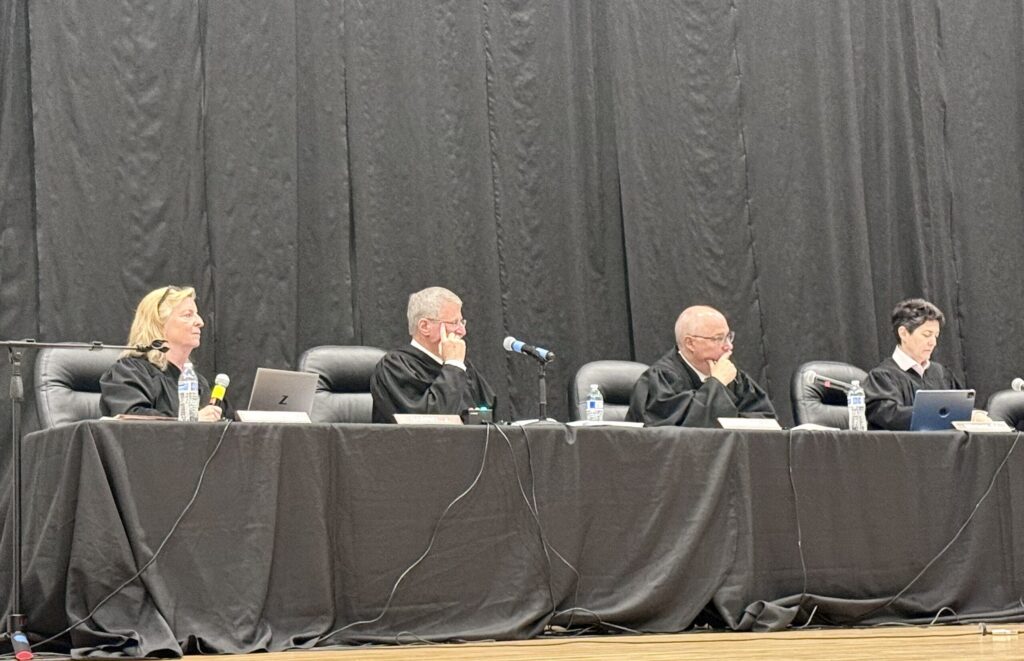
The Colorado Supreme Court pondered the fallout on Tuesday from its nearly six-year-old decision interpreting the state’s impaired driving laws, with the justices now addressing how defendants affected by the legal change must seek postconviction relief. In contrast to other...

Disagreements between Supreme Court justices bubble into public view as major rulings loom
The Associated Press
the-associated-press@coloradopolitics.com
Updated 18 hours ago
WASHINGTON (AP) — The Supreme Court is handing down major opinions at a rapid clip, but even with some of the biggest decisions yet to come there are signs of tension between the justices. One highly unusual exchange for the...

Will one unqualified AG replace another? | George Brauchler
George Brauchler
george-brauchler@gazette.com
Updated 1 day ago
Colorado Democrats are poised to nominate another attorney general candidate with de minimis relevant credentials or experience. Far from disqualifying, Colorado’s recent voting history mirrors that of America in favoring biography over experience, partisanship over policy, and emphasizing what divides...

Pueblo’s mayor keeps stirring the pot | Dennis Maes
Dennis Maes
dennis-maes@coloradopolitics.com
Updated 1 day ago
Pueblo Mayor, Heather Graham, has clearly proven to be a disciple of the Donald Trump school of governance. And, like her mentor, she is experiencing the same catastrophic results. The format is to ignore what the electorate approved and expects...