

The future of Colorado condo development | OPINION

By Peter LiFari
For nearly two decades, the story of condominium construction in Colorado has been mistold, misunderstood and misrepresented.
This outcome reflects the cumulative effect of more than two decades of Colorado policy, beginning with the Construction Defect Action Reform Act of 2001 and evolving through subsequent legislative changes, that have reshaped the risk landscape governing construction defect claims and liability, producing results that have been nothing short of disastrous for condominium construction.
That framing misses the real consequence, though. The aggrieved party in Colorado’s condominium market is the Colorado homebuyer, not the builder. As the housing fellow for the Common Sense Institute, I lay out the data in a new report explaining this collapse and the consequences now rippling through the state’s broken housing continuum.
For years, demand for owned housing in Colorado has remained strong. CSI’s mortgage capacity data shows a growing share of Colorado households retain the ability to finance owned housing. Yet the housing market has increasingly failed to produce homes at the price points those households can afford.
If condominium construction had maintained its early-2000s relationship to population growth, the Front Range would have produced 80,000 additional condominium units since 2006. Instead, production collapsed to historic lows while rental housing surged. By 2025, attached rental units are expected to exceed condominium production by nearly 39 to 1.
At today’s pace, it would take nearly four decades of condominium construction to equal one year of apartment production. The entry point to homeownership has vanished.
The explanation for this shift is often misunderstood. Colorado’s condominium market is constrained by risk, not demand. Because of Colorado’s policies, builders must prepare for the high probability of construction defect litigation years after a project is completed. That risk must be insured. When the litigation environment becomes unpredictable, the insurance market responds predictably. Insurers narrow coverage, and most withdraw from the market entirely, leaving extremely high policy rates.
Today, condominium-builder liability insurance in Colorado typically ranges from 4% to 6% of project hard costs — roughly four to five times the cost to insure comparable multifamily rental projects. Fewer than five insurance carriers in Colorado are currently willing to underwrite condominium liability risk. Developers build apartments instead.
The cost of this system falls on households. Higher liability insurance costs are embedded in the price of a home. When that cost increases, or when projects are never built at all, the result is fewer attainable homes and higher prices for the homes that remain.
Today the median price of a Denver condominium sits around $395,000. The entry-level ownership opportunity that condos once provided has become increasingly inaccessible. Using standard mortgage underwriting assumptions, only 44% of Colorado households can afford the payment on a typical condominium. If condominium builder insurance costs were reduced to levels comparable to apartment construction, roughly 43,000 additional households could afford condominium ownership in Colorado.
Even where they are built, starter homes are being replaced by luxury homes. The small number of condominiums built today increasingly appear in higher-income areas. During the past 15 years, the share of new condos delivered in higher-income zip codes has risen from 20% to 28%. Production in lower-income areas has fallen from 4% to 2%.
Colorado is not the only state that faced this problem, but others have handled it differently with different results.
Nevada experienced a similar collapse in condominium construction after the 2008 housing crash but chose a different response. Lawmakers narrowed the definition of construction defects, strengthened notice-and-repair procedures, and limited certain litigation incentives that had fueled large association-wide lawsuits.
The new-found predictability for developers changed everything.
Condominium construction returned. Builders re-entered the market. Insurers adjusted pricing. Capital followed. Most importantly, buyers once again have access to attainable condominium homes.
Colorado lawmakers acknowledged this issue in 2025 with the passage of House Bill 25-1272, the Construction Defects and Middle Market Housing Act. The law created a voluntary pathway that exchanges enhanced inspections, warranties, and transparency for a more structured defect-resolution process. It represents a small shift in how the state approaches condominium risk. The reform is incremental because participation is voluntary and the underlying litigation framework largely remains intact. As such, insurers and builders remain extremely doubtful the reforms will materially change underwriting behavior or development feasibility in the near term.
Over the next three to five years, the truth will reveal itself through market behavior. If participation remains limited and condominium construction does not return, policymakers will need to revisit the issue.
The stakes extend far beyond the development industry. Condominiums have long been the steppingstone to homeownership. When that steppingstone disappears, the ladder to the middle class becomes much harder to climb. The people most affected are not builders or insurers. They are Colorado homebuyers.
Peter LiFari is chief executive of Maiker Housing Partners and serve as a housing fellow for the Common Sense Institute.


Colorado joins lawsuit challenging changes to Endangered Species Act
Marissa Ventrelli
marissa.ventrelli@coloradopolitics.com
Updated 16 minutes ago
Colorado once more joined a coalition of states challenging the Trump administration — this time on proposed rules regarding the Endangered Species Act. The pair of lawsuits challenge new rules made under Interior Secretary Doug Burgum, who earlier said the...

Boebert challenger Eileen Laubacher says she’ll ‘break through the noise’ in Democrat’s 1st TV ad
Ernest Luning
ernest.luning@coloradopolitics.com
Updated 1 hour ago
Democratic congressional candidate Eileen Laubacher says she’ll take a different approach than her opponent in a campaign ad released by Wednesday that opens with a cacophonous series of videos featuring Republican U.S. Rep. Lauren Boebert. “Eileen’s had enough of the...

Lori Gimelshteyn on 3 ballot measures to ‘let kids be kids’ | The OpEdge Podcast
Tony Olivero
tony.olivero@gazette.com
Updated 4 hours ago
Lori Gimelshteyn — board member of Protect Kids Colorado and executive director of the Colorado Parent Advocacy Network — joins The OpEdge to discuss three measures headed to Colorado voters this November. Gimelshteyn tells host and investigative columnist Jimmy Sengenberger...
A path toward justice and public safety | PODIUM
Anthony Hartsook
ahartsockop@gmail.com
Updated 18 hours ago
Strangulation can be one of the most dangerous forms of assault; despite the lack of visible ailments it is accompanied by. Though strangulation leaves no broken bones, bruises or visible wounds, it is one of the strongest predictors of future...

From moving people to managing them | GUEST COLUMN
Michael Hancock
michael-hancock@coloradopolitics.com
Updated 18 hours ago
Transportation policy used to have a fairly uncomplicated purpose: move people safely, efficiently and reliably. Build roads where people drive. Maintain bridges before they fail. Add capacity where growth overwhelms the system. Provide transit where it makes sense. Infrastructure was...
Disgraced ex-CBI analyst Missy Woods sentenced to prison in DNA scandal
Jenny Deam
jenny.deam@gazette.com
Updated 1 day ago
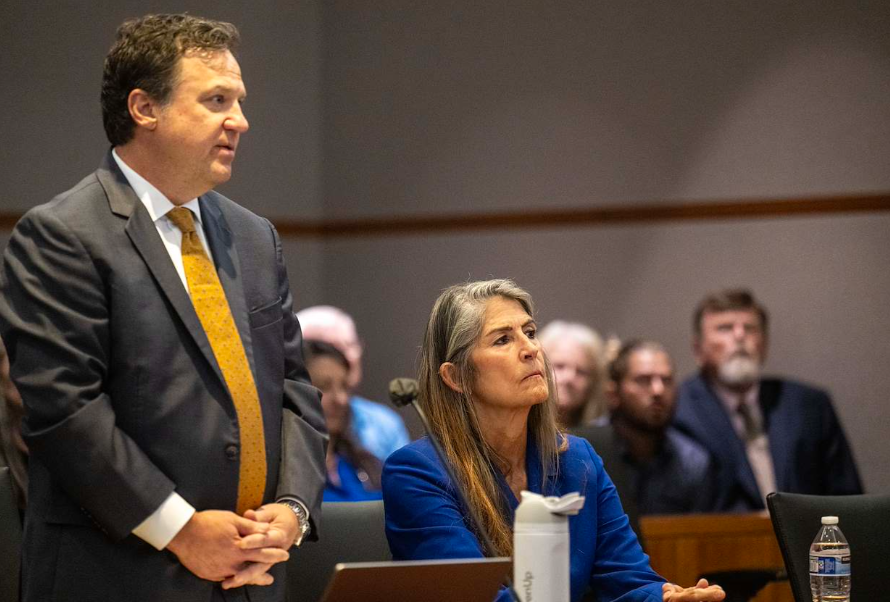
A Jefferson County district court judge on Tuesday sentenced a disgraced former Colorado Bureau of Investigation DNA analyst to a decade in prison for altering and deleting data in scores of criminal cases over several years. Jefferson County District Judge...
Jason Crow endorses Democrats up and down Colorado’s ballot, chips in $100K for campaign efforts
Ernest Luning
ernest.luning@coloradopolitics.com
Updated 1 day ago
Democratic U.S. Rep. Jason Crow on Tuesday formally endorsed more than 60 Democrats running up and down Colorado’s ballot and said he’s putting $100,000 into statewide and county campaigns and organizing programs to drive turnout in the fall election. Crow,...

Trumpicans thumb their nose at the Constitution | Hal Bidlack
Hal Bidlack
hal-bidlack@coloradopolitics.com
Updated 2 days ago
As is all too often the case, there are again too many interesting things appearing in Colorado Politics for me to comment on all of them. So let me tell you what I won’t be talking about before I get...

CoComandering? | Miller Hudson
Miller Hudson
miller-hudson@coloradopolitics.com
Updated 3 days ago
At 8 a.m., Friday morning, Aug. 28, 70 or 80 mostly bleary-eyed visitors to the Transportation Technology Center outside Pueblo packed a conference room to attend the Front Range Passenger Rail District’s (FRPRD) Board meeting. With the exception of those...

Even Dem court couldn’t abide theft of GOP seats | Dick Wadhams
Dick Wadhams
dick-wadhams@coloradopolitics.com
Updated 3 days ago
Thanks to the Colorado Supreme Court, Colorado voters will be able to reaffirm their support for the Independent Congressional Redistricting Commission after the court struck down the Democratic scheme to steal three Republican congressional seats. Billionaire-funded national Democratic groups from...
PREV
PREVIOUS

Colorado Democrats eye new fee on home insurance companies
Colorado Democrats are reviving a proposal to levy a new fee on home insurance companies, with the aim of distributing grants to fund “resilient” roofing. Introduced by Sen. Kyle Mullica, D-Thornton, Senate Bill 155 creates a government “enterprise,” which would collect a 0.5% fee of the total premium collected by an insurer on what’s called […]

The danger of when government goes rogue | Paula Noonan
It’s dangerous, even fatal, when government goes rogue whether in a democracy or autocracy. Government officials who ignore or taunt laws that constrain bad acts should be given the heave ho. We’re witnessing these egregious scenarios now at the federal and the Douglas County level. Scorn of basic rules of governance at the federal level […]