

Federal judge formalizes injunction blocking USDA’s ‘pilot project’ for Colorado food assistance

A federal judge formalized his order on Monday to prevent the U.S. Department of Agriculture from requiring Colorado to participate in a food assistance “pilot project,” finding that it violates the law, the U.S. Constitution, and “the bounds of reasoned decision-making.”
After a hearing in late January, U.S. District Court Senior Judge R. Brooke Jackson concluded Colorado would face imminent and irreparable harm in the form of households losing Supplemental Nutrition Assistance Program benefits and the USDA potentially withholding millions of dollars in funding from the state. The consequences could have arisen if Colorado failed to comply with an abruptly announced pilot project requiring five counties to rapidly recertify more than 100,000 households for food assistance.
In a March 16 written order, Jackson elaborated that the USDA’s letter describing the pilot project is “as astonishing as it is brief.”
“Congress established a statutory and regulatory framework to provide households with an orderly, predictable, and fundamentally fair process for periodically demonstrating their continued eligibility for SNAP, including by prescribing a definite certification period, ensuring adequate notice, and permitting telephonic interviews,” he wrote. “The Recertification Letter runs roughshod over these safeguards.”
Jackson also situated the USDA’s directive within the federal government’s broader actions toward Colorado in recent months, beginning with President Donald Trump’s pressure for Gov. Jared Polis to release convicted Mesa County clerk Tina Peters, a Trump ally.
“The following week, the Trump Administration launched a barrage of threats and actions designed, by all appearances, to punish Colorado: terminating $109 million in Department of Transportation funds, signaling the cancellation of $615 million in Department of Energy funds, announcing a plan to dismantle the National Center for Atmospheric Research in Boulder, and denying two requests from the State for disaster relief assistance,” wrote Jackson, a Barack Obama appointee. “The December 17th Recertification Letter directing Colorado to participate in the pilot project arrived amid this flurry.”
On Dec. 17, Deputy Under Secretary Patrick A. Penn sent a letter to Polis “hereby requiring Colorado to participate” in a pilot project. Penn cited, as a reason, “ongoing fraud affecting federally funded food benefits.” As an intervention, the USDA proposed to require Arapahoe, Adams, Jefferson, Boulder and Douglas counties to review and recertify all households receiving SNAP benefits within 30 days.
Normally, Colorado recertifies beneficiaries every six months, staggering the process such that one-sixth of households are renewed in a given month.
“Failure to participate in this pilot project as specified by USDA will trigger noncompliance procedures,” Penn’s letter continued. “It may also affect Colorado’s continued participation in SNAP.”
On Jan. 12, days before the deadline, the state sought a preliminary injunction blocking the USDA’s demand. Separately, Minnesota was litigating against its own pilot project letter. Two days after Colorado filed its motion, the USDA withdrew SNAP funding from Minnesota, minutes before a judge there was scheduled to hear the case. The judge quickly blocked the department from enforcing its demand, finding the government imposed a new obligation “without any reasoned explanation.”
“USDA gave Colorado no advance notice, no time to plan. Just an unexpected letter that showed up in the governor’s mailbox with an untenable deadline,” Deputy Solicitor General David Moskowitz told Jackson at a Jan. 28 hearing. “The request wasn’t remotely feasible. … It wasn’t meant to be. This is not a real pilot project. It doesn’t look anything like a real pilot project.”
U.S. Department of Justice attorney Tyler J. Becker argued that states administering SNAP through counties are more susceptible to delivering duplicate benefits. But Jackson repeatedly asked him about USDA’s evidence that fraud was occurring in the five Colorado counties selected for mass recertification.
“This is a big deal. You’re accusing Colorado with fraud. And you throw it out and you say it’s obvious that USDA thought there were some problems with Colorado. Fraud — fraud in Colorado,” said Jackson. “I’ve asked you that two or three times. You’ve given me nothing to support that. And yet you just make this statement — accusing Colorado of one of the worst kinds of conduct that you can accuse it of. How do you do that?”
At the hearing, Jackson blocked the pilot project after finding Colorado faced imminent and irreparable harm. In his order, he elaborated that U.S. Secretary of Agriculture Brooke Rollins could not force states into pilot projects, and this particular effort would require violations of existing legal requirements.
“At a minimum, the failure to give any thought to this problem reflects a lack of reasoned decisionmaking,” Jackson wrote.
Jackson added the pilot project was likely unconstitutional to the extent it imposed new conditions on Colorado’s acceptance of federal funds. Moreover, he suggested it was “a counterintuitive proposition, at best” that Colorado could effectively unearth fraud with an abrupt, mass recertification of households without preparation time.
“The pilot project promises to generate confusion, disruption, and erroneous terminations,” he added.
The case is The State of Colorado v. Trump et al.

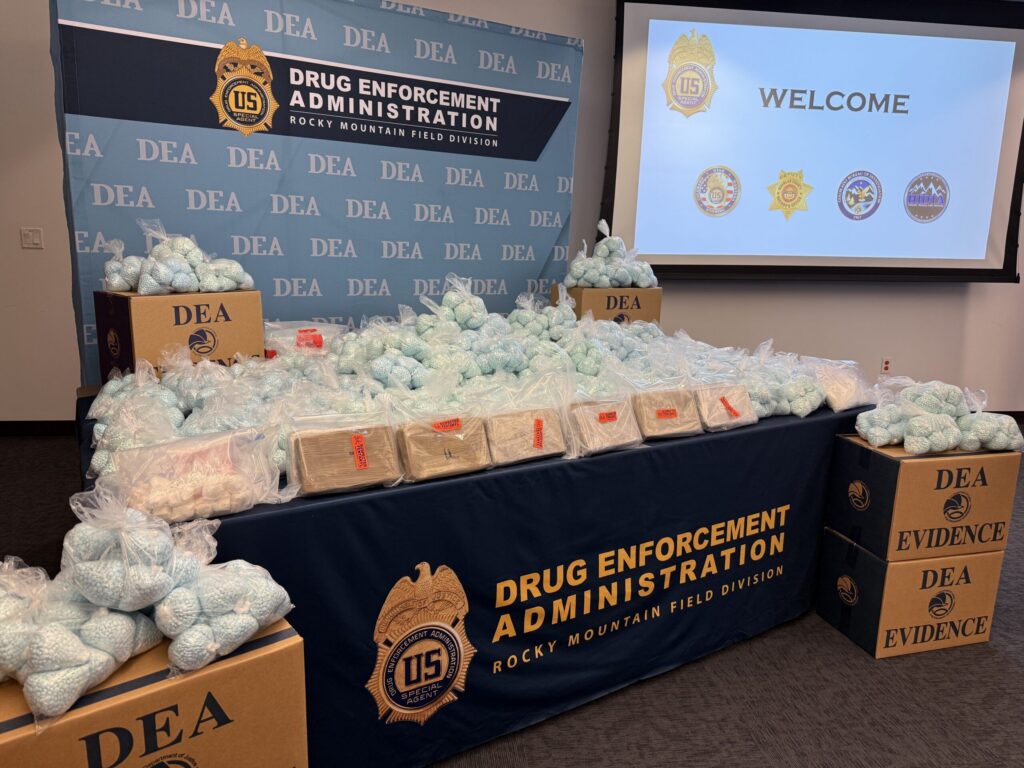
Overdose deaths from opioids dip in America — but not in Colorado, study says
Jacob Mauk
jacob.mauk@denvergazette.com
Updated 9 hours ago
Overdose deaths from opioids rose in Colorado, diverging from the national trend, which has been decreasing, according to a new study from a think tank. In its new report, the Common Sense Institute said synthetic opioid overdose deaths in Colorado...
Error-prone Douglas County judge triggers another reversal of criminal convictions
Michael Karlik
michael.karlik@coloradopolitics.com
Updated 14 hours ago
Colorado’s second-highest court overturned a defendant’s Douglas County convictions on Thursday due to the error of a judge whose actions have triggered a disproportionate number of reversals to convictions and sentences in recent years. Since 2021, the Court of Appeals...

Colorado justices speak about inner workings of court, analysis of appellate opinions | COURT CRAWL
Michael Karlik
michael.karlik@coloradopolitics.com
Updated 18 hours ago
Welcome to Court Crawl, Colorado Politics’ roundup of news from the third branch of government. Members of the state Supreme Court provided an inside look at the workings of their institution, and a Colorado Politics analysis found that some appellate...
Appeals court finds no requirement for different judge to handle attorney-client conflict hearings
Michael Karlik
michael.karlik@coloradopolitics.com
Updated 19 hours ago
Colorado’s second-highest court rejected a defendant’s argument on Thursday that a judge improperly heard about a potential conflict between himself and his lawyer right before sentencing, and the man’s reaction could have “tainted” the sentencing decision. In September 2023, Anthony...
The influencers? Some Colorado appeals judges outpace colleagues in setting legal precedent
Michael Karlik
michael.karlik@coloradopolitics.com
Updated 19 hours ago
A handful of judges on Colorado’s second-highest court are producing substantially more precedent-setting opinions than their colleagues, which create binding interpretations of the law that reach beyond individual cases. The Court of Appeals issues approximately 1,700 opinions each year. A...
Colorado justices weigh fairness concerns after defendant prevailed despite ghosting case
Michael Karlik
michael.karlik@coloradopolitics.com
Updated 2 days ago
Members of the Colorado Supreme Court struggled on Tuesday to balance the need for one defendant to shield itself against a plaintiff’s claim that its employee sexually assaulted her child, and the fact that the employee legally admitted the allegations...
Colorado justices skeptical of appellate court’s limitation on prosecution’s appeal
Michael Karlik
michael.karlik@coloradopolitics.com
Updated 5 days ago
The Colorado Supreme Court seemed skeptical on Tuesday that Denver prosecutors should be barred from appealing a trial judge’s permanent dismissal of a criminal case, based upon the sequence of events after the original ruling. Prosecutors charged Quinn M. Jebe...
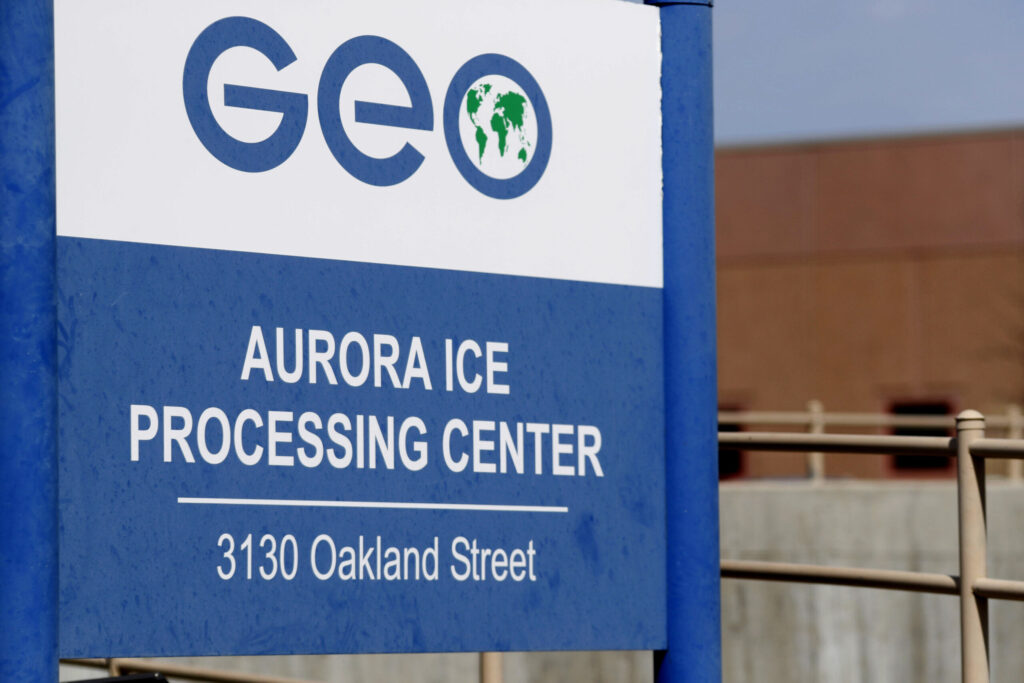
Federal judge: Government violated order shielding man from deportation in ‘one-off mistake’
Michael Karlik
michael.karlik@coloradopolitics.com
Updated 2 days ago
A federal judge acknowledged on Thursday that the government violated his order by deporting a man in immigration detention during his pending court case, but it “serves nobody’s interests” to require the government to return him. On Feb. 18, Tesfami...
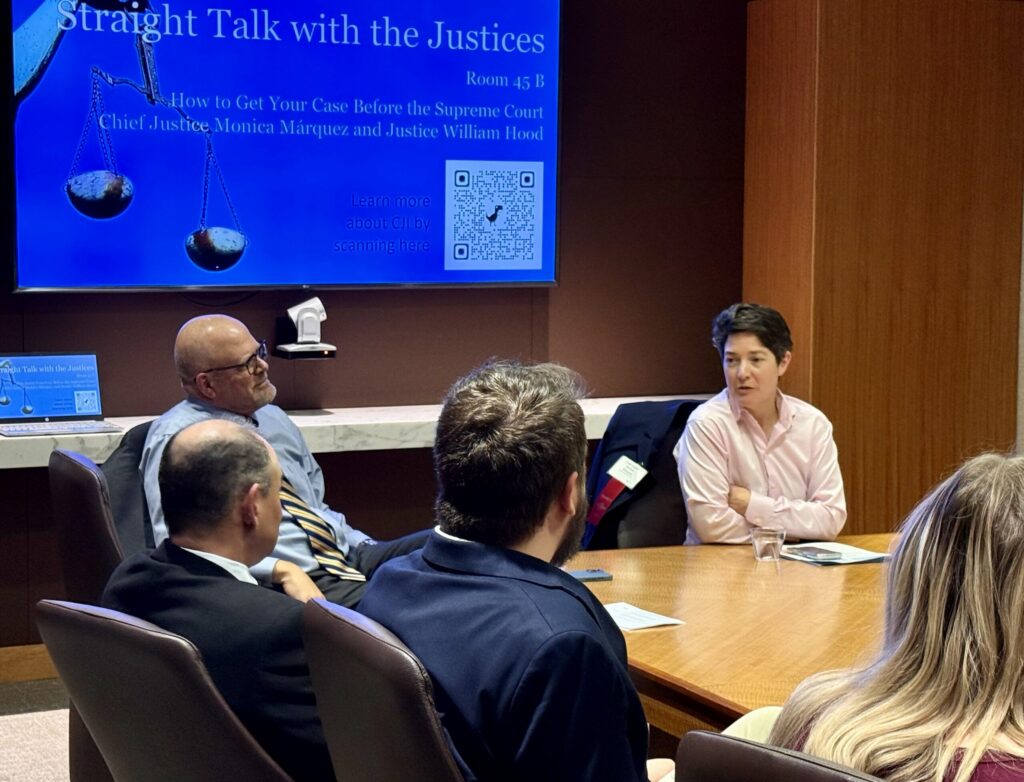
Colorado Supreme Court lifts curtain on decision-making at legal event
Michael Karlik
michael.karlik@coloradopolitics.com
Updated 5 days ago
Members of the Colorado Supreme Court sat down with lawyers on Wednesday to answer questions about behind-the-scenes topics, including what happens immediately after an appeal is argued, why they might intervene in an ongoing case, and the consequence of a...
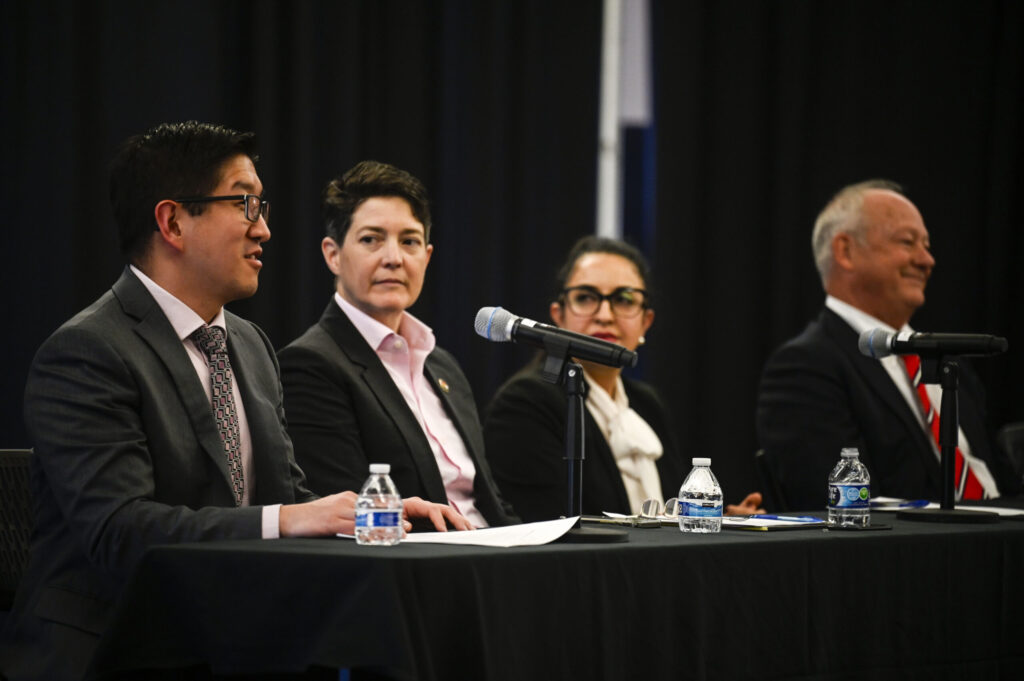
Colorado’s newest federal judge speaks about techniques for advancing cases
Michael Karlik
michael.karlik@coloradopolitics.com
Updated 2 days ago
U.S. Magistrate Judge Cyrus Y. Chung described on Wednesday the various tactics he employs to resolve court cases, summing up his role with a laxative-based metaphor. “Someone told a group of us federal magistrate judges that magistrate judges are the...
PREV
PREVIOUS

Colorado justices speak about inner workings of court, analysis of appellate opinions | COURT CRAWL
Welcome to Court Crawl, Colorado Politics’ roundup of news from the third branch of government. Members of the state Supreme Court provided an inside look at the workings of their institution, and a Colorado Politics analysis found that some appellate judges are producing many more precedent-setting opinions than their colleagues. Colorado Supreme Court update • By […]

Hacked crosswalks in Denver sound anti-Trump messages
Denver pedestrians got a surprise this weekend when the audio messages from push-button speakers on some crosswalks were mysteriously replaced with anti-President Donald Trump messages. “The walk signal is on, Trump … (reference to the Iran school that was bombed),” a robotic voice said, according to a video on the social media platforms TikTok and […]